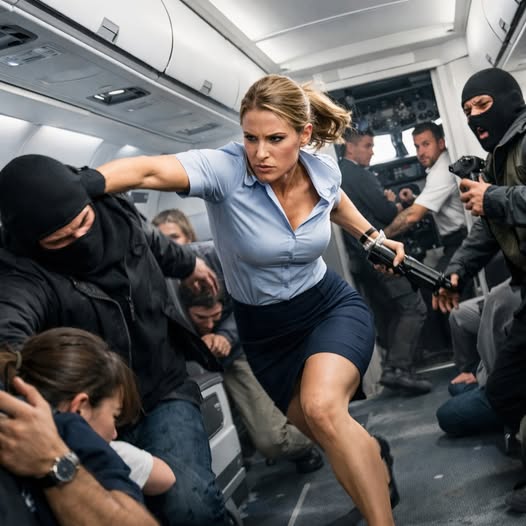
The first scream didn’t come from the cockpit.
It burst from the aisle, raw and sudden, like the cabin itself had finally realized what was happening and couldn’t keep quiet about it anymore. One second the plane was the usual sealed world of recycled air and low engine hum, and the next that world cracked open.
Three men pushed forward from the rear of the aircraft with hard eyes and harder intentions. People didn’t even understand what they were seeing at first—just movement, force, a rush of bodies cutting through the narrow corridor. A drink cart tipped, cups skittered across the carpet, and the sound of plastic bouncing became a soundtrack to panic.
Passengers froze the way humans freeze when reality changes too fast. A woman slapped both hands over her mouth as if silence could undo what she’d seen. Someone started praying out loud, each word louder than the last, as if volume could turn fear into protection. A child began to cry, not the soft kind, but the choked, frantic kind that spreads dread like smoke.
Mara Ellison was halfway down the aisle with a coffee pot when one of the men—Victor—caught her by the arm.
He didn’t grab her like someone scared. He grabbed her like someone collecting something he believed belonged to him.
He jerked her down between the seats, forcing her to her knees in a movement so casual it was almost worse than brutality. It told the cabin this wasn’t a negotiation. It was a demonstration. The easiest way to control two hundred people was to break the person they assumed represented safety.
Mara kept her eyes lowered.
To most of the passengers, she looked like what she was supposed to look like: a middle-aged flight attendant in a navy uniform, hair pinned neatly, face arranged in practiced calm. The kind of person people looked through, not at. The kind of person who existed to bring water and soften complaints.
Victor spoke in clipped, broken English, making it clear he wanted obedience. The weapons did most of the speaking. Not with shots, but with the implied promise of them. The glint of metal, the posture of ownership, the way his gaze moved over the cabin like he was counting what he could take.
Mara didn’t argue. She didn’t plead. She didn’t give the cabin the drama it was hungry to attach to. She absorbed the moment, then rose slowly, as if she were just trying to do her job in the middle of a nightmare.
She began gathering spilled cups, offering water, murmuring calm words. She moved with a steadiness that looked like routine to frightened people who needed to believe routine still existed.
But one man watched her and felt his stomach tighten.
Cole Barrett had spent eighteen years in the Air Force before retirement dropped him into civilian life with a plaque and a body that still woke up at five a.m. even when no one demanded it. He hadn’t wanted an aisle seat, but it was what he got, and now he had a clear view of everything.
He didn’t watch the hijackers first.
He watched Mara.
Fear leaves traces. It makes shoulders hunch like shields. It makes breathing jagged. It makes hands grab at anything nearby. It makes people sloppy because panic steals precision.
Mara’s shoulders didn’t rise.
Her breathing slowed.
And when the aircraft hit minor turbulence—just enough to rattle overhead bins—she adjusted before the bump fully arrived, shifting her balance as if her body already knew what the plane would do.
It was small. Nearly invisible.
To Cole, it was a warning bell.
Mara’s eyes didn’t wander the way terrified eyes wandered. They tracked. They measured. They flicked toward the cockpit door, then the galley, then the aisle, then back to the men with the kind of focus that wasn’t desperation.
At the front of the cabin, Senator Paul Whitmore sat stiff with outrage, radiating entitlement like heat. He watched Mara with the impatience of someone who believed service workers existed to solve his problems.
When Mara paused near a shaking woman, Whitmore leaned toward her.
“Do something,” he hissed. “You’re the crew. Fix this.”
It sounded brave. It wasn’t. It was contempt dressed up as leadership.
Mara gave him the same neutral nod she’d given angry travelers for years and moved on.
Phones were taken. One teenager tried to hide his and was punished for it, the crack of a shattered screen echoing like a gunshot. The cabin fell into a grim rhythm: silence, barked commands, the heavy stillness that follows.
Linda Moore, the senior attendant, moved carefully, doing what she could without drawing attention. She watched Mara too. Linda had trained hundreds of crew members. She knew the difference between calm that was professional and calm that was something else.
Mara’s calm had edges.
Not panic-management edges.
Combat edges.
Victor paced the aisle, owning the space. Tomas Vargas, quieter and sharper, watched faces and exits with a calculating patience. Novak, twitchy and volatile, prowled like a dog kept on a short chain.
Mara kept offering water, kept telling people to breathe, kept giving frightened passengers something small to focus on.
Then Victor changed the rules.
A pregnant woman—Emily Carter—was singled out. Her small boy clung to her sleeve, crying in a way that made the whole cabin inhale at once. Novak grabbed at her, using her fear as a message to everyone else.
Mara stepped forward before anyone else could.
Her hands were open. Her voice was soft. She offered herself instead—not theatrically, not heroically, just firmly, like a person stepping into a role she’d already accepted.
Emily was shoved back into her seat, trembling. The boy didn’t stop crying, but now he clung to his mother with both arms like a lifeline.
Victor leaned close to Mara and said something too low for the cabin to hear—no shouting, no performance, just a private threat meant to get inside her head.
Mara nodded, appearing submissive.
But Cole saw the change in her posture, and Linda felt it too. Even Dr. Nathan Brooks, a trauma surgeon seated mid-cabin, sensed the atmosphere shift, like a storm front sliding into place.
Mara wasn’t waiting for courage.
She was waiting for timing.
When she disappeared behind the galley curtain after being ordered away, the cabin held its breath. People couldn’t see what was happening back there, but they heard enough—shuffling, a sharp sound, an abrupt silence—to understand something had changed.
Then a loud crack tore through the aircraft, and the passengers screamed as one.
Not because they knew what happened, but because the sound confirmed their worst assumptions.
Mara came back into the aisle a minute later, moving differently now. Not slumped, not performing harmlessness. Purposeful. Controlled. A bruise already darkening on her arm, her breathing steady despite pain.
The hijackers’ pacing had stopped. Their rhythm was broken.
For a moment, the cabin froze in the strange quiet that follows a shift in power. You could feel fear trying to decide whether to become hope.
Mara walked straight to the cockpit door and knocked once—firm, deliberate—then spoke through it with a voice that didn’t belong to customer service.
“Mara Ellison. Open.”
There was a pause, then the reinforced door cracked and she slipped inside. It shut again behind her, sealing the cabin away from whatever was happening at the controls.
Inside the cockpit, the air smelled of warm electronics and stress. The captain was injured but breathing. The first officer looked like a man balancing terror and responsibility on a thread. When he saw Mara, his expression shifted from confusion to something like disbelief.
Mara didn’t waste time on explanations. She checked the captain, checked instruments, and spoke into the headset with clipped clarity, confirming contact with air traffic control and stating what mattered: the cockpit was secure, the passengers were alive, and the aircraft needed a safe landing with security waiting.
As the plane began its descent, the cabin reacted like a body exhaling. People cried quietly. Some clung to strangers. Some laughed without humor. Some sat stone-still, eyes fixed ahead, like movement might tempt fate.
Linda moved up and down the aisle, keeping people seated, keeping the space calm. Cole stood when needed, not to play hero, but to block panic from becoming a stampede. When Whitmore tried to stand and take control of the narrative, Cole stopped him with a look and a flat instruction.
“Sit down.”
For once, the senator did.
The aircraft hit turbulence on the way down. Overhead bins rattled. A few passengers whimpered. But the plane held steady. The engines changed pitch. The runway came into view like a promise.
The wheels hit the ground hard and real. The cabin jolted, then erupted—prayers, sobs, gasping laughter. The aircraft slowed, turned, and finally stopped amid flashing vehicles and armed responders.
The doors stayed closed until security took over. When they opened, the air on the tarmac felt colder and more honest than the recycled fear inside the cabin. Passengers filed out shaking, blinking like they’d just woken from a nightmare that didn’t fully release them.
When Mara finally stepped back into the cabin from the cockpit, there was a moment of stunned silence. People stared at her like they didn’t know where to place what they’d witnessed: a flight attendant who had moved like command, who had carried the weight without theatrics, who had brought the plane down safely when everything inside it had tried to tear apart.
Applause started, messy and loud, the desperate human need to turn survival into meaning.
Mara didn’t smile for it. She didn’t perform humility. She simply walked down the aisle, bruised and bleeding, eyes steady, moving toward the exit like the work wasn’t done until everyone else was out.
Outside, cameras waited. Officials waited. A story was already being drafted by people who hadn’t been trapped in those seats. They wanted a hero that fit their expectations. A politician. A pilot. A dramatic passenger.
They didn’t know what to do with a woman whose competence had been hidden behind a uniform designed to make her forgettable.
Later, in a hospital room under fluorescent lights, an investigator asked why the records listed her as cabin crew.
Mara stared at the ceiling, then said the truth with the calm of someone who had stopped caring what sounded believable.
“I used to fly fighters.”
And just like that, the neat version of the story broke apart.
Because the hijackers had taken the plane.
They just hadn’t expected the “flight attendant” to be the person who knew exactly how to bring it home.
Leave a Reply