Most people scroll past long joke compilations the way they scroll past junk mail: half-amused, half-annoyed, looking for the one line that actually lands. But this collection has a theme, and it sticks because it’s built on the same simple engine: everyday authority getting outsmarted, twisted logic exposing nonsense, and human weakness getting the last laugh.
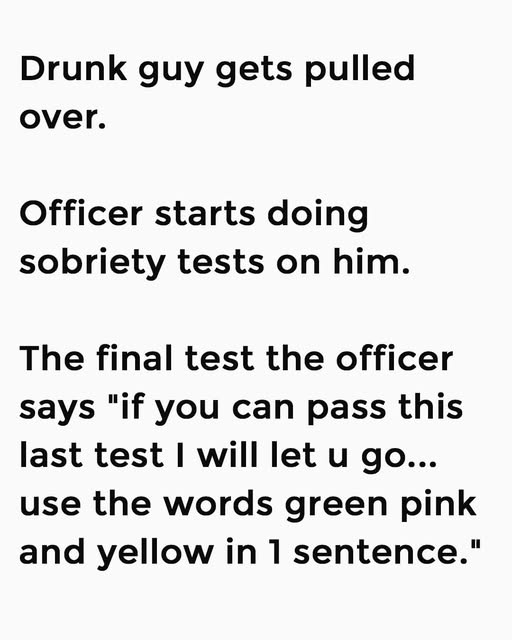
It opens with a classic “sobriety test” setup. A drunk driver gets pulled over, and the officer decides to make the final test a language puzzle: use the words green, pink, and yellow in one sentence. The driver, in full chaos mode, delivers the punchline by turning the words into a slurred phonetic sentence: “My phone went green and I pinked it up and said yellow.” It’s dumb. It’s clever. It’s exactly the kind of joke people repeat because the wordplay feels like a magic trick, even when it’s lowbrow.
The next one is the cleaner version of the same idea: a man tries to dodge every sobriety test with a medical excuse. Breathalyzer? Asthma. Blood test? Hemophilia. Urine sample? Diabetes. The officer finally says, fine, walk the line. And the man admits the only honest thing he’s said the whole time: he can’t, because he’s too drunk. The joke works because it plays with the lie’s momentum until the liar trips over the truth.
Then the humor pivots into the “cop outsmarts the tough guy” lane. A giant boasts he can beat the officer and the heavyweight champion and can escape anything. The officer treats the arrogance like an opportunity. He “tests” the man with handcuffs, watches him fail to break free, and calmly announces the arrest the second the man confirms he can’t escape. The punch isn’t violence. It’s simplicity. The giant’s ego walks him straight into the trap.
The tone softens with Grandma Bessie and Grandpa Morris. The officer brings Morris home, explaining he got lost in the park. Bessie calls him out—he’s been going there for thirty years. Morris leans in and admits the truth: he wasn’t lost, he was tired and didn’t want to walk home. That one hits because it’s relatable. It’s the quiet, petty honesty people only tell when they’re old enough to stop caring.
Another old-school gag follows: the pickup truck full of ducks. The officer tells the old man to take them to the zoo. Next day, the truck is still full of ducks, now wearing sunglasses. The old man says he took them to the zoo yesterday, and today they want to go to the beach. It’s cartoon logic delivered with deadpan confidence, which is why it works. The absurdity never winks; it commits.
Then there’s the cowboy who orders three beers at a time, sipping each in rotation. He says he’s drinking for his brothers in other states—one beer for each of them, like a shared ritual. It’s sentimental enough to disarm you, so when he returns one day and only orders two, everyone assumes one brother died. The bartender offers condolences, and the cowboy clarifies: nobody died, he just joined the Baptist church and quit drinking, but his brothers are still “going strong.” The joke lands because it exploits a wholesome setup, then flips it with religious irony.
The genie story takes that “string attached” idea and makes it literal. An old cowboy in the desert finds a briefcase genie, but she’s an Australian Taxation Office auditor. That detail alone tells you where it’s going. He wishes for an oasis, then riches, then for beautiful women to want and need him wherever he goes. The genie turns him into a tampon. The moral: if the government gives you something, it comes with a string attached. It’s crude, but it’s structured well: escalating wishes, bureaucratic genie, then a punchline that’s both wordplay and humiliation.
The riddle about money is a different kind of trick. It tries to bait you into adding everything—13 plus 10 plus 30 plus 100 plus 5—when the question is “How much money did I have?” not “How much did I receive?” The intended answer is 18: the original 13 plus the “another 5.” It’s a linguistic trap disguised as math, which is why people argue about it. The punchline isn’t funny; it’s smug. And that’s exactly why it gets shared.
Then the compilation turns into domestic warfare comedy. Bert and Edna, married forever, start talking bucket lists. Bert wants to skydive; Edna wants to confess her long history of petty sabotage—jamming a spatula into the recliner so it leaned left, short-circuiting the remote so it always landed on Hallmark. Bert fires back that his “fishing trips” were actually bowling, and he has trophies hidden behind the water heater. The humor is in the realism: long marriages aren’t only romance; they’re quiet revenge and mutual surveillance.
A similar pattern shows up in the “Heaven is free” joke. A health-obsessed wife drags her husband through years of bran muffins and low-cholesterol living, and when they die and arrive in Heaven, everything is free and limitless—steak, lobster, desserts, no weight gain, no sickness. The husband explodes in anger: if it weren’t for her healthy lifestyle, they could have been there ten years earlier. It’s dark, but it nails the selfish logic of gratitude twisted into resentment.
The compilation keeps feeding the same formula: misunderstandings used as weapons. Little Johnny fails math because the teacher keeps giving different equations that all equal eight, so he claims she can’t make up her mind. A prisoner smashes a computer because he hit the escape key and nothing happened. A Jewish boy names Jesus as the most famous man ever because “business is business.” A magic desk taps out how much money a man has—then goes wild when asked about his wife’s bank account, hinting at uncomfortable truths.
Even the “wife stays home” story follows the same structure: a man envies his wife’s workload, asks God to switch bodies, spends a day drowning in chores, begs to switch back, and God says fine—but you’re pregnant, so wait nine months. It’s a blunt punchline built on a long setup meant to exhaust the reader the same way the character gets exhausted.
Put together, the whole collection is basically a parade of one idea: people lie, people brag, people complain, and reality slaps them. Authority gets embarrassed. Arrogance gets trapped. Everyday life gets re-framed as absurd. Some jokes are clever, some are groaners, some are crude, but the reason these things keep circulating is simple: they’re small, fast stories where somebody thinks they’re in control—and then they aren’t.