Eight years is a lifetime when measured in the silence of a missing child. For Elena, the memory of that sweltering afternoon in Puerto Vallarta remained a jagged glass shard embedded in her soul. The boardwalk had been a sensory overload of salt spray, mariachi music, and the golden haze of a setting sun. Her daughter, Sofía, was ten years old then, a vibrant girl in a yellow embroidered dress with hair meticulously woven into neat, dark braids. Elena had turned away for a heartbeat—hardly long enough to retrieve a fallen hat—and in that sliver of time, her universe fractured. The girl was gone.
The initial minutes of confusion curdled into hours of absolute terror. Elena’s screams were swallowed by the roar of the surf as lifeguards, police, and volunteers scoured the beach. They dragged the calm Pacific waters, though there had been no struggle, no splash, and no sign of distress. They searched the crowded markets and the winding alleys of the old town, but not a single trace remained. Not a sandal, not a ribbon, and most heartbreakingly, not the small cloth doll that Sofía had clutched like a talisman since she was a toddler. The investigation eventually grew cold, leaving behind only tattered “missing” posters and the cruel, hushed whispers of the townspeople. Elena eventually retreated to Mexico City, carrying a grief so heavy it felt as though her bones were made of lead. Her husband, unable to withstand the corrosive guilt and the hollow silence of their home, passed away three years later, leaving Elena to navigate the darkness alone.
Elena survived through the rhythmic, meditative labor of her small bakery in the Roma Norte neighborhood. She spent her days kneading dough with hands that still instinctively remembered the tension of braiding a child’s hair. Customers called her a pillar of strength, but Elena knew better. It wasn’t strength that kept her upright; it was a quiet, stubborn refusal to accept that the light of her life had been extinguished. She lived in a state of perpetual waiting, her heart tuned to a frequency only a mother can hear.
The breakthrough arrived on a suffocating April morning when the air in Mexico City felt like a physical weight. Elena was sitting in the shadow of her bakery’s doorway, watching the city exhale its early morning fog. A battered pickup truck rattled to the curb, and a group of young laborers stepped inside to escape the heat and buy water and bolillos. Elena moved with the practiced efficiency of a woman who had long ago automated her life, until her gaze fell upon the forearm of the youngest man in the group.
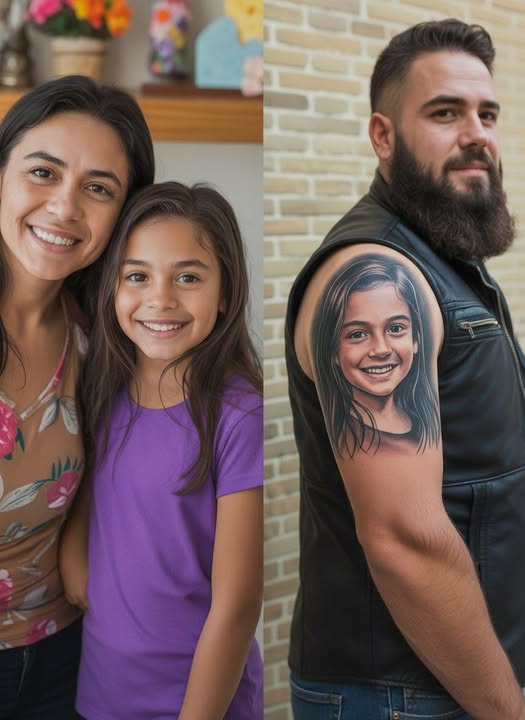
There, etched in simple black lines, was a tattoo of a young girl’s face. It was a portrait of a child with round cheeks, bright, inquisitive eyes, and hair tied in familiar braids. Elena’s world tilted. The glass of water she was holding shattered on the tile floor, the sound echoing like a gunshot in the small shop. She didn’t see a stranger’s ink; she saw the face she had kissed a thousand times in her dreams. She saw her daughter.
Summoning a primal courage, Elena ignored the trembling of her limbs and whispered a question that felt like a prayer: “That girl on your arm… who is she?” The young man, whose name was Daniel, froze. He looked at the middle-aged baker with a mixture of confusion and a dawning, terrible realization. Slowly, he lowered his arm as if the weight of the image had become unbearable. He told her the girl’s name was Sofía, and that she was his sister.
Inside the quiet sanctuary of the bakery, amidst the scent of yeast and sugar, the truth finally spilled out. Daniel recounted a story of a seventeen-year-old boy whose mother, Teresa, had returned home one evening eight years prior with a terrified, silent little girl. Teresa had claimed she found the child wandering alone near a highway and that no one was looking for her. Daniel had suspected a darker reality, but in a household ruled by a mother’s iron will and desperate loneliness, he was told never to ask questions.
Teresa had kept the girl, raising her in a remote village far from the prying eyes of the city. She loved the child with a fierce, possessive devotion that was born of a kidnapping disguised as a rescue. Sofía had grown up in a fog of stolen identity, told she had been abandoned, yet she harbored fragments of a different life—a yellow dress, the taste of salt on the wind, and a specific prayer her “real” mother used to whisper into her hair at night. Two months before this chance meeting, Teresa had passed away, but not before unburdening her soul in a final, agonizing confession.
The reunion took place at a small community clinic where Sofía, now eighteen and a woman of grace and resilience, worked as an assistant. The drive to the village felt like an eternity for Elena, a bridge across nearly a decade of sorrow. When she stepped into the clinic, she saw a young woman with braided hair tending to a patient. When their eyes met, the air seemed to leave the room. The recognition was instantaneous, bypassing logic and leaping straight into the marrow of their bones. “Mom?” Sofía whispered. The word didn’t sound like a question; it sounded like a homecoming.
Elena collapsed to her knees, and the two women clung to each other, a decade of stolen years dissolving in a torrent of tears. It was a scene of restoration that defied the statistics of missing persons and the finality of time. There were legal hurdles to follow—DNA tests, police statements, and the complicated process of undoing a life built on a lie—but the emotional truth was settled.
Sofía eventually moved to Mexico City to be with Elena. The bakery, once a silent monument to a mother’s endurance, became a place of vibrant life once more. They spent their evenings relearning the nuances of each other’s voices, healing the fractures of the past through shared stories and the simple act of baking bread. Daniel remained a part of their lives, a bridge between the family Sofía had and the family she had lost. His tattoo was no longer a symbol of a haunting secret, but a permanent testament to a love that refused to be erased.
A year after their reunion, mother and daughter returned to the boardwalk in Puerto Vallarta. They walked hand in hand along the same stretch of stone where they had been torn apart. They didn’t come to mourn the ten-year-old girl in the yellow dress; they came to honor the women they had become. They cast white flowers into the waves, watching the petals dance on the surf before being pulled into the deep. It was a final act of release, a signal to the universe that the darkness had lost. Elena looked at her daughter, whose braids caught the golden light of the Pacific sun, and realized that some things are never truly lost as long as someone is brave enough to keep looking for them. In the end, life had found its way back to the light.
Leave a Reply