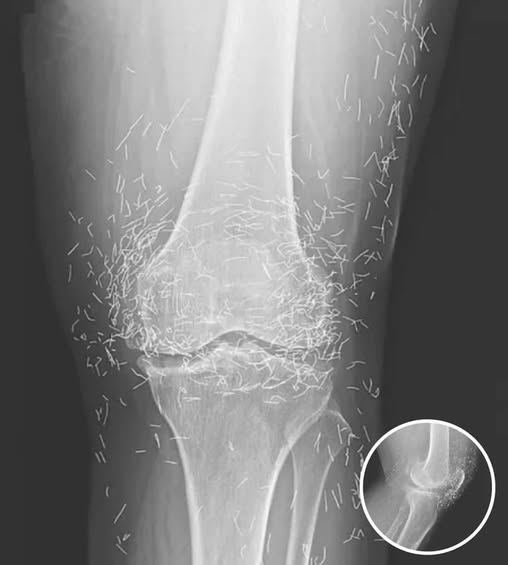
The intersection of ancient tradition and modern diagnostic medicine rarely produces an image as startling as the one that recently captivated the global medical community. When a 65-year-old South Korean woman presented herself for a routine examination to address chronic, debilitating joint pain, her physicians expected to see the standard markers of age-related wear and tear. Instead, as the X-ray film developed, they were met with a sight that seemed more akin to a piece of intricate jewelry than a human anatomy. Embedded deep within the soft tissue and synovial spaces of her knees were hundreds of tiny, shimmering gold needles, perfectly preserved in a geometric display of alternative intervention. This case, later documented in the New England Journal of Medicine, has ignited a fierce debate over the boundaries of traditional healing and the hidden risks of permanent “embedded” therapies.
The patient’s journey to this moment was paved with the frustration of chronic illness. Like millions of others her age, she had been battling osteoarthritis—a degenerative condition characterized by the slow, painful breakdown of cartilage and bone. For years, she had relied on the standard pharmaceutical arsenal of non-steroidal anti-inflammatory drugs (NSAIDs) and high-potency painkillers. However, these medications eventually took a toll on her digestive system, causing severe stomach issues that made long-term pharmaceutical management impossible. In search of a solution that didn’t involve a pill bottle, she turned to a practice deeply rooted in the cultural heritage of East Asia: acupuncture.
In the traditional sense, acupuncture is a transient therapy where fine needles are inserted into specific “meridians” to balance the body’s energy and stimulate natural pain-relief chemicals like endorphins. However, in certain specialized practices within South Korea and other Asian nations, a more permanent variation exists. Known as gold needle or gold thread implantation, this procedure involves intentionally leaving the metal behind. The underlying philosophy suggests that these permanent implants provide a “continuous stimulation” to the nerves and tissues, offering a 24-hour therapeutic effect that far outlasts a thirty-minute session. While advocates point to centuries of anecdotal success, modern radiologists are sounding a profound alarm.
The biological reality of the human body is that it is a highly defensive and territorial system. As Dr. Ali Guermazi, a professor of radiology at Boston University, observed when reviewing the case, the body possesses an inherent distaste for foreign materials. When an object—be it a splinter, a piece of shrapnel, or a gold needle—is introduced into the tissue, the immune system immediately classifies it as an invader. This triggers a localized inflammatory response, which is the body’s first line of defense. Over time, the body attempts to “wall off” the intruder by forming dense, fibrous scar tissue around it. While this might keep a single needle in place, the presence of hundreds of such objects can lead to chronic inflammation, the formation of abscesses, and deep-seated infections that are difficult to treat because the source of the irritation is literally woven into the muscle.
Beyond the immediate risk of infection, these “shimmering” knees present a massive obstacle to modern diagnostic technology. Metal of any kind is notorious for creating “artifacts” on an X-ray or CT scan—streaks of white light that obscure the very anatomy a doctor is trying to see. In this woman’s case, the sheer density of the needles made it nearly impossible for physicians to accurately assess the current state of her osteoarthritis. The very “cure” she sought had created a visual shield that hid the progression of her disease.
However, the most life-threatening risk involves the gold standard of modern diagnostics: the MRI (Magnetic Resonance Imaging). An MRI machine is, essentially, a massive and incredibly powerful magnet. If a patient with hundreds of metal needles embedded in their joints were to enter an MRI suite, the results could be catastrophic. The magnetic field can exert enough force to cause the metal fragments to migrate or vibrate violently within the tissue. This could lead to internal hemorrhaging, the puncturing of vital blood vessels, or severe nerve damage. In a medical emergency where an MRI might be the only way to save a life, these permanent acupuncture needles could effectively bar a patient from receiving life-saving care.
Despite these warnings, the allure of permanent acupuncture remains strong, particularly in regions where traditional medicine is integrated into the national healthcare fabric. In South Korea, these procedures are not seen as “extreme” but as a natural extension of cultural wisdom. This highlights a significant global divide in how we define “evidence-based” medicine. While Western medicine demands rigorous clinical trials to prove that the benefits of gold implants outweigh the risks of inflammation and imaging interference, traditional practitioners rely on the continuity of historical practice and the reported relief of their patients.
The case of the 65-year-old woman serves as a powerful cautionary tale for the globalized world. As alternative therapies continue to gain traction in the United States—with millions of Americans seeking acupuncture for everything from chronic back pain to migraines—the need for clear communication between traditional healers and modern physicians has never been more vital. The National Institutes of Health has noted a steady rise in the use of acupuncture among both adults and children, but the specific practice of permanent implantation remains rare in the West.
For the patient in South Korea, the X-ray is a permanent record of her search for relief in a world where standard medicine had failed her. It reflects the desperate measures often taken by those who live in the shadow of chronic pain. Her knees, studded with gold, are a beautiful but dangerous testament to the lengths humans will go to find a life without suffering. As medical science moves forward, her story encourages a more holistic but cautious approach to “integrative” medicine. It reminds us that while we must respect the ancient traditions that offer comfort to millions, we must also respect the biological boundaries of the human body and the technological realities of the 21st century.
The future of pain management likely lies somewhere in the middle—harnessing the nerve-stimulating power of acupuncture while utilizing materials that are bio-compatible and “MRI-safe.” Until then, the stunning X-ray of the woman from South Korea remains a chilling masterpiece of medical mystery. It is a reminder that what we put into our bodies in the name of health can sometimes become a permanent obstacle to our survival. The goal of any therapy, whether ancient or modern, must always be to heal without leaving a trail of unintended consequences in its wake.
Leave a Reply