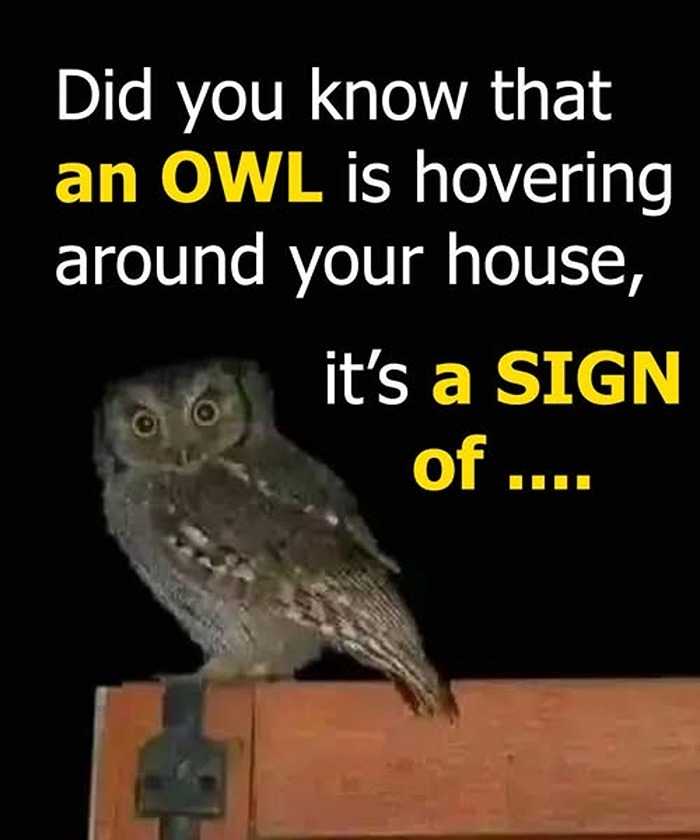
On quiet, shadowed nights, when the world seems to slow and the noise of the day finally fades, a silent presence may be moving through the darkness above your home. With wide wings and an almost ghostlike stillness, the owl glides across the night sky—rarely seen, often heard, and always surrounded by mystery.
Owls have fascinated humans for thousands of years. Their ability to appear without warning, observe without being noticed, and vanish just as quickly has earned them a powerful place in folklore, symbolism, and storytelling across cultures. Long before streetlights and modern cities, people looked to the night sky and wondered about the unseen watchers perched in trees or hidden among rooftops.
From a biological perspective, owls are among the most efficient nocturnal predators on the planet. Their flight is so quiet that it borders on unreal, thanks to specialized feathers that break up sound as air passes through them. This allows them to hunt without alerting prey, giving them a decisive advantage in the dark. Combined with extraordinary hearing and keen night vision, owls can detect the faintest movements—whether it’s a mouse beneath leaves or an insect hidden in tall grass.
Their eyes, large and forward-facing, are designed to gather as much light as possible. While they cannot move their eyes in their sockets, their flexible necks allow them to rotate their heads dramatically, giving the impression that they see everything at once. Their hearing is just as remarkable. Many owls have asymmetrical ears, enabling them to pinpoint sound with astonishing accuracy, even in complete darkness.
This blend of silence, precision, and patience is what makes owls supreme hunters of the night. They feed on small mammals, insects, reptiles, and occasionally other birds, helping maintain ecological balance by controlling pest populations. In this sense, an owl near your home is not an omen of danger, but a sign of a healthy surrounding ecosystem.
Yet biology alone doesn’t explain why owls stir such strong emotions in people.
Symbolically, owls have carried different meanings depending on time and place. In many traditions, they are associated with wisdom, insight, and knowledge. Their nocturnal nature links them to the unseen—to thoughts, truths, and understandings that reveal themselves only when things are quiet. Seeing or hearing an owl near your home has often been interpreted as a reminder to slow down, reflect, and pay attention to what lies beneath the surface.
In some cultures, an owl’s presence is seen as protective. The belief is that the owl watches over the home, guarding it from harm while others sleep. Its vigilance in the night becomes a metaphor for awareness and guidance, suggesting that not all protection is loud or obvious. Sometimes, it is silent and patient.
Other traditions view owls with caution, connecting them to transformation, endings, or deep transitions. This is not necessarily negative. Change, after all, is often uncomfortable before it becomes meaningful. The owl’s role in these stories is not to threaten, but to signal that something unseen is shifting—within a person, a family, or a moment in life.
What makes owls particularly unsettling or enchanting is how rarely we actually see them. Unlike daytime birds, owls are masters of concealment. Their coloring blends perfectly with tree bark, rooftops, and shadows. They can perch motionless for long periods, observing quietly. It is entirely possible for an owl to be near your home for weeks without you ever noticing.
Often, the first sign of their presence is sound. A distant hoot drifting through an open window. A sudden rustle from a tree just beyond the yard. A soft wingbeat overhead that feels more like a shift in air than a sound. These moments can feel eerie, especially if you’re unfamiliar with them, but they are simply part of the owl’s nightly routine.
Urban and suburban environments have become increasingly attractive to owls. Artificial lighting draws insects, which draw rodents, which draw predators. Tall buildings and quiet neighborhoods can mimic cliffs and forests, offering ideal nesting and hunting grounds. An owl near your home is not unusual—it’s adapting, just as humans have.
For those who believe in symbolism, noticing an owl can feel personal. People often report encountering owls during moments of reflection, grief, change, or decision-making. Whether coincidence or perception, the experience tends to leave an impression. The owl doesn’t announce itself. It doesn’t demand attention. It simply appears, watches, and moves on.
That subtlety is part of its power.
Rather than seeing an owl’s presence as something to fear, many find comfort in it. The idea that something ancient and intelligent shares the night can feel grounding. It reminds us that the world is larger, older, and more interconnected than our daily routines suggest.
At the same time, it’s important to remain grounded. An owl near your home is, first and foremost, a wild animal following instinct. It doesn’t carry messages in the literal sense. Any meaning we attach comes from our own interpretation, culture, and inner state. The value lies not in superstition, but in what the moment prompts us to notice—stillness, awareness, curiosity.
If you ever catch a glimpse of an owl perched nearby or flying silently overhead, consider it a rare privilege. These birds are elusive by nature, and seeing one is often the result of timing rather than chance. Pause. Observe. Let the moment exist without forcing meaning onto it.
The night holds many quiet wonders, and the owl is one of its most enduring symbols. Whether viewed as a masterful hunter, a guardian of balance, or a reminder to look inward, its presence near your home speaks less about fate and more about the hidden rhythms of the world around us—always moving, always watching, even when we’re not aware.
Leave a Reply