Category: Dog Stories

  • A Little Girl Lay Hooked to an IV — The Dog Rested His Chin on the Bed and Never Looked Away

    A Little Girl Lay Hooked to an IV — The Dog Rested His Chin on the Bed and Never Looked Away

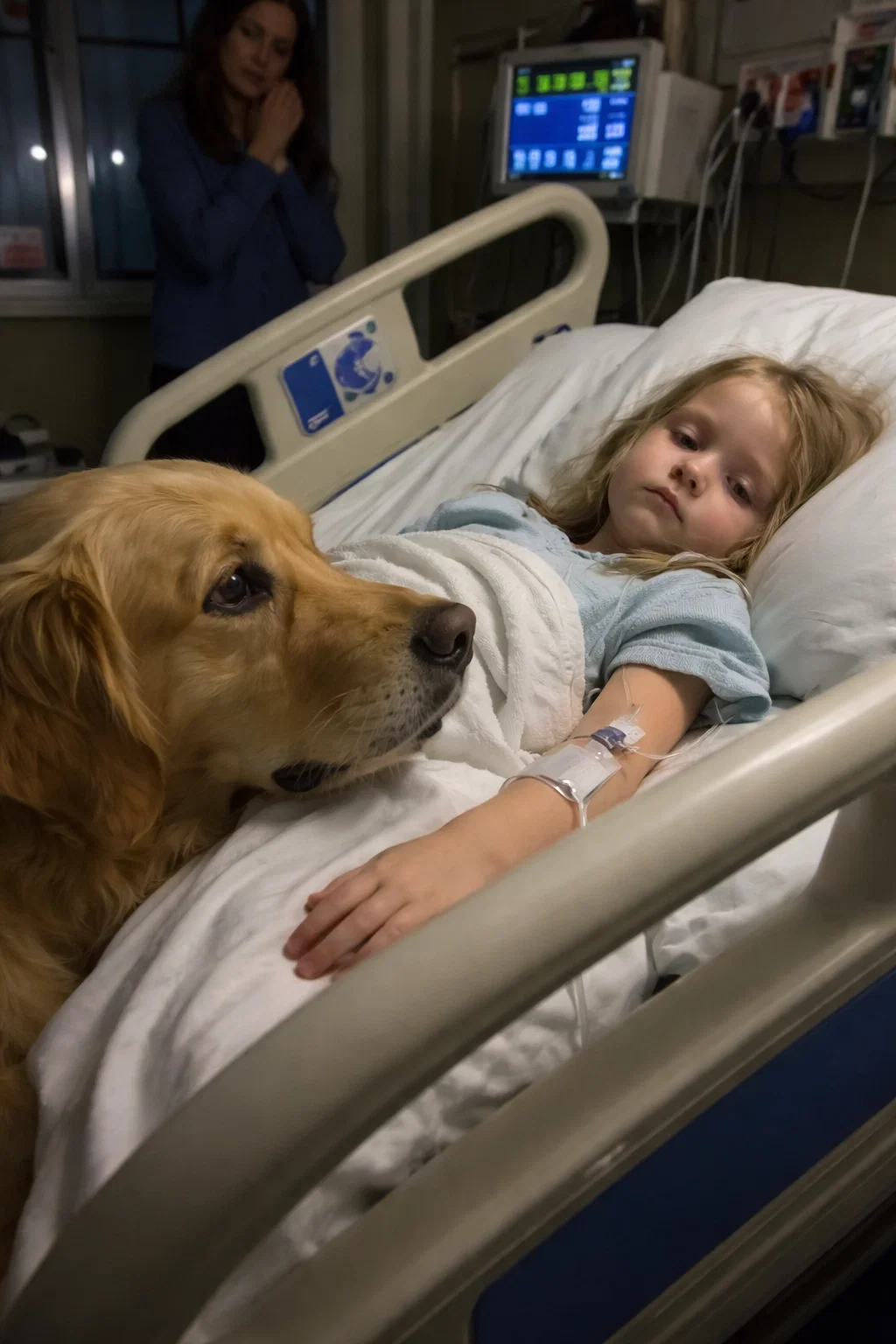
    The dog rose onto his hind legs, pressed his weight forward, and rested his chin on the edge of the hospital bed—and the nurse stopped mid-step, unsure whether to pull him away or protect the moment.

    The IV pump clicked.
    Once.
    Twice.

    A fluorescent light flickered and steadied. The room fell into a silence hospitals aren’t supposed to have—the kind that feels like everyone is listening for a sound that might not come.

    The girl lay beneath thin white sheets, seven years old and far too small for the bed. Clear tubing trailed from her arm to a bag that dripped with patient cruelty. Her fingers trembled, just barely, as if they were arguing with sleep.

    The dog did not blink.

    He was a golden retriever, five years old, brushed but rumpled now, a blue therapy vest hanging crooked over his shoulder. His ears were pinned back. His mouth was closed tight. His eyes were wide, glassy, fixed on the girl’s face like he was counting her breaths with his own.

    A doctor murmured, “He shouldn’t—”

    No one finished the sentence.

    The girl’s mother stood in the corner, arms folded around herself as if she were trying to keep from coming apart. Late thirties. Pale. Hair pulled into a knot that had given up hours ago. Her coat smelled of rain and old coffee. She watched the IV drip with the intensity of someone who believes vigilance can bend outcomes.

    The dog shifted his chin, closer now, just enough to feel the warmth of the girl through the rail.

    Her fingers twitched again.

    The dog’s chest tightened.

    And in that held breath of a moment, the room understood this wasn’t a visit.

    It was a watch.

    Her name was Lily Harper.

    Before the bed and the beeps, Lily had been loud in the specific way children are loud when the world feels safe. She sang off-key in the back seat. She laughed with her whole body. She believed dogs understood everything if you spoke slowly enough.

    The golden retriever had been hers since she was two.

    His name was Buddy.

    They learned each other early. Lily learned that Buddy slept on the floor but always touched the bed with one paw. Buddy learned that Lily cried quietly and laughed explosively. Mornings belonged to cereal spills and fur. Nights belonged to stories whispered into a listening ear.

    When Lily got sick, Buddy noticed first.

    He stopped chasing balls. He followed her from room to room. He lay beneath her chair at dinner, eyes lifted, tracking every breath. He learned stillness the way some learn tricks.

    The diagnosis arrived months later, delivered gently and without mercy. Leukemia. The word closed doors even before anyone knew which ones.

    Hospital days became a grammar of their own. Charts. Hallways. Conversations lowered to a register that pretended hope and fear couldn’t hear. Buddy waited at home at first—rules were rules—while Lily learned the rhythm of machines that never slept.

    She sat by the window and waited for him anyway.

    Every afternoon, Buddy sat outside the hospital entrance, staring at the doors. Rain or shine. People noticed him before they noticed the girl inside. A security guard brought water. A nurse snapped a photo and sent it to her sister with a caption that read, He’s still here.

    A volunteer coordinator recognized the vest in the photo and asked a question that changed the day. Buddy was therapy-certified. He knew how to be still. He knew how to listen. He knew how to stay when staying mattered.

    An exception was made.

    That morning, Lily was weaker than usual. Her breathing was shallow. Her skin looked almost translucent under the lights. The doctor’s voice softened until it barely qualified as sound.

    “Today may be hard,” he said.

    Buddy walked in slowly, nails clicking against the floor. He didn’t jump. He didn’t lick. He stood. He lifted himself just enough. He placed his chin on the bed.

    The nurse froze.

    The afternoon stretched thin.

    Machines hummed. The IV dripped. Outside, a storm rolled in and tapped against the window like someone asking to be let in. Buddy didn’t move. His legs trembled from holding himself upright. His breath came slow and measured, as if he were borrowing calm from somewhere else.

    The nurse adjusted the line, hands unsteady. “I’ve never seen a dog do that,” she whispered.

    Lily’s mother moved to the bed and rested one hand on her daughter’s hair. With the other, she touched Buddy’s back. Warm. Solid. There.

    Lily stirred.

    Her eyes opened a sliver. She found Buddy first.

    A smile—small, tired, unmistakable—tugged at her mouth.

    “You stayed,” she whispered, the words barely clearing her lips.

    Buddy exhaled softly through his nose, the sound of it a promise kept.

    The doctor entered and stopped short. He took in the room the way you take in a photograph you know will last. No one spoke. Minutes passed. The storm softened.

    Then the numbers changed.

    Lily’s breathing steadied. The tremor in her fingers eased. The monitor’s beeping relaxed into something less insistent. The nurse checked again. And again.

    “They’re stabilizing,” she said, disbelief edging her voice.

    Buddy shifted, just enough to rest more weight on the rail. His eyes never left Lily’s face. When his legs finally gave out, he slid down gently and lay on the floor, exhausted, chin on his paws, still watching.

    Lily slept.

    Deeply.

    Later, the doctor spoke differently. “We’re not out of the woods,” he said. “But she fought today.” He paused. “And she didn’t fight alone.”

    Lily stayed for weeks after that day. Buddy visited whenever he was allowed. Sometimes he rested his chin on the bed. Sometimes he lay beneath it, a quiet anchor. Lily lost her hair and gained time. The nurses started calling him Doctor Buddy. The security guard saved him a place by the door.

    When Lily was discharged, Buddy walked beside her wheelchair, step for step.

    Years later, Lily would remember the light in that room, the steady drip, the weight of a dog’s chin on the edge of a bed. She would learn that some love doesn’t bark or beg. It watches. It waits. It stays until the hardest moment passes.

    If this story stayed with you, tell us—who stayed beside you when you needed it most? Share your thoughts in the comments.

  • A Young Soldier Came Home on Leave — And the Old Dog Collapsed Into His Chest Like They’d Never Been Apart

    A Young Soldier Came Home on Leave — And the Old Dog Collapsed Into His Chest Like They’d Never Been Apart

    The dog lost his balance, let out a soft broken sound, and collapsed forward—burying his gray-muzzled head into the soldier’s chest, as if the world had finally given him permission to stop holding on.

    For a split second, no one moved.

    The front door stood half open, winter light spilling across the worn wooden floor. A suitcase rested upright by the wall. A jacket still dripped melted snow onto the mat.

    The young man froze.

    Early twenties.
    White.
    Military haircut still sharp at the edges.
    Uniform creased, boots dusty from travel.
    The faint smell of cold air and airport coffee clung to him.

    His arms hovered in the air, unsure where to land.

    The dog sagged fully now.

    Thirteen years old.
    Once broad-chested, now thin through the hips.
    Hind legs shaking, barely holding.
    Clouded eyes blinking too fast.
    His breathing came in shallow bursts as his weight pressed into the soldier like a confession.

    A woman gasped from the kitchen.

    Someone whispered, “Oh my God…”

    The dog didn’t bark.
    Didn’t whine.
    Didn’t even lift his head.

    He just leaned.

    The soldier’s hand finally came down, gripping fur that felt too fragile, too light.

    “Buddy…?” he said, voice breaking on the name.

    And that was when everyone realized this wasn’t just a homecoming.

    It was a release.

    The soldier’s name was Evan Miller.

    Before the uniform, before the deployment orders and the months measured in video calls and silence, Evan had been a boy who ran barefoot through the yard with a dog always two steps behind him.

    Buddy came into the family when Evan was ten.

    A shelter dog.
    Already old enough to know disappointment.
    Already grateful for warmth.

    They grew together in quiet ways.

    Buddy waited by the door every afternoon for Evan to come home from school. Evan talked to Buddy about things he never said out loud—fear, anger, dreams that felt too big for his chest.

    When Evan enlisted, Buddy noticed before anyone else did.

    He followed Evan constantly.
    Slept pressed against his bedroom door.
    Watched the packed duffel bag with suspicion.

    The night before Evan left, Buddy refused to leave his side.

    “You’ll be okay,” Evan whispered, burying his face in Buddy’s fur. “I’ll be back before you know it.”

    Buddy licked his chin slowly, deliberately, like he was memorizing the taste of him.

    The first year was manageable.

    Video calls.
    Photos.
    Updates sent across oceans.

    Buddy waited.

    He waited by the door every evening.
    He slept less.
    He ate slower.

    The second year changed things.

    The calls came less often.
    The news carried words Evan’s mother learned to mute.
    And Buddy began to age fast.

    His hearing dulled.
    His steps shortened.
    He stared at the door longer.

    One night, during a thunderstorm, Buddy tried to stand and couldn’t.

    The vet said it gently.

    “His heart is tired,” she said. “He’s holding on, but… not forever.”

    Evan didn’t know.

    The letter sat on the kitchen table, unopened, because his mother couldn’t bring herself to write it the right way.

    Evan’s leave came unexpectedly.

    Three days.
    No warning.
    A flight booked between missions.

    He didn’t call ahead.

    He wanted the door to open the way it always had.

    Buddy heard him before anyone else did.

    Not the footsteps—
    the presence.

    He dragged himself from his bed by the window, nails scraping softly against the floor. His body protested. His lungs burned. But he moved.

    When the door opened, Buddy stood frozen.

    His ears lifted.
    His tail twitched once, unsure.
    His eyes searched the face they had carried for years in memory.

    Then his legs gave out.

    Evan dropped to his knees instinctively, arms wrapping around a body that trembled with effort and relief.

    “I’m here,” Evan whispered, forehead pressed to fur that smelled like home. “I’m right here.”

    Buddy’s breathing slowed.

    His heart, so often unsteady, settled into a rhythm it hadn’t found in months.

    The vet came later that evening.

    She knelt quietly, listened, then looked up with something like wonder.

    “He’s calmer,” she said. “Stronger than I expected.”

    For the next three days, Evan didn’t leave Buddy’s side.

    They slept on the floor together.
    Evan fed him by hand.
    He carried him outside so Buddy could feel the cold air again.

    On the third night, Buddy lifted his head and rested it against Evan’s chest—stronger this time.

    “You waited,” Evan said softly. “You really waited.”

    Buddy didn’t get younger.

    But he got time.

    Evan arranged for a transfer closer to home. When he left again, it was different. He kissed Buddy’s head, slower this time, and promised nothing he couldn’t keep.

    Buddy lived another year.

    A quiet year.
    A good year.

    When the end came, Evan was there.

    No uniforms.
    No hurry.

    Just a man and an old dog who had already said everything that mattered.

    Some bonds don’t weaken with distance.

    They stretch.
    They wait.
    And when the moment finally comes, they hold each other like nothing was ever lost.

    If this story stayed with you, tell us—who would your heart run to, no matter how long it had been?
    Share your thoughts in the comments.

  • The Dog Waited Outside the Military Base for Months — Until One Car Finally Stopped

    The Dog Waited Outside the Military Base for Months — Until One Car Finally Stopped

    The dog threw himself against the stopped car, paws scraping the pavement, tail whipping the cold air—and when the window rolled down, he didn’t bark or beg, but collapsed trembling at the door, whining as if every month of waiting had suddenly come crashing back at once.

    The base gate went silent.

    Engines idled.
    A guard froze mid-step.
    Radio chatter cut off abruptly.

    The afternoon light was thin and gray, the kind that makes everything feel unfinished. Soldiers moved in and out of the base behind the tall metal fence, boots crunching gravel, faces set in routine discipline.

    And there, just outside the gate, was the dog.

    Medium-sized.
    About seven years old.
    Tan coat dulled by dust and weather.
    One ear bent permanently, the tip scarred.
    Ribs faintly visible beneath skin pulled tight by time and hunger.

    Everyone at the gate knew him.

    The guards.
    The drivers.
    The passing soldiers.

    For months, he had been there.

    Always sitting.
    Always watching.

    And now—when the black sedan stopped unexpectedly—something in the dog broke open.

    The guard stepped forward. “Sir—”

    But no one finished the sentence.

    Because the dog’s reaction didn’t look like excitement.

    It looked like recognition.

    And the man inside the car stared back, breath caught halfway in his chest.

    The guards called him Gate Dog at first.

    Then just Buddy.

    He appeared one morning early winter, sitting just beyond the checkpoint, facing inward like he belonged there. No collar. No leash. No fear.

    They tried to chase him away.

    He moved a few steps.

    Then came back.

    They offered food. He ate politely, then returned to the same spot—eyes fixed on the gate as if watching for something that hadn’t arrived yet.

    Weeks passed.

    Rain soaked his fur.
    Snow dusted his back.
    Summer sun baked the asphalt beneath him.

    Buddy stayed.

    Every morning at shift change, he lifted his head.
    Every convoy, he stood.
    Every unfamiliar car, his tail twitched—then fell still.

    He never crossed the line.
    Never caused trouble.
    Just waited.

    One guard, Officer Mark Reynolds, noticed something strange.

    Buddy didn’t react to most soldiers.

    But when certain units returned—dusty boots, tired posture—the dog leaned forward, tense, hopeful… and then sank back again.

    Like he was looking for one specific person.

    Mark tried to read the dog’s eyes.

    “Who are you waiting for, huh?” he muttered one night, crouching down.

    Buddy rested his chin on Mark’s boot.

    That was the closest thing to an answer he ever got.

    Then came the rumor.

    A handler mentioned a K9 unit deployed months earlier.
    One soldier injured.
    Emergency evacuation.

    No one knew what happened to the dog.

    Buddy didn’t know either.

    All he knew was that his world ended inside that gate—and he wasn’t ready to accept it.

    The car that stopped that day wasn’t supposed to.

    A black sedan.
    Government plates.
    Late arrival.

    Inside sat Staff Sergeant Luke Carter, 34 years old, white, lean but worn thin by recovery. His left leg stiff, hidden beneath pressed trousers. His hands smelled faintly of antiseptic and hospital soap.

    Luke hadn’t planned to look out the window.

    But something pulled him.

    Then he saw the dog.

    Time folded in on itself.

    The scarred ear.
    The stance.
    The eyes that locked onto him and didn’t let go.

    “Stop the car,” Luke said sharply.

    The driver hesitated. “Sir—”

    “Stop. The. Car.”

    The moment the tires halted, Buddy ran.

    Not fast.
    Not cleanly.
    But with everything he had left.

    And when he reached the door, he collapsed.

    Luke pushed it open before anyone could stop him.

    “Buddy…” he whispered.

    The dog cried out—high, broken, uncontrollable—and pressed his head into Luke’s knee like it was the only solid thing left in the world.

    Luke fell to one knee on the gravel, ignoring the pain shooting through his leg. His hands shook as they buried into familiar fur.

    “I’m here,” he said, voice tearing. “I’m right here.”

    The guards didn’t move.

    Mark turned away, blinking hard.

    Luke had been Buddy’s handler.

    They’d worked patrols together.
    Cleared roads.
    Slept back-to-back in foreign dirt.

    Then an explosion.

    Luke woke up in a hospital three countries away.

    Buddy never saw him leave.

    “He waited,” Mark said quietly, stepping forward. “Every day.”

    Luke closed his eyes.

    “I tried to come back sooner,” he whispered. “They said it wasn’t possible.”

    Buddy didn’t care.

    He only knew this moment.

    Paperwork followed.
    Exceptions were made.
    Rules bent.

    Buddy went home with Luke.

    The house was small. Quiet. Healing.

    Buddy lay by the door at first—old habits hard to break.
    Then by the couch.
    Then by Luke’s bed.

    At night, when Luke’s leg ached and memories surfaced uninvited, Buddy pressed closer, breathing steady and real.

    Months later, Luke drove past the base again.

    Buddy sat in the passenger seat.

    He didn’t look at the gate.

    He didn’t need to.

    Some dogs don’t wait for food.
    Or shelter.
    Or comfort.

    They wait for their person.

    And sometimes, love waits longer than reason allows.

    If this story stayed with you, tell us—
    who would you wait for, even when everyone else says it’s time to leave?
    Share your thoughts in the comments below.

  • A Biker Stopped His Bike Outside a School — What Happened Next Made the Kids Run Toward the Dog, and the Man Finally Smile

    A Biker Stopped His Bike Outside a School — What Happened Next Made the Kids Run Toward the Dog, and the Man Finally Smile

    The biker slammed on his brakes in front of the elementary school, swung his leg off the bike, and stood there staring at the dog tied to the gate—and for a second, parents stopped walking, teachers stopped talking, and the street went silent with suspicion.

    The engine ticked as it cooled.
    Leather creaked as the man straightened up.
    The smell of fuel mixed with the crisp morning air.

    He was tall.
    Late 40s.
    White.
    Broad shoulders wrapped in a sleeveless black leather jacket, tattoos crawling down both arms.
    Dark sunglasses.
    Heavy boots.

    The kind of man people notice—and then pull their kids closer from.

    The dog didn’t move.

    Small.
    Maybe two years old.
    Short tan fur matted with dust.
    A cheap rope tied too tight around its neck, looped clumsily over the school gate.

    Its body shook.

    Not from cold.
    From fear.

    A teacher whispered, “What is he doing here?”
    A parent reached for a phone.

    The biker crouched slowly, careful not to startle the dog.

    “Hey,” he said softly. “Easy, buddy.”

    The dog’s ears flattened.
    Its paws trembled.
    But it didn’t bark.

    Behind the gate, children pressed their faces to the metal bars, watching with wide eyes.

    Then—before anyone could stop it—the school bell rang.

    The gate opened.

    And instead of screaming or running away from the biker, the kids ran straight toward the dog.

    That was when the man’s jaw tightened.

    And something in his eyes changed.

    His name was Jack Mercer.

    To most of the neighborhood, he was “that biker.”
    The guy who passed through early mornings.
    The one parents warned kids not to stare at.

    They didn’t know he slowed down every day in front of this school for a reason.

    Jack used to stand right there once—years ago—holding his daughter’s hand.

    She’d worn a pink backpack too big for her shoulders.
    She’d waved at him through the gate every morning.

    Then one winter, everything stopped.

    A drunk driver.
    A red light.
    A hospital room that smelled like bleach and regret.

    Jack never talked about it.

    He rode instead.

    He rode until the noise in his head quieted just enough to breathe.

    And he avoided schools—until this one.

    Because sometimes grief pulls you back to the places that hurt the most.

    The dog had been tied there before sunrise. Jack knew that because he passed through early. He saw the rope. The bowl of water already tipped over. No note.

    Just abandonment.

    As the kids poured out, something unexpected happened.

    They didn’t see a biker.

    They saw a dog.

    A little girl with braids knelt first.
    A boy followed, careful and slow.
    Small hands reached out.

    The dog flinched—then froze—then leaned into the touch.

    Laughter spilled into the street.

    Jack stayed crouched, heart hammering harder than any engine ever had.

    “Can we pet him?” a child asked a teacher.

    The teacher hesitated. Looked at Jack.

    Jack raised his hands slightly.
    “I’ll hold him,” he said. “He won’t hurt anyone.”

    His voice wasn’t rough.
    It was tired.
    Gentle.

    That was the first crack.

    The dog relaxed under the children’s hands.

    Its tail wagged—hesitant at first, then faster.

    Jack untied the rope carefully, fingers shaking as he loosened the knot.

    “Who left you here?” he murmured.

    A school security guard approached, cautious.

    “You planning to take him?” the guard asked.

    Jack looked up.

    “I’m planning to make sure he’s safe,” he said. “That’s all.”

    The children circled closer now.
    A girl hugged the dog’s neck.
    Another child laughed when the dog licked his hand.

    Jack felt it then—the ache he’d been carrying for years.

    The sound of kids laughing.
    The simple trust in their faces.

    A teacher stepped closer.

    “Do you have experience with dogs?” she asked.

    Jack nodded once.

    “I volunteer at a shelter. On weekends.”

    That surprised her.

    He hadn’t told anyone that either.

    The dog suddenly whimpered, pressing against Jack’s knee.

    Jack scooped him up instinctively, leather creaking as he stood.

    The dog rested its head against Jack’s chest.

    Just like his daughter used to.

    Jack swallowed hard.

    “I’ll take him to the vet,” he said. “Get him checked. Find his family. Or… a new one.”

    The children protested.

    “Can he stay?”
    “Can we name him?”
    “Please don’t take him away.”

    Jack knelt again.

    “He won’t be gone forever,” he said quietly. “I promise.”

    A girl slipped something into his hand.

    A drawing.

    A dog.
    A motorcycle.
    A stick-figure man smiling.

    Jack didn’t realize he was crying until a tear hit the paper.

    The dog didn’t have a family.

    No chip.
    No calls.
    No one came forward.

    Jack named him Lucky.

    Every morning after that, Jack stopped his bike in front of the school.

    Lucky sat beside him, tail wagging.

    The kids waved.
    The teachers smiled.
    Parents stopped crossing the street.

    Jack smiled too—slowly at first, like someone relearning how.

    Some people look dangerous because they’ve been hurt.

    Some dogs wait in the wrong place because someone gave up.

    And sometimes, kindness only needs one moment
    one stop,
    one choice,
    one smile.

    If this story stayed with you, tell us—
    what moment changed the way you see someone you once judged too quickly?
    Share your thoughts in the comments.

  • No One Chose the Old Dog — Until One Person Finally Stopped

    No One Chose the Old Dog — Until One Person Finally Stopped

    The old dog didn’t lift his head when the shelter door opened for the fifth time that morning—didn’t flinch, didn’t wag—until a stranger stopped in front of his kennel and asked, in a voice that trembled, “Why hasn’t anyone taken him?”

    The room froze.

    The adoption floor hummed with the usual sounds—leashes clinking, paws skittering, hopeful barks bouncing off cinderblock walls—but around that kennel, everything went still. Even the fluorescent lights seemed to buzz more softly.

    The dog lay on a thin blanket.
    Twelve, maybe thirteen.
    Gray frosting his muzzle.
    Hips narrow, back legs folded wrong beneath him.
    One ear drooped lower than the other, like it had given up trying to listen.

    His eyes were open, though.
    Clear.
    Watchful.
    Waiting.

    A volunteer swallowed. “He’s… older,” she said carefully. “Medical needs. People usually—”

    She didn’t finish.

    The man crouched anyway.

    Late 50s.
    White.
    Weathered hands.
    A jacket that smelled faintly of motor oil and winter rain.
    He rested his forearms on his knees and leaned closer, careful not to crowd the bars.

    The dog’s chest rose and fell, slow and shallow. His tail did not move.

    Around them, families drifted past with puppies and promises. A little girl laughed as a young dog licked her face. Papers were signed. A bell rang.

    The old dog watched it all without blinking.

    The man looked up again, eyes wet. “How long has he been here?”

    “Seven months,” the volunteer said.

    The man’s jaw tightened.

    And in that silence—heavy, unmistakable—everyone felt the same question press in at once:

    What happens when time runs out, and no one chooses you?

    The dog’s name was Henry.

    They knew that much because it was stitched onto the frayed collar he arrived with. No microchip. No phone calls returned. Just a quiet surrender at the back door one cold morning, a note clipped to the leash that said, He’s a good dog. I’m sorry.

    Henry didn’t bark when he arrived. He didn’t pull. He didn’t panic.

    He walked in, lay down, and waited.

    Weeks passed. Then months.

    People paused at his kennel, smiled politely, and moved on. They talked about energy. About stairs. About years left.

    Henry learned the pattern.

    He learned the sound of footsteps that slowed—and then didn’t stop. He learned the difference between a glance and a gaze. He learned to keep his tail still so it wouldn’t ache from false starts.

    The volunteers loved him fiercely. They bathed him. They brushed the soft fur behind his ears. They gave him the best blanket and whispered apologies they hoped he couldn’t understand.

    They also knew the truth.

    Older dogs mentioned “quality of life.” They learned to say it gently. They learned to say it without crying.

    The man who stopped that morning didn’t know any of this yet.

    His name was Tom Gallagher.

    He hadn’t planned to come in. He’d been driving past when the rain started, wipers squealing, a restlessness tugging at him he couldn’t name. He pulled over on impulse, the way you do when you’re tired of your own thoughts.

    Tom had lost his wife two years earlier.

    Cancer doesn’t care how carefully you plan. It doesn’t care how long you’ve been together. It leaves behind a house full of quiet and a calendar that doesn’t know what to do with itself.

    After the funeral, Tom learned the geography of loneliness. Mornings stretched too long. Evenings arrived too early. He talked to the radio. He cooked for one and washed two plates out of habit.

    He told himself he wasn’t ready for a dog.

    He told himself a lot of things.

    Henry lifted his head just a fraction as Tom crouched there. The dog’s eyes tracked him—not hopeful, not pleading—just present.

    Tom reached out slowly. The bars were cold beneath his fingers.

    “Hey, old man,” he whispered.

    Henry sniffed once. Then, with effort, pushed himself up enough to sit. His hind legs shook. His breath came faster.

    Tom felt something break open in his chest.

    “He’s hurting,” Tom said.

    “He has arthritis,” the volunteer replied. “And a heart condition. He needs meds. And patience.”

    Tom nodded, like the list made sense. Like it fit.

    He asked to walk Henry.

    Outside, the rain had eased to a mist. Henry moved carefully, paws testing the pavement. Tom matched his pace without thinking. When Henry paused, Tom paused. When Henry leaned, Tom steadied him.

    They didn’t go far.

    They didn’t need to.

    On the way back, Henry stopped and looked up at Tom. His tail wagged—once. A small, uncertain motion, like he didn’t trust it yet.

    Tom swallowed hard.

    Tom signed the papers that afternoon.

    The volunteer’s hands shook as she slid the clipboard across the counter. “Are you sure?” she asked, because she had to.

    Tom nodded. “I am.”

    The ride home was quiet. Henry lay on the back seat, head resting against the door, watching the world pass with a tired curiosity. Tom drove slower than usual, one hand on the wheel, the other reaching back every so often just to feel fur.

    At home, the house smelled like coffee and dust and memories. Tom spread blankets in the living room, low to the ground. He filled a bowl with water and knelt to place it just right.

    Henry drank carefully.

    That first night, Henry struggled to settle. He paced, nails ticking softly, unsure of the corners. Tom slept on the couch, hand hanging down so Henry could find it when he needed to.

    In the dark, Henry pressed his head into Tom’s palm.

    Tom’s breath hitched.

    The days that followed were not easy.

    Meds at dawn. Slow walks. Vet visits that smelled of antiseptic and worry. There were moments—honest ones—when Tom wondered if love could be enough.

    Then there were moments that answered him back.

    Henry learned the sound of Tom’s truck. He learned the rhythm of mornings. He learned that the bowl would always be filled again. His tail wagged more often now—still careful, but present.

    Neighbors noticed.

    “Did you get a dog?” they asked, surprised.

    Tom smiled, a little shy. “Yeah,” he said. “I did.”

    One afternoon, a storm rolled in hard and fast. Thunder rattled the windows. Henry froze, trembling, eyes wide.

    Tom sat on the floor with him, back against the couch, arms wrapped around a body that shook like it remembered something old and frightening.

    “It’s okay,” Tom murmured. “I’ve got you.”

    Henry’s breathing slowed. His head found Tom’s chest. They stayed that way until the storm passed.

    Weeks turned into months.

    Henry gained weight. His steps steadied. He still tired easily, but he moved with purpose now. The vet smiled during checkups. “He’s doing better than expected,” she said, surprised.

    Tom believed her.

    Henry lived another year.

    It wasn’t a miracle year. It was a real one.

    Mornings in the sun. Afternoons on the porch. Evenings where Tom read aloud just to hear a voice fill the room. Henry listened, eyes half-closed, tail thumping softly when Tom laughed at his own mistakes.

    When the end came, it was quiet.

    Tom sat on the floor, Henry’s head in his lap, the house holding its breath the way it had learned to do. The vet spoke softly. The light outside faded to gold.

    “You’re a good dog,” Tom whispered, fingers tracing familiar paths. “You’re the best.”

    Henry’s eyes found his. His tail moved once—just once—and then he rested.

    Afterward, the house felt different.

    Not emptier.

    Full.

    Full of the proof that choosing late is still choosing. That love doesn’t measure itself in years but in moments shared and promises kept.

    No one chose Henry—
    until one person did.

    If this story stayed with you, tell us: who would you stop for, when everyone else keeps walking?
    Share your thoughts in the comments.

  • The Dog Lay Beside the Empty Chair Every Afternoon — Until the Neighbors Finally Understood

    The Dog Lay Beside the Empty Chair Every Afternoon — Until the Neighbors Finally Understood

    The dog refused to move from beside the empty chair—rain soaking his back, paws trembling, eyes fixed on nothing—and when a neighbor tried to pull him away, the dog let out a low, broken whine that silenced the entire street.

    It was 4:17 p.m.

    The same time every day.

    Traffic slowed.
    A screen door creaked open and shut.
    Someone stopped mowing their lawn.

    There he was again.

    A medium-sized mixed-breed dog, maybe nine or ten years old, brindled fur dulled by age and weather. He lay curled on the concrete porch of the small blue house at the end of Maple Street. His body pressed close to a wooden chair—old, chipped, one leg reinforced with a metal brace.

    The chair was empty.

    It had been empty for weeks.

    The dog’s head rested against the chair leg as if listening for a heartbeat. His ribs rose and fell too quickly. One paw twitched, stiff and arthritic. A faded red collar hung loose around his neck.

    “Why is that dog still here?” someone muttered.

    A neighbor stepped closer, bending down. “Hey, boy… come on.”

    The dog didn’t growl.
    Didn’t snap.

    He simply tightened his body around the chair and stared straight ahead, eyes glassy, distant—waiting.

    And for the first time, the street felt like it was holding its breath.

    Because no one could answer the question everyone was thinking:

    What was he waiting for—and what would happen if it never came back?

    The chair had belonged to Arthur Bell.

    Seventy-eight years old.
    A retired postal worker.
    Widowed.
    Quiet.

    Arthur had lived in the blue house for thirty years. He waved politely, shoveled his portion of sidewalk, and sat outside every afternoon—rain or shine—watching the neighborhood go by like it was a movie he’d already seen but never tired of.

    And beside him, always, was the dog.

    Max.

    Arthur found Max six years earlier on a cold morning behind the post office. Skinny. Limping. Afraid. Arthur wrapped him in his old jacket and brought him home without a second thought.

    From that day on, they followed a routine.

    Lunch at noon.
    A short walk at three.
    The chair on the porch at four.

    Arthur would lower himself into it slowly, joints creaking, newspaper folded on his lap. Max would curl beside him, head against the chair leg, eyes half-closed.

    They didn’t talk much.

    They didn’t need to.

    Three weeks ago, Arthur didn’t come home.

    An ambulance had arrived quietly one evening. No sirens. No spectacle. Just two EMTs and a stretcher.

    Arthur waved to Max from the doorway.
    “Stay,” he said gently. “I’ll be back.”

    Max stayed.

    Arthur never came back.

    The house went dark.

    But every afternoon at 4:17, Max walked out onto the porch and lay beside the chair.

    Neighbors noticed, but no one asked.

    At first, it felt respectful not to interfere.

    Then it felt uncomfortable.

    “Someone should call animal control.”
    “He’s probably just confused.”
    “He’ll move eventually.”

    But Max didn’t.

    He waited through heat waves.
    Through cold rain.
    Through long, quiet evenings.

    Until the day someone finally tried to move him.

    It was Martha Klein, the woman from two houses down, who couldn’t take it anymore.

    She was sixty-five, retired, sharp-eyed and soft-spoken. She brought a bowl of water and knelt carefully beside Max.

    “You must be thirsty,” she said.

    Max sniffed the bowl. Took a few sips. Then settled back into place.

    Martha’s hands shook as she reached out, touching his fur for the first time.

    It was colder than it should’ve been.

    That night, Martha made calls.

    By morning, animal services arrived—not with nets or urgency, but with caution.

    Max didn’t resist when they examined him. His breathing was shallow. His legs stiff. His eyes still searching the street.

    “He’s not a stray,” one officer said quietly. “He’s waiting.”

    They tried to lift him.

    That’s when Max panicked.

    He cried out—not loud, not aggressive—but desperate. His body strained toward the chair, claws scraping concrete.

    Martha stepped forward without thinking.

    “Wait,” she said. “Let me try.”

    She sat down in the chair.

    Max froze.

    Then, slowly, he leaned his head against her knee.

    The street went silent again.

    Martha swallowed hard.

    “It’s okay,” she whispered. “You don’t have to be alone anymore.”

    The officers backed away.

    Instead of a truck, Martha opened her front door.

    Max followed her inside.

    Not eagerly.

    But willingly.

    At the vet, they confirmed what Arthur likely knew already.

    Heart failure.
    Arthritis.
    Time measured in months, not years.

    Martha nodded.
    “So be it,” she said.

    Max lived with Martha for four more months.

    Every afternoon at 4:17, he walked with her to the porch.

    She placed Arthur’s chair beside her own.

    Max lay between them.

    Some days, neighbors stopped to sit. To talk. To remember Arthur. To pet Max gently.

    The street changed.

    People slowed down.
    They waved more.
    They noticed each other.

    When Max passed, it was quiet.

    Martha sat with him, hand on his chest, as the light faded gold across Maple Street.

    Afterward, she moved the chair back onto Arthur’s porch.

    She left it there.

    Because some things don’t need to be taken away.

    Some things need to be understood.

    Max wasn’t refusing to leave.

    He was keeping a promise.

    If this story touched you, tell us—
    who or what would you wait for, no matter how long?
    Share your thoughts in the comments.

  • The Dog Ran Toward the Returning Soldiers — What He Did Next Left Everyone Silent

    The Dog Ran Toward the Returning Soldiers — What He Did Next Left Everyone Silent

    The dog bolted straight toward the returning soldiers, slipping free from the crowd, sprinting across the open tarmac—and when he reached the formation, he didn’t bark or jump, but collapsed trembling at one man’s boots, pressing his head down as if the ground itself had finally given way.

    The air froze.

    Boots stopped moving.
    Commands died in throats.
    A brass band lowered their instruments mid-note.

    It was supposed to be a clean homecoming.

    Families stood behind the barrier, flags clutched tight, faces scanning rows of uniforms for familiar eyes. The afternoon light hung low and pale, catching on medals and polished helmets. A faint smell of jet fuel mixed with cold air.

    And then there was the dog.

    Medium-sized.
    About eight years old.
    Tan coat dulled by dust.
    One ear torn slightly at the edge, the way working dogs often are.
    His legs shook so hard his nails scraped against the concrete.

    Handlers shouted.
    A military police officer stepped forward instinctively.

    But the soldiers didn’t move.

    Because the dog wasn’t looking at the crowd.

    He was staring at one man.

    A young soldier, early 30s, standing rigid in line. White. Lean. Jaw clenched so tight a muscle jumped in his cheek. His uniform smelled faintly of sweat and metal and old sand.

    The dog crawled the last step and pressed his forehead against the soldier’s boot.

    And began to whine.

    Low. Broken. Uncontrollable.

    The kind of sound that doesn’t ask for attention—
    it begs.

    No one breathed.

    Because in that sound, something felt terribly wrong.

    And terribly important.

    The dog’s name was Rex.

    Not a mascot.
    Not a pet.

    A former military working dog.

    Rex had served two tours overseas. Explosives detection. Patrol. Search and clear. He had saved lives without ever knowing their names.

    Including Staff Sergeant Daniel Brooks.

    Daniel and Rex had been paired for almost four years. They slept in the same dust-filled tents. Ran the same roads. Learned each other’s movements in silence.

    When Rex froze, Daniel froze.
    When Daniel’s hand tightened on the leash, Rex knew something was wrong.

    Once, on a night patrol, Rex stopped short—body stiff, tail low. Daniel trusted him. Took a step back.

    The blast took the ground where Daniel would’ve been standing.

    After that, Daniel talked to Rex more than anyone else.

    “You good?”
    “Stay sharp.”
    “Easy, buddy.”

    Rex listened.

    Then came the day everything broke.

    An ambush. Chaos. Smoke and shouting and confusion folding in on itself. Daniel went down hard—shrapnel in his leg, ringing in his ears. Rex dragged him behind cover, teeth clamped into fabric, ignoring gunfire.

    They both survived.

    But command decided Rex was done.

    Too many injuries.
    Too much wear.
    Too old to redeploy.

    Daniel begged.

    “He’s not equipment,” he said. “He’s my partner.”

    Rules were rules.

    Rex was retired and reassigned stateside for rehabilitation and adoption.

    Daniel stayed.

    They were separated without ceremony.

    No goodbye.

    No explanation Rex could understand.

    Daniel told himself Rex would forget.

    He told himself dogs always do.

    Rex didn’t forget.

    He stopped eating properly.
    Stopped responding to new handlers the same way.
    At adoption events, he stayed quiet, distant, eyes scanning crowds instead of faces.

    Until today.

    Rex had been brought to the base as part of a public outreach event—“honor our service dogs.” He wasn’t supposed to be near the formation. A handler had clipped the leash loosely, trusting his training.

    But training didn’t matter when memory hit like a wave.

    Rex smelled Daniel before he saw him.

    The scent was different—cleaner, washed, mixed with home soil—but underneath was the same human. The same heartbeat Rex had learned to follow in darkness.

    So he ran.

    Now, pressed against Daniel’s boots, Rex shook harder.

    Daniel’s hands trembled at his sides.

    He wasn’t supposed to break formation.

    But the whine cut through him.

    Daniel dropped to one knee.

    Gasps rippled through the crowd.

    He removed his glove with clumsy fingers and placed his hand on Rex’s head.

    Rex looked up.

    And the sound he made then—
    half-cry, half-breath—
    broke Daniel completely.

    “I’m here,” Daniel whispered, voice cracking. “I’m right here.”

    Rex surged forward, front paws braced against Daniel’s chest, weight shaking, breath hot and uneven. Daniel wrapped his arms around him, forehead pressed into fur that smelled like dust and old battles.

    No one moved to stop them.

    A commander turned away, jaw tight.

    Families cried quietly behind the barrier.

    Because this wasn’t a disruption.

    It was a reunion that had waited too long.

    A handler stepped forward, eyes wet. “He’s been waiting for you,” she said softly.

    Daniel looked up, stunned. “What?”

    “He never bonded again,” she continued. “He kept scanning crowds. We didn’t know why.”

    Daniel closed his eyes.

    “I left him,” he said hoarsely.

    Rex licked his face.

    Slow. Careful.

    Like forgiveness.

    Paperwork took weeks.

    Exceptions were made.

    Rules bent.

    Rex went home with Daniel.

    The house was small. Quiet. Ordinary.

    But Rex followed Daniel from room to room like he used to in the field, settling only when Daniel sat down. At night, Rex slept beside the bed, one paw touching the frame, just in case.

    Daniel’s nightmares came less often.

    When they did, Rex was there.

    Breathing.
    Solid.
    Real.

    Sometimes, Daniel sat on the porch in the evening, Rex’s head heavy against his knee, watching the light fade. They didn’t talk about the war.

    They didn’t have to.

    Rex remembered what Daniel tried to forget.

    And Daniel learned that some bonds don’t weaken with distance—
    they wait.

    They wait through silence.
    Through separation.
    Through orders and years.

    They wait until the moment they are finally allowed to come home.

    If this story stayed with you, tell us—
    who would you recognize in a crowd, even after years apart?
    Share your thoughts in the comments below.

  • He Couldn’t Hold a Spoon — But His Hands Stopped Shaking When He Brushed the Dog

    He Couldn’t Hold a Spoon — But His Hands Stopped Shaking When He Brushed the Dog

    His hands were shaking violently—until they weren’t.

    In the corner of the fluorescent-lit shelter room, an old man in a worn brown coat lifted a brush toward a dog’s back. Everyone froze. Volunteers stopped mid-step. A clipboard slipped from someone’s fingers and clattered to the floor. The dog—a seven-year-old mixed breed with cloudy eyes and a shaved patch along his ribs—stood perfectly still. The man’s hands, moments ago trembling so badly he could barely sign his name, went quiet as the brush touched fur.

    The silence was heavy, unnatural. You could hear the hum of the lights, the distant bark from another wing, the man’s breath coming out thin and uneven. A faint smell of antiseptic hung in the air, mixed with wet dog and old wool. Someone whispered, “That’s not possible.”

    The man’s face was pale, deeply lined. Stubble shadowed his jaw. His eyes—blue, tired, and glassy—never left the dog. A faded military cap rested on his knee, fingers curled around it like an anchor. When he moved the brush again, slow and deliberate, the tremor didn’t return.

    Ten seconds passed. Then twenty. No shaking.

    The dog’s ears relaxed. His mouth opened slightly, tongue just visible. Relief softened his rigid posture. A volunteer noticed the dog’s legs—once stiff with anxiety—finally loosen.

    The question hit everyone at once: How could a man who couldn’t hold a cup suddenly hold this moment so steadily?

    They didn’t know it yet, but they were watching the first crack in a long, brutal story—one shaped by illness, loss, and a kind of quiet courage that refuses to announce itself.

    And just as the man leaned closer, brushing carefully around the scar on the dog’s side, a tremor surged back into his wrist.

    The brush slipped.

    Gasps filled the room.

    His name was Walter Hale, seventy-two years old. Parkinson’s had taken hold of him six years earlier, first as a subtle twitch in his fingers, then as a constant, humiliating companion. It stole his handwriting. His balance. Eventually, his independence.

    Walter used to be a mechanic. Before that, a combat medic in the early 1970s. He’d learned to keep his hands steady when lives depended on it. That was the cruelest part now—knowing what his hands used to do.

    After his wife passed from ovarian cancer, the disease accelerated. Grief, the doctors said, could worsen symptoms. Walter stopped going out. Stopped seeing friends. He drank more than he should have, just enough to dull the nights. The tremors grew worse.

    Two months earlier, he’d found the dog.

    The dog—later named Buddy—had been abandoned near a drainage ditch behind a grocery store. Malnourished. Ribs showing. A jagged scar suggested he’d been hit by a car and left untreated. When Walter crouched to check him, Buddy didn’t flinch. He just leaned in, desperate and gentle at the same time.

    Walter tried to lift him. His hands failed.

    “I’m sorry,” Walter whispered then, to the dog, to himself. “I’m not who I used to be.”

    A passing driver called animal control. Buddy went to the shelter. Walter went home, ashamed and empty. That night, his hands shook so badly he spilled soup across the counter. He broke down crying, the kind that leaves you breathless.

    The next day, he showed up at the shelter anyway.

    “I can’t adopt,” he told the receptionist. “But I can sit. I can talk. Maybe help brush.”

    They almost said no. Liability concerns. His condition. But something in his voice—steady despite the tremor—made them pause.

    That’s when they noticed something strange.

    When Walter spoke softly to Buddy, the shaking eased. When he rested his palm on the dog’s side, it eased more. And when he brushed, focusing entirely on the slow rhythm, the tremor nearly disappeared.

    A neurologist later explained it—paradoxical kinesia, a phenomenon where intense focus or emotional connection temporarily bypasses motor symptoms. But in that moment, it felt like a miracle nobody wanted to name.

    Walter didn’t care why it worked. Only that it did.

    “I don’t feel sick,” he murmured one afternoon, brushing Buddy’s neck. “Not with you.”

    The day everything nearly fell apart came with freezing rain.

    Walter slipped on the shelter steps. Hard. The sound of bone on concrete echoed like a gunshot. Volunteers rushed out to find him sprawled, coat soaked, breath ragged. His hands shook violently again, uncontrollable now. Blood trickled from his temple.

    Buddy howled.

    Not barked—howled. A raw, desperate sound that cut through the rain.

    An older woman named Marilyn, a retired nurse who volunteered twice a week, knelt beside Walter. “Stay with me,” she said, pressing gauze to his head. Her hands were steady. Her voice, calm.

    Buddy dragged himself free from the handler’s grip and planted his body against Walter’s chest, whining softly. Walter’s breath slowed. His eyes focused.

    The ambulance arrived, lights washing the gray afternoon in harsh blue and red. Inside the vehicle, Walter shook so badly they struggled to secure an IV. Buddy was barred from entry.

    Walter reached out blindly. “Don’t let him think I left,” he whispered.

    Marilyn made a decision. She tucked Buddy’s leash into her coat pocket and climbed in.

    In the hospital room, white and cold, machines beeping softly, Walter lay pale beneath thin blankets. His hands trembled until Buddy’s head rested against his forearm.

    The shaking eased.

    A doctor paused mid-sentence. “That’s… remarkable,” he said quietly.

    Walter spent three days in the hospital. Buddy waited outside the doors, refusing food until Marilyn snuck him bites. On the fourth day, Walter was discharged—with a walker, new medications, and something else.

    Permission.

    The shelter waived the restrictions. Volunteers helped fill out paperwork Walter couldn’t manage alone. Buddy was officially his.

    At home, things weren’t suddenly easy. Some days the tremors returned with a vengeance. Some nights Walter stared at his hands in anger and fear.

    But every morning, he brushed Buddy.

    Slow strokes. Careful pressure. Steady hands.

    Buddy healed, too. Weight returned. His limp softened. The scar faded into fur.

    Two broken beings, holding each other upright.

    A year later, Walter still shook. Parkinson’s doesn’t grant absolution.

    But he volunteered now—telling new visitors, “Sit. Let him come to you.” He drank less. Slept better. Laughed sometimes.

    Buddy slept at the foot of his bed, head on Walter’s slippers.

    On bad days, when the tremors surged, Walter would whisper, “We’ll wait it out.” And they would.

    The brush hung by the door, worn smooth.

    Some miracles don’t cure disease. They give you back yourself in smaller, truer ways.

    Walter once said to Marilyn, “My hands don’t obey me anymore. But they remember kindness.”

    If this story stayed with you, share what you felt. Do you believe healing can come in unexpected forms? Tell us in the comments—we’re listening.

  • He Was Bleeding on Duty — Yet He Used His Jacket to Shield a Drenched Puppy

    He Was Bleeding on Duty — Yet He Used His Jacket to Shield a Drenched Puppy

    He was bleeding, leaning against the patrol car — yet he pulled off his jacket and wrapped it around a shivering puppy instead.

    Rain slammed against the asphalt like thrown gravel. Red and blue lights cut through the darkness, then froze. The radio crackled once… and went silent.

    People stopped moving.

    A police officer stood hunched under a flickering streetlamp, one hand pressed hard against his side, blood seeping between his fingers. His face was pale, jaw clenched, breath short and sharp. The smell of rain mixed with iron filled the air. His uniform was torn, soaked, heavy.

    At his feet, barely visible in the storm, was a tiny puppy — no more than eight weeks old. Mud streaked its white-and-brown fur. Its legs trembled violently. One ear folded unnaturally as it whimpered, too weak to cry loudly.

    The officer looked down.

    Then he did something no one expected.

    With shaking hands, he unbuttoned his jacket — the only thing slowing the bleeding — and lowered himself to the ground. Pain flashed across his face. His teeth rattled, whether from shock or cold, no one could tell.

    He wrapped the jacket around the puppy.

    Tight. Protective. Complete.

    A passing driver slammed the brakes. A woman stepped out, frozen in disbelief. Another officer arriving on scene stopped mid-stride.

    “Sir,” someone shouted, “you’re hurt!”

    The officer didn’t look up.

    The puppy’s small chest rose and fell against his blood-warm fabric.

    Rain kept falling.
    No one spoke.
    No one understood why a wounded man would choose to protect something even weaker than himself.

    And as the officer’s knees finally buckled, the question hung heavy in the storm:

    What kind of life teaches a man to make that choice?

    Officer Daniel Reeves, thirty-nine, had been on the force for eleven years.

    He wasn’t known for heroics. No medals. No viral moments. Just steady work and quiet nights. The kind of officer people rarely remembered — unless they needed him.

    Six months earlier, Daniel had lost his partner on the force during a routine domestic call gone wrong. One second they were joking about bad coffee. The next, there was a gunshot. Then silence that never really left.

    Daniel blamed himself.

    He replayed the moment endlessly. If I had stepped left. If I had spoken first. If I had been faster.

    Sleep became impossible. Food tasted like cardboard. His marriage strained under the weight of things he couldn’t say. He started volunteering for night shifts — fewer people, fewer questions.

    That night, the call came in as “disturbance near the canal.”

    By the time Daniel arrived, the suspect fled. Daniel chased. Slipped on wet concrete. Felt the sharp, tearing pain as something — glass, metal — sliced into his side.

    He went down hard.

    That’s when he heard it.

    Not a shout.
    Not a siren.

    A whimper.

    Faint. Fragile. Almost lost in the rain.

    The puppy had been trapped near a storm drain, likely thrown from a car earlier that night. Cold. Exhausted. Barely alive.

    Daniel remembered another sound like that — years ago — when he was a kid.

    His father, drunk and angry.
    A dog chained outside in winter.
    Daniel sneaking out with his own coat, wrapping it around the animal, whispering apologies into the dark.

    No one came for that dog.

    Daniel did.

    Kneeling there now, bleeding in the rain, the memory slammed into him.

    “I won’t leave you,” he whispered to the puppy, voice cracking. “Not like that.”

    And in that moment, the pain in his side mattered less than the life trembling in front of him.

    The ambulance arrived late — roads flooded, traffic snarled. Every minute stretched.

    Daniel’s vision blurred. His breaths came shallow. Blood soaked into the pavement.

    A middle-aged truck driver named Frank knelt beside him, holding an umbrella uselessly against the rain. “Stay with me, officer,” he said. “Help’s coming.”

    Daniel nodded once.

    His hand — slick with blood — stayed wrapped around the jacket.

    The puppy stirred.

    A young female officer, Emily, pulled off her own coat and tried to cover Daniel. “Sir, please,” she begged, voice shaking. “Let me take the dog.”

    Daniel shook his head.

    “Cold kills faster,” he muttered. “He won’t make it.”

    The puppy pressed its face into Daniel’s chest. Its tiny heart beat fast, uneven.

    Sirens finally cut through the rain.

    In the ambulance, under harsh white lights, paramedics worked frantically. Daniel’s blood pressure dropped. His skin turned gray. One medic whispered, “We’re losing him.”

    And still — even as they lifted him onto the stretcher — Daniel kept the jacket wrapped around the puppy until the very last second.

    “Promise me,” he gasped, eyes locking onto Emily’s. “Don’t… let him be alone.”

    “I promise,” she said, tears spilling freely.

    At the hospital, Daniel drifted in and out. Cold. Pain. Darkness.

    Somewhere far away, he felt warmth against his chest again.

    He woke hours later.

    The room was quiet. Machines beeped softly. Yellow light from the hallway spilled through the door.

    On the bed beside him, curled up and dry, was the puppy — clean now, wrapped in a blanket, sleeping peacefully.

    Daniel’s eyes filled.

    He reached out with trembling fingers.

    The puppy’s tail thumped once.

    Daniel survived. Surgery went well. Recovery was slow.

    The department offered counseling. Time off. Support he hadn’t known how to ask for.

    The puppy — later named Storm — never left his side.

    Daniel adopted him officially three weeks later.

    Storm grew stronger. Bigger. Happier.
    Daniel grew quieter. Kinder. More present.

    They walked together every evening. Rain or shine.

    Sometimes people recognized him. Sometimes they didn’t. Daniel didn’t mind.

    Because heroism, he learned, isn’t loud.

    It’s a choice, made in pain.
    A jacket given away when you’re cold.
    A life protected when your own is bleeding.

    If this story moved you, share what you felt.
    Would you have made the same choice?
    Tell us your thoughts in the comments.

  • He Stopped His Bike to Warm a Freezing Dog in a Snowstorm — Then Noticed What Was Hiding Behind It

    He Stopped His Bike to Warm a Freezing Dog in a Snowstorm — Then Noticed What Was Hiding Behind It

    He cut the engine in the middle of the blizzard, pulled the dog against his chest to warm it — and only then realized it wasn’t alone.

    The highway was a white blur.

    Snow whipped sideways, needles of ice biting into exposed skin. Headlights from passing trucks faded in and out like ghosts. The world felt muted, as if sound itself had frozen.

    A biker stood beside his bike, boots sinking into fresh snow.

    Mid-40s. Broad frame. Sleeveless leather vest over a thermal shirt, tattooed arms already turning red from the cold. His beard was crusted with ice. The faint smell of engine oil mixed with cheap coffee and frozen air clung to him.

    In his arms was a dog.

    Medium-sized. About three years old. Fur matted with snow, ribs visible, legs trembling so badly they could barely hold weight. The dog’s eyes were wide, unfocused, reflecting fear more than pain.

    The biker wrapped his jacket around it, pressing the dog to his chest, using his own body heat.

    Cars slowed.
    Drivers stared.
    No one stopped.

    The dog let out a weak sound — not a bark, not a whine — and turned its head.

    That’s when the biker saw movement in the snowbank behind them.

    Small.
    Barely visible.

    He froze.

    “What the hell…” he muttered.

    And as he stepped closer, the dog in his arms tried to twist free, panic surging through its fragile body.

    Something was back there.

    Something the storm had almost erased.

    His name was Evan Cole.

    People knew him as a biker who didn’t talk much. Rode alone. Worked odd jobs. The kind of man strangers crossed the street to avoid.

    They didn’t know he’d once been a volunteer firefighter. Or that he’d left after a winter rescue went wrong.

    Eight years earlier, Evan had been part of a search team during a snowstorm. A call came in late — family stranded, exposure risk. The decision to wait for backup was made.

    By the time they reached the site, it was too late.

    A child didn’t make it.

    Evan carried that weight quietly. Quit the department. Sold almost everything. Bought a bike. Kept moving.

    That night, he was riding back from a delivery job, already numb from the cold, when he saw the dog staggering along the shoulder, collapsing every few steps.

    He stopped without thinking.

    Now, following the dog’s gaze, Evan pushed through the drifting snow.

    Behind the snowbank was a cardboard box, half-collapsed, soaked through, barely holding its shape.

    Inside were three puppies.

    Newborns. Eyes barely open. Bodies stiff, breaths shallow. One wasn’t moving at all.

    The mother dog struggled in Evan’s arms, whimpering, desperate.

    “No,” Evan whispered. “No, no…”

    His hands shook — from cold, from memory.

    The radio in his helmet crackled uselessly. Cell signal was gone.

    The storm was getting worse.

    And Evan knew something with painful clarity:

    If he left now, none of them would survive.

    Evan acted.

    He stripped off his outer jacket, wrapped the puppies together, tucking them inside his vest against his chest. He placed the mother dog as close as possible, using his scarf to bind them together.

    His breathing turned shallow. The cold bit deeper now.

    A set of headlights appeared, slowing.

    A pickup truck pulled over.

    An older man stepped out, face shocked. “Jesus… what are you doing?”

    “Saving them,” Evan said, teeth chattering. “I need heat. Now.”

    The man didn’t hesitate. He waved Evan toward the truck.

    Inside the cab, the heat blasted. Steam rose from wet fur and frozen clothes. The mother dog crawled forward, licking her puppies frantically, crying softly.

    One puppy didn’t respond.

    Evan rubbed it gently, hands trembling. “Come on,” he whispered. “Stay with me.”

    Minutes passed.

    Then — a twitch.
    A breath.

    A thin squeak.

    Evan exhaled a sound that was half laugh, half sob.

    The truck driver’s wife rushed out with blankets. A call went through to a rural vet clinic. Doors were opened despite the hour.

    Under harsh white lights, hands moved fast. Towels. Oxygen. Gentle voices.

    “They’d have been gone,” the vet said quietly, looking at Evan. “Another ten minutes out there…”

    Evan sat on the floor, back against the wall, snow melting beneath him, arms wrapped tight around himself now that the dogs were safe.

    The mother dog walked over, placed her head on his knee.

    Didn’t move.

    The storm passed by morning.

    Evan stayed.

    He helped feed the puppies. Cleaned cages. Slept in a chair the first night, then on a cot. The clinic staff didn’t ask him to leave.

    Weeks later, all three puppies survived.

    The mother dog never stopped watching Evan.

    He adopted them all.

    Built a small shelter behind his rented cabin. Took fewer road jobs. Started volunteering again — quietly — during winter storms, helping stranded drivers, animals, anyone he could.

    The town began to wave when he rode by.

    Evan never talked about that night.

    But sometimes, during snowfall, he’d stop his bike, listen to the wind, and rest his hand on the dogs pressed against him for warmth.

    Because some storms don’t take things away.

    Sometimes, they return what you thought you’d lost forever.

    If this story stayed with you, share your thoughts in the comments.
    What would you have done in that storm?