Category: News

  • Melania Trump mocked online after she is seen struggling to read Christmas book at Childrens Hospital

    Melania Trump mocked online after she is seen struggling to read Christmas book at Childrens Hospital

    Melania Trump’s annual visit to Children’s National Hospital was meant to be the kind of soft, warm holiday moment every First Lady is expected to deliver—calm smiles, a Christmas book, a room full of children, and a brief escape from the reality of being in a hospital during the holidays. But what should have been a feel-good tradition turned into another online pile-on the moment clips of her reading began circulating on social media.

    The tradition itself goes back decades. First Ladies have visited the hospital since the days of Bess Truman, bringing small sparks of joy to patients who are spending Christmas surrounded by IV poles instead of tinsel. No matter who occupies the White House, the gesture tends to be the same: show up, sit with the kids, listen to their stories, read them a holiday book, hand out some gifts, and try—if only for a few minutes—to make everything feel normal.

    This year, Melania Trump continued that tradition, arriving at Children’s National on December 5th. Hospital staff described her visit as warm and uplifting. She was greeted by two young patients, Faith and Riley, who escorted her through the halls with the unfiltered excitement only children can bring to the room. According to the hospital, their energy and humor helped set the tone, softening the weight of the place for everyone attending.

    Inside the decorated room—complete with a Christmas tree, garlands, and a large red chair draped with a festive blanket—Melania sat down to read How Does Santa Go Down the Chimney?, a playful, imaginative children’s book by Mac Barnett. The setting couldn’t have been more classic: holiday lights twinkling, a group of children gathered on the floor, some with stuffed animals tucked under their arms, and a First Lady flipping pages filled with Santa illustrations.

    But the internet saw something else.

    As clips hit social media, especially X, critics immediately zoomed in on Melania’s delivery. English is her third language, and while she spoke clearly enough for the children to follow along, online commenters seized on every mispronunciation, every moment she paused to sound out a word, every hint of her Slovenian accent. To them, the imperfections overshadowed the purpose of the visit.

    Lines like “Does he wears night vision?” were replayed, slowed down, and mocked. Commenters accused her of lacking emotion, of appearing stiff, of being disconnected from the kids. Some took it further, tying their criticism to the Trump administration’s hardline stance on immigration—arguing that the irony of an immigrant First Lady struggling with English while tied to anti-immigrant policies was impossible to ignore.

    “Completely devoid of emotion,” one comment read. “The kids deserve better.”

    “Melania Trump struggles to read out loud. What did you MAGAs do?” another wrote.

    Others weaponized her accent, joking that if she weren’t First Lady, ICE would stop her on the street. Some mocked the way she pronounced “Christmas,” turning it into punchlines. The tone online quickly shifted from critique to open ridicule.

    But inside the hospital, none of that mattered. The kids weren’t critiquing her cadence or her vowel sounds. They were laughing at the silly questions in the book, pointing at the pictures of Santa squeezing into chimneys, whispering to each other about what toys they hoped to get this year. They were present in a way adults on the internet rarely are.

    When she finished reading, Melania wished them strength, joy, and “lots of toys,” a message simple enough for the youngest child in the room to understand. She reminded them that Santa would visit them no matter where they were spending Christmas, and she delivered a message from President Donald Trump, who she said was sending love and holiday wishes as well. She handed out toys—another tradition she’s continued—and spent time greeting families one by one.

    Some parents said the visit made their children smile for the first time in days. Others appreciated the distraction, even if only for twenty minutes. For people living inside the walls of a hospital, kindness tends to outweigh politics.

    But outside those walls, the debate raged on. Supporters defended her, arguing that the criticism was rooted in bias—that people were mocking her not because she read poorly, but because she was a Trump. Others insisted the First Lady of the United States should be able to read a children’s book without stumbling through the text. And some saw the entire controversy as a reflection of the modern political climate: everything is ammunition for someone.

    What’s undeniable is that Melania Trump’s public appearances have always drawn intense scrutiny. Her accent, her reserved demeanor, her facial expressions—every detail becomes evidence for one side or the other. Some see her as aloof. Others see her as composed. Some interpret her restraint as disinterest. Others call it dignity. Her silence invites projection, and the internet never misses an opportunity to project.

    But the reality of that day was simpler. A group of sick children had a visitor who brought gifts, attention, and a break from hospital routines. They weren’t grading her reading skills. They were kids being kids, listening to a Christmas story from a woman in a red chair beside a sparkling tree.

    The online commentary will fade the way it always does—replaced by the next controversy, the next headline, the next viral clip. But inside Children’s National Hospital, the memory that will linger isn’t the debate. It’s the moment of normalcy. The gifts. The smiles. The feeling, however brief, that Christmas doesn’t skip over children in hospital rooms.

    Melania Trump didn’t deliver a flawless performance. She delivered a tradition. And for the kids sitting cross-legged on the floor that day, that was enough.


  • The Truth Behind Body Features and!

    The Truth Behind Body Features and!

    For generations, people have tried to decode women’s bodies as if they were puzzles hiding secret meanings—fertility clues, moral judgments, sexual histories, even personality traits. The myths get passed around casually, repeated like they’re facts, until they harden into cultural assumptions that follow women through adolescence, relationships, motherhood, and aging. But the truth is straightforward: the body doesn’t work the way these rumors claim, and pretending otherwise only fuels shame, insecurity, and ignorance.

    Take the obsession with breast size. Whole industries and social narratives have been built around this one body feature, assigning it meanings it never had. A woman’s cup size doesn’t tell you anything about her fertility, her health, her libido, or her “experience.” Fertility is governed by hormones, ovulation cycles, egg quality, the reproductive system, genetics, and lifestyle. Breast tissue plays no role in any of that. It’s fat, glandular tissue, ducts, and nerves—nothing more mysterious than that. Big breasts don’t signal stronger fertility, and small breasts don’t signal weaker fertility. The myth persists because people conflate appearance with biology, and biology doesn’t care about human assumptions.

    The same goes for another popular superstition—the idea that vaginal “tightness” reveals something about a woman’s sexual history. It’s a belief built on misinformation and insecurity, not reality. Vaginal tone is influenced by genetics, age, hormones, pelvic floor strength, childbirth, health conditions, and even stress. Muscles tighten, relax, weaken, strengthen—just like any other muscle group in the body. They do not permanently change based on the number of sexual encounters a woman has. Bodies are not scorecards. They don’t keep moral tallies, and they don’t reveal private histories to anyone who thinks they know how to interpret them.

    These myths don’t just get the anatomy wrong—they damage people. When we tie a woman’s worth, purity, desirability, or health to her body’s shape or function, we create a culture where normal variations become targets of shame. Young women grow up believing their bodies are constantly being judged, analyzed, or decoded. They learn to fear natural changes. They learn to compare themselves to impossible standards or worry they’re being silently evaluated for traits they can’t control.

    Letting these beliefs go isn’t just about correcting misinformation—it’s about choosing respect. When we stop treating bodies like scientific clues or moral evidence, we open the door to healthier conversations, deeper understanding, and better relationships. We allow people to exist without the constant pressure of proving themselves through appearance. We give future generations a chance to grow up without the weight of false narratives about what their bodies mean.

    Real health has nothing to do with myths and everything to do with habits. Nutrition, regular movement, sleep quality, stress levels, emotional balance, and proper medical care—these are the things that define well-being. Hormones shift throughout life. Bodies change. Menstrual cycles fluctuate. Weight rises and falls. Pelvic floor strength can improve with practice. Beauty and health evolve together, not according to old superstitions but according to the care we give ourselves and the kindness we extend inward.

    Real beauty, the kind that stays long after youth fades, comes from confidence, warmth, honesty, humor, generosity, and the way someone carries themselves. Confidence rooted in acceptance can outshine any physical feature society claims to value. When people stop policing their bodies and start appreciating them as living, capable systems, they begin to move through the world differently—freer, calmer, and far more grounded.

    Breaking these myths is a cultural shift as much as a personal one. It means encouraging open conversations about female anatomy in schools, homes, relationships, and communities. It means challenging jokes, comments, and assumptions when they show up in conversations or online. It means teaching young people that biology isn’t a moral code and that no one’s value can be measured by external traits. It means reminding them that every body—small, large, curvy, straight, young, aging, strong, injured, or healing—is worthy of dignity.

    When we stop reading women’s bodies as if they’re symbols or warnings, we begin to see the actual human being standing in front of us. Not a stereotype. Not a projection. Not a collection of measurements. A whole, complex person with a life, a mind, a story, and a future that cannot be predicted—or judged—by the size of her breasts or the tone of her muscles.

    Letting go of these outdated ideas doesn’t just improve how we understand women; it improves how we treat them. It softens the world, removes pressure, and builds space for authenticity. It allows relationships to be based on connection rather than appearances, and for intimacy to thrive without myths distorting expectations.

    The truth has always been simple, but clarity takes courage. Bodies are not moral indicators. They are not fertility charts. They are not confessions. They are vessels that carry us through our days, changing constantly and telling no one’s story but our own. And when we finally let go of superstition and choose truth, respect, and humanity, we build a world where everyone—women especially—can exist without being decoded like folklore.

    That’s what dignity looks like. That’s what honesty sounds like. And that’s the kind of understanding that actually strengthens connection—real, grounded, human connection, free from judgment and full of clarity.

  • THE NEWS about Al Rokers health has broken our souls!

    THE NEWS about Al Rokers health has broken our souls!

    The news about Al Roker’s health hit like a punch to the gut. For decades, he hasn’t just been a familiar face on the Today show; he’s been part of the everyday rhythm of millions of households. Morning coffee, weather updates, a quick laugh before work—Roker has been woven into all of it. So when word spread that he was once again facing serious health complications, the reaction was immediate and emotional. Fans, colleagues, and anyone who ever paused to watch him on TV felt the weight of it.

    Roker has never pretended to be invincible. He’s lived much of his life in front of the camera, and he’s handled his health challenges with the same openness that made him a household name. Over the years, he has dealt with prostate cancer, multiple surgeries, and a string of medical setbacks that would have sidelined most people. Yet every time, he found a way back—sometimes faster than doctors expected—smiling, cracking jokes, and easing right back into the seat viewers knew so well. His resilience became part of his brand, an unspoken promise that no matter what happened, he’d push through.

    But the latest update feels different to people. It carries a heaviness that lingers. Fans who have watched him since their childhood, or who relied on his warmth to start their mornings, say it feels personal—almost like hearing that a relative has fallen ill. The reaction flooded social media instantly. Messages of support poured in from all corners: longtime viewers, co-workers, celebrities, and even people who had met him only once but still remembered how kind he was. Everyone seemed to echo the same sentiment—worry mixed with unwavering hope.

    Part of the reason this news hits harder is because Roker has become more than a broadcaster. He represents constancy in a world that doesn’t offer much of it. Generations have grown up with him. He’s been there through national tragedies, holidays, storms, births, graduations, and ordinary mornings alike. People don’t feel like they’re watching a performer; they feel like they’re welcoming a friend into their living room. When someone who has provided stability for so long suddenly steps away due to illness, it shakes something loose in the public consciousness. It reminds people that even the most dependable figures are vulnerable.

    Roker’s colleagues have stepped in to fill the silence on the screen, but they make no effort to hide how much he is missed behind the scenes. Several of them, both on and off camera, have shared heartfelt reflections—moments of humor, memories of his generosity, and the quiet leadership he offered without ever demanding attention for it. They describe him as the heartbeat of the show, the one who cracked jokes during breaks, calmed nerves before big broadcasts, and checked in on people when he sensed they were struggling. His absence isn’t just noticeable; it creates a void that can’t be filled by professionalism or routine.

    Meanwhile, fans replay old clips, interviews, and weather segments, almost as if keeping him visible might somehow help. Many talk about how he influenced them personally. Some say they decided to take their health more seriously because of his constant encouragement about screenings and checkups. Others recall small interactions—him signing an autograph at an airport, posing for a quick photo on the street, or offering words of kindness when he didn’t have to. What they all reflect is the same thing: Roker treats people like they matter. And now, people feel a responsibility to return that energy in whatever way they can.

    Roker himself has always been forthright when it comes to discussing his health. Instead of shying away from the uncomfortable parts, he has spoken openly about the importance of early detection, regular doctor visits, and listening to your body even when life gets busy. His honesty has likely saved lives, pushing many viewers to book screenings they would have otherwise postponed. Each of his public health battles carried a message that reached far beyond entertainment—one rooted in awareness, prevention, and resilience.

    Still, transparency doesn’t erase fear. With this latest setback, people sense the seriousness. They feel the uncertainty. They’re aware that even someone as strong-willed as Al Roker can only fight so many battles before the weight becomes heavy. Yet his history of bouncing back gives people something to cling to. His fighting spirit is part of his identity, and it fuels the belief that he isn’t done yet.

    For now, viewers wait. They scroll for updates, hold onto every statement from his family or colleagues, and hope that the next piece of news will tilt toward recovery. They send prayers, well-wishes, and messages of strength. Some write long posts about growing up watching him deliver the weather. Others share how his humor helped them through dark mornings when they didn’t want to face the day. Enough of these stories exist to fill libraries, each one capturing how a man who talks about weather ended up affecting people’s lives in ways no forecast could measure.

    The truth is simple: when someone shows up for you every day, even through a screen, you start showing up for them too. Roker has spent decades connecting with people—genuinely, consistently, without ego. Now the public is trying to return that connection, to offer something steady while he faces another uphill climb.

    This moment is more than a headline or a trending topic. It’s a reminder of the fragility that exists even in the figures we assume will always be there. It’s a reminder that strength doesn’t mean being untouched by hardship; it means confronting hardship repeatedly without letting it define you. And it’s a reminder that a community—whether physical or spread across millions of screens—can rally around someone who has earned their respect, their admiration, and their affection.

    People aren’t just hoping for Al Roker to get better; they’re rooting for a man who has shown them, time after time, what resilience looks like. They’re hoping for another comeback, another morning where his familiar voice fills the room and his easy smile steadies the day. Until then, the world waits, watches, and wishes him the strength he has given so freely to others.

  • A House Full of Memories! My Fathers Final Surprise

    A House Full of Memories! My Fathers Final Surprise

    The call came on a muted, gray afternoon, the kind where time feels slower and every sound lands heavier than usual. When the lawyer answered, I didn’t hesitate. “My father passed,” I said, my voice steady in a way that didn’t match the knot sitting in my chest. It felt like I’d rehearsed the line, even though nothing about losing him had felt predictable.

    We were never a wealthy family. My father lived modestly, quietly, and I grew up assuming that when he died, there wouldn’t be much to sort out. A meeting with a lawyer, maybe a few documents to sign, a bank account with just enough to close his affairs — simple, straightforward, expected. I walked into that office ready for all of that.

    So when the lawyer opened a thick folder and started reading through the formal language of the will, I listened out of politeness more than interest. Then he reached a line that snapped my attention back into the room.

    “As per your father’s wishes… his house will be left to you.”

    I must have misheard. “The house?” I asked, before I could stop myself.

    Yes. That house. The old place where I grew up, the home that had sagged and creaked and worn down with the years. The one I had assumed he’d let fall into quiet disrepair because he never wanted to spend money on himself. The one I thought wouldn’t survive another winter without major repairs.

    But the lawyer kept talking, and the story he told didn’t match the version I had always known. My father, it turned out, had spent years quietly fixing what time tried to break. Every creaky floorboard that I remembered from childhood? He had repaired them. The fading shutters I teased him about when I last visited? He had repainted them one by one. The plumbing problems he brushed off as “nothing to worry about”? He’d upgraded them in secret. He wasn’t neglecting the house at all — he was rebuilding it, piece by piece, without ever mentioning it.

    He didn’t tell me because he wanted it to feel like a gift, not a burden. He knew that if I saw him pouring time and energy into it, I’d insist he was wasting effort on something he didn’t need. He knew I’d try to repay him or stop him, and he didn’t want that. He wanted to leave me something prepared, something whole. Something I could step into without guilt or hesitation — a final expression of love in the only language he had mastered: quiet, steady work.

    Hearing that cracked something open inside me. Love isn’t always loud. It isn’t always spoken or wrapped in big gestures. Sometimes it hides in the patience of someone sanding a window frame alone on a cold night, or in a man fixing a floorboard while telling you it’s “just maintenance.” Sometimes love is the work you never see until the person who gave it is gone.

    Weeks later, when I returned to the house with the key in hand, I hesitated at the door. I hadn’t walked inside since the funeral. I expected dust, decay, the lingering heaviness of memories. Instead, when I pushed the door open, a familiar warmth washed over me so suddenly that I had to stop and steady myself.

    The garden — the same garden he fussed over when I was a kid — was blooming with a quiet pride. The shelves inside still held the books he reread every winter like rituals he could never break. The walls, which once felt too cramped, now held a softness I hadn’t noticed before. Everything felt intentional, preserved, cared for.

    For the first time since he died, I felt him there. Not as a memory, but as a presence stitched into every corner.

    Over the next few weeks, I sorted through the house. There was the practical work — cleaning out closets, repairing a loose hinge, sorting paperwork — but something deeper happened too. Each drawer I opened felt like uncovering a conversation we never had. Every object I found became a breadcrumb leading me back to who he was beyond the quiet man I thought I knew.

    I left some things exactly as he had them. The mug he used every morning, chipped on one side but still sitting by the sink. The old chair by the window where he read until he fell asleep. The coat hanging by the front door, as if he’d step out to check the mail at any moment. Keeping these things in place wasn’t sentimentality — it was recognition. A way of honoring the truth that a house carries the fingerprints of its owner long after the person is gone.

    As I worked through each room, I realized how much he had prepared this space not for himself, but for me. He wasn’t fixing a house; he was building a home he hoped I would return to someday. A place that could hold me long after he no longer could.

    He didn’t leave behind money or assets or anything that would make someone look at the will with envy. What he left behind was something far deeper: intention. Care. A map back to who he was and who he hoped I might become.

    Standing in the living room one evening, surrounded by his quiet handiwork, it hit me all at once. His final gift wasn’t the property. It wasn’t the repaired roof or the polished floors or the freshly painted shutters. Those were just the surface. The real inheritance was what those acts of labor represented.

    He was giving me belonging. A place to root myself if the world ever pulled too hard. A physical reminder that I came from someone who loved without spectacle, who showed devotion through work and patience, who believed that the best gifts don’t announce themselves — they wait for you to discover them.

    His last message, woven into the beams and floorboards and walls, was simple and steady:

    You will always have somewhere to return to.

    And that kind of inheritance doesn’t fade, doesn’t depreciate, doesn’t vanish with time. It stays. It anchors. It turns grief into something softer, something that can be lived with. Something that matters.

    I walked into that house thinking I was receiving a piece of property. Instead, I walked into the last, quiet chapter of a love story I didn’t fully understand until he was gone.

  • Little Girl Screamed That Is My Grandpa While Police Pinned Biker Down Because He Looked Like A Criminal

    Little Girl Screamed That Is My Grandpa While Police Pinned Biker Down Because He Looked Like A Criminal

    The scream that cut through the fairgrounds belonged to a little girl in a pink fairy dress, and it echoed over a scene no family should ever have to witness. Five-year-old Lily watched two police officers throw her grandfather to the ground because a stranger decided a man in a leather vest couldn’t possibly belong to a child who adored him.

    My name is Rebecca, and the man pinned to the asphalt was my father. Sixty-seven years old. A Vietnam veteran. A retired ironworker. A grandfather who never missed a chance to spoil his granddaughter. To the woman who called 911, all of that meant nothing. She saw a “dirty old biker” and decided he must be a kidnapper.

    I wasn’t at the fair that day. I was home recovering from surgery, barely able to walk, and my dad had insisted on taking Lily out so she wouldn’t be stuck inside. He’d bought her the glittery fairy dress himself, planned their entire outing around rides and cotton candy. He looked forward to it all week.

    But one phone call shattered that day.

    I eventually heard the 911 recording. I wish I hadn’t. The caller’s voice dripped with certainty: “There’s a suspicious man with a little girl. He looks homeless. Dirty leather jacket. Long gray hair. The child is well-dressed and he clearly doesn’t belong with her. I think he might have taken her.”

    The dispatcher asked whether the child seemed hurt. “No,” the woman said, “but he looks like a criminal.”

    That was all it took.

    My dad had been kneeling, tying Lily’s shoe, wiping cotton candy off the fake fairy wings she insisted on wearing. She was laughing. He never saw the officers coming. They grabbed him by the vest, yanked him backward, and slammed him face-down on the pavement. With his bad knees and the metal plate in his spine, he didn’t stand a chance.

    Lily screamed the moment he hit the ground.

    “That’s my grandpa! Stop hurting my grandpa!”

    She tried to pull the officers off him—a five-year-old fighting grown men in uniforms because she thought they were killing her grandfather. Someone filmed it. That video is how I found out what happened, because at 4 PM my phone rang and Lily was sobbing into the receiver. “Mommy, the police hurt Grandpa. He’s bleeding. Please come.”

    I don’t remember driving to the fair. I just remember the fear.

    By the time I got there, a security officer had finally stepped in. He asked Lily her last name. “Collins,” she said—my father’s name too. Only then did anyone think to check his ID. Only then did they start to realize the truth.

    But it was far too late.

    My father sat on a bench holding Lily, his hands shaking. His face was scraped raw. His glasses broken. His knee twisted. Blood trickled down from a cut above his eyebrow. Lily was pressed against his chest, trembling.

    “Daddy, what happened?” I forced myself to ask.

    He looked up with eyes full of hurt. “Someone thought I was kidnapping my own granddaughter. Because of how I look.”

    One of the officers approached me with that tight, sanitized guilt police use when they don’t want to admit they screwed up. “Ma’am, we received a call about a potential kidnapping. We had to investigate.”

    “Did you ask him for ID?” I snapped. “Did you ask the child? Did you even speak to them before you threw him down?”

    The officer didn’t answer.

    I pointed at Lily. “He’s taken her to this fair every year of her life. He bought her that dress. He is the kindest man I know. And you humiliated him in front of hundreds of people because someone decided he ‘looked wrong.’”

    My father stood up slowly. “Becca, let’s just go home.”

    But none of this was something you just go home from.

    That night, I filed a formal complaint. The next morning, the video had gone viral. Millions of views. Most people were furious on my father’s behalf. But predictably, some comments cut deep.

    “He looks sketchy.”
    “I’d have called too.”
    “Better safe than sorry.”
    “If he doesn’t want to be treated like a criminal, he shouldn’t dress like one.”

    My father read every one of those comments. Every single one. And something inside him cracked. He stopped visiting Lily. Said he didn’t want to put her in danger again.

    “Dad, she asks for you every day,” I told him.

    “I know,” he said quietly. “But what if next time, they pull a gun? What if they hurt her trying to ‘save’ her from me?”

    And he wasn’t wrong. A stranger’s assumptions nearly cost him his life. Nearly traumatized my daughter forever. Things could’ve escalated far worse.

    For two weeks, Lily sat by the window waiting for the sound of his motorcycle. “Why isn’t Grandpa coming? Is he mad at me?” she’d ask. It broke me every time.

    I finally drove to my father’s house. He was in the garage working on his bike, shoulders slumped like a man twice his age.

    “Dad, you can’t disappear like this. She needs you.”

    He didn’t look up. “I’m trying to protect her.”

    “From what? From people who judge you? Dad, those people will always exist. But Lily only has one grandfather.”

    He finally faced me. “You saw what they did. I’ve dealt with prejudice my whole life—getting followed in stores, pulled over for no reason. But this time, it happened in front of Lily. She watched them hurt me. She tried to fight them off. How do I explain that to her? How do I tell her the truth about how the world sees me?”

  • A Lifetime Together, Then One Choice Changed Everyth!ng

    A Lifetime Together, Then One Choice Changed Everyth!ng

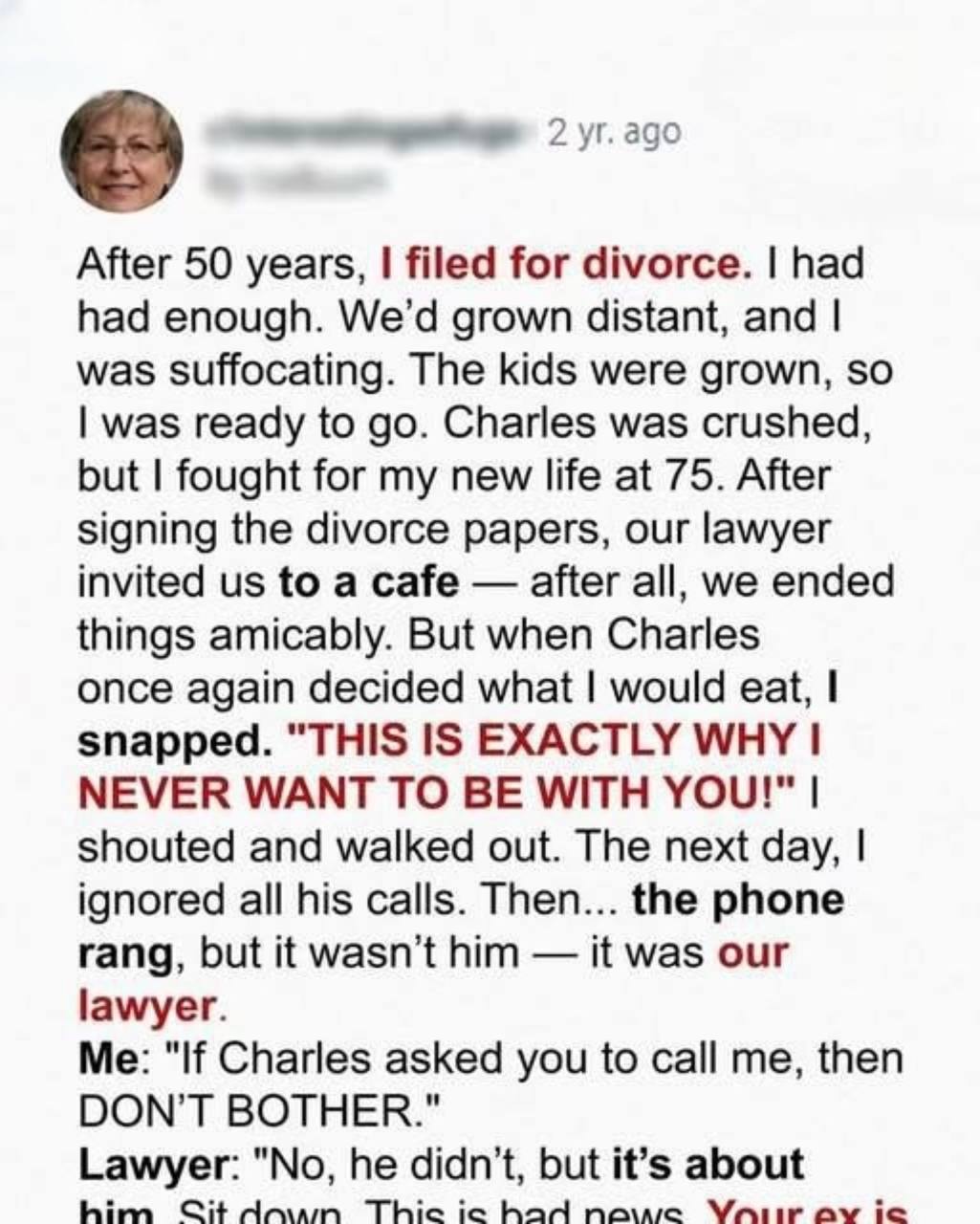
    For more than fifty years, Rose and Charles lived a life built brick by brick, memory by memory. They raised children, buried loved ones, celebrated milestones, weathered storms, and held each other through all the ordinary and extraordinary moments that make up a lifetime. Their marriage wasn’t perfect, but it was steady, familiar, and rooted in the kind of loyalty that only half a century can shape.

    But when they reached their mid-70s, something inside Rose shifted. It wasn’t sudden, and it wasn’t dramatic. It was quiet, a small tug she kept trying to ignore. She had spent her entire adult life caring for others — children, grandchildren, even Charles through his long work years and his health scares. Now the house felt too still, and the days felt too repetitive. She started wondering what her life might have looked like if she had taken more risks, carved out more freedom, listened to her own needs earlier in life. The more she thought about it, the heavier that longing became.

    Little disagreements — the kind every couple shrugs off — began to sting more than they should. A misplaced comment felt dismissive. A forgotten chore felt intentional. She started to believe Charles no longer heard her, no longer understood how trapped she felt. And once that belief settled in, it grew roots.

    Eventually, after months of internal struggle, Rose asked Charles for a divorce.

    The words nearly broke him. He didn’t yell. He didn’t argue. He didn’t accuse her of abandoning their history. He simply looked at her with a grief so deep it almost made her take it back. But she was convinced she needed space, convinced she needed to rediscover the pieces of herself she felt she had lost. And because he loved her, Charles agreed. Sometimes love, he thought, meant not holding someone in place when they were desperate to move.

    Their longtime family lawyer — a man who had known them for decades — invited them to dinner at their favorite restaurant after the divorce was finalized. He meant it as a gesture of compassion, a way to soften the edges of something painful. Maybe even a quiet hope that they might find their way back to each other in some small way.

    Charles arrived early. Old habits guided him. He asked the waiter to dim the lights by their table because Rose had always complained that bright bulbs gave her headaches. He ordered her a light salad, the same one she always chose when she wanted something healthy. He wasn’t trying to control anything; he was trying to care for her the way he always had.

    But Rose wasn’t the same woman who had once leaned into those gestures. She was overwhelmed, raw, and confused after the divorce. When she saw Charles adjusting the lights and ordering on her behalf, something inside her snapped. Instead of kindness, she saw control. Instead of tenderness, she saw the old patterns she had worked so hard to escape. Without a word, she stood up, grabbed her coat, and walked out of the restaurant.

    Charles sat frozen, his heart sinking as he watched her go.

    That night, he went home and wrote her a letter. The handwriting was shaky, the words careful and full of the kind of honesty that only comes when you think you’re out of chances. He apologized if he had ever made her feel trapped. He told her he loved her, not out of habit, but out of genuine devotion. He wrote that he wished she could see that everything he did — even the small things — came from concern, not control. Then he folded the letter and set it aside, planning to give it to her the next day.

    He never got the chance.

    The following morning, Charles suffered a heart attack. The neighbors found him collapsed on the porch and called an ambulance. When Rose received the call, her breath caught in her chest. She rushed to their old home — the one she had left behind but still thought of as hers — to gather some of his things before going to the hospital.

    She found the letter on the kitchen table.

    She unfolded it with trembling hands. The more she read, the more her chest tightened. It wasn’t a desperate plea. It wasn’t an attempt to sway her. It was a quiet, vulnerable outpouring from a man who had loved her through every season of their lives. A man who had no idea she would ever read these words in the shadow of tragedy.

    And for the first time, she saw the truth clearly.

    All the little gestures she had interpreted as control had always been rooted in affection. Dimming the lights. Remembering her favorite meals. Reaching for her hand when she seemed anxious. He wasn’t holding her back — he was holding her together. But she had been too lost in her own restlessness to see it.

    Regret hit her hard.

    She grabbed the letter, ran out the door, and headed to the hospital. When she reached his room, Charles looked smaller than she remembered — pale, fragile, hooked up to wires and monitors that beeped steadily, each sound reminding her how close she had come to losing him for good.

    She took his hand, and he opened his eyes.

    “Charles,” she whispered, tears blurring her vision, “I read your letter.”

    He swallowed, his voice weak. “I didn’t want to upset you.”

    “You didn’t,” she said. “You reminded me of everything I forgot. Everything I didn’t appreciate. Everything I misunderstood.”

    He tried to speak again, but she squeezed his hand. “I’m sorry. I’m so sorry for walking away. For not seeing what was right in front of me. For thinking your love was control when it was care.”

    His eyes filled with tears. “Rose… I just wanted you to be happy.”

    “I know,” she said. “And I want to be happy with you. If you’ll forgive me… I want to come home.”

    He didn’t need to answer. The way his fingers tightened around hers said everything.

    From that moment on, Rose decided to stop searching for freedom in the places that pulled her away and instead found it in the man who had stood beside her for a lifetime. They began again — not as a perfect couple, but as two people who finally understood how easily love can get tangled in miscommunication, and how powerful it is when you fight your way back to it.

    Rose never forgot how close she came to losing him. And every day that followed, she chose gratitude over doubt, gentleness over fear, and devotion over the restless ache that had once convinced her she needed to walk away.

    They walked forward together, hand in hand, grateful for a second chance — a gift not many people receive after a lifetime of love.

  • Jeep plows into Amish buggy near Berne, father airlifted, multiple children!

    Jeep plows into Amish buggy near Berne, father airlifted, multiple children!

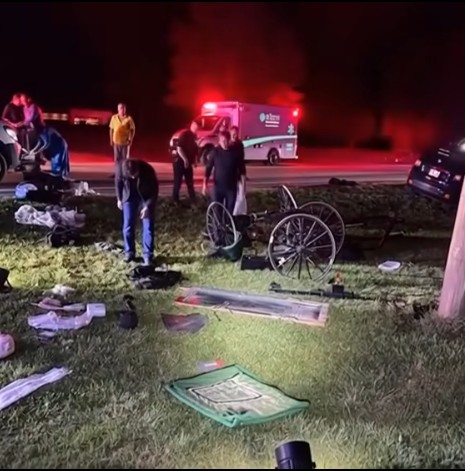
    A quiet October night in rural Indiana turned violent in seconds when a Jeep slammed into a horse-drawn Amish buggy on State Road 218 near Berne. What should have been a peaceful ride home for one family became a chaotic emergency scene stretching across the dark highway. First responders were called out just after 11:20 p.m. on October 7, and what they found was grim: a shattered buggy torn apart across the pavement, debris scattered in every direction, and a Jeep crumpled in a ditch.

    The buggy had been carrying nine people — a heavy load even on a good day, and a deadly vulnerability on a rural highway at night. Seven of the occupants were injured badly enough to require medical care. Six of them were juveniles, though specific ages varied depending on the early reports. The driver of the buggy, 32-year-old Ruben L. M. Schwartz of Berne, suffered the most severe injuries. He was airlifted to Lutheran Hospital, a sign of how urgent his condition was. Joseph L. M. Schwartz, age 20, and five children were taken by ambulance to Parkview Hospital. Two other passengers — 32-year-old Saraetta L. Schwartz and a 2-year-old child — declined medical treatment at the scene, shaken but physically stable.

    According to Adams County Sheriff Dan Mawhorr, the Jeep was driven by 33-year-old Bradley J. Ocilka of Burlington, Kentucky. He had been traveling eastbound when he struck the buggy from behind. Buggies move slowly, especially at night, and without the bright lights modern vehicles rely on, they can be difficult to spot. Ocilka was taken to the hospital to undergo a legal blood draw but refused any further medical treatment. As of the initial reports, no charges had been filed, though investigators emphasized that their work was far from finished.

    Within minutes of the crash, the scene was crowded with flashing lights from multiple agencies. Adams County EMS, Berne and Geneva police departments, the Berne Fire Department, Wells and Jay County EMS, Indiana State Police, and the Lutheran Hospital Flight Team all responded. The rural road became a temporary command center as crews worked with speed and focus, assessing injuries, stabilizing patients, and clearing the roadway. First responders described the scene as chaotic — a mix of twisted metal, splintered wood, a frightened horse, crying children, and panicked adults trying to understand what had just happened.

    Photos released later paint a stark picture: the buggy splintered and broken, wheels twisted, pieces of wood and personal items littering the asphalt. Emergency vehicles lined the road, their lights casting harsh red and blue flashes across the dark farmland. These roads are familiar to the large Swiss-Amish community in Adams County — routes used daily for school, work, worship, and family visits. A crash like this ripples through the entire settlement, touching not just a single household but an extended network of relatives and neighbors who share responsibilities, traditions, and support systems.

    Anyone who has spent time in Amish country knows that late-night travel by buggy is always a risk. Modern vehicles often underestimate how slow a buggy moves or how little margin for error exists on narrow rural highways. Safety experts repeat the same warnings year after year: slow down, increase following distance, and expect sudden changes in speed when approaching a buggy. At night, reflective markers, lanterns, and small battery lights help, but they are no match for distracted or fast-moving drivers.

    This accident serves as another grim reminder of the vulnerability of horse-drawn vehicles in a world built for speed. One driver misjudges a distance, becomes inattentive, or simply fails to see the buggy in time — and suddenly a family’s entire world collapses in seconds. The Amish themselves accept the risks as part of their way of life, but every crash cuts deep, especially in a community where family bonds run strong and children outnumber adults.

    In the immediate aftermath, neighbors began to gather information and offer support. In Amish communities, help arrives quickly — meals prepared, chores taken over, children watched, and emotional support offered with quiet steadiness. The Schwartzes, like many Amish families struck by tragedy, won’t face recovery alone. The network around them will tighten, and while the pain is heavy, no one will carry it without hands reaching out to help.

    Authorities are still piecing together what happened. Crash reconstruction, witness interviews, vehicle analysis, and blood test results all take time. Early reports noted that no charges had been filed yet, but that is common in the first phase of an investigation. Officials stressed that they would release updates as more information becomes available.

    For people living in the area, the message from law enforcement and community leaders is simple: slow down. Buggies will always be on these roads. They will always move at a pace that frustrates impatient drivers. But frustration is not a justification for risk. A moment of caution can prevent a lifetime of consequences. For residents who want to help the affected family, local churches and community organizations may coordinate support or establish recovery funds. Whatever you choose to give — meals, money, or prayers — respect the family’s need for privacy as they navigate grief, fear, and uncertainty.

    The Schwartzes face a long road ahead. Physical injuries will take time to heal. Emotional wounds may last longer. Children thrown from a buggy in the dead of night don’t forget the terror easily. Adults carrying the responsibility of keeping those children safe bear their own heavy weight of guilt, even when they did nothing wrong.

    But if there is one thing rural Indiana knows well, it’s how to rally when tragedy hits close to home. The Amish community will handle the internal emotional load; the English community around them has already begun offering support in the ways they can. Crashes like this pull people together — not out of curiosity, but out of recognition that on roads like these, anyone can become a victim in an instant.

    The investigation continues. Charges may follow, or they may not. But whatever the outcome, the message remains unchanged: when you share the road with buggies, slow down, pay attention, and give more space than you think you need.

    Lives depend on it — as this family learned in the hardest possible way.

  • Taylor Swift, Now 35, Steps Into the Spotlight with Her New Boyfriend!

    Taylor Swift, Now 35, Steps Into the Spotlight with Her New Boyfriend!

    Gwen Stefani has spent decades in the public eye, but even now, at this stage in her life and career, she still manages to command attention without even trying. Singer, songwriter, fashion icon, television personality — she has never fit neatly into a single role. Her path has always been a blend of bold reinvention, raw talent, and a fearlessness that set her apart from the beginning. What started as a young woman fronting No Doubt in the ’90s grew into a cultural force that crossed music, fashion, and television. And through it all, she maintained the same distinctive mix of vulnerability and attitude that made her unforgettable.

    Her sound — an unmistakable fusion of ska, pop, punk, and rock — gave her a signature style no one else could replicate. Her look became just as iconic: platinum hair, red lipstick, and outfits that walked the line between edgy and glamorous. Gwen never hesitated to be exactly who she was, and because of that, people connected to her not just as an artist, but as a person carving out her identity under a spotlight that never turned off.

    But while her professional life has always looked electric and unstoppable, her personal life has told a much more complicated story. Her first marriage to Gavin Rossdale played out under intense public scrutiny, and its ending became headline fodder everywhere. That chapter tested her — not as an entertainer, but as a woman trying to navigate heartbreak while the world watched and dissected every detail. She handled it the way she handles everything: head-on, openly, and without losing herself in the noise.

    Then came her relationship with Blake Shelton, another high-profile partnership that instantly became a favorite talking point for media and fans. The pairing felt unlikely on paper — a California ska-punk icon and an Oklahoma country star — but in real life, the connection made sense. They met during a challenging moment in both of their lives and found humor, understanding, and comfort in each other. When they eventually married, fans celebrated it as a moment of brightness for two artists who had weathered their own storms. It was a relationship built on respect and shared creativity, and it carried them into a chapter that felt lighter and more grounded.

    Through all the public fascination, Gwen kept a firm grip on her identity. She balanced motherhood with her career, fashion ventures, TV roles, and creative projects, proving again and again that reinvention didn’t mean losing anything — it meant expanding into something more.

    Now, as she steps deeper into her midlife era, Gwen continues to evolve with the same boldness that defined her early years. The woman who once wore bindis and punk-inspired outfits on MTV is the same woman who now embraces glamour, country influences, and a softer, reflective style. Her artistry is still there, but so is the wisdom earned from decades of living under bright lights and through very real private struggles.

    The public, of course, remains fascinated by her life offstage. Her marriage to Blake Shelton became part of the cultural conversation not because of scandal or drama, but because people saw genuine affection — the kind built on shared laughter, mutual encouragement, and two artists supporting each other’s work. Their creative collaborations added warmth to both of their careers, and for a while, the world viewed their union as a testament to finding love unexpectedly and letting it transform you.

    But like any relationship in the spotlight, theirs invited its own layer of pressure. People speculated, debated, analyzed every interaction. Gwen, who had always worked hard to maintain authenticity, found herself once again balancing personal happiness with the constant chatter of public curiosity. Even so, she continued showing up with grace — performing, judging on television, designing, collaborating, raising her children, and navigating her marriage with the same honesty she brought to her music.

    If there’s anything consistent about Gwen Stefani’s story, it’s resilience. She has never backed down from reinvention, never shied away from the messy or painful parts of life, and never apologized for the choices she made to protect her happiness. Whether she was at the top of the charts, facing heartbreak, stepping into a new romance, or reinventing her creative identity, she did it with conviction.

    Fans gravitate toward that. They see someone who built a career without compromising who she was. Someone who embraced all the contradictions — tough and tender, glamorous and grounded, playful and introspective. Someone who could headline a stadium one night and show up on a TV set the next morning to coach young artists with patience and genuine kindness.

    Her journey is a reminder that reinvention doesn’t require erasing the past. It requires understanding it, learning from it, and using it as fuel to move forward. Gwen knows how to do that better than most. She’s lived multiple lifetimes in one career, loved deeply, hurt deeply, and kept going through every twist.

    Today she stands as a woman fully in control of her narrative — still creative, still expressive, still impossible to define by a single chapter of her life. Her relationship with Blake Shelton added joy and partnership to her story, but it never overshadowed the person she has always been: an artist who constantly grows, adapts, and finds new ways to shine.

    At 35, 45, or 55 — it doesn’t matter. Gwen Stefani remains Gwen Stefani: a force, a style icon, a musician with a distinct voice, and a woman who continues to navigate the balance between public fascination and private truth with the same resilience she showed from the very beginning.

    Her story isn’t finished. If anything, the chapters ahead promise even more evolution, more creativity, and more of the bold authenticity that has defined her from the start.

  • Trumps Latest Financial Blueprint Sends Shockwaves Across America, What His Private Accounts Really Mean

    Trumps Latest Financial Blueprint Sends Shockwaves Across America, What His Private Accounts Really Mean

    Rumors started swirling long before anything official was announced. Conversations behind closed doors, vague comments from economic insiders, and carefully worded hints in media interviews all suggested that something big was coming. Policy analysts claimed unusual patterns in internal planning documents. Political strategists whispered about a proposal unlike anything seen in recent economic debates. By the time Donald Trump finally stepped forward with his latest idea, the country was already braced — sensing that whatever he had in store wouldn’t be routine policy but something disruptive, highly controversial, and destined to spark nationwide debate.

    His plan arrived with a bold name and an even bolder promise: the creation of “Trump Accounts,” a set of government-funded investment portfolios intended to give newborn American children a financial stake from the moment they enter the world. The announcement spread instantly across social media, talk shows, and news programs, with reactions ranging from excitement to disbelief. Supporters hailed it as a radical step toward leveling America’s growing wealth gap. Critics warned it was an experiment built on fragile ground.

    The structure of the proposal was simple on paper but sweeping in impact. Every child born within a designated four-year period would automatically receive a $1,000 investment account funded by the federal government. This account wouldn’t sit idle like a savings bond. Instead, it would track with the stock market — compounding over years, theoretically growing into a meaningful nest egg by the time the child reached adulthood. The idea painted an enticing picture: turning 18 with thousands of dollars available for college, housing, business investment, or emergency support. For families shut out of wealth-building opportunities, the concept felt almost revolutionary.

    For many Americans struggling to get ahead, the idea hit a nerve. Homeownership grows more unattainable every year. Wages lag behind inflation. Young people carry massive debt before they ever reach financial stability. To those who feel the system is rigged against them, the notion of an automatic financial foundation for every newborn sounded like the first hopeful concept to emerge from politics in a long time.

    But as soon as the applause started, so did the questions — and they were heavy ones.

    The biggest concern centered on the volatility of the stock market itself. Unlike traditional guaranteed programs, these accounts would rise and fall with market conditions. One year could bring record growth; the next could wipe out half the accumulated funds. Critics argued that tying a child’s future to Wall Street’s unpredictable movements was irresponsible. What happens, they asked, when the market crashes during a recession, a geopolitical crisis, or another pandemic-style event? Would millions of young Americans enter adulthood with empty accounts just because they were born at the wrong point in the economic cycle?

    Then came questions about management. Who would oversee these accounts? Would private firms be contracted to invest and monitor funds? Would the government build a new bureau? What rules would govern the investments — high-risk, high-yield portfolios or safer, long-term strategies? Without answers, skeptics worried that “Trump Accounts” could become a magnet for mismanagement, political interference, or financial exploitation. Americans wanted to know who would be watching the watchmen.

    Another concern, one raised quickly by policy experts, was political durability. Massive social programs often collapse or morph when administrations change. What would happen if a future president terminated the program halfway through? Would children born in a specific four-year window receive benefits that their younger siblings never could? That kind of uneven policy could introduce new divisions into a society already strained by inequality.

    Despite all the red flags, one truth emerged clearly: Trump’s proposal had forced the country to confront its deep and growing wealth divide. For decades, the gap between the wealthy and the working class has widened at a pace that once seemed impossible. By offering a dramatic and unconventional proposal, Trump pushed that issue front and center in a way few political figures have dared.

    Supporters called it a bold start — a way to help families who have been locked out of investment culture entirely. Critics saw it as a risky gamble that could backfire on the very people it was supposed to help. But both sides admitted the same reality: America’s approach to economic opportunity hasn’t changed meaningfully in generations, and the old structures aren’t working for millions of citizens.

    Even those who dismissed the proposal outright acknowledged that it had sparked a national conversation long overdue. What should economic opportunity look like in the modern era? Should children begin life with some measure of financial support? Should generational wealth be accessible beyond families who already have it? And if not this program, then what replaces it?

    The debate spilled across platforms — not just political talk shows but community forums, classrooms, workplaces, and family dinner tables. Teachers wondered whether students would one day rely on these accounts to pay for college. Parents questioned whether they should adjust their financial planning. Economists argued about whether the program would stimulate investment culture or destabilize future markets. Everyone had an opinion, and for once, the discussion stretched far beyond partisan lines.

    As the story developed, analysts noted something important: regardless of whether this proposal ever becomes law, it has already shifted the national dialogue. Americans are being forced to rethink what economic fairness means in a world where opportunity is increasingly uneven. The conversation is no longer about small tweaks to tax codes or scattered social programs. It is about structural change — about reimagining what the country owes to its youngest citizens before they can fend for themselves.

    Supporters see empowerment. Critics see danger. But no one denies that the stakes are high.

    While the future of Trump Accounts remains uncertain, the controversy has cracked open a deeper truth. America is wrestling with fundamental questions about wealth, risk, responsibility, and the vision of a nation where every child begins life with something more than nothing. Whether the idea becomes a historic turning point or fades into political memory, it has already done what few policies manage to do: it forced a reckoning.

    The country now waits — cautiously, anxiously, or optimistically — to see what comes next, knowing that whatever direction this debate takes, its impact on the American dream will echo long beyond this moment.

  • DEADLY FALL, Prince Harry is devastated with grief, With heavy hearts, we announce the passing

    DEADLY FALL, Prince Harry is devastated with grief, With heavy hearts, we announce the passing

    News broke quietly at first, then spread with the kind of force only tragedy can summon: a member of the aristocratic Brudenell-Bruce family had died in a horrific fall. What began as an ordinary evening turned into a scene of panic and heartbreak, leaving those closest to him stunned, and the wider public drawn into the strange and sudden nature of the accident.

    Michael Brudenell-Bruce, the 98-year-old 8th Marquess of Ailesbury and a relative of model and Prince Harry’s former girlfriend Florence Brudenell-Bruce, died after falling from a bedroom window in his West London home. What made the tragedy even more startling was the reason behind the fall — a simple moment, an everyday gesture, the kind no one imagines can turn deadly.

    According to Teresa Marshall de Paoli, his partner of more than three decades, the chain of events began with Honeybun, the couple’s cat. Stuck at the window and desperate to get out, the cat prompted the marquess to open it further. Teresa believes he must have pushed the glass upward to help the cat squeeze through, lost his balance, and tumbled backward out the window. He landed headfirst on the concrete patio below.

    “It was a freak accident,” Teresa said, still struggling to wrap her mind around the suddenness of it all. “He had blood all over himself. I leaned over him and said, ‘Oh, my dear, what happened?’ But he was already gone.”

    The fall had been catastrophic. The impact to the back of his head was instantly fatal, and investigators later confirmed that even immediate medical intervention would not have saved him. Teresa suspects he lay there for an hour or more before she found him — pale, cold, and still.

    Emergency crews were on the scene within minutes after she called 999. Police and paramedics descended on the small London property in Shepherd’s Bush, quickly assessing the scene and confirming what Teresa already feared: the marquess had died.

    But what Teresa didn’t expect was the reaction that followed.

    “When they first arrived,” she said, “they thought I might have killed him.”

    The situation was initially treated as a potential crime scene. Any unexplained death — especially one involving a fall, blood, and no witnesses — triggers suspicion by default. Police had dozens of questions, and Teresa, still dazed with shock, had few answers beyond the terrible truth she had witnessed.

    “There wasn’t a fight,” she repeated. “I hadn’t hit him. It was just… a horrible accident.”

    Once police determined there was no sign of struggle and no evidence of foul play, the tone of the investigation shifted. They allowed Teresa to return to his side. She was able to say goodbye and gently apply her partner’s favorite aftershave — the small, tender act of care she could still offer after a lifetime of companionship.

    The marquess’s daughter, Lady Kathryn Brudenell-Bruce, rushed to the home immediately after being notified. The two women spent the night together in the drawing room because there was nowhere else to rest while investigators continued their work.

    “The police were there all night and all the next day,” Teresa recalled. “It was endless. But they had to do their job.”

    This was not a man unknown to the world. Born into nobility, Michael Brudenell-Bruce lived a life that crossed eras and continents. He attended Eton, served as a captain in the Royal Horse Guards, became a stockbroker, and navigated the complexities of aristocratic life for nearly a century. His family’s estate — a 4,500-acre expanse in Savernake Forest near Swindon — had been his home for years before he and Teresa moved to London. They lived in a cottage on the estate for sixteen years, sharing quiet routines, books, gardens, and the steady companionship of long-term love.

    He had been married three times before meeting Teresa, and his family tree includes well-known figures such as his granddaughter Bo Bruce, a finalist on the BBC series The Voice. The Brudenell-Bruce lineage is long, visible, and intertwined with British cultural and aristocratic history.

    But none of that mattered in the small, devastating moment when a simple act of helping a cat spiraled into tragedy.

    Police later confirmed publicly that although the death was unexpected, it was not being treated as suspicious. The official investigation remains open only for procedural reasons, as is standard with accidental deaths involving the elderly.

    Emergency responders, neighbors, and extended family all expressed shock at the nature of the incident. A fall from a window sounds dramatic, but for someone nearing 100 years old, balance is fragile, reflexes are slower, and even minor risks can escalate without warning.

    For Teresa, the shock is compounded by the mundanity of the cause.

    “Honeybun got her head stuck,” she explained. “He must have tried to help her, lifted the window, and leaned too far. As he fell, he even broke the roses on the wall. It happened so fast, and there was no one there to catch him.”

    After the authorities left, the house felt impossibly quiet. The imprint of his absence was immediate — a missing voice, a missing presence, a missing warmth. Teresa spent the following hours replaying the evening in her mind, searching desperately for something she could have done differently. But the truth was painfully simple: some tragedies arrive like lightning — fast, unexpected, and beyond anyone’s control.

    The news of his death spread quickly, not because of scandal but because of the absurd fragility of the moment that took him. The story rippled beyond aristocratic circles, touching people who understood that no matter how grand a life someone leads, no one is immune to fate’s smallest twists.

    His family mourns a man who lived nearly a century, served his country, raised children, and loved deeply. Teresa mourns the partner who shared three decades of her life — the quiet mornings, the familiar routines, the companionship that becomes its own kind of heartbeat.

    The police statement was simple: the death was unexpected, but not suspicious. In the end, it was exactly what Teresa said it was — a freak accident.

    A life that spanned almost a hundred years ended in a single misstep, a single moment, a single attempt to help a stuck cat.

    And now those who loved him are left with memories, with grief, and with the lingering echo of a man whose life was full, whose end was sudden, and whose story reminds us how quickly everything can change.