Category: News

  • 10 Celebs Who Do Not Care About What People Say When It Comes to Breastfeeding!

    10 Celebs Who Do Not Care About What People Say When It Comes to Breastfeeding!

    Being a woman is no simple task, and once the journey of motherhood begins, the equation becomes exponentially complicated. The endless demands, the lack of sleep, and the immense pressure to perform perfectly under the relentless scrutiny of the public eye combine to create an environment where every decision is judged. Yet, among all the challenges that motherhood brings, supplying something as basic and vital as food for the baby remains a surprisingly contentious issue. For centuries, the act of breastfeeding has been shunted behind closed doors, wrapped in an often puritanical discomfort that prioritizes the comfort of strangers over the nourishment of an infant. This cultural hang-up suggests that a natural biological function is somehow “out of place” or “wrong” in public spaces, perpetuating a stigma that makes life harder for mothers worldwide.

    Thankfully, a new guard of influential figures is actively challenging this outdated notion. These are the celebrities who, with a powerful blend of practicality, pride, and unapologetic transparency, have chosen to breastfeed their children in full view of the cameras, proudly and in defiance of anyone who might dare to object. They are leveraging their vast platforms not for personal gain, but to normalize this foundational act of care, proving that feeding a baby is a priority that trumps societal decorum. Their willingness to share these intimate, yet utterly universal, moments acts as a loud, collective declaration that the judgment stops now. Here are ten of those powerful voices who refuse to care about “what people say” when it comes to breastfeeding, fundamentally shifting the cultural narrative around motherhood, one photo at a time.

    1. Kourtney Kardashian has consistently championed an organic, holistic approach to her lifestyle, and motherhood is no exception. As a central figure in one of the world’s most watched reality television dynasties, Kourtney’s choice to document her nursing journey became a non-negotiable part of her public narrative. She often shares photos that are beautifully raw, showing her nourishing her children while relaxing, traveling, or in the midst of a busy day. Her approach normalizes breastfeeding by simply integrating it into the tapestry of her everyday life, demonstrating that this vital maternal function is not an inconvenience to be hidden, but a natural component of her demanding schedule. Her message is clear: if it’s necessary, it happens, regardless of the setting.

    2. Gwen Stefani, an enduring music icon, brings her characteristic confidence and ‘cool mom’ energy to the breastfeeding conversation. Balancing a high-octane career with the demands of raising a family, Stefani’s public posts have focused on the pure, joyful connection of nursing. Her stance speaks volumes to working mothers, asserting that maintaining one’s identity as a powerhouse performer or professional is entirely compatible with embracing the biological rhythms of new motherhood. Her image as an artist known for defiance naturally extends to defying the expectations of what a celebrity mother should be, making her a powerful advocate for the practical mother who refuses to slow down.

    3. Halsey has been a monumental force in advocating for body positivity and postpartum honesty. Their approach to sharing their breastfeeding journey has been particularly raw, tackling the often-unseen realities of pumping, engorgement, and the physical changes that accompany feeding. By posting unfiltered selfies showing the messy, non-glamorous side of nursing—sometimes while working or attending events—Halsey challenges the polished, unrealistic standards often presented to new mothers. Their advocacy is a passionate call for authenticity, insisting that the priority is the baby’s health and the mother’s peace of mind, not a picture-perfect facade.

    4. Kate Hudson, hailing from a famous Hollywood lineage, frames her motherhood journey with a joyful, slightly bohemian spirit. Her public nursing photos often capture a moment of serene connection amidst the chaos of a large, active family life. Hudson’s contribution to the discussion emphasizes the spiritual and emotional bond of breastfeeding. She shows the act as an integrated part of a vibrant, active life, refusing to compartmentalize the feeding experience. For Hudson, sharing these photos is a way to celebrate the female body’s power and its incredible ability to sustain new life, making her a champion of holistic, uninhibited parenting.

    5. Pink is perhaps the most defiant figure on this list, known for her feminist punk-rock stance. True to form, her approach to public breastfeeding is powerful and unapologetic. She has used her social media to forcefully push back against critics, linking the act of nursing to her broader platform of female empowerment and bodily autonomy. Pink’s posts often exude a ‘no apologies’ attitude, showing her feeding her children in various public and exotic locations, reminding her millions of followers that she is a mother first, and the convenience of feeding her child will always supersede the archaic comfort levels of strangers. She makes the statement that nursing is a powerful, normal, and even badass act.

    6. Paola Mayfield, gaining visibility through reality television, faced intense scrutiny from a highly judgmental viewing audience. Her decision to share her breastfeeding moments was a direct challenge to the critics watching her every move. Her advocacy highlights the struggle of mothers who are constantly under the microscope of public opinion, especially those whose lives are televised. For Mayfield, sharing these photos was a way to reclaim agency over her body and her parenting choices, insisting on her right to feed her child whenever and wherever necessary, regardless of the relentless, often cruel, commentary from online trolls.

    7. Shay Mitchell, an actress known for her glamorous, high-fashion aesthetic, used her platform to show that motherhood and style are not mutually exclusive. Her breastfeeding photos often juxtapose the very human act of feeding with a luxurious, jet-setting backdrop. She normalizes nursing by demonstrating that it fits seamlessly into a modern, busy lifestyle. Mitchell’s images are aspirational yet grounding, providing a powerful visual representation for mothers who feel pressured to choose between their pre-baby identity and their new role, proving that a baby’s need for nourishment is a perfect accessory to any ensemble.

    8. Chrissy Teigen is renowned for her radical transparency, especially concerning the highs and lows of motherhood, mental health, and the postpartum experience. Teigen’s breastfeeding posts are often imbued with her signature wit and self-deprecating humor, using comedy to dismantle the sanctity and seriousness that sometimes surrounds parenting. By sharing photos of herself pumping or nursing in less-than-ideal situations, she makes the act highly relatable and human. Her willingness to discuss the physical and emotional toll of feeding, and to push back against the ‘perfect mom’ myth, has made her a crucial voice for normalizing the reality, not just the romance, of breastfeeding.

    9. Hilary Duff, a beloved figure from her childhood star days, embodies a quiet, powerful normalization of motherhood. Her feeding moments are often captured in candid, unfiltered settings, emphasizing the practicality of the act. Duff’s advocacy is less about grand defiance and more about integrating nursing so completely into her daily life that it becomes mundane and unremarkable—which is, in itself, a profoundly radical statement. She shows that the primary concern is the comfort and care of the child, and that simple, honest documentation is often the most effective form of activism against shame.

    10. Heidi Montag, known for her earlier reality television presence on The Hills, uses her current platform to showcase a more mature, authentic version of herself as a mother. Her choice to share these intimate moments signifies a willingness to be truly vulnerable and real with her audience. Montag’s posts contribute to the larger conversation by demonstrating personal growth and focusing on the essential, unconditional bond between mother and child. She validates the experience of many mothers who are navigating their identity in the public sphere, emphasizing that the love and nourishment provided to her baby takes precedence over any lingering, superficial concerns about appearances or propriety.

    These ten women, each with their unique platform and approach, are collectively forging a new cultural landscape where the simple, profound act of feeding a baby is met not with discomfort or judgment, but with acceptance and respect. By sharing these photos and stories, they provide a much-needed shield against the negativity and a powerful dose of courage for mothers everywhere, ensuring that no mother feels compelled to hide or apologize for nourishing her child. They are demanding a world where prioritizing a baby’s need is always seen as the right, and most normal, choice.
  • Marvelous Mrs Maisel actress Davis dies at 60!

    Marvelous Mrs Maisel actress Davis dies at 60!

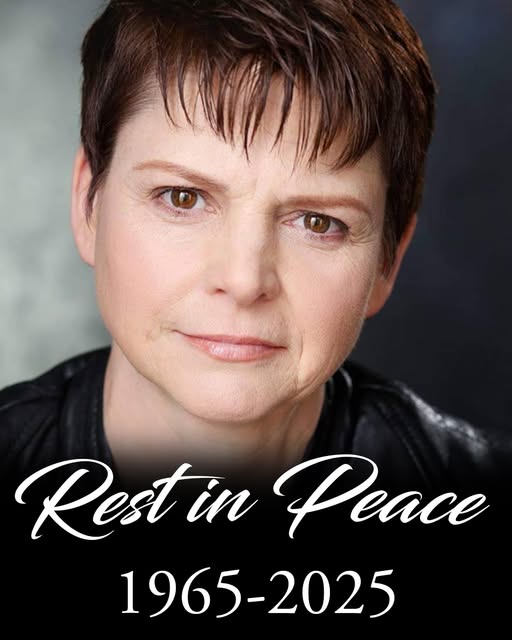
    The entertainment community and fans of the beloved series The Marvelous Mrs. Maisel are mourning the sudden and tragic loss of actress Wenne Alton Davis, who died at the age of 60.1 Known for her infectious warmth, dedication to her craft, and bright, generous spirit, Davis’s life was cut short in a devastating accident in New York City on a Monday evening. The news has sent a shockwave through the industry, highlighting the fragility of life and the immense contributions Davis made both on and off the screen.

    Wenne Alton Davis, born Wendy Davis in 1965, was struck by a car while crossing the street near the bustling theater district, an area she navigated with the casual familiarity of a lifelong New Yorker.2 According to authorities, the incident occurred at approximately 9:00 PM at the busy intersection of West 53rd Street and Broadway. Davis was reportedly out to dinner with friends and making her way toward the train station when the accident took place.3

    The collision was severe. Davis suffered extensive and critical trauma to the head and body.4 Emergency Medical Services (EMS) swiftly responded to the scene and transported her to Mount Sinai West Hospital, where, despite the best efforts of medical staff, she was tragically pronounced deceased.5

    The vehicle involved in the collision was identified as a 2023 Cadillac XT6, driven by a 61-year-old male. The driver remained at the scene following the accident and cooperated fully with the investigating officers. As of the time of the initial reports, the driver faces no immediate charges or arrest.6 The official investigation is being diligently conducted by the NYPD Highway District’s Collision Investigation Squad, a standard protocol for incidents involving fatal traffic accidents, as authorities work to piece together the exact sequence of events that led to the devastating outcome.7

    Davis’s career trajectory was a testament to her persistent passion for the arts and her resilient spirit. She was a true New York story, moving to the city in her twenties with the singular goal of pursuing a career in stand-up comedy. The city’s energy fueled her ambition, but like so many artists striving for their breakthrough, she balanced her creative aspirations with practical necessity. To support herself during the early, challenging years of her career, Davis worked diligently at JFK International Airport. This dual life—working a demanding job while chasing the elusive dream of performance—defined her character, fostering an incredible work ethic and a deep empathy for the ordinary people whose stories she would eventually help tell on screen.

    Jamie Harris, Davis’s long-time manager, was among the first to share an emotional tribute, beautifully encapsulating the spirit of the woman the public knew as Wenne Alton Davis. Harris described her as nothing less than “a bright light.”

    “She had a huge love for New York, for acting, for her colleagues at JFK, and, most of all, her family and her circle of friends (which was also huge),” Harris said in a heartfelt statement to The New York Times. “She was someone for whom friendliness and kindness were not what she did but more who she was as a person.”

    This sentiment resonated deeply with those who had the privilege of working alongside her. Davis possessed a genuine warmth and an ability to connect with people that transcended the often-fickle nature of show business. Her kindness was not a professional veneer but a core trait, making her a beloved figure both on set and in her personal life.

    While her career included a variety of roles across different mediums, Davis gained broader recognition late in her career for her appearance in a 2023 episode of the critically acclaimed Amazon Prime series, The Marvelous Mrs. Maisel. The show, celebrated for its vibrant portrayal of mid-century New York and the world of stand-up comedy, served as a perfect, poignant backdrop for Davis, who began her professional life striving for laughs on similar stages. Though her role may have been brief, her performance added texture and authenticity to a series that celebrated the very world she dedicated her life to.

    Beyond her most recent work, Davis’s resume included appearances in several other notable television series and films, showcasing her versatility as an actress.8 She held roles in popular series such as Blindspot and New Amsterdam, demonstrating her ability to transition seamlessly between comedy and drama.9 Furthermore, she appeared in the critically acclaimed and powerful film The Normal Heart, a project that highlighted her commitment to meaningful storytelling and complex narratives.10

    The tragic nature of her death—a sudden, random accident in the city that she loved and had chosen as her home—serves as a painful reminder of the delicate balance of life, especially in a bustling metropolis. The loss of Wenne Alton Davis, at an age when many actors find their most resonant work and deepest fulfillment, is a profound blow to the creative community.

    The ongoing investigation by the NYPD is focused on ensuring that every detail surrounding the collision is thoroughly examined.11 While the driver remained at the scene and no charges have been filed yet, the police statement confirmed the severe nature of the trauma Davis sustained and the formal, sustained efforts being made by the Collision Investigation Squad to conclude their inquiry.12

    Wenne Alton Davis will be remembered not just for the roles she played, but for the light she brought to every room and every project. Her perseverance, her kindness, and her deep, abiding love for her friends, family, and the unique, vibrant life of New York City will remain her enduring legacy. As the investigation continues, the many people whose lives she touched pause to grieve a bright light extinguished far too soon. The memory of her laughter, her dedication, and her vibrant spirit will serve as a lasting tribute to a remarkable woman who truly embodied the resilience and heart of an artist.

    Rest in peace, Wenne Alton Davis.

  • Social Security Announces New Cost-of-Living Adjustment (COLA) Checks – What You Need to Know! Sotd

    Social Security Announces New Cost-of-Living Adjustment (COLA) Checks – What You Need to Know! Sotd

    📰 Social Security Cost-of-Living Adjustment (COLA): Your Essential Guide to 2025 Benefit Changes

    The Social Security Administration (SSA) has officially announced the Cost-of-Living Adjustment (COLA) for the upcoming year, a critical financial measure designed to help millions of beneficiaries manage the persistent pressure of rising inflation and the increasing cost of essential living expenses. This annual adjustment, which is statutorily tied to changes in the Consumer Price Index, represents a vital lifeline for over 70 million Americans, including retirees, disabled workers, surviving spouses, and children who rely on Social Security and Supplemental Security Income (SSI). The new COLA will be reflected in all monthly payments beginning in January 2025.

    The 2025 COLA: A Return to Modest Growth

    For 2025, the COLA is set at 2.5%. This adjustment is based on the increase in the Consumer Price Index for Urban Wage Earners and Clerical Workers (CPI-W) from the third quarter of 2023 through the third quarter of 2024.

    While this 2.5% increase is a welcome boost for fixed-income households, it marks a return to more modest adjustments compared to the historically high rates seen in previous years. It follows the 3.2% increase in 2024 and the significant 8.7% surge in 2023, which was the largest COLA in four decades and a direct response to soaring inflation during the post-pandemic period. The smaller 2025 adjustment reflects a general cooling of inflation across the U.S. economy.

    💰 What the 2.5% Increase Means for Your Monthly Check

    The 2.5% COLA will translate to an average monthly benefit increase of approximately $49 for the typical retired worker. This boost is designed to preserve the purchasing power of benefits as the cost of goods and services continues to rise.

    Here is a detailed look at the estimated average and maximum benefit changes taking effect in January 2025, based on the official 2.5% COLA:

    Category Average Benefit Before COLA (Dec 2024) Estimated Average Benefit with 2.5% COLA (Jan 2025)
    All Retired Workers $1,927 $1,976
    Aged Widow(er) Alone $1,788 $1,832
    All Disabled Workers $1,542 $1,580
    Widowed Mother and Two Children $3,669 $3,761
    Retired Couple (Both Collecting) $3,014 $3,089

    Maximum Social Security Benefits for New Retirees

    For those retiring in 2025, the maximum monthly benefit payable is also seeing an increase. The maximum benefit is determined by a worker’s lifetime earnings, specifically their average indexed monthly earnings over their 35 highest-earning years.

    Category Maximum Monthly Benefit (2024) Maximum Monthly Benefit (2025)
    Worker Retiring at Full Retirement Age (FRA) $3,822 $4,018
    Maximum at Age 62 (Reduced Benefit) N/A $2,781 (Estimated)
    Maximum at Age 70 (Delayed Benefit) $4,873 (Estimated) $5,001 (Estimated)

    Note: The maximum benefit figures are estimates and vary significantly based on the specific age of retirement and full retirement age (FRA).

    Supplemental Security Income (SSI) Changes

    Recipients of Supplemental Security Income (SSI) will also see their federal payment standard increase as a result of the COLA. The new SSI payment levels are scheduled to take effect with the payment dated December 31, 2024 (which covers the month of January 2025).

    SSI Category Current Federal Payment Standard (2024) Estimated Standard with 2.5% COLA (2025)
    Individual $943/month $967/month
    Couple $1,415/month $1,450/month

    The Broader Economic Context: Why COLA Matters

    The Cost-of-Living Adjustment is an indispensable tool for protecting the financial security of Americans on fixed incomes. Without the COLA, rising prices—particularly for non-discretionary expenses like food, housing, and healthcare—would rapidly erode the purchasing power of benefits, pushing vulnerable citizens closer to poverty.

    However, the 2.5% COLA for 2025 has generated mixed reactions. While the adjustment is a sign that overall inflation has moderated closer to the Federal Reserve’s target, many advocacy groups, such as the AARP, argue that the COLA formula, which is tied to the CPI-W, does not accurately reflect the expenditure patterns of seniors. Older Americans tend to spend a disproportionately higher share of their income on medical care and housing, categories where inflation often outpaces the broader CPI-W measure. Consequently, the benefit increase may not fully offset the actual cost pressures felt in seniors’ daily lives.

    Furthermore, the gains from the COLA are often partially offset by increases in Medicare premiums. The standard monthly premium for Medicare Part B, which is typically deducted directly from Social Security checks, is also subject to annual adjustment, which can effectively reduce the net financial benefit of the COLA for most enrollees.

    Crucial Actions to Take Now

    To ensure you are prepared for the 2025 benefit changes, the SSA advises beneficiaries to take the following steps:

    1. Monitor Official Notification: The SSA will send out official notices detailing your specific new benefit amount in December. These notices will be available online through your personal “my Social Security” account and sent via mail. Be sure to look for this official correspondence and verify your new payment amount.
    2. Verify Direct Deposit: The new benefit amount will be reflected in your checks starting in January 2025. If you receive direct deposit, confirm that the higher payment is accurately credited to your account.
    3. Watch for Fraud: Be aware that no government agency or reputable company will ever solicit your personal information or request advance fees for services via wire transfers or gift cards related to the COLA. Protect yourself from fraudulent calls and phishing schemes by only using the official SSA website.

    The 2025 COLA, while smaller than recent historical highs, provides a necessary layer of financial protection against inflation. For millions of retired, disabled, and surviving Americans, understanding this increase is the first step toward planning for a financially secure year ahead.


    For those planning their financial future, it is essential to consider how Social Security benefits interact with state and federal tax policies. The ongoing national debate regarding potential changes to Social Security funding and taxation, including various legislative proposals, could significantly affect the net income of future retirees. Staying informed about legislative developments, like those concerning the Social Security tax cap and potential benefits taxation, is crucial for comprehensive retirement planning.

  • The Real Meaning Behind the Phrase Six-Seven Explained!

    The Real Meaning Behind the Phrase Six-Seven Explained!

    The digital age is characterized by an unprecedented speed of cultural dissemination, where phrases and sounds originating in the ephemeral spaces of social media can transition almost instantaneously into real-world phenomena. Few recent examples demonstrate this collision between online spontaneity and offline order as clearly as the inexplicable rise of the phrase ‘six-seven.’ What began as a throwaway element in a viral sound clip has metastasized into a pervasive cultural reference, particularly among younger audiences, baffling adults and presenting a unique challenge to educators worldwide.

    According to online educators and trend experts, such as the TikTok creator Mr. Lindsay, the phrase’s power lies precisely in its lack of intrinsic meaning. As Mr. Lindsay explained, “It’s just a meme reference. There’s no meaning, it’s fun to say, especially with hand motions.” For the millions of young users participating in the trend, this absence of logic is the central comedic pillar. The phrase is playful, delightfully nonsensical, easy to repeat, and effortless to exaggerate. It does not demand context, background knowledge, or complicated explanation. All that is required is for the listener to hear it once and to join in the rhythm and the shared joke of saying it together. This inherent simplicity and low barrier to entry are what make it spread with such explosive speed.

    This effortless quality contributes significantly to its appeal among children and teens. It functions as a form of verbal white noise, an inside joke used to fill awkward silences or to spark instant laughter without requiring any cleverness. The humor is not layered; it is purely absurd, and intentionally so. In the saturated, often overwhelming landscape of online culture, this shared absurdity signals belonging and immediate recognition. If a peer understands the reference, a bond is momentarily forged. If a student can deploy the phrase at the perfect, disruptive moment, they receive instant validation and recognition from their social group. It becomes a social lubricant and a shared secret code, allowing rapid peer-to-peer connection.

    However, the rapid migration of this online joke into structured environments like schools has created significant friction. Teachers, tasked with maintaining an environment conducive to learning, are finding themselves far less amused than their students.

    Elementary school educator Kaitlyn Biernacki described how the phenomenon began in her classroom: students started shouting “six” and then the full “six-seven” during math lessons, often completely out of context. What might start as a few suppressed giggles quickly escalates. One student tests the boundary, another echoes it, and within moments, the entire room is buzzing with the infectious, nonsensical phrase. Routine instruction grinds to a halt as more students are drawn into the collective release of energy, transforming focused lessons into noise and confusion. In some classrooms, the phrase has become so profoundly disruptive that school administrators and teachers have been forced to issue outright bans, recognizing that while the joke itself is harmless, its timing is rarely so.

    Middle and high school teachers report similar, large-scale experiences, often occurring in classes that rely on counting or structured verbal response. Activities such as taking attendance, administering warm-up exercises, or organizing students into groups can dissolve into a low-grade, synchronized chanting of “six-seven.” The meme’s draw is so powerful that even students who are normally quiet or reserved feel compelled to join the chorus, drawn by the safety and thrill of collective, low-stakes humor. For a brief, empowering moment, the power dynamic of the room is inverted, and the students collectively dictate the flow of attention. For educators dedicated to maintaining focus and structure, this constant influx of trending online jokes presents a familiar, yet increasingly challenging, battle. Classrooms inevitably become the testing grounds where the spontaneity of digital culture clashes head-on with the order of the academic environment.

    The ‘six-seven’ phenomenon, despite the frustration it breeds within schools, offers a compelling case study in how humor is amplified and disseminated in the contemporary digital age. What might have once been a throwaway lyric or a forgotten sound clip now possesses the technological leverage to transform into a pervasive cultural reference almost overnight. The underlying mechanism is simple: algorithms reward repetition, and that repetition breeds instant familiarity. That familiarity, in turn, becomes the source of the humor itself. The process involves repetition, imitation, and ultimately, exaggeration, which transforms something initially meaningless into a universally recognized touchstone. The point of the joke ceases to be about clever content and becomes entirely about participation. Saying the phrase together, being ‘in on it,’ matters far more than what the phrase is actually saying.

    This rapid-fire pattern of meme diffusion is what distinguishes the current digital landscape. In the past, cultural trends and inside jokes required weeks or even months to spread across large populations. Today, thanks to seamless sharing and viral algorithms, memes move in days, sometimes hours. By the time adult authority figures—parents, teachers, and school administrators—become aware of the joke, students have often already cycled through its peak popularity and are actively pushing its boundaries into real-world spaces. Schools, with their inherent need for routine, structure, and focused attention, are particularly vulnerable to this swift, relentless collision between the chaotic, spontaneous energy of the internet and the necessary order of the learning environment.

    For those who remain puzzled by the ‘six-seven’ craze, the primary key to understanding its appeal is acknowledging its inherent emptiness. It offers a fleeting but palpable moment of shared, communal silliness in a world that students often perceive as being overly structured, serious, and demanding. For students, it is an accessible way to bond with peers, release nervous energy, and test the boundaries of authority without incurring any genuine risk. For adults, the entire phenomenon serves as yet another stark reminder that internet culture now moves with a velocity and reach that traditional institutions, especially classrooms, are still struggling to accommodate. Like countless memes before it, the phrase ‘six-seven’ will inevitably fade from the public consciousness as quickly as it materialized, to be replaced by the next absurd sound or nonsensical phrase that manages to capture the collective attention and inexplicably makes everyone laugh anyway.

  • Major Update Announced Which Will Have Huge Impact On $2,000 Checks Trump Has Promised To Almost Everyone In America!

    Major Update Announced Which Will Have Huge Impact On $2,000 Checks Trump Has Promised To Almost Everyone In America!

    Amid swirling media reports and persistent online speculation, a major clarification is necessary regarding the proposed $2,000 checks often referenced by President Donald Trump as a “tariff dividend” for American taxpayers. While the concept has gained significant public traction due to its political appeal, a crucial reality remains: no official program has been approved, authorized, or funded by Congress to distribute $2,000 checks to most Americans. Despite the high level of public discourse, any claims suggesting an imminent payment schedule, finalized eligibility rules, or official IRS distribution plan are currently based on conjecture, not confirmed action by the federal government or legislative bodies.

    The core of the matter is that a major development has not yet occurred to move this proposal from a political concept into actionable policy. Reports circulating online, particularly those suggesting an official announcement is “days away” or that payments are guaranteed for late 2025 or early 2026, are speculative and lack concrete basis in legislative or administrative action.

    The Proposal Origin: Tariff Dividends in Context

    The concept of the “tariff dividend” stems directly from President Trump’s broader trade policy platform. He has publicly articulated support for a mechanism that would return a portion of the revenue collected from newly imposed or heightened tariffs back to American taxpayers. The public target figure most often cited is $2,000 per adult. This idea is framed as a way for citizens to directly benefit from the government’s trade revenue streams.

    However, moving from a stated public objective to a functioning federal program involves a demanding process that has yet to be initiated. While White House officials have confirmed that they are actively exploring various structural avenues for such a dividend, it is essential to note that no authorizing legislation has been passed by Congress. This step—the passage of a new bill—is non-negotiable for establishing the legal authority to fund and distribute such payments. Consequently, the Internal Revenue Service (IRS), the agency responsible for disbursement, has made no official announcement about distributing $2,000 checks in the coming months because it lacks the legal mandate to do so.

    Understanding the Mechanism: What the Dividend Would (and Wouldn’t) Mean

    President Trump has maintained that his intent is to utilize tariff revenue to provide refunds or rebates to American citizens. While the political intent is clear, the practical and legal implementation is highly complex. Treasury officials and policy experts have suggested that the concept could ultimately manifest in many forms that differ significantly from a direct, one-time cash check. Alternatives discussed include tax reductions, refundable tax credits, or other forms of tax relief integrated into the annual filing process, rather than the immediate lump-sum payment most people envision.

    Furthermore, a critical financial hurdle exists: the total revenue currently collected from tariffs falls far short of the massive projected cost required to issue $2,000 checks to the vast majority of Americans. Experts who have analyzed the figures note that if the program were to be widely implemented, it would almost certainly have to be financed through broader government funding or deficit spending, rather than being solely reliant on the existing pool of tariff revenue. This funding gap alone necessitates major legislative action to authorize the necessary appropriations. Implementing the idea requires clear legal authority and funding mechanisms, neither of which are currently established.

    Eligibility and Reliability: Unverified Speculation

    One of the most frequent areas of confusion and misinformation online concerns eligibility. Claims that “everyone will qualify,” that payments would be multiplied for families (e.g., $8,000 for a family of four), or that specific details on income caps are imminent are entirely unverified and highly speculative.

    Crucially, there are no official eligibility criteria from the IRS or the Treasury Department for this proposed dividend. Any statements circulating about specific income thresholds, payments to dependents, or exact amounts are based on supposition until a bill is formally drafted, passes both the House and the Senate, and is signed into law by the President. This entire legislative sequence—which is fundamental to the creation of any new federal benefit—has not yet happened.

    Without a passed bill, administrative bodies like the IRS cannot draft rules for distribution, and Congress cannot allocate the necessary funds. Therefore, any assurance regarding who qualifies, how much they will receive, or when they will get the money is premature and should be treated with extreme caution.

    Why This Lack of Action Matters to Taxpayers

    The persistent public discussion of direct rebate checks holds significant political appeal, particularly during times of economic instability or high cost-of-living. However, the reality is that the move from a political pledge to actual delivered payments requires stringent legislative approval and exhaustive administrative planning.

    While public statements from the executive branch confirming commitment to the idea demonstrate political intent, they do not constitute final policy or provide any guarantee that the $2,000 payments will ever be delivered in their proposed form or amount.

    The timeline for any such disbursement would be lengthy. Even if a bill were to be introduced and gain traction quickly, legislative and bureaucratic processes could easily extend the delivery of any authorized payments well into 2026 or beyond. Taxpayers and beneficiaries must distinguish between a public political promise and a ratified government program.

    The Undeniable Bottom Line

    To reiterate the essential facts:

    • No Confirmed Program: There is currently no confirmed program, legislative authorization, or administrative mandate that will send Americans $2,000 tariff dividend checks in December 2025 or early 2026.
    • Congressional Action Required: The proposal remains under discussion at the executive level, but it absolutely requires new Congressional action—including the drafting, passage, and funding of legislation—to authorize and enact any payments.
    • Speculation vs. Policy: All specific figures, eligibility criteria (such as income thresholds or dependent multipliers), and timelines currently being circulated are speculation, not ratified policy.

    Taxpayers are advised to rely exclusively on official announcements from the Internal Revenue Service and documented legislation passed by Congress, rather than unverified reports circulating on social media or in non-authoritative publications. The promise is a powerful political talking point, but the mechanism for delivery is still fundamentally absent.

  • JOKE! When Three Italian Nuns Were Given a Second Chance or Fun

    JOKE! When Three Italian Nuns Were Given a Second Chance or Fun

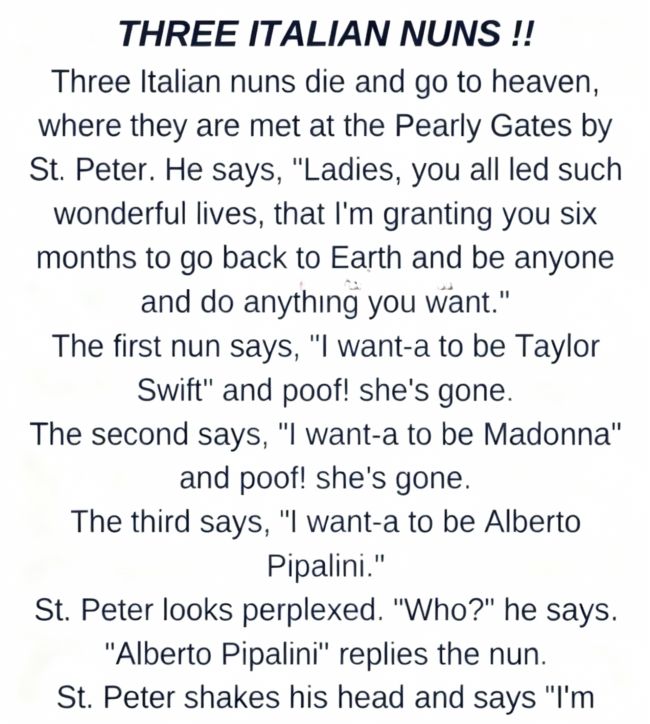
    At the Pearly Gates, an ethereal tableau of swirling white clouds and light so pure it seemed to hum, three Italian nuns arrived together, their faithful, disciplined lives complete. Sister Maria, Sister Angelina, and Sister Chiara stood before St. Peter, their simple habits a stark contrast to the dazzling brilliance of the celestial entrance. St. Peter, robust and smiling, welcomed them with a warmth that felt like an embrace. He consulted a list that shimmered with divine light, checking their names against a record of humility, compassion, and tireless service.

    “Sisters,” St. Peter announced, his voice carrying the gentle weight of eons, “you have fulfilled your vows with distinction. Your lives were a testament to sacrifice and devotion. As your reward, Heaven offers you a rare and special reprieve. You may return to Earth for six months, not in your accustomed roles, but as a chance for pure, uninhibited fun. You may be anyone you wish, doing anything you choose.”

    The nuns exchanged looks of profound astonishment. A lifetime defined by rigid adherence to the Divine Office, quiet routines, and the constant discipline of renunciation had suddenly been replaced by the possibility of absolute, glorious freedom. Their eyes, accustomed to the solemn quiet of the convent chapel, now sparkled like children promised a fantastical adventure past their bedtime.

    Sister Maria, usually the most reserved, was the first to step forward. A thrill of almost-forbidden excitement ran through her. She imagined the dazzling spectacle of the modern world, the sheer, electrifying power of commanding attention. “I would-a like to be Taylor Swift,” she declared, her voice imbued with a new sense of aspiration. She envisioned standing beneath stadium lights, a microphone clutched in her hand, singing songs that moved millions and made complex human emotions feel understood and celebrated. She dreamed of glitter, energy, and the kind of connection that transcended language. With a gentle poof, accompanied by a faint echo of synthesized pop music, Sister Maria vanished, presumably already rehearsing choreography.

    The second nun, Sister Angelina, followed with characteristic confidence. She had always been the most creative and intellectually daring of the three, often pushing the boundaries of the convent garden designs and organizing the more ambitious charity drives. “I want-a to be Madonna,” she announced with firm conviction. She dreamed of a life dedicated to bold artistic reinvention, fearless confrontation of cultural norms, and the kind of groundbreaking creativity that shapes generations. She yearned for the platform to be controversial, celebrated, and utterly in control of her own narrative. Another swift poof, accompanied by a flicker of avant-garde visual artistry, and Sister Angelina was gone, off to craft her new, temporary persona.

    St. Peter smiled, nodding approvingly at the magnitude of their dreams. He had seen countless souls choose fame and influence. He then turned his attention to the third nun, Sister Chiara. She stood quietly, her hands folded exactly as they had been in prayer for decades, wearing a peaceful, deep-set smile that suggested she was contemplating something far beyond the reach of spotlights and platinum records.

    “And you, Sister Chiara?” St. Peter asked gently. “You have seen your sisters choose the brightest stars of Earth. What extraordinary life calls to you?”

    “I want-a to be Alberto Pipalini,” the third nun said softly, the name possessing a quiet, almost unassuming resonance.

    St. Peter blinked once, then twice. He furrowed his brow, momentarily thrown off his celestial game. He flipped rapidly through the gleaming records, checked the heavenly databases reserved for artists, leaders, and global influencers, and then scratched his beard in confusion.

    “I’m sorry, sister,” he said, his tone gentle but puzzled. “I truly do not recognize that name. Is he a celebrated singer? An acclaimed artist? A major world leader or philanthropist whose good works resonated across continents?”

    Sister Chiara’s smile grew wider, turning into a look of profound, secret satisfaction. With the easy confidence of someone who knows they hold the answer to a riddle, she calmly reached into the pocket of her habit—a mysterious relic she had somehow managed to carry past the gates—and pulled out a small, dog-eared newspaper clipping. She carefully unfolded the piece of paper and pointed a slender finger to a humble headline printed in bold, unassuming type.

    The headline read: ‘Local Man Alberto Pipalini Named Happiest Person Alive.’

    The accompanying article was remarkably detailed, explaining that Alberto Pipalini was known not for any grand public achievement, global fame, or massive personal fortune. Instead, he was celebrated in his tiny Italian town for the quiet, enduring success of his simple life. He ran a small, generations-old family business that sold artisanal bread. He was known for laughing often and easily, for having an unwavering capacity for gratitude, for consistently helping his neighbors without seeking recognition, and, crucially, for the simple fact that he never, ever took life—or himself—too seriously. His fun lay in contentment.

    St. Peter looked from the small clipping to the peaceful face of Sister Chiara, and then he burst into laughter. It was a deep, joyful, booming sound that echoed through the vast halls of the Pearly Gates, momentarily silencing the quiet chorus of the angels.

    “Sister Chiara,” St. Peter said, wiping a tear of celestial mirth from his eye. “You know, after everything I have witnessed here—all the ambition, the power, the striving for earthly glory—that might just be the wisest choice any soul has ever made.”

    With a final, loving wave of his hand, poof, the third nun vanished as well, destined not for the dazzling stage or the controversial art scene, but for the profound, unheralded joy of a simple, fully lived life.

    As the gates closed, settling back into their magnificent, quiet rotation, St. Peter paused to add a new, important note to the glowing ledger of Heaven’s collected wisdom. He wrote: True happiness isn’t always about being famous or powerful—it is about choosing joy, gratitude, and balance, and finding contentment exactly where you are.

    And somewhere down on Earth, three former Italian nuns were beginning their grand, six-month reprieve, each learning that while fun can indeed come in the loud, electrifying form of a superstar, enduring joy and profound contentment are the real, quiet miracles.

  • SOTD – What a Womans Legs Can Tell You About Her! Style and Stature

    SOTD – What a Womans Legs Can Tell You About Her! Style and Stature

    It is tempting to view the legs through a purely functional lens, acknowledging them solely as the essential tools for movement—walking, running, climbing stairs, and standing. However, in the expansive world of style commentary, fitness culture, and casual observation, the shape and posture of a woman’s legs frequently transcend mere utility. They are often interpreted, playfully and non-scientifically, as subtle clues about an individual’s posture, inherent anatomical structure, and even their approach to personal presentation and lifestyle. From the meticulously photographed stance of runway models to the dynamic physique of gym enthusiasts, leg shape has quietly influenced everything from the cut of tailored trousers to the type of exercise regimen an individual embraces. While these interpretations exist more in the realm of cultural curiosity than rigorous analysis, they hold widespread appeal because the legs naturally articulate the body’s fundamental structure and strength in a way that makes every person’s silhouette uniquely distinct. Therefore, rather than engaging in judgment, this exploration serves as a lighthearted, anthropological look at how diverse anatomical forms can be connected—through culture and imagination—to differing approaches to style, movement, and self-expression.

    The Foundation: Anatomy, Genetics, and Natural Diversity

    Many of the common leg shapes frequently discussed and categorized in popular culture are, at their heart, straightforward expressions of natural human anatomy. The fundamental structure of the skeletal system—specifically genetics, bone length, pelvic width, and the angle of the hip and knee joints—determines the individual silhouette. Whether the legs meet neatly at the knees, the thighs, or the ankles is a matter of congenital disposition, and each variation is far more normal, common, and healthy than superficial beauty standards often imply.

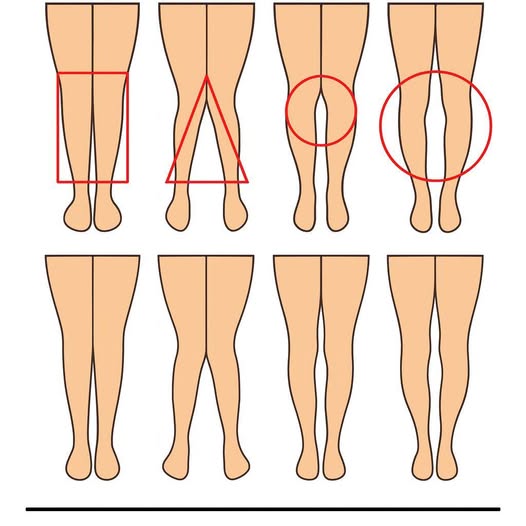
    For example, the look of straight, parallel legs is frequently admired for its appearance of balanced and symmetrical alignment. Conversely, the shape often referred to as the “diamond gap” is simply a reflection of the natural spacing required for the femur and tibia joints, a structural necessity that countless people possess without ever giving it a second thought. Even the heavily scrutinized “thigh gap,” often erroneously chased through extreme diet and exercise, is primarily determined by the width and tilt of the pelvis. Experts and medical professionals universally stress that the presence or absence of a thigh gap is not a measure of physical fitness or health; it is a genetically influenced trait that is neither universal nor necessary for a healthy body.

    Other structural variations, such as mild bowing (genu varum) or inward angling (genu valgum, or “knock-knees”), are expressions of joint positioning that can subtly but significantly influence how an individual walks, stands, distributes their body weight, and experiences stability. These structural differences affect an individual’s gait, or manner of walking, influencing how they carry themselves through the world.

    Style Interpretations and Lifestyle Associations

    Because these structural anatomical differences affect movement patterns and overall posture, popular culture often extrapolates them, linking certain leg shapes to perceived personality traits, gait characteristics, or lifestyle choices in a fun, non-serious context.

    • Straight, Parallel Legs: This shape is sometimes associated with a naturally grounded posture, suggesting a stable presence and an ease of movement. Culturally, it might be interpreted as indicating confidence or a preference for disciplined movement.
    • Inward Angling (Knock-Knees): This joint alignment may result in a softer, more relaxed, or sometimes seemingly less-assured movement pattern. In fashion, it might lead to a preference for flowing fabrics or wide-leg silhouettes that minimize visual focus on the joint alignment.
    • Natural Curvature/Bowing: Legs with a natural outward curvature might be associated with a more energetic, purposeful stride, possibly suggesting an active or athletic lifestyle focused on activities that build outward muscle mass.

    It is crucial to re-emphasize that these interpretations are not medical facts, nor are they psychological indicators. They are cultural observations that blend visible anatomy with social imagination. They become relevant primarily in two specific areas: fashion and fitness.

    In Fashion, leg shape often subtly influences clothing choices. For individuals with more pronounced curvature or angling, there might be a preference for:

    • Wide-leg pants or trousers: These silhouettes offer a clean, uninterrupted vertical line, regardless of underlying bone structure.
    • A-line skirts and dresses: These pieces highlight the flow of movement rather than structural alignment.
    • Athletic or performance wear: Pieces that prioritize comfort and function often fit and flatter diverse shapes equally.

    In Fitness, leg shape can sometimes reflect the preferred activities an individual engages in, which sculpt different types of muscle tone and definition.

    • Cycling or High-Intensity Interval Training (HIIT): These activities tend to build powerful, defined quadriceps and hamstring muscles, leading to greater overall mass.
    • Yoga or Pilates: These practices emphasize length, core stability, and deep muscle engagement, often leading to a more streamlined appearance.
    • Running (particularly long-distance): This generally promotes leaner, more endurance-focused muscle development.

    Regardless of the activity, the underlying bone structure sets the definitive boundaries for shape; fitness routines may enhance strength, endurance, or muscle definition, but they rarely, if ever, change the foundational skeletal alignment.

    The True Verdict: Celebration of Diversity

    Ultimately, the shape of a woman’s legs is not, and should never be considered, a verdict on her beauty, health, or worth. It is simply one of the countless ways the beautiful diversity of the human body expresses itself. The vast majority of variations observed in public and online are harmless, natural, and profoundly influenced by genetic destiny.

    While culture will inevitably continue to attach fleeting personality traits or style trends to different physical shapes, the most meaningful takeaway is that the human body carries its own unique, highly personalized blueprint. It is a structure built to move, support, and adapt to the world in unique ways dictated by billions of years of evolution and a specific genetic code.

    Appreciating this biological diversity forces us to shift focus away from superficial symmetry or fleeting beauty ideals. What legs truly “say” is that strength, balance, comfort, and the ability to move freely matter infinitely more than achieving a specific geometric shape. True confidence comes from moving through the world comfortably in the body one was given, celebrating the fact that every single body is capable, distinct, and perfectly engineered for its own unique existence.

  • UPDATE – The 9-year-old little girl left house for her school, but she never cam! See more

    UPDATE – The 9-year-old little girl left house for her school, but she never cam! See more

    A wave of profound grief and disbelief has swept through a local community following a heartbreaking tragedy: the sudden passing of a 14-year-old girl while she was engaged in a routine activity that countless people undertake every day without a second thought. What began as an ordinary morning, defined by the familiar rhythm of school preparation and routine, quickly devolved into an unimaginable loss, as the young teenager’s vibrant life was cut short in a manner no one could have possibly foreseen. The devastating circumstances surrounding her death serve as a sobering, painful reminder that even the most common, taken-for-granted routines can sometimes carry an unexpected and fatal risk.

    The young girl, described universally by her family and friends as a bright, vibrant, and loving spirit, was a source of light and energy to everyone who knew her. Her laughter was infectious, her curiosity boundless, and her presence was a constant source of joy. At just 14 years old, she stood on the precipice of adulthood, beginning the exciting and formative journey of self-discovery. She was actively exploring her interests, enjoying the simple pleasures of music and friendship, and cultivating big, ambitious dreams for her future. She was, in the words of her closest relatives, a girl full of life, whose immense potential was only just beginning to unfold.

    Her sudden, senseless death has left her family utterly reeling, trapped in a relentless cycle of shock and grief. The struggle to comprehend how someone so young could be taken away with such terrifying abruptness is a burden that has been acutely felt by every member of her extended circle. Her absence is a palpable void in the home that was once filled with her energy.

    The devastation extends far beyond her immediate family. Her classmates and teachers at school are equally heartbroken, remembering her as an exemplary student known for her cheerful disposition and eagerness to help others. She was a curious learner, always engaged in classroom discussions, and a reliable friend on the playground. Her seat in the classroom now stands empty, a visible symbol of the loss to her peer group and the entire school environment. Counselors and support staff have been brought in to help students and faculty navigate the complex and confusing trauma of losing a classmate and friend under such shocking circumstances.

    The tragedy has done more than simply shake the foundation of her family and school; it has sent a ripple of heightened awareness through the wider community about the very real, yet often ignored, dangers that can lurk within ordinary routines. The fact that something so unremarkable—an activity so ingrained in the daily lives of millions—could turn fatal has prompted widespread disbelief and a collective desire for answers. As a result, conversations are already beginning among parents, school officials, and local authorities about preventative measures, aiming to understand the specifics of what happened and seeking ways to safeguard against similar incidents in the future. The community is now wrestling with the difficult question of how to reconcile the necessity of daily life with the unforeseen risks it occasionally presents.

    While the investigation into the exact sequence of events that led to the passing is ongoing, and a full explanation remains forthcoming, the focus for those closest to her remains anchored in remembrance. More important than the tragic details of her final moments is the lasting, indelible memory of a girl who was profoundly loved, whose kind heart touched many, and whose presence made a powerful, enduring impact in her short time on Earth. She will be remembered not for the way she died, but for the vibrant, joyful way she lived.

    (Note: The original text intentionally withheld the specific cause of death, suggesting a follow-up piece. This rephrased version maintains that journalistic structure by focusing on the emotional impact, the unexpected nature of the incident, and the community response, without fabricating the missing details.)

  • SOTD – At Almost 103, He is the Oldest Living Star See below!

    SOTD – At Almost 103, He is the Oldest Living Star See below!

    They are figures who, by the sheer measure of time, should belong exclusively to history books. Yet, here in 2025, Hollywood’s oldest living legends continue to stand firmly in the present, quietly but powerfully rewriting the rules of time, aging, and relevance. These are the names we grew up with, the faces we associate with cinematic history, who are not merely surviving, but actively working, mentoring, and remembering. Their continued presence is a phenomenon that defies belief, challenging our cultural notions of retirement and vitality. Behind every smile and every interview lie decades of untold personal battles, the loss of cherished friends and colleagues, and the burning desire to complete unfinished dreams.

    The resilience of these icons is truly stunning. Their commitment is not just to longevity, but to sustained contribution, ensuring that their immense personal and artistic legacies are not simply archived, but kept alive and resonant.

    The story of the oldest among them is often the most astonishing. At 103, the musician and bandleader Ray Anthony embodies the enduring spirit of American romance and swagger. Anthony remains the living soul of the Big Band era, the swing and brassy confidence of a time that once defined American leisure and aspiration. His life spans the entire evolution of American popular music, and his continued vitality at an age few reach is a testament to the power of a life lived in rhythm.

    Also among the oldest and most extraordinary is Elizabeth Waldo, born in 1918. While perhaps less recognized by modern audiences than her film star peers, Waldo’s contribution is monumental. She has dedicated a lifetime to ethnomusicology, tirelessly traversing continents to rescue indigenous music and ancient melodies from oblivion. Her work is a profoundly moving act of turning fragile memory into vibrant, recorded melody, ensuring that cultures and sounds that might have vanished are preserved for perpetuity.

    Karen Marsh Doll carries a different, yet equally vital, piece of history. Her life acts as the last living thread to Hollywood’s revered Golden Age. Doll is a bridge from the iconic, demanding studio sets of The Wizard of Oz and Gone with the Wind—a system characterized by structure and unrelenting glamour—to a modern cinematic world that barely resembles its origins. Her memories are a living archive, offering invaluable, first-hand accounts of the industry’s most mythical era.

    Around these incredible centenarians, a magnificent constellation of enduring icons continues to shine, proving that talent, warmth, and wit can easily outlast decades. These figures, all pushing or exceeding ninety years of age, continue to hold a massive cultural footprint:

    • June Lockhart, Eva Marie Saint, and Dick Van Dyke remain symbols of enduring warmth and wit. Van Dyke, in particular, continues to charm audiences with his effervescent spirit, his career a powerful reminder that joyous energy is timeless.
    • The creators and comedians, Mel Brooks and William Shatner, still actively generate content, mentor younger artists, and step into the public light with undiminished vigor and sharp humor. Brooks’ continued involvement in theatrical adaptations of his work, and Shatner’s philosophical explorations of life, demonstrate their refusal to accept a passive retirement.
    • The international sex symbol of the 1960s, Barbara Eden, remains a picture of elegance and enduring appeal, showing that an iconic presence can maintain its luster decades after the original magic carpet ride.

    Other giants of the cinematic arts demonstrate that artistry does not fade or retire; it simply evolves, deepening with experience and perspective:

    • Clint Eastwood, Sophia Loren, and Michael Caine continue to defy expectations. Eastwood, not content with his iconic acting roles, has spent the past two decades focusing on a masterful directorial career, refining a style of filmmaking that is spare, profound, and deeply human. Loren and Caine, both international treasures, still accept challenging roles, proving that the screen presence cultivated over fifty years remains an invaluable asset to modern storytelling.

    Finally, figures such as Julie Andrews, Shirley MacLaine, Al Pacino, and Jane Fonda demonstrate that relevance is not a matter of chronological age, but of continuous courage and engagement.

    • Jane Fonda, in particular, has carried her lifelong commitment to activism and her rigorous craft into a restless 21st century. She is a constant, visible presence on current social and political battlegrounds, showing younger generations that powerful advocacy is compatible with a successful, decades-spanning career.
    • Julie Andrews and Al Pacino remain vital cultural commentators, beloved actors, and influential voices in their respective fields, demonstrating that the integrity of one’s craft speaks louder than any arbitrary age limit.

    The collective presence of these legends serves as a living, breathing archive of 20th-century entertainment, offering a direct, unbroken line to the foundational moments of modern culture. They represent a wealth of experience, accumulated knowledge, and masterful technique that can never be replicated.

    Ultimately, these stars are more than just celebrities; they are a profound challenge to anyone who believes that time has the final, definitive word on relevance, productivity, or passion. Their sustained careers force a re-evaluation of what constitutes ‘old age’ in the arts, proving that the desire to create, to connect, and to contribute is an innate human drive that, with resilience and good fortune, can burn brightly into the second century of life.

  • SAD NEWS!!20 Minutes ago in Chicago, Michelle Obama was confirmed as! See more

    SAD NEWS!!20 Minutes ago in Chicago, Michelle Obama was confirmed as! See more

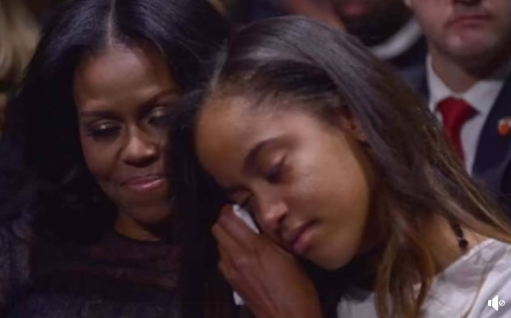
    A palpable wave of political and cultural suspense swept through the nation twenty minutes ago, following reports of a major, yet undisclosed, announcement delivered by former First Lady Michelle Obama at the Obama Presidential Center in Chicago. The news, emanating from the heart of her political and personal roots, has sent immediate shockwaves, triggering intense speculation across media platforms, especially given the Center’s proximity to its scheduled 2026 opening and Mrs. Obama’s influential, though non-traditional, role in American public life.

    This event is not occurring in a political vacuum. Michelle Obama remains one of the most broadly respected and admired public figures in the world, transcending partisan lines due to her authenticity, her emphasis on health and education initiatives, and her candid memoir, Becoming. Despite her extraordinary star power, she has consistently and unequivocally rejected the perennial calls for her to pursue a presidential campaign.1 As recently as March 2025, she reiterated her definitive stance on political ambition, calling the idea of a presidential run “unthinkable” and citing a strong desire to protect her daughters from the intense scrutiny that accompanies public office.2 Her public statements have repeatedly served as a firm firewall against electoral speculation.

    Therefore, the nature of this “major, yet undisclosed announcement” is almost certainly focused not on a sudden political pivot, but on a significant new philanthropic endeavor, a major strategic shift for the Obama Foundation, or a critical update related to the Obama Presidential Center itself. Given the venue—a sprawling, 19.3-acre South Side Chicago campus that is rapidly nearing completion—the latter possibility is the most probable and impactful.

    The True Momentum: The Obama Presidential Center

    The Obama Presidential Center (OPC) is scheduled to open its doors in June 2026, marking a pivotal moment for the community and for the preservation of the Obama legacy.3 The Center is more than a traditional library; it is designed as a dynamic hub for civic engagement, athletic activity, and community revitalization in Jackson Park, where Mrs.4 Obama grew up. The progress of the OPC has been the primary focus of the Obama Foundation in 2025:

    • Construction Milestones: As of late 2025, construction crews have been working tirelessly on all components of the campus.5 The Museum Building, a distinctive granite-clad tower designed to look like four hands coming together, is nearing exterior completion, with granite and glass installations progressing steadily.6
    • Community Hubs: Key ancillary buildings are taking shape.7 This includes the new branch of the Chicago Public Library, which will house a reading room curated by the Obamas, and the Home Court athletic facility, a 45,000 square-foot space featuring an NBA-regulation basketball court and seven program rooms for community workshops.8
    • Outdoor and Cultural Spaces: Significant effort is being dedicated to the outdoor areas, which include the Eleanor Roosevelt Fruit and Vegetable Garden (inspired by Michelle Obama’s White House garden), the Women’s Garden, the Wetland Walk, and a fully inclusive playground.9 Furthermore, in September 2025, the Foundation announced the commissioning of ten artists for nine site-specific works across the campus.10

    It is highly likely that Mrs. Obama’s announcement concerns a crucial development in the Center’s operational future or its programmatic scope, perhaps the unveiling of a flagship community initiative or the specifics of the Center’s inaugural year exhibits. Given the timing, an announcement regarding a major capital campaign completion, the definitive timeline for the final phase of construction, or the naming of a key partnership for the Home Court facility are all within the realm of possibility.

    The Enduring Political Speculation

    Despite the consistent evidence pointing away from a direct political run, the perpetual rumors reflect Michelle Obama’s immense cultural power. The political world views her as a “superstar” due to her high approval ratings and broad demographic appeal, particularly in moments when there is perceived uncertainty within the Democratic party’s leadership.11

    However, Mrs. Obama’s decision to remain active in public life while avoiding the electoral arena is a carefully maintained strategy. She, alongside President Obama, has actively campaigned for candidates they support, most recently endorsing the Harris-Walz ticket, but she has maintained clear boundaries around her personal political involvement. Her focus is firmly on leveraging her influence through her books, media projects, and, most importantly, the philanthropic mission of the Obama Foundation, which seeks to inspire and support the next generation of leaders. The Chicago announcement, regardless of its specific content, is a reaffirmation of her commitment to this mission, which she launched from the South Side neighborhood where she was raised.

    Ultimately, while the media buzz around the “undisclosed announcement” may feed the persistent, hopeful speculation of a surprise entry into politics, the factual evidence points toward a significant development related to the monumental civic project she and her husband are building. The real news is not that she is running for office, but that her commitment to the community and the Center is reaching a new, critical phase.

    You can learn more about the early days of the Obama Presidential Center in Chicago. Barack and Michelle Obama attend groundbreaking ceremony for Obama Presidential Center is a video of the groundbreaking ceremony for the Obama Presidential Center.