Category: News

  • Congress Preparing To Debate Crime Bill Amid Trumps DC Crackdown!

    Congress Preparing To Debate Crime Bill Amid Trumps DC Crackdown!

    As the humidity of summer begins to fade from the nation’s capital, the political temperature is rapidly rising. Washington D.C., a city that serves as both the seat of global power and a local municipality for nearly 700,000 residents, is poised to become the epicenter of a fierce legislative struggle. President Donald Trump, advancing into the heart of his administration’s second-term agenda, is preparing to launch a comprehensive crime bill aimed specifically at the District of Columbia. This move signals a distinct shift from rhetorical criticism of “blue cities” to direct federal intervention, setting the stage for a high-stakes confrontation with Congress upon their return after Labor Day.

    The genesis of this upcoming legislative package lies in the administration’s stated goal to transform Washington D.C. into a “beacon” of safety and order. For years, Republicans have pointed to crime rates in the capital as a symptom of failed Democratic governance. Now, with the levers of executive power firmly in hand, the White House is moving to operationalize that critique. On Wednesday, President Trump indicated that a legislative proposal is imminent, designed to serve as a model for urban renewal across the country. While the President offered limited specifics regarding the minutiae of the bill, he emphasized that the initial focus would be squarely on the District, describing the funding request as a “relatively small amount of money” intended to repair infrastructure, clean up the streets, and aggressively combat crime.

    The political machinery behind this initiative is already in motion, involving high-profile allies in both the Senate and the Department of Justice. Senator Lindsey Graham of South Carolina has emerged as a primary architect of the legislative strategy. Following discussions with the President, White House staff, and Attorney General Pam Bondi, Graham outlined a dual-pronged approach: securing federal funding and reinforcing federal authority. He indicated that the White House is crafting a package to be delivered to him and Senator Katie Britt of Alabama. Britt’s role is pivotal; as the chair of the Homeland Security appropriations subcommittee, she holds the keys to the federal purse strings necessary to finance the “D.C. Security Fund.”

    Senator Graham’s public comments on the platform X (formerly Twitter) underscore the ambitious scope of the project. “Together, we will try to shepherd the D.C. Security Fund through Congress to give President Trump the resources he will need to improve the safety and quality of life in our nation’s capital,” Graham stated. He framed the initiative not merely as a policy adjustment, but as a patriotic imperative, arguing that every American has a stake in ensuring Washington becomes a “shining city on a hill.” This rhetoric suggests that the administration views the D.C. crime bill as a symbolic victory—a proof of concept that conservative policing policies can succeed in deep-blue territory.

    Attorney General Pam Bondi has reinforced this message, signaling that the Department of Justice will take an active, hands-on role in the District’s law enforcement operations. In a statement to Fox News Digital, Bondi confirmed that the DOJ is working in concert with the Metropolitan Police Department (MPD), federal law enforcement agencies, and Congress. Her objective is to “address the scourge of violent crime” and ensure safety for both residents and visitors. This collaboration points to a significant tightening of the relationship between federal prosecutors and local police, a dynamic that has historically been fraught with tension in the District.

    However, the path to passing this legislation is fraught with procedural and political landmines. The timing of the proposal is critical. Congress is currently in recess and is not scheduled to reconvene until after Labor Day. When lawmakers return, they will immediately be confronted with a hard deadline: September 30, the end of the fiscal year. To avoid a government shutdown, Congress must pass a spending bill. It remains unclear whether the Trump administration will attempt to fold the D.C. crime package into this must-pass spending bill or introduce it as a standalone supplemental funding measure. Attaching it to the budget would raise the stakes considerably, potentially daring Democrats to shut down the government over the issue of D.C. autonomy.

    The most contentious aspect of the upcoming debate revolves around the President’s authority over the D.C. police force. Currently, President Trump is operating under a temporary expansion of power that grants him direct control over the MPD—an authority that is time-limited to 30 days. To maintain this level of control, the President requires Congress to pass a joint resolution granting an extension. Without this legislative approval, the emergency powers will lapse, returning operational control fully to local officials. This deadline creates a pressure cooker environment for the September session.

    While Republicans are largely united in their support for extending the President’s authority, citing the need for decisive action against crime, the Democratic opposition is expected to be fierce. For Democrats, this is not just a debate about crime statistics; it is a fundamental issue of Home Rule and local democracy. The District of Columbia has fought for decades to maintain autonomy over its local affairs. Ceding control of the police force to the White House is viewed by many D.C. leaders and Democratic lawmakers as a hostile federal takeover and a dangerous precedent.

    The legislative math in the Senate presents a formidable hurdle for the administration. While the House may pass the measure, the Senate requires 60 votes to overcome a filibuster on a joint resolution. President Trump expressed optimism, predicting that Republicans would support the measure “almost unanimously,” but he acknowledged the partisan divide, stating, “We think the Democrats will not do anything to stop crime.” This framing suggests that the White House is prepared to use the vote as a political cudgel in the midterms, portraying any opposition to the bill as opposition to law and order itself.

    Insiders suggest that Democrats are unlikely to provide the necessary votes to reach the 60-vote threshold to tighten Trump’s grip on the capital. They argue that public safety can be achieved without stripping the District of its self-governance. Consequently, the negotiation may shift toward the “D.C. Security Fund”—the financial component of the plan. Democrats might be more amenable to federal dollars flowing into the city for infrastructure and officer recruitment, provided it does not come with strings attached that permanently erode local authority.

    As September approaches, Washington is bracing for a collision between executive ambition and legislative reality. The debate will likely transcend the specific details of street repairs or police funding, evolving into a broader argument about federalism, the rights of D.C. residents, and the divergent visions of urban governance held by the two parties. President Trump has staked significant political capital on his ability to “fix” Washington. Whether he can translate that ambition into law through a divided Congress remains one of the most significant uncertainties of the coming political season. The outcome will determine not only the future of policing in the capital but also the extent to which the federal government can intervene in the affairs of America’s cities.

  • Why a Jar of Pickles Became an Unforgettable Memory!

    Why a Jar of Pickles Became an Unforgettable Memory!

    It started on an ordinary evening, the kind where nothing feels particularly special until life decides to hand you a moment you’ll carry forever. My wife was deep into her pregnancy, and anyone who has lived through that phase knows how unpredictable cravings can be. They appear out of nowhere, hit with the subtlety of a freight train, and suddenly the entire universe revolves around satisfying them. That night, her world locked onto one very specific target: McDonald’s pickles.

    Not the burgers, not the fries—just the pickles. The craving was so strong and so oddly specific that she looked at me with the kind of seriousness usually reserved for medical emergencies. I didn’t question it. When a pregnant woman needs something, you don’t negotiate. You mobilize. So I grabbed my keys and headed out, determined to bring back whatever her heart—and hormones—desired.

    The nearest McDonald’s wasn’t far, but the entire ride over felt like a mission. What if they were out of pickles? What if they refused? What if I walked back into the house empty-handed while she sat there imagining the exact taste of those briny slices? That wasn’t a scenario I was willing to face.

    When I walked in, the place was quiet, the way fast-food restaurants get late in the evening—just a few customers, the hiss of the fryer, and tired employees waiting for the clock to run out. I stepped up to the counter and asked the cashier, as politely and straightforwardly as possible, if I could buy a container of just their pickles.

    She looked at me like she wasn’t sure she had heard correctly. Then she apologized and said they couldn’t sell pickles on their own. Company policy.

    Most people would’ve accepted that answer. But I had a pregnant woman at home whose entire emotional stability was, at that moment, tied directly to the existence of McDonald’s pickles. I couldn’t walk out without trying everything. So I leaned in a bit, half-joking, half-desperate, and said, “Alright then. Give me one hundred hamburgers with extra pickles, and hold everything except the pickles.”

    The cashier blinked, froze, then looked toward the kitchen like she needed backup. She disappeared to find the manager, probably assuming I had either lost my mind or was trying to pull some kind of stunt.

    A moment later, the manager came out—a guy in his late thirties, the kind of person who looked like he had seen every possible type of customer and was hard to rattle. He asked what was going on, and I explained the situation in the simplest, most honest way possible: “My wife is pregnant, she’s having a serious craving, and she specifically wants McDonald’s pickles. I’m just trying not to go home empty-handed.”

    He didn’t laugh. He didn’t brush me off. He didn’t give me a corporate line about what the register allowed or what the rules said. He just paused, took a slow breath, and nodded like a man who understood exactly what was at stake. Then he told me to wait for a minute and walked into the back.

    I stood there, trying to guess how this was about to play out. Was he rejecting the request politely? Calling security? Preparing one hundred deconstructed hamburgers? After a few minutes, he returned—and in his hands was a large plastic container filled to the brim with fresh McDonald’s pickles.

    He handed it to me and said, “Take these to your wife. No charge.”

    No charge. No paperwork. No judgment. Just pure, simple kindness.

    I thanked him repeatedly, probably more times than necessary, then carried that container out the door like it was some rare treasure. When I got home, my wife’s face lit up with an expression I can’t fully describe—something between gratitude, amusement, and absolute relief. She opened the container immediately, and the joy that washed over her was so pure it felt infectious. It wasn’t about the pickles themselves, not really. It was about the feeling of being seen, supported, and loved at a time when her emotions were all over the place.

    We sat together that night while she happily snacked on those pickles straight from the bucket. And somewhere between her laughter and the crunch of those briny slices, I realized the moment had become something bigger than a craving.

    It became a reminder—a simple, honest reminder—of what it means to love someone enough to go out into the night to get what they need, even if it seems ridiculous. It was a reminder of how much small acts of understanding can mean, especially when life feels chaotic. And it was a reminder that strangers, even at the end of a long shift, can choose compassion in the most unexpected ways.

    The manager didn’t just bend a rule. He didn’t just hand me a bucket of pickles. He created a memory—a story we’ll tell our child one day about how a craving, an awkward request, and a stranger’s kindness turned an ordinary night into something that stuck with us.

    That container of pickles lasted less than a week. The memory of that night will last forever.

  • These Bikers Threatened To Burn Down My Bakery Unless I Gave Them Everything I Had!

    These Bikers Threatened To Burn Down My Bakery Unless I Gave Them Everything I Had!

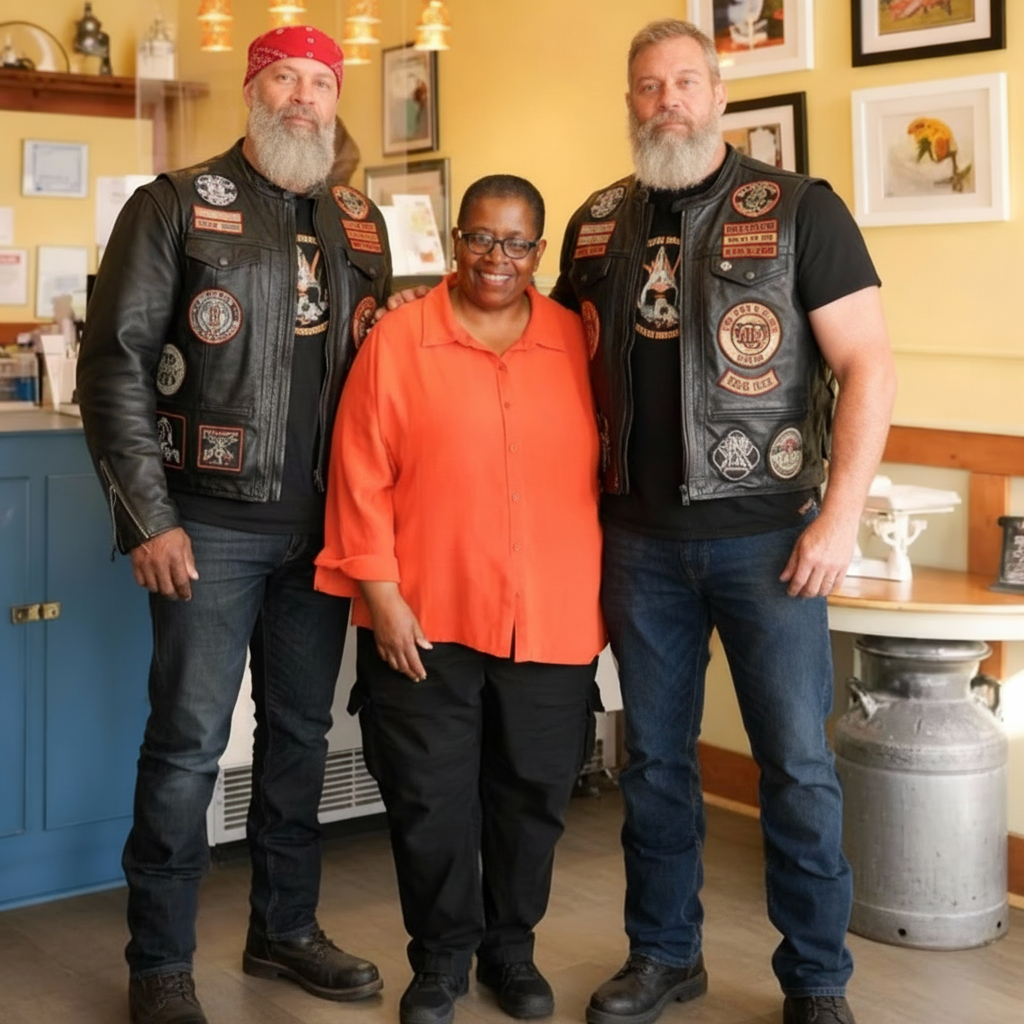
    The bikers threatened to burn down my bakery unless I handed over everything I had. That’s what I believed, anyway, the moment two enormous men stepped into Sweet Grace Bakery just as I was locking up for the night. It was a Tuesday, already long and exhausting. My last employee had left minutes earlier, and the quiet inside the shop felt fragile — until they shattered it.

    They were massive. Leather vests heavy with patches, long beards, the kind of faces that looked carved from hard roads and bad history. When the taller one reached behind him to lock the door, the click echoed like a warning.

    “We need to talk about your debt,” he said. No emotion. No warmth.

    My heart lurched.

    I’m Diane Foster, fifty-three, single mother, owner of this bakery for eight years. I named it after my daughter, Grace, who died of leukemia when she was just six. She used to talk about opening a bakery when she grew up — “a place that makes sad people smile,” she’d say. When she died, I nearly let myself fall apart. But her dream kept tugging at me. So I borrowed everything I could. Loans, credit cards, favors — anything. And Sweet Grace Bakery was born.

    For seven long years, I scraped by. Some months I couldn’t even pay myself, but the doors stayed open. Grace’s photo hung on the back wall, and every cake I made felt like a promise I was still keeping for her.

    Then six months ago the big oven died — the industrial one, the heart of the bakery. Replacing it would cost more money than I could dream of. The banks turned me down. Credit unions turned me down. My credit score looked like it had been through a war.

    That’s when I met Marcus.

    He found me at the bar down the street, bought me a drink, listened while I vented. He said he knew people who could help — “private lenders,” he called them. No credit check. Immediate cash. High interest, sure, but I was desperate.

    I signed without reading closely. He handed me $15,000. I fixed the oven. The bakery survived.

    But the loan came with a 40% interest rate — the kind of number you don’t recover from. Within months, my debt ballooned. I paid and paid, but the amount barely budged. And now, apparently, Marcus had sent these men after me.

    The shorter one stepped forward, red bandana tied around his head. “You’re three weeks behind,” he said, flipping open a folder. “Marcus doesn’t like when people fall behind.”

    My hands shook so badly I pressed them against the counter. “I have $400 in the register. Take it. Please. I’ll get you the rest.”

    “We don’t care about your $400,” the tall one said, drifting around the shop, studying everything — the glass display, the mixer, the framed photos of Grace.

    “Nice place,” he murmured. “You own it?”

    I swallowed. “Yes. Please… just don’t hurt me. Don’t hurt the bakery.”

    The man with the red bandana read from the folder. “Says here you borrowed fifteen grand. Paid back eight already. But because of Marcus’s rate, you still owe thirty-two.”

    My knees almost gave out.

    He looked up calmly. “You know that’s illegal, right? That interest rate?”

    Illegal? I blinked at him. Terror made it hard to think.

    The tall one stepped forward. “Marcus is a loan shark. He preys on small-business owners, single parents — people with nowhere else to go. Then he sends guys like us to collect.”

    My chest tightened. So this was it. The part where they broke my kneecaps or smashed my ovens.

    Except the shorter one closed the folder and said quietly, “But we don’t work for Marcus.”

    It took me a full second to understand.

    “What?”

    The tall man extended his hand. “Ma’am, I’m Thomas Crawford. This is my brother Robert. We’re with the Iron Brotherhood Motorcycle Club.”

    I stared at him, speechless.

    “We’re not here to hurt you,” Robert said. “We’re here to shut Marcus down.”

    I sank into a chair before my legs failed me completely.

    Thomas explained it slowly, carefully — like someone used to dealing with traumatized people. For months, they’d been posing as Marcus’s hired muscle. He trusted them, had no idea they were working with the police and the FBI. They’d been collecting evidence, recording conversations, documenting every illegal loan.

    And three hours earlier, the FBI had arrested Marcus at his home.

    “You’re safe now,” Thomas said. “You don’t owe Marcus a dime.”

    Robert added, “Legally, you might not owe anything at all. Worst case? You owe seven thousand — the remainder of what you actually borrowed. But the courts will deal with that at fair interest.”

    I broke. All the fear, exhaustion, and grief of the last six months came crashing out. I cried harder than I had in years.

    “Why help me?” I whispered.

    Thomas took out a worn wallet. Inside was the photo of a woman standing proudly in front of a small diner.

    “My sister,” he said. “She took a loan from a shark just like Marcus. Couldn’t pay. Lost everything. She was so ashamed and scared she ended her life.” He swallowed hard. “She left behind a fifteen-year-old boy. My nephew.”

    He looked at me, eyes tight with pain. “I swore I’d never let another person go through what she did. So this is what I do now. I hunt guys like Marcus.”

    Robert nodded. “We’re bikers, sure. But we’re not criminals. We’ve taken down twelve loan sharks in four states. Marcus is number thirteen.”

    I kept crying. “I thought you were here to kill me.”

    Thomas grimaced. “We had to act like we were. In case Marcus was watching. But you’re safe now.”

    Robert handed me a card — a lawyer who handled predatory lending cases pro bono. Thomas handed me another — a grant program for small business victims of illegal lending.

    I didn’t have words.

    They turned to leave, but I stopped them. I went to the display case and pulled out the last cake of the day — chocolate with buttercream, Grace’s favorite.

    “Please,” I said. “Take it. My daughter believed cake could make sad people smile.”

    Thomas’s eyes softened. “Thank you. We’ll eat it in memory of her — and of my sister.”

    After they left, I cried for an hour. But for the first time in months, my tears weren’t only fear — they were relief.

    The next morning, the bakery was barely open when twenty motorcycles rolled into the parking lot. Thomas stepped inside first.

    “We took a vote,” he said. “We’re making your bakery our Saturday stop.”

    One by one, twenty bikers ordered pastries and coffee. Each left a $100 bill. By 7 a.m., I had $2,000 — more than I usually made in a week.

    “This is too much,” I protested.

    “It’s payment,” Thomas said simply. “Best muffins around.”

    And they kept coming. Every Saturday. Sometimes fifteen bikes, sometimes thirty. They brought their families, then their friends. Business exploded.

    I paid off the remaining loan. The courts later erased it entirely. I won a $25,000 grant. I hired more staff. Expanded catering. The bakery flourished.

    Last month, on the anniversary of Grace’s death, I brought a memorial cake to the Iron Brotherhood clubhouse. Forty bikers stood at attention as I carried it in. Thomas announced, “This cake is for Grace, the girl who wanted to make sad people smile.”

    They all took a slice. And they all smiled.

    Later, Thomas pulled me aside. “Helping people like you… that’s how I honor my sister.”

    I hugged him. “You saved me,” I whispered. “You saved my daughter’s dream.”

    He wiped his eyes. “You saved us too, ma’am. More than you know.”

    Today, when the roar of motorcycles fills my street every Saturday morning, I don’t feel fear.

    I feel protected.
    I feel supported.
    I feel Grace.

    Those bikers didn’t come to burn down my bakery.

    They came to save it.

    And they saved me in the process.

  • A House Full of Memories! My Father Final Surprise

    A House Full of Memories! My Father Final Surprise

    The call came on a dull, gray afternoon — the kind of day when everything feels heavier than it should. The lawyer’s voice was steady, practiced, the voice of a man who has done this too many times. But when I hung up, the silence in the room shifted. I sat there for a moment, letting the news settle: my father was gone.

    I told the lawyer I could meet him later that week. I didn’t expect much from the estate. We had never been wealthy, and I was his only child. I figured he left behind a small bank account, maybe a few personal belongings, nothing that would require more than a few signatures. I walked into the lawyer’s office prepared for something simple. Clean, procedural, forgettable.

    But then he opened the folder.

    He listed the usual items — a few accounts, some documents, instructions for cremation. I nodded along, not really thinking, just waiting for it to be over. And then he paused, looked up, and read a line that made me sit straighter.

    “As per his wishes,” the lawyer said, “your father’s house will be left to you.”

    I froze. The house? The old place I grew up in? The one I thought had been falling apart ever since he retired? I hadn’t been inside that house in years. We kept in touch, of course, but he always waved off my concerns. “Just a little dust,” he’d say. “Nothing worth worrying about.”

    I assumed he was downplaying how bad it had gotten. I assumed he didn’t want to burden me with repairs, decisions, or guilt.

    Then the lawyer told me the truth — the part my father had never shared.

    He had been fixing the house for years. Quietly. Patiently. Bit by bit. Every loose shutter. Every creaky floorboard. Every worn-out hinge. Every faded wall. All of it. He had repainted, repaired, and restored the place without ever calling attention to it. He didn’t brag. He didn’t update me. He didn’t ask for help. He simply took care of the house the way he had once taken care of me — quietly, without fanfare, wanting the end result to feel like a gift, not an obligation.

    Hearing this cracked something open in me. I had spent my whole life thinking love looked like grand gestures or emotional speeches. My father wasn’t a man of dramatic words. He expressed himself in small, consistent actions that I hadn’t fully appreciated until that moment.

    When I unlocked the front door for the first time since his passing, the air inside hit me like a memory I didn’t realize I had misplaced. The place looked… good. Better than I remembered. Clean. Solid. Familiar in a way that was comforting rather than sad.

    The garden he used to fuss over — the one I assumed was long dead — was blooming. He had kept it alive. The shelves were still lined with the books he reread every winter. The kitchen smelled faintly like the coffee he used to make before sunrise. The same walls I once thought were too small for me felt warm now, intentionally lived in.

    For the first time since he died, I felt him there. Not as an idea, not as a memory, but as a presence woven into the house itself.

    Over the next few weeks, I worked my way through his belongings. I dusted shelves, sorted mail, folded old jackets, and scrubbed tile grout he had probably already cleaned a dozen times. But I left some things untouched — the old mug he loved, the dented one with the chipped handle. The worn chair by the window where he always sat to read. The coat hanging by the door that still held the faintest trace of his cologne.

    Each task became a conversation with him. Each drawer I organized felt like discovering a new detail about a man I thought I knew completely. Repairing a loose cabinet hinge turned into a reminder of how many times he had done the same thing for me when I was a kid — fixing toys, tightening screws, repairing what I had broken.

    I kept coming back to one simple truth: this man had loved me in the only way he knew how. Not loudly. Not dramatically. But steadily. Consistently. And without ever asking for recognition.

    His final gift wasn’t a house. Not really. It was belonging. Stability. A place he had prepared piece by piece, year after year, in quiet anticipation of the day I might return. It was his way of telling me, “You’ll always have a home. You’ll always have a place to come back to.”

    He couldn’t give me wealth, or status, or the kind of inheritance that shows up on paper. He gave me something deeper — something you can’t put a price on.

    Sometimes love isn’t loud. Sometimes the grandest gestures are the quiet ones no one else ever sees. A repaired floorboard. A repainted wall. A garden kept alive. A house restored not for himself, but for the person he hoped would one day walk through the door and feel safe.

    Standing in the living room, surrounded by the life he left behind, I realized that goodbyes aren’t always final. They’re softened by what people choose to leave for us — not the objects themselves, but the intention behind them. My father didn’t leave me a property. He left me reassurance. He left me a reminder that I mattered to him more than he ever said out loud.

    His last gift was simple and immeasurable at the same time: “You’ll always have somewhere to return to.”

    I used to think inheritance meant money or valuables. Now I know better. The real inheritance is the love threaded through every corner of that house — a place where his presence still lingers, where every repaired crack and repainted surface says the same quiet thing:

    “I was thinking of you.”

  • Visible Veins Explained! Normal Causes, Health Risks, and When to Worry!

    Visible Veins Explained! Normal Causes, Health Risks, and When to Worry!

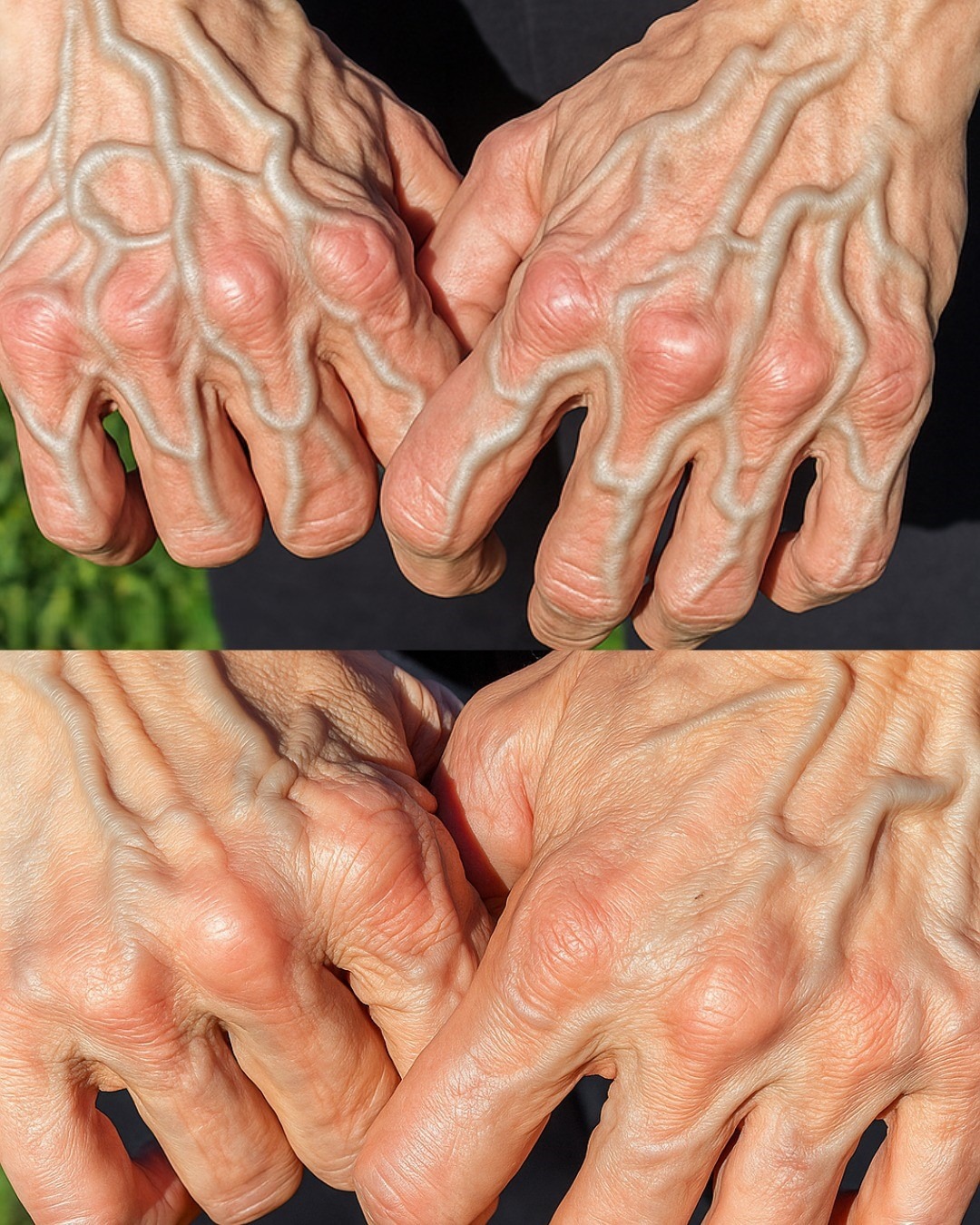
    Most people don’t think twice about the veins running under their skin—until one day they look down and realize those faint blue lines have suddenly become sharper, brighter, almost startlingly visible. For some, it’s a fleeting curiosity. For others, it sparks a very real worry: Is this normal, or is my body trying to tell me something?

    Visible veins can be completely harmless. They can also be early signals that something in your circulatory system isn’t working the way it should. Knowing the difference matters more than most people realize.

    Why Veins Become More Noticeable

    Veins are the low-pressure highways of the circulatory system. They carry blood back to the heart and sit relatively close to the surface. Because of that positioning—and the thinness of their walls—they respond to all sorts of internal and external changes. Age, temperature, hormones, body composition, hydration, and physical strain all play a role.

    In many cases, visible veins are nothing more than biology doing its job. In others, they’re early alarms you’d be smart not to dismiss.

    When Visible Veins Are Completely Normal

    There are a handful of everyday reasons your veins may suddenly look more pronounced. None of these are dangerous on their own.

    Low Body Fat
    The less fat between the skin and the veins, the easier it is to see the veins. This is why athletes, bodybuilders, or people who’ve recently lost weight often notice sharp, rope-like veins even when they’re perfectly healthy.

    Aging Skin
    Skin thins as we get older and loses elasticity. The fat layer beneath it also diminishes. As a result, veins that were once hidden now stand out clearly. It’s a natural part of aging—not a sign of disease.

    Exercise and Blood Flow
    When you exercise, your heart pumps harder and your blood vessels expand to handle the demand. This “vascular pump” effect is why bodybuilders look extra veiny during or after workouts. The more conditioned you are, the more often your veins may remain visible.

    Heat and Warm Weather
    Warm temperatures cause veins to widen so heat can dissipate more easily. Even standing in a hot shower can make arm or leg veins pop out temporarily.

    Genetics
    Some people are simply more veiny. If your parents have prominent veins, you probably will too—regardless of your fitness level or age.

    When Visible Veins May Point to a Problem

    If your veins suddenly become more visible and the change comes with discomfort, swelling, warmth, or color changes, pay attention. Certain circulatory conditions can hide behind what appears to be a simple cosmetic issue.

    Chronic Venous Insufficiency (CVI)
    When the valves inside your veins weaken, blood flows backward and pools in the legs. The result: swelling, heaviness, aching—and yes, large, bulging veins.

    Varicose Veins
    These are twisted, enlarged veins that often look raised and discolored. They may itch or throb. While common, they indicate that the vein is under stress and not functioning well.

    Superficial Thrombophlebitis
    A clot near the skin’s surface can inflame the vein, causing redness, heat, hardness, and pain. It’s usually not life-threatening but shouldn’t be ignored.

    Deep Vein Thrombosis (DVT)
    This is the serious one. A clot forms deep in the leg, often with sudden swelling, tenderness, warmth, and a feeling of tightness. If part of the clot breaks loose, it can trigger a pulmonary embolism. DVT is a medical emergency—no exceptions.

    Other Harmless Triggers You May Overlook

    A few temporary or lifestyle-driven changes can also make your veins stand out more dramatically:

    – Hormonal shifts (pregnancy, menstrual cycles, menopause)
    – Dehydration
    – Rapid weight loss
    – Intense strength training
    – High-stress days that alter circulation

    These aren’t dangerous, but if the change feels sudden or extreme, it’s still worth keeping an eye on.

    When You Should See a Doctor

    You don’t need to panic over visible veins. But you do need to be smart. Seek medical advice if:

    – The visibility appeared suddenly without explanation
    – The veins are painful, warm, swollen, or tender
    – You notice skin darkening, sores, or unexplained redness
    – One leg looks dramatically different from the other
    – You’re short of breath or experiencing chest pain (seek emergency care)

    The goal isn’t to scare yourself—it’s to avoid ignoring something that demands attention. Circulatory issues are often easier to treat early than late.

    Treatment Options If You Need Them

    Depending on what’s causing the visibility—or if you simply dislike how the veins look—there are plenty of ways to manage or improve the situation.

    Lifestyle Fixes
    – Stay active and avoid long periods of sitting or standing
    – Elevate your legs when resting
    – Maintain a healthy weight
    – Stay hydrated
    – Quit smoking (nicotine wreaks havoc on blood vessels)

    Compression Stockings
    These are simple but effective. They improve blood flow, reduce swelling, and lessen discomfort.

    Medical Procedures
    Modern vein treatments are minimally invasive and highly effective. Common options include:
    – Sclerotherapy (veins injected with a solution that shrinks them)
    – Laser therapy
    – Endovenous ablation
    – Surgical intervention for severe cases

    These treatments are not just cosmetic. If veins are malfunctioning, correcting them can dramatically improve comfort and circulation.

    The Emotional Side of Visible Veins

    Not all concerns are medical. For some people, visible veins can trigger insecurity or frustration. Athletes might see them as a badge of fitness. Others view them as aging’s unwelcome spotlight. Both reactions are valid.

    The key is understanding why the change is happening so you can address it with confidence—not fear.

    The Bottom Line

    Visible veins are usually harmless. Most of the time, they’re tied to things like fitness, aging, genetics, or temperature. But they can also be early warnings of circulation issues—things like venous insufficiency, blood clots, or valve problems.

    The smart approach is simple: know what’s normal for your body, pay attention to sudden changes, and don’t ignore symptoms that feel off. When in doubt, talk to a doctor. Your veins aren’t just cosmetic—they’re a real-time snapshot of how well your circulatory system is functioning.

    In short, don’t jump to fear, but don’t shrug off changes either. Learning what your veins are telling you is one of the simplest ways to protect your long-term health.

  • A SHOCKING SPLIT THAT NO ONE SAW COMING FROM TRUMP!

    A SHOCKING SPLIT THAT NO ONE SAW COMING FROM TRUMP!

    A shocking political fracture erupted today—one that even Donald Trump’s closest loyalists didn’t see coming. After years of projecting absolute unity within his inner circle, a split has finally surfaced, and it’s not the kind of minor disagreement that gets patched over in a press release. This is the sort of rupture that shifts political gravity, leaving every strategist, pundit, and party insider scrambling to understand what it means for the months ahead.

    The first signs appeared quietly, the way major political earthquakes usually do. A rumor slipped out of a closed-door meeting. A staffer abruptly resigned. A longtime ally went unexpectedly off-message on a Sunday show. None of it looked dramatic in isolation—Washington is full of noise—but people who pay attention to power could feel the tension building. Trump’s orbit has always been tight, built on loyalty, fear, and the understanding that dissent is a one-way ticket out. So when someone close enough to matter started drifting away, insiders knew something real was brewing.

    The story broke when the ally—someone who had defended Trump through scandals, indictments, and the daily chaos of his political brand—released a statement that didn’t read like the usual scripted distancing. It wasn’t polite. It wasn’t vague. It was a clean, open declaration that they were done publicly aligning with him, effective immediately. No talk of “taking time to reflect.” No empty assurances that “the President and I remain close friends.” Just a blunt break with the man they had helped build back into a political force.

    The reaction was instant. Trump’s team tried to downplay it, cycling through the familiar playbook: deny, belittle, attack, pivot. But this time, the messaging wasn’t landing. Reporters weren’t dropping it. Lawmakers weren’t lining up to pretend the split meant nothing. Something about this particular break had weight. And people close to the situation said the quiet part out loud: this wasn’t just another Republican peeling away for self-preservation. This was a real blow, the kind Trump takes personally.

    Those who’ve watched him for years know how his alliances work. Trump doesn’t deal in steady loyalty—he deals in transactional loyalty. If you help him win, you’re useful. If you question him, you’re a traitor. That arrangement held up for a long time, but even the most transactional deals fall apart when power shifts. And this split signals something his campaign didn’t want to admit: cracks in the foundation.

    The ally’s motivations aren’t hard to interpret. They’ve been walking a tightrope for months, trying to project loyalty while distancing themselves from Trump’s increasingly volatile behavior and legal battles. They saw the internal fractures inside the campaign—the competing factions, the constant strategy reversals, the growing anxiety that Trump’s grip on the party might not be as absolute as it once was. And in classic political fashion, they chose the moment when leaving would cost them the least and matter the most. The move wasn’t impulsive. It was calculated.

    What makes this moment so explosive is the timing. A major election cycle is underway, and Trump’s team has been pushing a narrative of unstoppable momentum. Splits like this contradict that story in a way even loyal media outlets can’t spin. When someone who has stood by him through every controversy suddenly says “enough,” it signals to others—donors, operatives, lawmakers—that the political cost of staying could soon outweigh the cost of walking away.

    Republican insiders privately admitted they were stunned. Not because they didn’t know tension existed, but because they assumed no one would dare break ranks this publicly. Trump’s brand thrives on inevitability, and inevitability collapses quickly if people stop pretending. The question now is who follows. Politics is a herd sport, and once one powerful figure bolts, others start eyeing the exit.

    Trump himself responded in the way he usually does—through a rapid-fire series of insults, dismissals, and claims that he never needed the person anyway. But even for someone used to his temper, the tone felt sharper, less controlled. This wasn’t his usual casual mockery. It carried the edge of someone who knows a strike has landed.

    Behind the scenes, advisers are trying to stabilize the situation. They’re pressuring donors, reassuring allies, and insisting that this is just another media cycle that will fade. Maybe it will. Trump has survived dozens of political collapses that would’ve destroyed anyone else. But this one is different because it’s happening at a moment when every fracture matters more. Elections aren’t just about messaging—they’re about energy, unity, and momentum. A story like this drains all three.

    The split also exposes a deeper problem in Trump’s orbit: the assumption that fear can keep everyone in line forever. Fear works—until the moment it doesn’t. Once people start believing the consequences of staying outweigh the consequences of leaving, loyalty dissolves fast. Washington has seen this pattern before. Political machines look unbreakable right up until the minute they fall apart.

    For now, the full impact is still unfolding. More details from inside the relationship are emerging—years of private disagreements, strategic clashes, and growing discomfort with the increasingly radical rhetoric surrounding Trump’s campaign. These aren’t the kind of complaints that surface out of nowhere. They’ve been simmering. Today they finally boiled over.

    You don’t need to be a political analyst to recognize the significance. Even if Trump retains control of his movement, this kind of public defection alters the landscape. It challenges the narrative of total loyalty. It sends a signal to voters that not everyone in his orbit is willing to carry the burden of his baggage anymore. It forces Republicans to admit that aligning with him isn’t automatic—that people are reassessing what they’re willing to risk.

    The bigger question is whether this is the beginning of a larger unraveling or a one-off moment that fades into the noise. Trump’s history suggests both are possible. His base remains fiercely loyal, and one ally breaking away doesn’t change that. But campaigns don’t die because of the base—they die because the broader coalition falls apart. They die because donors stop calling, because strategists stop volunteering, because lawmakers decide the cost of association is too high.

    A split this dramatic doesn’t just alter headlines. It alters calculations.

    Whether it becomes a turning point depends on what happens next, but one thing is clear: for the first time in a long time, someone inside Trump’s inner circle walked away—and didn’t look back.

  • Tyrus wrestler! Wife, children, weight and net worth

    Tyrus wrestler! Wife, children, weight and net worth

    Tyrus, the towering former WWE wrestler, is a figure whose imposing physical presence belies a surprising depth of character. Known professionally by his ring name, Tyrus, the 51-year-old has successfully transitioned from a dominant force in the National Wrestling Alliance (NWA), where he was a former Worlds Heavyweight Champion, to an articulate and perceptive fixture in cable news media. Today, he is perhaps best recognized as a co-host on the popular late-night talk show Gutfeld! on Fox News and Fox Nation.

    Tyrus’s journey to fame and fortune has been anything but conventional, marked by significant personal struggles that forged the resilient, intelligent personality he presents today. His path began with a difficult and painful childhood, a time he has openly discussed with profound honesty. He once revealed that the pain of those early years led him to wish, at one point, that he could change the color of his own skin. This deep-seated hurt never truly vanishes, but instead of allowing it to fester into resentment or hatred, Tyrus harnessed that emotional weight, using it as fuel to build incredible inner strength and determination.

    His background makes his current success all the more remarkable. Tyrus’s professional trajectory highlights a compelling narrative of perseverance and transformation. Initially making a major impact within the wrestling world with his signature “tough-guy” persona, he garnered a strong following and achieved high-level accolades, including the NWA Worlds Heavyweight Championship. His time in the ring showcased his athleticism and ability to captivate an audience with his powerful performance.

    However, the shift to cable news has showcased a different set of talents entirely. Tyrus brings a unique, grounded perspective to political and social discussions. His on-screen persona is marked by sharp wit, articulate commentary, and a perceptive ability to cut through complex issues with relatable, no-nonsense observations. His co-hosting role on Gutfeld! maximizes these qualities, making him a popular and distinct voice among the show’s regulars. This second career phase has allowed him to connect with a broader audience who might not have been familiar with his athletic accomplishments, appreciating him instead for his candor and intelligence.

    The article hints that Tyrus’s incredible story of overcoming adversity and achieving success in multiple high-profile fields is closely tied to the support of a key figure in his personal life: his wife. She is described as a famous partner who has stood steadfastly by his side, helping to shape and anchor his journey. Understanding her role in his life is crucial to grasping the complete picture of the man behind the imposing figure.

    His life story, spanning from a challenging youth filled with insecurity and pain to becoming a successful champion wrestler and then a prominent media personality, is a testament to the power of resilience. It is a story of a man who refused to be defined by his difficult beginnings, instead using those experiences as a foundation for growth and achievement. His openness about his personal struggles resonates with many, lending an unexpected depth to his public image that extends well beyond the wrestling ring.

    Tyrus’s ongoing evolution, from the highly demanding physical world of professional wrestling to the fast-paced, intellectually engaging environment of cable news, demonstrates a remarkable versatility and adaptability. He continues to engage with his public across various platforms, maintaining a significant influence in both entertainment and commentary circles. His narrative serves as a powerful reminder that success often emerges from overcoming the greatest personal challenges, driven by inner strength and the unwavering support of those closest to us.

  • I Gave My Ex Full Custody After She Begged, One Day, When I Arrived to See My Child, Her New Husband Said, There Is No Daughter

    I Gave My Ex Full Custody After She Begged, One Day, When I Arrived to See My Child, Her New Husband Said, There Is No Daughter

    I still remember the day my ex-wife, her eyes red-rimmed but her voice firm, sat me down at our kitchen table and asked for a divorce. We had married young, and a year later, our daughter was born—a perfect child with large brown eyes and a laugh that could banish the gloomiest day. When I held her in the hospital, I made a silent, sacred vow to always protect her. The divorce request felt like a physical blow, but the real shock came when she demanded full custody.

    “No. Absolutely not,” I countered, my hands clinching into fists.

    She pleaded, “She’s just a baby. Her mother is her greatest need. I promise you can see her whenever you want. I would never deny you access to her.”

    I hated conflict, especially the kind that could scar a child. I didn’t want our daughter to grow up in a hostile war zone. So, I trusted her. I trusted the woman I had married, even as I secretly harbored doubts about her fidelity, having noticed her growing distance, late nights, and private texts long before the conversation about divorce. I reluctantly concurred with the full custody arrangement. A month after the papers were signed, she remarried. Not a shock, just a confirmation of my fears.

    I tried to focus on the silver lining. Perhaps she was happy, and perhaps this new husband would treat our daughter well.

    For a time, she kept her word. I was still a frequent, present father, holding my baby girl and basking in her love. But the visits began to thin out.

    “She’s sick today,” was the first excuse. Then, “We have plans, maybe next weekend.” Soon after, my texts went unanswered. Calls were ignored.

    My growing unease turned to panic. One day, I drove straight to her house. When she opened the door, a tight, forced grin on her face, she asked, “What are you doing here?”

    “I came to see my daughter,” I replied, my voice steady despite the shaking of my hands.

    She sighed dramatically. “You should’ve called first.”

    “I did,” I retorted. “You didn’t respond.”

    “Well, she’s asleep now.”

    I knew she was lying. From inside, I could hear the faint but distinct sound of the TV—cartoons playing—and then, my daughter’s gentle chuckle.

    “I’ll wait,” I stated, planting my feet.

    Her face hardened. “You’re making this difficult.”

    “No, you are,” I shot back. “I have a right to see her.”

    She slammed the door in my face. That was the beginning of the end.

    Weeks bled into months. I missed my daughter’s second birthday. I missed her first real steps, her first clearly spoken words. I was losing her, and the thought was unbearable.

    One evening, I reached my breaking point. I pulled up outside their house and stared at the lights, the glow a painful reminder of the life I was shut out of. I got out of the car, heart pounding, and walked up to the door.

    This time, the door was opened only a tiny crack, and it wasn’t my ex-wife. It was her new husband. His face was strained, his jaw tight, and he kept glancing nervously over his shoulder.

    “You have to go,” he muttered.

    I scowled. “Where’s my daughter?”

    He swallowed hard. “There is no daughter.”

    My blood ran icy cold. “What the hell are you saying?”

    “Her father has changed,” he whispered, urging me away. “You must go.”

    My anger flared, but I held it in check. “Until I see my daughter, I won’t be leaving. Where is she?”

    Then, my ex-wife emerged into the hallway, crossing her arms, a slow, cruel smile spreading across her face.

    “You will never see her again,” she stated.

    In that moment, my entire world shattered. I felt a searing, blinding rage, ready to push past them and search the house, room by room. But I saw the trap. I could picture the police arriving, dragging me away, with her playing the perfect victim. She wanted me to lose control, to give her the ammunition she needed to win completely.

    I made myself take a deep breath. To think. And then, I did the hardest thing imaginable: I smiled. It was slow and deliberate. Her smug grin faltered.

    “Okay,” I murmured, nodding slowly. “I understand now.”

    She squinted, confusion replacing the cruelty. “You do?”

    I turned and walked away. Not in defeat, but in calculated retreat. This was not the end. I was far from finished.

    That very evening, I called a lawyer and recounted everything: the willingly signed full custody agreement, the blocked messages, the missed calls, and the final, venomous threat.

    The lawyer’s voice was keen with curiosity. “She said what?”

    “She said, ‘You will never see her again.’”

    “Do you have proof?”

    My face broke into a slow, confident smile. “Yes. Yes, I do.” I had been suspicious for months, tracking every text, recording every conversation, and documenting every broken promise. I knew I would need proof, and I was prepared.

    A few weeks later, my ex and I were face to face in the sterile, cold courtroom. She sat with her attorney, comfortable and tranquil, certain of her victory.

    Her attorney was quick to dismiss my claims, arguing that she had full custody and I had willingly agreed to the arrangement.

    My attorney rose. “My client consented to full custody, Your Honor, on the express understanding that he would have unfettered access to his daughter. That pledge has been violated. We have evidence.”

    He played the recording. The courtroom fell silent as my ex-wife’s voice echoed with undeniable malice: “You will never see her again.”

    The judge leaned forward, his face unreadable. When my ex-wife’s lawyer tried to cover for her, arguing it was merely a statement made in frustration, the judge interrupted, raising his hand.

    “Stability doesn’t mean erasing a father from his daughter’s life,” he said with finality. “You made a promise, and you broke it.”

    My ex-wife’s face went white.

    The decision was swift: shared custody. She had suddenly lost control, and I had regained my daughter.

    In the aftermath, she tried to maintain her authority, sending passive-aggressive texts and complicating pickups. But she was losing, and she knew it. Her new husband began to wear down under the constant anxiety, the mounting court bills, and the stark reality of raising a child for someone else. Their marriage quickly disintegrated in a storm of arguments over money, me, and their future. One day, I received the news: he had abandoned her. Simply gone.

    My ex-wife had lost everything she sought to gain. She was alone, financially insecure, and the control she craved had vanished.

    The best part of all was my four-year-old daughter. She began to long to stay with me, begging for more nights and rushing into my arms during pickups. The visits stopped feeling like visits. They felt like she was coming home.

    Then came the moment I had waited for. I stood at my ex-wife’s door, holding my daughter’s tiny hand, her bag packed for our first official weekend together. My ex-wife tried to appear indifferent, but I saw the fatigue and defeat in her eyes.

    I gave her a slow, contented grin.

    “You were wrong,” I said softly. “You said I’d never see her again. It appears that I will see her frequently.”

    She tightened her lips, her face contorted with suppressed rage, but she remained silent. I turned, escorted my daughter to the car, and buckled her in.

    My young girl smiled up at me. “I love you, Daddy.”

    I kissed her forehead, swallowing the lump in my throat. “I love you more, sweetheart.”

    I climbed into the driver’s seat, closed the door, and drove away, finally, completely free.

  • From prison birth to Hollywood fame! The journey of a TV icon

    From prison birth to Hollywood fame! The journey of a TV icon

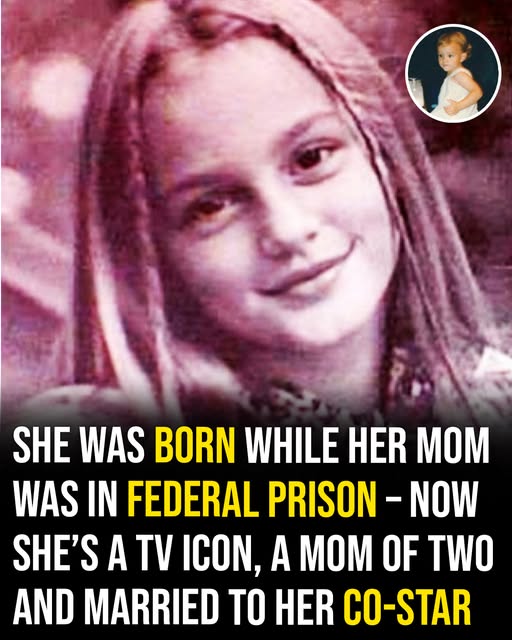
    Leighton Meester’s life didn’t begin with any promise of glamour. There were no Hollywood connections, no privileged introductions to studio executives, no glossy family legacy waiting to usher her onto a film set. Instead, she arrived in the world under circumstances that most people only read about: born while her mother was serving a federal prison sentence, with both parents tangled in drug trafficking charges. Statistically, her path should’ve been bleak. Instead, she built one of the most recognizable and enduring careers in modern television. Her story isn’t just about fame — it’s about grit, perspective, and refusing to let the place you start dictate where you’re allowed to end.

    She was born in Texas in 1986 while her mother, Constance, was locked up on drug-smuggling charges connected to a marijuana operation moving large quantities from Jamaica into the United States. After giving birth, Constance was permitted to stay with her newborn for three months in a halfway-house-type arrangement before returning to finish her sentence. Leighton’s father was also involved in the smuggling ring, and the chaos of her parents’ criminal past meant her earliest months were anything but steady. She ended up living with her paternal grandparents, who stepped in and provided stability where they could.

    The story sounds harsh on paper, but Leighton has always resisted dramatic retellings of her childhood. She’s said repeatedly that despite the messy circumstances, there was warmth, play, and a real attempt from her family to give her a life that didn’t revolve around their mistakes. As she once put it, “I look back now and I see it in a nice light. It wasn’t uncomplicated, but I played outside. I went to the beach. There were happy, fun times.” That perspective — the ability to find the humanity in imperfect people and imperfect beginnings — would become one of the defining traits of her adulthood.

    By ten, she was already moving toward the world that would eventually define her career. Discovered at a modeling convention in Atlanta, she soon relocated to New York City, juggling schoolwork with commercials and print shoots. This wasn’t some dreamy childhood hobby; it was work. Real work. And even as a kid, she took it seriously. She understood what it meant to contribute, to keep going, to build something beyond her circumstances.

    At fourteen, she made another big move — this time to Los Angeles. While most teens agonized over crushes and cafeteria drama, Leighton was thinking about gas money, audition schedules, and whether her family could make ends meet. She’s said bluntly, “I didn’t care if some kid didn’t like me. I was worried about food, about rent. That was my reality.” That kind of early adulthood either crushes a kid or steels them. In her case, it forged her.

    The first real break came when she appeared on an episode of Law & Order in the late ’90s. From there, she kept working — bit parts, guest spots, smaller roles that slowly built her reputation as a young actress with talent and focus. Then, at nineteen, her life changed in a way no one could’ve predicted: she landed the role of Blair Waldorf on Gossip Girl.

    Blair wasn’t just any character. She was sharp, magnetic, complicated — a queen bee with layers under every perfectly delivered insult. Leighton played her with precision, turning Blair into one of the most iconic television characters of the 2000s. The show ran from 2007 to 2012 and became a global phenomenon. Its influence exploded across fashion, pop culture, and the teen-drama genre. Overnight, Meester went from ambitious young actress to household name.

    But behind the curtain of celebrity, she often felt the weight of being young in an industry that never sleeps. “I was being looked at all the time,” she said later. The attention, the pressure, the expectation — it wasn’t always healthy. Still, she stayed grounded. If anything, her strange, uneven childhood had prepared her for a world where nothing stays normal for long.

    Off-screen, she found something far more important than fame: stability. While filming The Oranges, she met actor Adam Brody. They began dating quietly, married quietly, and built a family the same way — far from the noise. Today they share two children, and Meester is unapologetic about her priorities. She’s turned down roles to stay close to her family and has no interest in sacrificing what matters most. “I don’t like being away from them,” she’s said simply. It’s not drama; it’s clarity.

    Music also became part of her creative path. Early in her career, she released pop-leaning singles that found commercial success, but she later admitted they didn’t feel true to her. They were catchy, polished, but not her voice. In 2014, she released Heartstrings, a stripped-down, introspective album that resonated more deeply with fans and critics. Tracks like “Give In to Me” built a loyal following, and for the first time she felt artistically aligned with her own sound.

    Not everything in her personal life stayed calm. In 2011, she sued her mother over funds intended for her younger brother, a cancer survivor, claiming they were being misused. Her mother countersued, insisting Leighton had agreed to support her indefinitely — a claim Meester denied. The court eventually ruled in Leighton’s favor, and she continued supporting her brother while setting firm boundaries with her mother. It wasn’t about punishment; it was about finally drawing a line she’d avoided for years.

    More recently, she faced a different kind of loss. In early 2025, she and Brody lost their Pacific Palisades home to the catastrophic Palisades Fire, the most destructive wildfire in Los Angeles history. Losing a home isn’t just losing walls and furniture — it’s losing pieces of your life you can’t get back. Reflecting on it, she said something painfully honest: loving deeply means risking deep hurt, but that love is still worth it. It’s the kind of perspective that only comes from someone who’s lived through enough instability to value what’s real.

    Now, with a steady career, a dedicated fan base, and a major upcoming role opposite Jared Padalecki in Netflix’s adaptation of The Bodyguard, Meester stands as a contradiction to her beginnings. She wasn’t handed anything. She earned everything — not just success, but peace, family, and the right to tell her story on her own terms.

    Leighton Meester’s life isn’t a fairytale. It’s not a movie script tied with a bow. It’s messy, raw, unpredictable, and ultimately triumphant. She didn’t escape her past; she built on top of it. She didn’t hide where she came from; she reshaped it. And she’s a reminder that a chaotic beginning doesn’t doom you — sometimes, it prepares you for a life big enough to carry it.

  • The biker has been running with my autistic son every morning and I just found out why!

    The biker has been running with my autistic son every morning and I just found out why!

    For three months, I watched a tattooed stranger in a leather vest meet my thirteen-year-old son at our driveway every morning at 6 AM. For three months, I assumed he was just a kind neighbor with a surprising amount of patience.

    My son, Connor, has severe, nonverbal autism. He communicates with an iPad, relies on strict routines, and has run the same 2.4-mile loop at exactly 6 AM every day for four years. The routine keeps his world steady. If it breaks, everything else breaks with it.

    For years, I ran with him. But six months ago, multiple sclerosis made that impossible. Some mornings I can barely walk; running is out of the question. Connor didn’t understand why I suddenly couldn’t follow his routine. He waited at the door, humming and swaying anxiously, and when I couldn’t go outside, he spiraled — screaming, hitting himself, overwhelmed by a disruption he couldn’t make sense of.

    I tried everything. My ex-husband said mornings were too early. Neighbors offered sympathy, not help. A few caregivers tried; none of them lasted. I was losing the only thing that kept my son grounded, and I couldn’t fix it.

    Then one freezing January morning, I woke up to silence. No meltdown, no pacing, no pounding on the walls. I dragged myself to the window and froze.

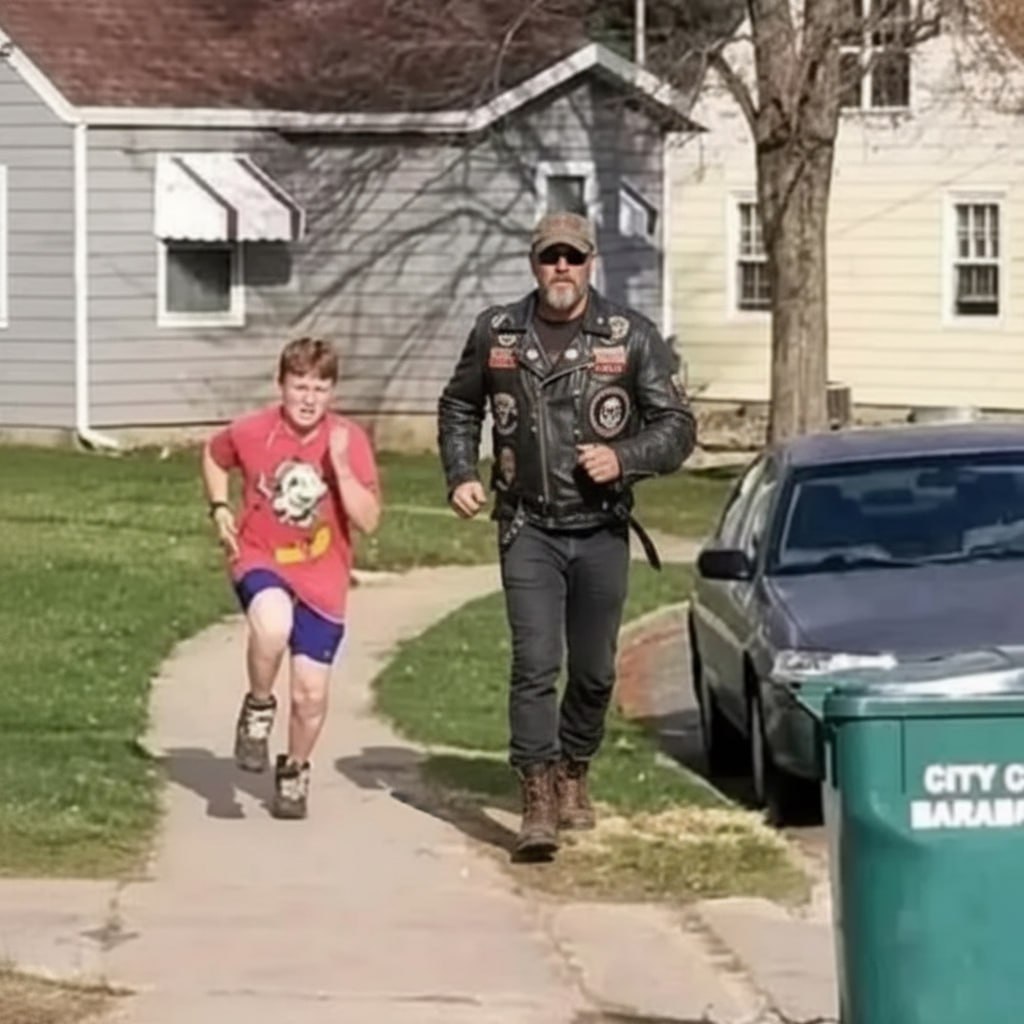
    Connor was running down the street — and a biker I’d never seen before was running next to him. Leather vest, gray beard, heavy boots, tattoos up both arms. Not exactly someone you’d expect to volunteer for a 6 AM charity marathon with an autistic kid.

    They ran the entire route. When they got back, the man high-fived Connor, turned around, and walked off like it was the most ordinary thing in the world. Connor came inside calm, smiling, at peace.

    And the biker kept showing up. Every morning. Weekends. Holidays. Rain. Freezing wind. He was always there, ready to match Connor’s pace, match his silence, match the exact motions he needed.

    I kept trying to thank him, but by the time I got my wheelchair to the door, he was already gone. When I asked Connor who he was, he tapped his iPad and wrote: “Run. Friend. Happy.”

    Then one morning, Connor returned holding a folded piece of paper. On it was a message from the stranger: “Mrs. Harrison, my name is Marcus Webb. I think it’s time I explain why I’ve been running with your son. I need you to understand what he did for me. If you’re willing, please meet me at the coffee shop on Main Street at 10 AM. – Marcus”

    When someone writes “what your son did for me,” you go. I showed up early. Marcus was already there — older than he looked from the window, maybe sixty, a little worn, a little nervous. His tattoos were military. Marines. Combat tours.

    He helped me get my chair to the table. His hands were shaking.

    “I’m sure this seems strange,” he said quietly. “I promise I’m not some random guy who decided to follow your kid around. I’d like to tell you why I showed up that first morning — and why I haven’t stopped.”

    He pulled out his phone and showed me a picture of a red-haired young man with a bright, crooked smile. “This is my son, Jamie. He had severe autism. Nonverbal, just like Connor. And he loved to run.”

    Had. Loved. Past tense.

    Two years earlier, Jamie had gone for his morning run alone after Marcus, sick with the flu, told him they’d skip that day. But autism doesn’t skip. The routine matters more than comfort, more than weather, more than logic. Jamie ran anyway, had a seizure on the sidewalk, fell, and never got up. He was twenty.

    Marcus told me he hadn’t recovered. The guilt hollowed him out. He lost his job, his marriage, his sense of purpose. For two years he drifted through life without direction, drowning in the belief that he had failed his son in the one moment Jamie needed him most.

    Then, on the second anniversary of Jamie’s death, Marcus made a decision he wasn’t supposed to survive. “I’d loaded my service pistol,” he admitted, voice raw. “I’d written a note. I wasn’t planning to see another sunrise.”

    But before ending his life, he decided to take one last ride on his motorcycle — the same route Jamie used to run. And that was when he saw Connor at our front door, rocking, humming, overwhelmed, desperate to run.

    “I saw my son,” Marcus said. “I saw the exact same movements. The same urgency. And then I saw you — trying to explain that you couldn’t go with him, apologizing, crying. I saw the guilt I’ve carried for two years, playing out in front of me. It wrecked me.”

    He parked his bike and walked toward Connor without thinking. When he started running, Connor accepted him instantly — something that doesn’t happen often with strangers.

    “We ran the whole route,” he said. “And for the first time since Jamie died, I felt… alive. Like maybe I still had a purpose. Like maybe I could still protect someone.”

    That night, Marcus put the gun away. The next morning, he returned at 6 AM. And the morning after that. And every morning since.

    For him, running with my son wasn’t charity — it was oxygen.

    “I’ve been sober for three months because of Connor,” he told me. “I got a job. Started therapy. Started climbing out of a hole I never thought I’d leave. Because every morning, I know I need to show up. Someone is counting on me.”

    He slid a folded page across the table — a written schedule of 6 AM runs. Every single day.

    “I want to keep doing this,” he said. “If you’ll let me. I want to be Connor’s running partner. Permanently.”

    I told him I couldn’t pay him. He shook his head immediately.

    “I don’t want money,” he said. “I want purpose. Running with Connor gives me that.”

    Over the next four months, Marcus became part of our lives. He and Connor developed their own rhythm — landmarks, matching leather vests, little routines only they understood. Connor lights up when Marcus’s motorcycle pulls into the driveway. He even hugs him — something he rarely does with anyone.

    Marcus helps me around the house when he can. Fixes things. Checks in. He never oversteps; he just shows up where he’s needed.

    “You’re family now,” I told him one afternoon.

    Marcus had to turn away so I wouldn’t see him cry.

    Recently, he was offered a management position at work — better pay, better hours. But it started at 7 AM.

    “I can’t take it,” he told me. “I run with Connor at 6. That’s non-negotiable.”

    I told him we could adjust. He refused.

    “This is my mission,” he said. “Connor saved my life. Running with him is how I honor my son. It’s how I stay alive.”

    People see a biker running with an autistic kid and assume he’s a nice guy helping out. They have no idea the truth is so much deeper.

    Connor saved him first.

    And now, at 6 AM every morning, they save each other.