Category: News

  • Trump snaps at female reporter in furious outburst! Be quiet, piggy

    Trump snaps at female reporter in furious outburst! Be quiet, piggy

    Donald Trump’s hostility toward the press has never exactly been subtle, but this week he pushed the tension into new territory. After several terse exchanges with reporters, he capped it off mid-flight with a remark that ricocheted across the internet within minutes: a sharp, irritated “Be quiet, piggy,” directed at a female Bloomberg reporter who pressed him on his connection to emails tied to Jeffrey Epstein.

    The clash happened aboard Air Force One on November 14. Trump was already facing uncomfortable questions about newly surfaced Epstein documents — emails in which his name appeared alongside others, including former President Bill Clinton. According to the BBC and multiple reporters on the plane, Trump brushed off the inquiries as irrelevant and insisted he knew “nothing” about the messages. Instead, he deflected attention toward others mentioned in the files. The tone was tense but controlled — until Bloomberg reporter Catherine Lucey tried to follow up.

    “If there’s nothing incriminating in the files, sir, why not—”

    Trump didn’t let her finish. He snapped forward, jabbed a finger in her direction, and cut her off with an abrupt, “Quiet! Quiet, piggy.” The moment was caught on camera, and within an hour, clips and screen recordings were everywhere — Twitter, Reddit, TikTok, Instagram, cable networks, commentary accounts, parody pages. It wasn’t the first time Trump insulted a journalist, but the combination of the setting, the target, and the word he chose triggered a storm.

    Online reactions ranged from outrage to ridicule to weary resignation. One X user wrote, “This is the president of the United States, who himself is overweight, calling another person ‘piggy.’” The user posted a photo of Miss Piggy for emphasis. Others pointed out the gender dynamic, arguing that the insult landed differently because it was directed at a female reporter in a professional setting. “Imagine any other president calling a woman in the press corps that,” another user wrote.

    Reddit threads erupted with jokes and anger in equal measure. “Female reporters should start addressing him as Mr. Fat F*** from now on,” one commenter wrote bluntly. Another focused not on Trump but on the rest of the press corps: “The fact that the entire plane just sits there and lets him talk to their colleagues like that is the most spineless thing in D.C.”

    By Tuesday, the White House weighed in. MSNBC correspondent Vaughn Hillyard reported on X that administration officials tried to shift the narrative by casting blame back on the reporter herself. They claimed she “behaved in an inappropriate and unprofessional way toward her colleagues,” and added: “If you’re going to give it, you have to be able to take it.” What exactly she supposedly “gave” remained vague. Critics pointed out that this kind of response — attack the journalist, not the behavior — was consistent with how Trump and his team have handled press conflicts for years.

    The outburst wasn’t isolated. Over the same weekend, Trump lashed out at another journalist who interrupted him during a hallway gaggle. His reply — “You are the worst. I don’t know why they even have you” — was brief but hostile enough to circulate widely. A few days later, he targeted ABC correspondent Mary Bruce when she brought up the killing of Jamal Khashoggi, the journalist murdered by Saudi agents in 2018. Trump, visibly irritated, pivoted not to policy but to punishment, suggesting FCC Chairman Brendan Carr should look into ABC’s reporting. “I think the license should be taken away from ABC because your news is so fake and it’s so wrong,” he said.

    All of this unfolded during an already heated national conversation about whether the government should release the full archive of Jeffrey Epstein–related documents. For years, both political parties have floated support for transparency, but movement on the issue has always stalled. Over the weekend, however, Trump reversed his earlier reluctance and urged Republicans to back a bill calling for a full release of the files. Critics say the timing was convenient, given how often his own associations with Epstein have been cited online. Supporters argued that his shift was overdue.

    Still, the renewed focus on the files repeated the same old cycle: speculation, partial information, finger-pointing between political camps, and a battle over who benefits or loses from more disclosures. Against that backdrop, the “piggy” remark hit harder — not because it revealed something new about Trump’s style, but because it happened at a moment when he was already under scrutiny and using high-stakes policy debates to frame himself as an advocate for transparency. The insult clashed badly with that narrative.

    The administration’s attempt to paint Lucey as the instigator didn’t soften the backlash. Journalists from across the political spectrum weighed in — some sharply critical, others resigned to what they see as a pattern that’s unlikely to change. Press advocates pointed out that this kind of behavior erodes trust in journalism by framing reporters as the problem rather than the questions they’re asking. Women in media noted that insults about appearance or gendered language often get used against them far more than against their male colleagues.

    Trump’s allies, meanwhile, brushed off the incident. Some said Lucey had been interrupting repeatedly. Others insisted the president was simply “fighting back” in the blunt style his supporters expect. To them, the outrage was just another media overreaction.

    But even among Trump’s critics, the details of this specific confrontation weren’t the core issue. The deeper concern is what these repeated clashes say about the future relationship between the White House and the press — especially when the remarks target a reporter doing her job in a controlled, official environment like Air Force One.

    For now, the moment has already been absorbed into the digital bloodstream — edited into memes, dissected in comment threads, clipped for late-night monologues, spun in every possible direction. But beneath all the viral noise is a quieter, more enduring question: what does it say about the state of American politics when exchanges like this barely shock anyone anymore?

    Reporters will keep asking hard questions. Trump, as he has shown for years, will keep deciding on the spot how politely he’s willing to answer — or whether he’ll answer at all. And every time the tension cracks open like it did on that flight, the same debate resurfaces: is this just Trump being Trump, or is it a sign of a deeper erosion in how a president deals with accountability?

    The answer, depending on who you ask, is already decided. But the story itself — a president, a journalist, and one cutting insult that instantly set off a national reaction — continues to echo, one viral clip at a time.
  • Breaking – The separation between a woman legs means that she is! See more

    Breaking – The separation between a woman legs means that she is! See more

    Throughout history, people have tried to read meaning into physical traits — palms, facial lines, posture, and just about anything else the eye can land on. Leg shape is one of those features that, in various cultures, has been linked to personality and behavior. None of it is scientific, but people still find it fascinating because, strangely enough, the descriptions sometimes hit close to home. You wouldn’t build your identity around something like this, but you can definitely enjoy the insights the same way you’d enjoy a horoscope — a little entertainment, a little introspection.

    The idea is simple: the way your legs align when you stand naturally — whether your thighs, knees, or ankles touch — supposedly hints at what kind of person you are. Some women swear the descriptions nail their temperament. Others just enjoy the curiosity of it. Whatever camp you fall into, the interpretations are interesting enough to explore.

    One common classification mentions “Type B” legs — where the thighs touch, the knees meet, but the lower legs separate before coming back together at the ankles. In folklore and personality lore, women with this leg shape are said to be independent, grounded, and confident. They carry themselves with a quiet sense of capability that doesn’t need constant verification. People around them often pick up on that calm certainty even before they speak.

    This type of woman is comfortable being on her own. Solitude isn’t frightening or lonely — it’s restorative. She thinks clearly when she has space, makes decisions without needing applause, and moves toward her goals with steady focus. She doesn’t chase validation. She doesn’t rush into relationships, commitments, or obligations. She prefers to be selective rather than distracted.

    Because of that independence, she can be misread by others. Some see her confidence as distance. Some mistake her self-reliance for disinterest. But people who take the time to get past the surface quickly discover someone loyal, warm, and incredibly passionate about the things and people she chooses to invest in. She doesn’t waste energy on the wrong places, which means she gives her best where it counts.

    In friendships, women with this so-called Type B alignment are seen as steady forces. They’re not dramatic, not clingy, not volatile. They show up when it matters. They give honest advice. They protect the people they love with a calm determination that makes them reliable anchors during storms. Their boundaries are firm but fair: they won’t tolerate disrespect, manipulation, or emotional chaos, and they don’t apologize for that.

    Romantically, the lore paints them as intense but controlled partners. They’re not reckless with affection. They don’t dive into relationships out of boredom or fear of being alone. Instead, they look for someone who respects their autonomy and doesn’t try to cage it. A partner who can stand beside them, not above or behind. Someone who understands that independence doesn’t exclude intimacy — it strengthens it.

    Because they know what they want and don’t want, they’re selective. They prefer partners who communicate directly, think for themselves, and don’t crumble under pressure. They’re drawn to people with ambition and purpose. They can’t stand insecurity disguised as ego, or neediness disguised as devotion. They want balance: closeness without suffocation, companionship without control.

    In relationships, they’re all-in — loyal, attentive, thoughtful. They pursue passion with intention and depth. But if a relationship becomes toxic or imbalanced, they don’t linger. They don’t drag out endings that should happen. They leave when it’s time to leave, even if it hurts. That ability often surprises people who expect them to cling the way many do when emotions are involved. Independence, for them, isn’t a pose — it’s part of their foundation.

    In lifestyle terms, this leg-shape folklore often describes women who manage their lives with order and quiet discipline. They plan without becoming rigid. They take care of themselves, physically and emotionally. They notice details most people miss. Their routines aren’t strict or obsessive, but intentional. They know how to recharge and aren’t afraid to say no to protect their energy.

    Type B personalities in this mythos are also labeled as creative introverts — women who thrive when they can explore ideas privately before bringing them into the world. They make excellent problem-solvers because they observe first, analyze second, and act last. But when they act, they do it with clarity.

    Their confidence can intimidate people who expect women to soften themselves in public. Some may call them aloof or too direct. But the truth is simpler: they don’t dilute themselves to make others comfortable. They like who they are, and they protect that identity carefully.

    Despite their strong exterior, they’re not cold. They feel deeply — they just don’t broadcast every emotion. They choose who gets access to their vulnerability, and once they trust someone enough to open up, they do so with total sincerity. That vulnerability, when given, is real and rare.

    The cultural symbolism attached to this leg type also links it to emotional steadiness. These women don’t swing wildly between moods. They stay balanced. Their calmness makes them excellent partners, friends, and problem-solvers, because they can step back, breathe, and avoid turning small issues into catastrophes.

    As with any physical-trait personality reading, none of this is hard science. It’s not a diagnosis. It’s not destiny. No body part reveals the secrets of your identity. But the reason these descriptions circulate — and the reason women keep reading them — is because sometimes the reflections feel familiar. Sometimes they spark conversations about personality that women relate to more than they expect. And sometimes the simple act of reading something about yourself — true or not — helps you see yourself from a new angle.

    Think of it the way you’d think about astrology or personality archetypes. You’re not meant to take it literally. You’re meant to take it playfully — to consider it, compare it to your reality, and use whatever pieces feel useful.

    So if you have Type B legs, the folklore says you’re probably a woman who owns her independence, moves through life with confidence, protects her peace, and refuses to shrink for anyone. You want love that respects your autonomy, friendships built on loyalty, and a life shaped by your own choices.

    Again — not science, just cultural interpretation. But if the shoe fits, wear it.

  • Four Bikers Showed Up To Say Goodbye To The Little Girl Nobody Else Wanted To Visit!

    Four Bikers Showed Up To Say Goodbye To The Little Girl Nobody Else Wanted To Visit!

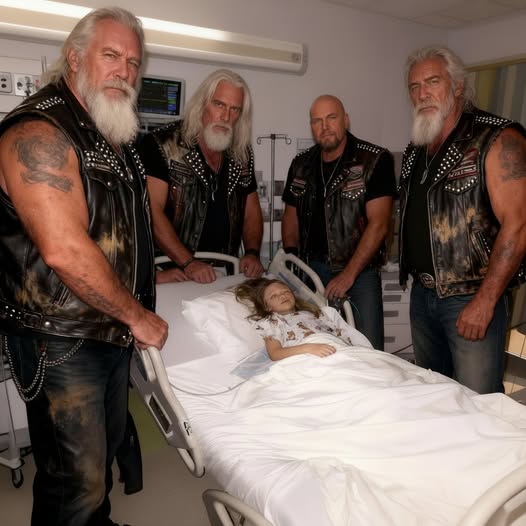
    Most people tense up when a pack of bikers walks into a hospital. Big men in leather vests, boots heavy enough to echo down hallways, tattoos creeping up their necks — the kind of sight that makes security hover a little closer. But on a cold Thursday morning, four of us from the Steel Brotherhood Motorcycle Club stepped into St. Mary’s Children’s Hospital for a very different reason. We weren’t there to make trouble. We were there to say goodbye to a seven-year-old girl none of us had ever met — a girl who was dying alone.

    My name is Jack “Hammer” Davidson. I’m sixty-six, and I’ve been riding with the Brotherhood more than four decades. I thought I’d seen hard things: combat in Vietnam, brothers killed in crashes, families falling apart. But nothing hit me like the phone call we got from a pediatric nurse named Sarah.

    She told us about Emma Rodriguez — a little girl fighting bone cancer, abandoned at the hospital by the mother who couldn’t face watching her decline, with a father serving time. Emma had been in the ward six weeks. Six weeks with no visitors. Not a single one. She watched other kids get balloons, toys, hugs from grandparents, and she sat there holding a toy motorcycle, asking if people stayed away because she was bad.

    When the nurse told me that, I had to pull my bike over because I couldn’t see through the tears.

    “What do you need?” I asked her.

    “She loves motorcycles,” Sarah whispered. “Says bikers are the bravest people in the world. I told her I knew some. She didn’t believe me.”

    “We’ll be there tomorrow.”

    I called the only men I trusted with something like this: Tommy “Hawk” Martinez, Robert “Bear” Johnson, and Marcus “Preacher” Williams. All three answered the same way: “Name the time, brother.”

    The next morning, Sarah met us in the lobby. She warned us Emma’s cancer was advanced, that she didn’t look like a child anymore. We told her we understood. We weren’t there to be comfortable. We were there because a little girl thought no one loved her.

    Room 312 was small and quiet except for the beeping machines. When Sarah opened the door, a small voice said, “You’re lying.”

    “Not this time,” Sarah said gently. “They’re really here.”

    Emma was tiny — almost swallowed by her hospital gown. Bald, fragile, pale. But her eyes were alive. Watching us. Studying us. And for the first time in a long time, they were hopeful.

    “You’re real bikers,” she whispered.

    Tommy knelt beside her bed, voice soft. “Sure are, sweetheart. I’m Hawk. This is Bear, Preacher, and Hammer.”

    “Those are your real names?”

    “Our road names,” Marcus told her. “Every biker earns one.”

    She looked at me. “What’s yours?”

    “Hammer,” I said. “Used to build houses. Built a lot of them.”

    Emma nodded, then dropped her gaze. “I don’t have a road name. I don’t have anything.”

    It felt like someone punched me.

    Then she said quietly, “I’m dying. The doctors said I’m going to heaven soon.”

    We didn’t know what to say at first. Then Bear pulled an embroidered patch from his vest pocket — a small angel with motorcycle wings.

    “This is for you,” he said. “We only give these to warriors.”

    Emma shook her head. “I’m not a warrior. I’m just sick. That’s why my mama left. Nobody wants broken things.”

    Tommy looked like he might break down right there. Marcus had his back turned, wiping his eyes. I leaned forward.

    “You’re not broken,” I said. “You’re fighting harder than any of us ever have. That makes you stronger than you know.”

    “Your mama didn’t leave because of you,” Tommy added. “She left because she couldn’t handle her pain. Not yours.”

    Emma looked at the patch again. “Can I really have it?”

    “It’s yours,” Bear said. “And if you want a road name, that’s yours too.”

    Emma straightened a little. “I want one.”

    “Then pick it,” I said. “Pick something true about you.”

    She thought for a long moment. “Hope. Nurse Sarah says I give people hope.”

    Marcus smiled. “That’s perfect. Emma ‘Hope’ Rodriguez.”

    And just like that, she belonged to us.

    We stayed three hours that day. Told her about the road, about the brotherhood, about what we do for kids and veterans. She soaked it all in. When we stood to leave, she grabbed my hand.

    “Will you come back?”

    “Every day,” I promised. “Family doesn’t walk away.”

    And we did. Every single day. Sometimes one of us, sometimes all four, sometimes half the club once word spread. Her room went from silent to full of laughter, stories, and more leather jackets than the hospital had probably ever seen.

    The other kids called her “the biker princess.” She wore her patch like armor.

    But cancer doesn’t care about love or loyalty. Two weeks ago, the doctors told us she had days left. We held a club meeting — thirty-seven bikers showing up without hesitation — and agreed: when the time came, Emma would get a full honor biker funeral.

    But before the funeral, she wanted us. Sarah called at 3 a.m. “She’s asking for her brothers.”

    We rode like hell. Ran through the hospital halls. Emma looked small, barely conscious, but when she saw us, she smiled.

    “You came.”

    “Always,” I said.

    “Am I dying?” she asked.

    I didn’t lie. “Yes, sweetheart.”

    “Will I be alone?”

    Tommy squeezed her tiny hand. “Not a chance. You’re riding out of here surrounded by your brothers.”

    “Tell me a story,” she whispered. “About riding. I want to feel like I’m going fast.”

    So we told her. Wind, sun, mountains, open road. Freedom.

    She died with that picture in her mind, at peace, with our hands holding hers.

    Three days later, two hundred fourteen bikers from eight clubs rode in her honor. Her casket had motorcycles and angels painted on it. She wore a tiny Brotherhood vest with her patch sewn on the back: Emma “Hope” Rodriguez — Forever Our Warrior.

    Marcus gave the eulogy. Big, intimidating Marcus cried through the whole thing.

    “Emma never asked why we didn’t come sooner,” he said. “She just thanked us for seeing her.”

    After the burial, Nurse Sarah pulled us aside. “Her mother came two days before she passed. Emma refused to see her. She said, ‘I already have a family. The brothers came for me.’”

    I’ve lived a long life. But those six weeks with Emma were the most meaningful I’ve ever known. She didn’t just change us. She redefined us.

    We built the Hope Foundation in her name. We visit sick kids. We give them patches, road names, family. Some survive. Some don’t. But none of them die alone.

    People see bikers and assume trouble. Emma saw something else. She saw our hearts before she saw the leather.

    We ride for her now. For all the forgotten kids. For every child waiting for someone to show up.

    Emma “Hope” Rodriguez didn’t die alone. She died loved. She died with family. She died knowing she mattered.

    And she’ll ride with us forever.

  • Understanding the Relationship Between Breast Size and Hormonal Health! SOTD!

    Understanding the Relationship Between Breast Size and Hormonal Health! SOTD!

    Breast size has carried myths, assumptions, and cultural baggage for generations. Some women wonder whether a larger or smaller bust reflects deeper hormonal patterns or overall health. Others feel pressure from social expectations rather than biology. The truth is far less dramatic — and far more grounded in science. Breast size can relate to hormones, but not in the simplistic way people often claim. Understanding what actually influences breast development, and what doesn’t, can help women separate fact from fiction and focus on real wellness.

    Biologically, breast size is shaped first and foremost by genetics. The blueprint for how breast tissue grows — how dense it becomes, how much fat it stores, and how it responds to hormonal changes — is written before birth. Hormones still play a key role, especially during puberty, pregnancy, menstrual cycles, and menopause, but they operate within genetic boundaries. Estrogen and progesterone stimulate breast tissue development, while body fat percentage, age, and lifestyle choices can shift how those hormones express themselves.

    That means two women with the same hormone levels can still have completely different bust sizes. And a woman with small breasts is not lacking femininity or hormonal function — she simply has a different genetic pattern. Small breasts do not indicate low estrogen or poor health. Large breasts do not prove stronger hormonal activity. They’re simply variations in how tissue responds to natural biological signals.

    Most myths surrounding breast size fall into two categories: assumptions about femininity and assumptions about health. One of the most common — and most damaging — is the idea that small breasts signal poor hormonal health or reduced fertility. This belief has no scientific backing. Hormonal wellness is measured by cycle regularity, energy levels, sleep, mood, metabolic balance, and other internal indicators — not by the amount of tissue on a woman’s chest. A woman with an A-cup can have perfectly balanced hormones, a thriving reproductive system, and excellent overall health.

    Another misconception claims that larger breasts reflect “better” hormonal function. In reality, breast size often simply tracks with body fat. Women with higher body fat percentages may naturally have larger busts because a portion of breast volume is made of fat cells. Some research suggests that a higher body mass index — not breast size itself — may correlate with certain health risks such as diabetes or heart disease. That risk has nothing to do with femininity or breast tissue characteristics and everything to do with overall metabolic factors.

    On the flip side, larger breasts can sometimes create physical strain, especially for women who carry most of their weight in the chest. Back pain, posture issues, and discomfort during high-impact exercise are common experiences. But again, these are mechanical issues — not hormonal ones.

    In short, breast size is a poor indicator of health. It reveals more about genetics and body composition than hormones. Real hormonal health is determined by habits and internal balance, and women of every body type can support that balance with simple lifestyle choices.

    A nutrient-rich diet is one of the strongest foundations for hormonal stability. Eating a mix of fruits, vegetables, whole grains, lean proteins, and healthy fats fuels the endocrine system and supports steady energy levels. Omega-3 fatty acids found in fish, seeds, and nuts help regulate inflammation and may assist hormone production. Biosystems thrive when they’re well-fed.

    Exercise is another powerful tool. Movement helps manage weight, support metabolism, reduce stress hormones like cortisol, and improve circulation. Yoga, strength training, walking, swimming — any consistent activity helps the body maintain equilibrium. Exercise doesn’t need to be extreme to be effective. Hormones respond well to routine, not punishment.

    Stress, often overlooked, exerts one of the most noticeable impacts on hormone balance. Chronic stress can disrupt menstrual cycles, increase fatigue, and throw off natural rhythms. Mindfulness practices, meditation, journaling, breathing exercises, or even small breaks throughout the day can help recalibrate the nervous system. This isn’t about achieving perfect calm — it’s about giving the body space to reset.

    Some women explore natural supplements to support hormonal balance. Evening primrose oil is sometimes used to ease PMS symptoms, and vitex (chasteberry) is known for its potential role in regulating menstrual cycles. These can be helpful when used appropriately, but supplements are not one-size-fits-all solutions. Individual biology matters, and it’s always wise to consult a healthcare professional before starting anything new.

    Beyond supplements, several natural ingredients have long been part of women’s wellness traditions. Sage tea has a history of use for hormonal comfort and menopausal support. Maca root is popular for its potential to boost energy and mood. Ginger tea acts as an anti-inflammatory and may help ease menstrual discomfort. These aren’t miracle cures — but they can complement a healthy lifestyle.

    Ultimately, focusing on bust size as a measure of wellness distracts from what actually matters. A woman’s worth, femininity, and health have never been tied to a number on a bra tag. Hormonal health is a complex interplay of nutrition, activity, sleep, stress levels, genetics, and age — not a physical measurement. Body diversity is natural, and breast size is just one expression of that diversity.

    Still, it’s understandable why the myths persist. Society has turned breast size into a symbol — of attractiveness, desirability, and even identity. But those messages come from culture, not biology. When women start examining their own health through a more informed lens, those cultural narratives lose their power.

    Instead of worrying about breast size, focus on the signals that actually reflect hormonal wellness: regular cycles, stable mood, good sleep, consistent energy, manageable stress levels, and proper nutrition. These indicators offer far more insight than the mirror ever could.

    If you choose to support your body with natural remedies, do so thoughtfully. If you adjust your diet or exercise routine, do it because it makes you feel stronger and healthier — not because you believe you need to change your appearance. And if you ever have concerns about your hormones or reproductive health, seek a professional who can evaluate your full picture, not just one physical trait.

    Breast size isn’t a medical verdict. It’s simply a part of who you are, shaped by genetics and life stages. What truly matters is building a lifestyle that keeps your hormones, body, and mind in balance. Wellness is not about measurements. It’s about care — and consistency.

    When women understand that, the myths lose their grip, and what’s left is something far more powerful: real knowledge, real confidence, and real health.

  • Behind the Scenes! Mistakes and Bloopers From Gilligans Island!

    Behind the Scenes! Mistakes and Bloopers From Gilligans Island!

    “Gilligan’s Island” is one of those rare shows that refuses to fade. It ran from 1964 to 1967—only three seasons—yet it cemented itself as a cultural staple. The premise was simple: seven castaways stranded on an island after what was supposed to be a harmless “three-hour tour.” But the show’s humor, charm, and eccentric characters carved out a permanent place in TV history. And like any production from that era, it had its share of mistakes, odd behind-the-scenes stories, and quirks that fans still catch decades later.

    One of the strangest bloopers appears not in an episode but in the opening credits of season two. The scene at the marina shows the S.S. Minnow leaving the dock with the cast on board, but sharp-eyed viewers have noticed something odd: in two separate shots, there are eight passengers instead of seven. It turns out the extra figures weren’t secret castaways. They were stand-ins used for wide shots while the real actors were off set. Most viewers never spotted it, but once you see the extra silhouettes, you can’t unsee them.

    Another memorable slip appears in the season two episode “The Friendly Physician,” where the castaways visit a neighboring island occupied by a mad scientist. The plot is already bizarre—body swapping, experiments, and Gilligan briefly sharing Mrs. Howell’s brain—but during the escape scene, a piece of Hollywood sneaks into the frame. If you look past the lagoon, you can spot structures from the CBS studio lot. The lush foliage that normally hides warehouses and soundstages wasn’t positioned quite right for that angle, leaving a quiet reminder that the “tropical island” was a carefully built set in the middle of Los Angeles.

    Not every behind-the-scenes moment was lighthearted. When the original pilot, titled “Marooned,” was being filmed in Honolulu Harbor, news broke that President John F. Kennedy had been assassinated. Production halted as military bases shut down during the national mourning period, delaying the shoot. In the season one intro, American flags in the background can be seen at half-mast—an unplanned detail that marks the show’s tragic historical context.

    Casting stories also add surprising texture to the show’s history. Alan Hale Jr. became iconic as the Skipper, but landing the role wasn’t easy. While filming a Western in Utah, Hale rode off set on horseback, hitchhiked to Las Vegas, caught a flight to Los Angeles, and arrived in time for his audition. His gamble paid off—he secured the role over several contenders, including Carroll O’Connor, who would later star in “All in the Family.”

    On set, mistakes were sometimes small but entertaining. In the butterfly-themed episode where fermented berry juice knocks everyone out, Natalie Schafer, who played Mrs. Howell, accidentally opens her eyes while pretending to be unconscious. In that same storyline, the Professor drinks alcohol despite previously claiming he was allergic—another continuity slip that fans eventually noticed.

    The show’s very first episode also carries a handful of technical errors. The scene with Gilligan and the Skipper battling a shark was shot not in open water but in a movie tank. If you watch carefully, you can see the edge of the tank in certain shots and the shadow of the boom mic crossing the raft. And when Gilligan hides inside a tree trunk and a woodpecker taps on his head, there’s another oversight—woodpeckers don’t inhabit remote oceanic islands.

    The theme song itself had its own awkward start. In season one, “the rest” referred to the Professor and Mary Ann—no names, no credit. Their characters were essential to the dynamics of the group, but contractual decisions left them lumped anonymously at the end of the song. Bob Denver, who played Gilligan, insisted that they be properly included. Starting in season two, the theme was updated to acknowledge “the Professor and Mary Ann” by name.

    Even the shipwrecked vessel carried a hidden joke. The S.S. Minnow wasn’t named after the fish. It was a tongue-in-cheek jab at Newton Minow, the FCC chairman who famously called American television a “vast wasteland.” Show creator Sherwood Schwartz didn’t take kindly to the remark and immortalized the critique in the most direct way he could.

    Production tricks show up again in “So Sorry, My Island,” where Vito Scotty plays a Japanese sailor who doesn’t know the war ended years earlier. When Gilligan “pilots” the submarine, what you actually see is a diver pushing the periscope and guiding the vessel. At one point, the diver’s air tank briefly breaks the surface. And despite the plot, Japan never developed single-man submarines during World War II—another fictional flourish.

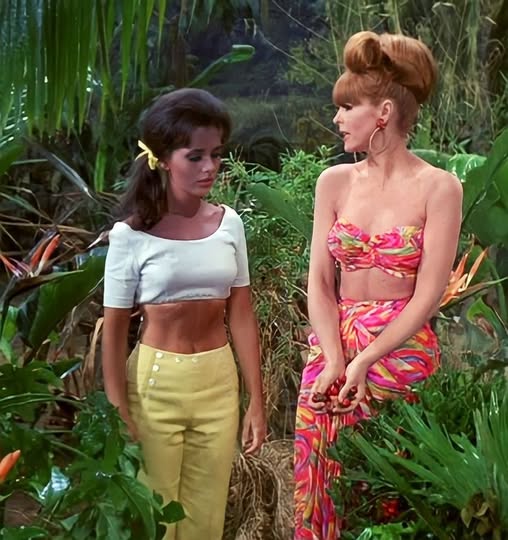
    Beyond bloopers, the show sparked one of the most enduring pop-culture debates of the era: Ginger or Mary Ann? Tina Louise played Ginger, the glamorous Hollywood star, bringing a mix of elegance and smoldering screen presence. Dawn Wells portrayed Mary Ann, the quintessential girl next door—kind, approachable, and sincere. Both characters captivated audiences for different reasons, and the actresses behind them shared genuine friendship off camera. Wells later reflected that Mary Ann’s relatability helped cement her as a fan favorite, while Ginger embodied the escapist fantasy of classic Hollywood.

    The human stories behind the cast are just as compelling. In the episode “They’re Off and Running,” where Gilligan briefly works as a house-boy for the Howells after losing a turtle race, Bob Denver’s real-life wedding ring can be spotted. Gilligan wasn’t married, but Denver wore the ring throughout production.

    Fans have long speculated about off-screen romances among the cast. Dawn Wells addressed the rumors directly in later interviews. She described Alan Hale Jr. as paternal, found Gilligan more friend than romantic lead, and acknowledged that many viewers assumed the Professor would be the most eligible. In truth, the cast developed deep platonic bonds rather than romantic ones.

    The passage of time has turned the show into a living memory. Today, Tina Louise—now in her nineties—is the only surviving member of the original seven castaways. Her relationship with the show has been complicated. She sometimes felt that the role limited her career, but she has continued to appreciate the fans who grew up with the series and still send letters decades later.

    Looking back, “Gilligan’s Island” remains a product of its era—quirky, innocent, occasionally clumsy, and endlessly entertaining. The bloopers, casting oddities, and production quirks don’t diminish the show. They enrich it. They remind us that even iconic stories are built from imperfect moments, rushed shoots, improvisations, and accidents. The charm of the series doesn’t lie in flawless execution. It lies in the warmth of the characters, the simplicity of the premise, and the way it wrapped adventure and humor into thirty-minute escapes from real life.

    For fans—new and old—the hidden mistakes make the show feel even more human. They’re reminders that, behind the laughter and the coconut radios, a team of actors and crew were simply doing their best to bring joy to millions. And judging by the fact that we’re still talking about these castaways more than half a century later, they succeeded.

  • My Kids Left Me Dying Alone But This Biker Held My Hand And Helped Me Get Sweetest Revenge!

    My Kids Left Me Dying Alone But This Biker Held My Hand And Helped Me Get Sweetest Revenge!

    I’m seventy-three years old, lying in a hospice bed with stage-four lung cancer, and for six long months not one of my three children has walked through that door. I raised them alone after their mother ran off. I worked seventy-hour weeks as a construction foreman. I paid for colleges, weddings, houses — the whole package. And when the doctor told me I was dying, my kids scattered like I was a burden they could finally drop.

    My daughter Stephanie lives twenty minutes away. She always has an excuse — brunches, committees, social events that apparently outrank her father’s last months on earth. My son Michael offered one sympathetic phone call and then disappeared behind “work deadlines.” And my youngest, David, told me he wouldn’t visit because hospice was “too depressing.” That one hurt more than the cancer.

    So I’ve been dying alone. Nurses in and out. A chaplain once a week. Mostly silence.

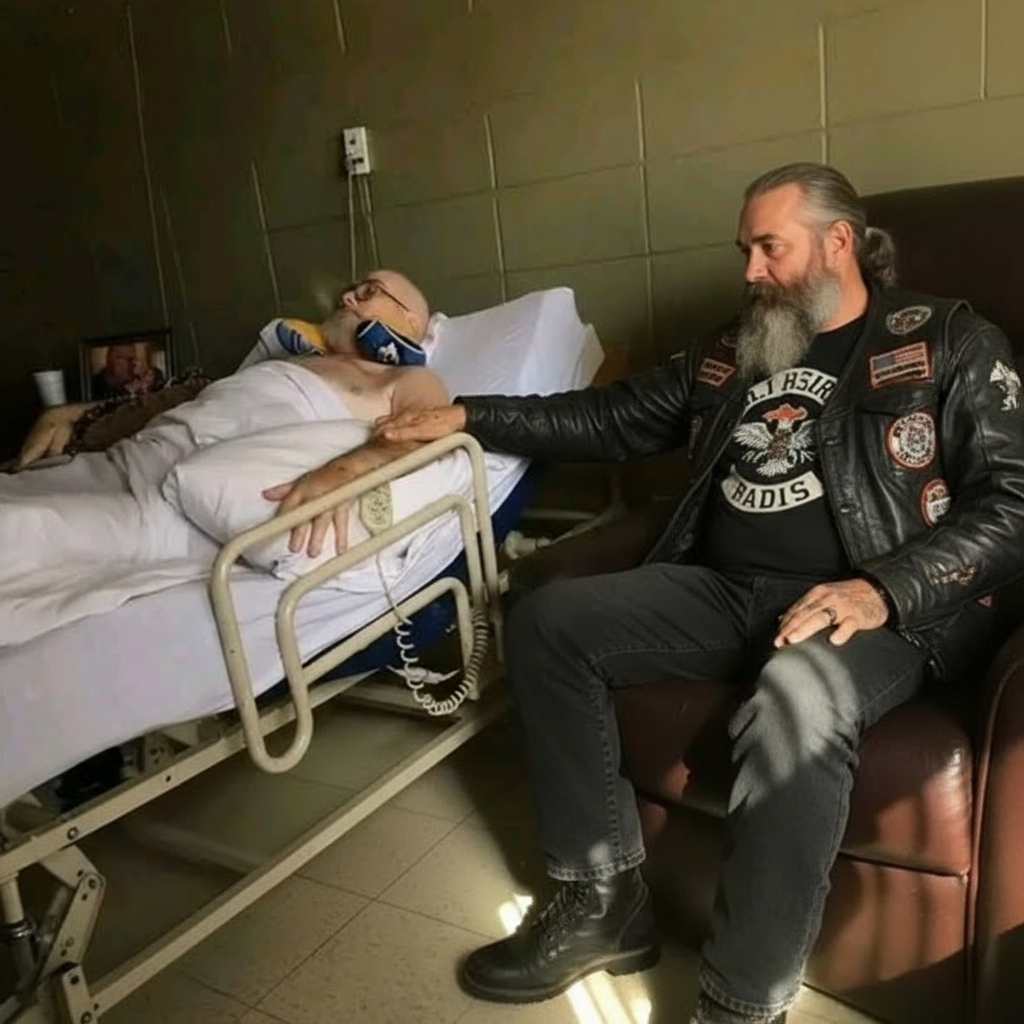
    Then last Tuesday, the door opened and a huge biker with a silver beard and a leather vest stepped in by accident. Marcus — that’s his name — was looking for another patient and mixed up the room numbers. He was about to leave when he spotted the Purple Heart on my nightstand and froze.

    “You served?” he asked.

    I nodded. Vietnam, ’68 to ’70.

    He stood at attention, saluted me, and said, “Thank you for your service, brother.”

    Nobody had called me brother since the war.

    He pulled up a chair. “Your family coming today?”

    I raised six fingers — six months without a single visit.

    He stared at me like he couldn’t decide whether to cry or punch someone. “You got kids?”

    Three fingers.

    “And not one of them visited while you’re dying?”

    I nodded again. It was easier than speaking through damaged lungs.

    Marcus leaned forward, fists balled tight. “Tell me their names.”

    I hadn’t said their names out loud in weeks. But something in me cracked — maybe because this stranger showed me more respect in five minutes than my kids had in years. So I told him. Everything. Their addresses. Their excuses. The fights over my will before I was even gone. The pressure to sell my house to “make things easier on everyone.” Their total vanishing act since my diagnosis.

    When I finished, Marcus shook his head. “Brother, I can’t make them love you. But I can make damn sure they remember what they did.”

    Then he sat back and said, “You want justice?”

    I nodded. I wanted justice like I wanted my next breath.

    Marcus wasn’t just a biker. He was a licensed lawyer who’d left the courtroom life for the road but kept his credentials sharp. He told me he knew every legal angle worth using.

    “Here’s the plan,” he said. “You’re changing your will. Everything — house, savings, insurance — goes to the Veterans Motorcycle Club. Your kids get nothing.”

    But that wasn’t the end.

    “You’re going to write them each a letter,” he said. “Your last words. And you’re going to tell them exactly why they’re cut out — abandonment, neglect, selfishness. Every truth you swallowed for years. And those letters will be read to them at your funeral. In front of everyone.”

    I tried to speak, voice cracking with emotion, but he held up his hand.

    “And we’re going to use your estate to build something real. A fund for forgotten veterans — men and women dying in facilities with no family to hold their hands. We’ll name it after you: The Robert Mitchell Never Alone Fund. Every time your kids hear about it, they’ll remember who actually showed up for you.”

    I cried harder than I had in months.

    Marcus spent six hours with me that day. He brought a notary, witnesses, all the paperwork. We rewrote the will. We wrote the letters. The truth poured out — decades of it. We sealed them, signed every page, and filed everything legally airtight.

    After that day, Marcus visited daily. Sometimes alone, sometimes with other bikers. They brought music, stories, real conversation — things I hadn’t had in months. A man named Carlos brought a guitar and played old country songs I thought I’d forgotten. Another man brought a therapy dog who slept against my legs. They treated me like family. My own blood had treated me like a responsibility to avoid.

    Three weeks later, Stephanie finally showed up out of guilt. Marcus was there.

    She breezed in, all perfume and irritation. “Dad, I’m so sorry I haven’t been by— things are insane.” She barely looked at me before turning to Marcus like he was something sticky she stepped in. “Who are you?”

    “I’m the man who’s been visiting your father every day,” he said. “Where have you been?”

    She bristled. “Excuse me? That’s private.”

    Marcus didn’t blink. “Your father is dying. Private doesn’t apply anymore.”

    She sputtered, insulted. He didn’t care. And when she left, she didn’t come back.

    Michael came once, talked about himself the whole time, and left without asking how I felt. David never showed up at all.

    I died on a Thursday morning at 6 a.m. Marcus was holding my hand. My last words were, “Thank you, brother.”

    My funeral was packed — mostly bikers and veterans. My three children sat stiffly in the front row, confused, embarrassed, surrounded by leather vests and American flags.

    Then my lawyer walked forward with the envelopes.

    “My client requested that his children read these letters aloud.”

    Stephanie started hers, voice steady at first, then cracking as the truth hit her — line after brutal line. She dropped to her seat, sobbing.

    Michael refused to read his aloud. He read it silently and went white.

    David tore his open, read two lines, and shouted, “He can’t do this!”

    The lawyer calmly explained that yes, legally, I absolutely could.

    Then Marcus stepped forward and reminded them there was video — me, explaining exactly why they were cut out — and offered to play it on the spot.

    They left the funeral early, humiliated and exposed.

    Six months have passed. The fund named after me has raised over $200,000. The bikers have visited dozens of lonely veterans, holding hands, telling stories, making sure no one dies alone again.

    My kids tried to contest the will, spent tens of thousands, and lost. The judge scolded them in open court. Stephanie’s marriage fell apart. Michael lost a promotion after his boss — a veteran — heard the story. David moved out of state to outrun the shame.

    And me? I died with peace. With dignity. With a hand holding mine when it mattered.

    Marcus still visits my grave. “You got your justice, brother,” he said last time. “But more than that, you left something good behind.”

    Family isn’t blood. Family is who shows up.

    And in the end, the ones who showed up wore leather, rode loud bikes, and treated me better than my own children ever did.

  • Nothing Edited, If You Notice What is Unique Here, You Have Amazing Eyesight and Nostalgic Memories!

    Nothing Edited, If You Notice What is Unique Here, You Have Amazing Eyesight and Nostalgic Memories!

    Hee Haw wasn’t just another television show. It was a cultural warm blanket, a weekly ritual that pulled families together long before streaming, rewinds, or algorithms existed. It lived in that sweet spot of American entertainment history where humor didn’t need polish, fancy editing, or clever production tricks — just good timing, a talented cast, and the comfort of knowing exactly what kind of joy you were about to get. And that’s why an uncut Hee Haw scene still carries real power today. It’s not simply a clip from an old show; it’s a time machine loaded with memories.

    If you grew up with Hee Haw, you know exactly what I mean. Saturday nights in front of the TV, the whole family gathered without being told, snacks on folding tables, maybe a fan humming in the corner. No one checked their phone. No one scrolled. The show commanded attention with nothing more than charm, music, and the kind of humor that made entire living rooms laugh in unison. Today, when people stumble across a rare unedited moment from Hee Haw, it’s not just nostalgia — it’s a reminder of a simpler kind of connection.

    What makes these raw, uncut scenes so captivating is how different they feel from modern television. Today’s entertainment is all sharp edges, heavy editing, dramatic re-takes, and everything packaged for viral potential. Hee Haw wasn’t built that way. It had rough edges. You could sometimes see the cast break character because the jokes genuinely caught them off guard. The timing wasn’t perfectly manufactured — it was natural. That slight awkwardness, the unpolished charm, the authentic laughter… those weren’t flaws. They were the magic.

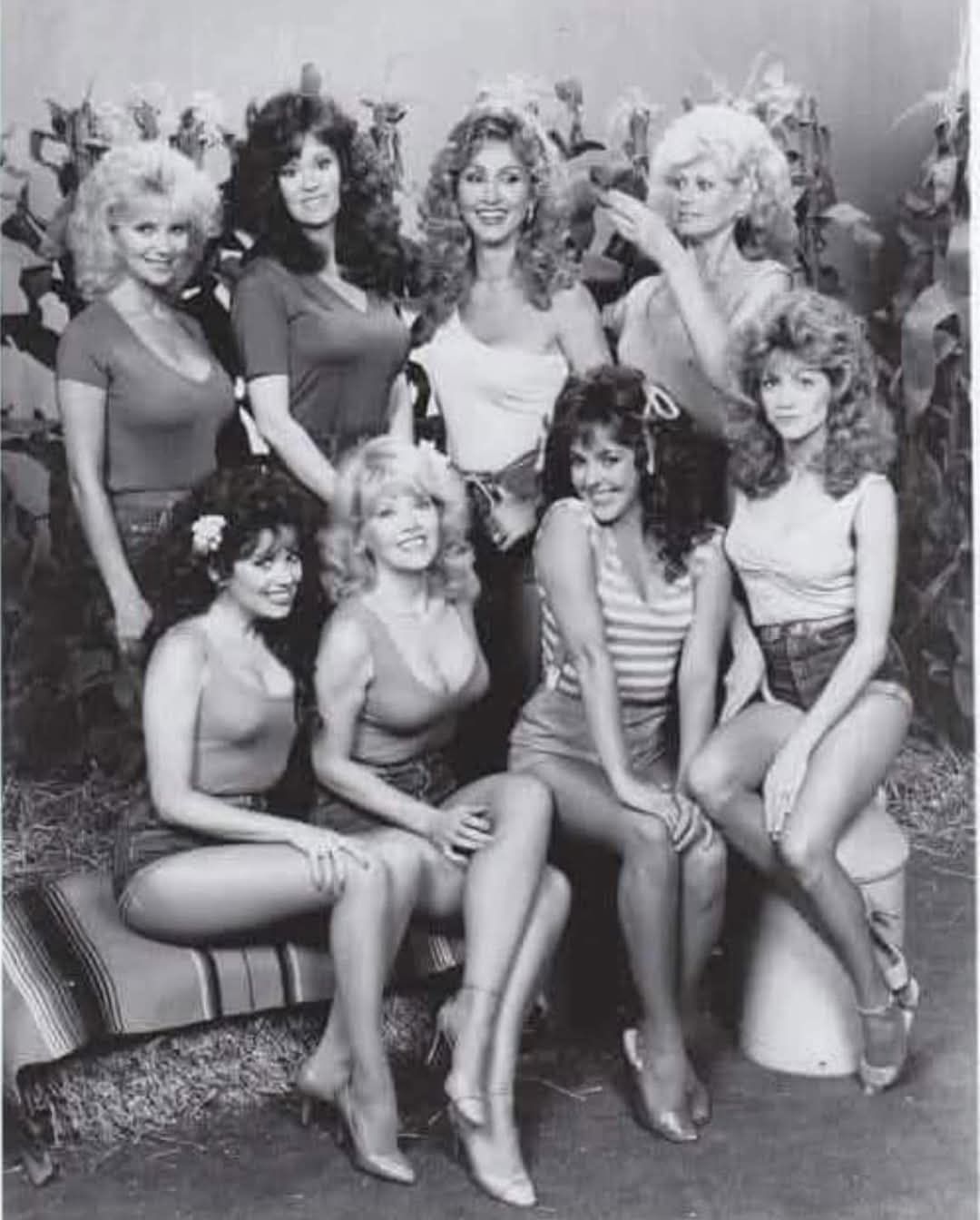
    That authenticity is especially visible in the legendary “Kornfield Jokes” segment — a staple of the show and practically an identity in itself. Cast members popping up out of a cornfield, trading groan-worthy jokes with deadpan expressions, cracking each other up, sometimes messing up a line on camera with zero shame. Nothing staged. Nothing corrected. Just real people, real reactions, and a whole lot of fun. You didn’t need to understand country living to appreciate it — the humor was universal because it came from genuine human connection.

    But the musical moments carried just as much weight. Hee Haw gave viewers access to an evolving parade of country legends and rising stars, all performing in a setting that felt more like a backyard jam session than a formal stage. There were guitars, banjos, fiddles, and a whole lot of energy — none of it forced. The music came straight from the roots of American culture, and the unedited recordings only make that more apparent. You can hear breaths between verses, see a wink from a bandmate, or catch an unexpected grin when someone ad-libs a line. These small details turn a simple scene into a living memory.

    It’s easy to forget how important communal television experiences once were. Before endless channels and personal devices, families watched the same thing at the same time. Hee Haw was one of those shows that appealed to everyone — grandparents laughed, parents relaxed, and kids soaked up the silly jokes without even understanding half of them. It bridged generations effortlessly, something few shows today can claim.

    That’s why an uncut Hee Haw scene hits so hard. You’re not just watching a show — you’re remembering the people you watched it with. Maybe a grandparent who always sat in the same chair. Maybe a parent who joked along with the actors. Maybe siblings who rolled their eyes but secretly loved every minute. These scenes store emotional fingerprints that last a lifetime.

    Even new viewers, people who didn’t grow up with the show, can feel that warmth. Something about the laid-back humor, the straightforward storytelling, the sense of community, still resonates today. Younger audiences who stumble across Hee Haw clips are often surprised by how refreshing it feels to watch something that isn’t performed for social media metrics. There’s no sarcasm or snark. No hidden agenda. Just simple, honest entertainment.

    And that honesty is what gives these scenes their timeless appeal. They remind us that entertainment doesn’t have to be perfect to be meaningful. In fact, imperfection is often what makes it human. A cast member tripping over a line, a prop not working perfectly, laughter breaking out at the wrong moment — those are the parts people remember most. They make the actors relatable, approachable, real.

    Another thing that stands out when revisiting unedited scenes is the chemistry within the cast. They weren’t just performing next to each other; they were enjoying each other. You can see it in every side glance, every shared laugh, every playful moment not meant for the spotlight. That kind of chemistry can’t be faked or edited into existence. It’s built from genuine bonds — something Hee Haw had in abundance.

    That bond extended to the audience too. The show never talked down to viewers. It never tried to be edgy or sophisticated. It embraced silliness with pride, wrapped comedy in kindness, and created a world where everyone was invited. That friendliness is what people miss today more than anything. Entertainment has gotten louder but not warmer, sharper but not deeper. Hee Haw’s simplicity feels like a breath of fresh air.

    When people watch these uncut scenes now, it’s not about nostalgia alone. It’s about finding a little slice of sanity in a world that feels like it’s going too fast. It’s about discovering a version of humor that doesn’t rely on cruelty. It’s about remembering that laughter can be shared without irony.

    So if you notice something in that unedited Hee Haw footage — a small detail, a subtle expression, a moment that doesn’t belong in a polished modern production — that means you’re seeing what made the show special. You’re catching the humanity. The heart. The authenticity.

    Hee Haw isn’t just a show. It’s a reminder of how good it felt when entertainment wasn’t trying to impress you — just trying to make you smile.

    And sometimes, that’s all we need.

  • SOTD – I Married My Late Husband Best Friend, but on Our Wedding Night He Said, There is Something in the Safe You Need to Read

    SOTD – I Married My Late Husband Best Friend, but on Our Wedding Night He Said, There is Something in the Safe You Need to Read

    I’m forty-one, and I feel like I’ve lived two full lives. One with my first husband, Peter — the man I built a family with, the man I thought I’d grow old beside. And the second life, the one I never expected, with the man who stood next to him for decades: his best friend, Dan. I never imagined grief and love would collide this way, but life doesn’t care about tidy endings.

    Peter and I were married for twenty years. Not a dramatic, sweeping love story — just the real kind. The kind that survives burnt dinners, broken appliances, sick kids, long nights, and bills that never stop coming. He was terrible at fixing things around the house but always tried anyway. He made me laugh even when he was exhausted, and he held our family together without ever bragging about it.

    Six years ago, a drunk driver ran a red light and destroyed everything. A police officer said Peter’s name, and the world simply caved in. My daughter locked herself in the bathroom and cried until she passed out. My son retreated into silence. I spent nights in the kitchen staring at his empty coffee mug like it might magically refill itself. Grief turned time into static — soundless, shapeless, relentless.

    Through all of it, Dan was there.

    Dan wasn’t just Peter’s best friend; he was practically part of the family. They grew up three houses apart, hitchhiked to concerts in college, road-tripped across the country, and remained inseparable through marriages, kids, divorces, and stress. Dan had a messy co-parenting arrangement with his ex, but he never complained. He was steady, grounded, and loyal in a way you don’t see often anymore.

    After Peter died, Dan slipped into our lives quietly. He showed up with groceries, fixed the fence without being asked, read bedtime stories to my son when I couldn’t function, taught my daughter how to use a power drill for a school project. He didn’t hover or try to take charge. He just filled the empty spaces so they didn’t swallow us whole.

    Months after the funeral, I told him he didn’t need to keep doing so much. He shrugged and said, “Pete would’ve done it for me,” and went right back to tightening a loose cabinet hinge. That was Dan — always doing, never grandstanding.

    It took three years before anything shifted. It happened on an ordinary night when my kitchen sink started leaking. I called Dan without thinking. He showed up half asleep, hair a mess, toolbox in hand. He cracked a stupid joke from under the sink and I laughed — really laughed — for the first time since losing Peter. Something softened that night, something neither of us said out loud.

    We didn’t rush it. Slow coffee on quiet mornings. Movies when the house felt too empty. Long talks that didn’t feel like work. My daughter was the first to call it out. “Mom, he’s in love with you,” she said with all the bluntness of a teenager. I tried to deny it, but the truth was obvious.

    Eventually, Dan admitted it himself, sitting beside me on the porch at sunset.

    “I’m in love with you,” he said, eyes fixed on the horizon because he was scared to look at me. “I know it’s complicated. I know he was my best friend. If you tell me to step back, I will.”

    I didn’t step back. And loving him didn’t feel like erasing Peter — it felt like learning how to breathe again.

    We told the kids only when we were sure. My daughter hugged him like she’d been waiting for it. My son shook his hand, swallowed hard, and said Peter would want me to be happy. I braced myself for Peter’s mother — the woman who worshipped her son.

    When she came over and saw how nervous I was, she took my hands and said, “You’re with Daniel.” It wasn’t a question. Then she added, “Sweetheart, Peter would thank him for loving you. You’re not betraying anything. You’re surviving.”

    I cried so hard I couldn’t speak.

    Dan eventually proposed in the same kitchen where he once fixed my sink at midnight. A simple question. A simple yes. We married in the backyard under string lights while our kids gave speeches that made everyone laugh through tears. It felt peaceful. Right.

    Our wedding night, though, was not soft or simple.

    I walked into the bedroom and found Dan standing in front of the closet safe with the door open. His hands were trembling.

    “Dan?” I asked. “What’s wrong?”

    He pulled out an old, cracked phone — one of Peter’s. He’d found it a few weeks earlier while helping me clear the attic. I hadn’t charged it in years.

    “There’s something in here I need you to see,” he said.

    He opened a text thread. The messages were six, maybe seven years old. At first, it was just the usual banter between best friends — football scores, jokes, memes, random updates. Then I saw the message that made my stomach drop.

    Dan had written: Sometimes I look at what you have and wonder if I’ll ever get that lucky. You and Isabel just work.

    And Peter had responded: Don’t. Promise me you’ll never try anything with her. Ever.

    My chest tightened.

    Dan looked devastated. “I was going through hell back then. My marriage was falling apart. I said something dumb — jealousy, loneliness, whatever it was. And Pete shut it down. I forgot the whole thing existed until I powered this phone on. And I didn’t know how to tell you. I don’t ever want you thinking I took advantage of your grief.”

    He sat heavily on the bed.

    “If you think I crossed a line… if you think I betrayed him… tell me. I’ll walk away. I need you to trust why we’re here.”

    I sat beside him and held his shaking hands.

    “Dan,” I said, “you didn’t steal me. You didn’t wait for anything. You didn’t plan any of this. Life just broke open, and we helped each other survive. Peter didn’t know he’d be gone so young. He didn’t know the future. But if he could see us now — the way you take care of me, the way you love the kids — he’d be grateful.”

    Dan let out a breath like he’d been drowning for weeks.

    We didn’t have a dramatic movie kiss. We held each other quietly, letting guilt and fear drain away until only the truth remained — we weren’t replacing Peter. We were carrying forward what he left behind: loyalty, love, and a life worth continuing.

    That was two months ago. Our life now is steady, warm, imperfect in human ways. The kids are okay. The house feels like a home again.

    Loving Dan doesn’t erase the love I had for Peter. It doesn’t rewrite the past or reduce the grief. It simply means I’m still capable of living. Of growing. Of choosing happiness.

    Peter is part of my story.

    Dan is my next chapter.

    And those two truths can exist side-by-side without breaking me.

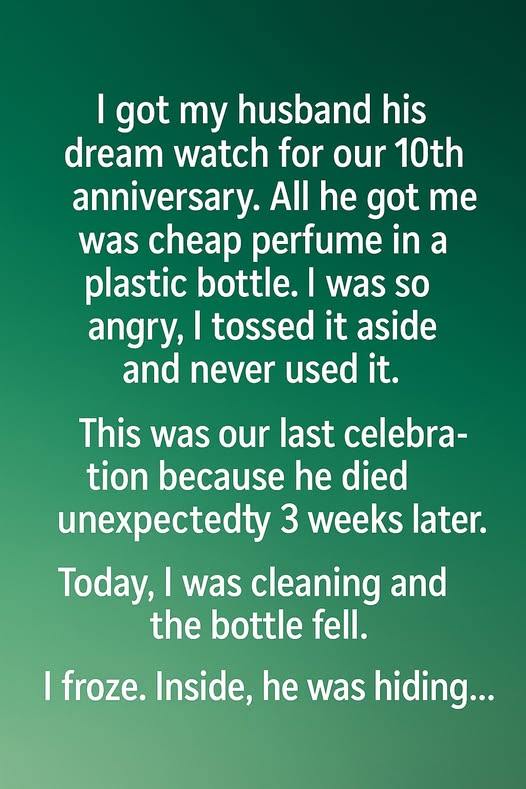
  • SOTD – The Perfume I Threw Away Held a Secret I Discovered Too Late

    SOTD – The Perfume I Threw Away Held a Secret I Discovered Too Late

    I bought my husband the watch he’d been dreaming about for years — a sleek, ridiculously expensive piece he’d never buy for himself. It was our 10th anniversary, a milestone I wanted to honor properly. I imagined he’d open it, smile that crooked smile of his, and pull me into one of those hugs that made the entire world feel steady.

    He did smile. He did hug me. And then he handed me my gift — a small plastic bottle of perfume that looked like something from a discount bin at the checkout counter.

    I wish I could say I hid my disappointment, but I didn’t. I forced a smile that even I didn’t believe. Later that night, when he wasn’t looking, I put the bottle in a drawer and shut it with more force than necessary. For days, just seeing it irritated me. I had spent months saving for his gift, and he had picked up something that looked like an afterthought.

    Three weeks later, he died.

    A heart attack — sudden, vicious, no warning. One minute he was teasing me about my terrible singing in the car, and the next he was gone. The world didn’t just crack — it collapsed. The house felt wrong. The bed felt too big. The silence became a physical weight pressing down on my chest.

    Grief does strange things to memory. I found myself replaying our anniversary night over and over, not because of the gift he gave, but because of the way I had acted. The way I had let disappointment take up space where love should have been. I kept thinking about the look in his eyes that night, the tenderness I barely acknowledged. I would’ve given anything to go back to that moment and throw my arms around him and tell him the gift didn’t matter. That he mattered.

    And that’s what hurt the most — all the small things I took for granted. His laugh from the kitchen, his terrible whistling, the way he reminded me to drink water like I was one of the kids he had to keep alive. I would’ve welcomed a cheap perfume every year for the rest of my life if it meant one more morning waking up beside him.

    Months passed. Grief came in waves — unpredictable, sharp, sometimes unbearable. But life doesn’t ask permission before moving forward. Eventually, I found myself doing things I hadn’t touched since the day he died — reorganizing drawers, cleaning shelves, dealing with the clutter that had gone untouched.

    That’s when it happened.

    I was dusting the dresser and accidentally knocked the forgotten perfume bottle onto the floor. It tumbled, hit the hardwood, and the cap popped off. Something tiny — a folded piece of paper — slipped out and landed near my foot.

    For a moment, I froze.

    I didn’t expect anything. Maybe a tag, maybe a price sticker. But when I picked it up, I recognized his handwriting immediately — rushed, messy letters, the kind he used when he was trying to write quickly before he forgot a thought.

    My heart stuttered as I unfolded it.

    “I know this perfume is temporary,” the note began. “But next month I’ll surprise you with the necklace you’ve been dreaming about. Thank you for believing in me even when I don’t say it enough. You are my forever gift.”

    I sank onto the floor, clutching the paper so tightly it shook. The tears came fast — raw, loud, the kind that leave you gasping for air. I pressed the note to my chest, wishing I could fold myself into it, wishing I could reach back through time and tell him I was sorry. That I saw him. That I understood.

    He hadn’t bought me a cheap perfume out of carelessness. He had chosen something small, knowing it wasn’t the real gift, because he was saving for something bigger. Something thoughtful. Something he knew I wanted. The perfume bottle had been a placeholder — and I had thrown it aside without giving him the benefit of the doubt he always gave me.

    He had been planning a surprise.

    He had been thinking ahead.

    He had been loving me in the quiet way he always did — steady, sincere, without showmanship.

    And I had missed it.

    I sat there for a long time, holding that bottle like it was made of gold. The perfume itself didn’t matter — it never had. What mattered was the intention tucked inside it, the message he left without knowing it would become the last gift he ever gave me.

    That night, I put the bottle on my bedside table. Not because I needed a reminder of the mistake I made, but because I needed a reminder of him — his softness, his effort, his heart. The kind of love that works quietly in the background, unnoticed until the silence makes you realize how loud it truly was.

    I sprayed the perfume once. It didn’t smell expensive. It wasn’t remarkable. But it smelled like something he chose for me, something he touched, something he carried home thinking it was just step one of a bigger surprise. And somehow, that made it beautiful.

    Grief teaches you things you don’t want to learn. It teaches you that moments matter more than gifts. That ordinary days are the ones you’ll ache for. That sometimes love is packaged in ways you don’t immediately recognize — unpolished, imperfect, humble.

    I used to think the perfume was cheap. I was wrong. It was priceless, because it held the last words he meant for me to find.

    Now, every night before bed, I touch the bottle lightly, the same way I once touched his shoulder in passing. Not to mourn what I lost, but to honor what I had — a love so genuine that even its simplest gesture carried something deeper than I realized.

    Sometimes the real gift isn’t what’s inside the box. It’s the heart that put it there.

    And sometimes, tragically, we only understand the value of that heart when it’s no longer here to beat beside us.

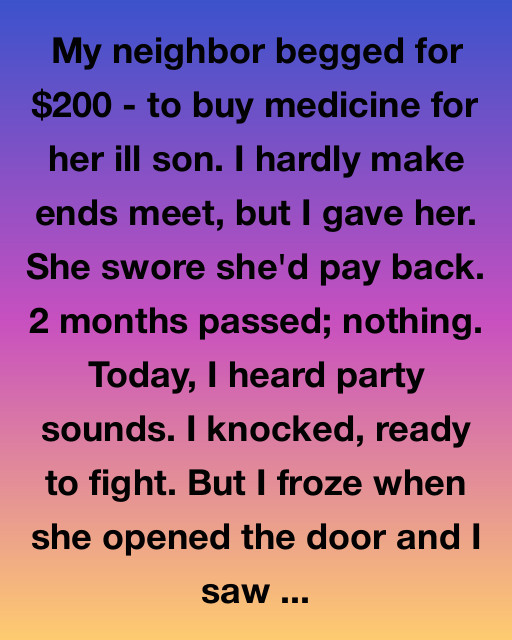
  • The $200 That Changed Everything!

    The $200 That Changed Everything!

    My neighbor showed up at my door one evening with red eyes and trembling hands, asking if she could borrow $200. Her little boy needed medicine, she said, and she was short. I’m barely making it myself—counting bills, praying my card doesn’t fail at checkout—but I handed her the money anyway. She promised she’d pay me back soon.

    Weeks dragged by. Then months. Nothing. No knock, no envelope, not even a text. Just silence.

    And then, one night, I heard music through our thin apartment walls. Laughter, kids yelling, chairs scraping. A party. My stomach twisted. She couldn’t pay me back, but she could host a celebration? Really?

    I marched over, rehearsing a speech in my head about trust and respect—how people like us can’t afford to get burned. But when she opened the door, flushed and startled, everything I had planned evaporated.

    She stepped aside.

    Her living room was packed with kids. Droopy balloons hung from the walls. A crooked cake sat on the table with shaky icing that read: “WELCOME HOME, CALEB” and underneath, “YOU’RE GOING HOME!”

    It hit me immediately: the frail boy in the corner, smiling, hair growing back in uneven tufts, clutching a paper cup like it was the best night of his life. He’d been in the hospital for months. He’d been fighting cancer.

    Every ounce of anger I carried deflated on the spot.

    The money I’d lent wasn’t a scam. It paid for whatever the insurance didn’t. For meds. For chemo. For keeping her kid alive. The party wasn’t indulgence—it was relief.

    She must’ve seen my face change. “I meant to pay you back,” she said, voice shaking. “I just… every time I saved a little, something else happened. His counts dropped. He needed more treatment. I wasn’t thinking about anything except the next appointment.”

    I had no smart reply. Just guilt and heat crawling up my neck.

    Then Caleb walked over and hugged me like I was family. “Thank you for helping my mom,” he murmured.

    I felt myself shrink to a fraction of my size.

    Later, she knocked on my door again, holding a slice of cake wrapped in foil and a small envelope. “It’s not the full amount,” she said softly. “But it’s something. I’ll bring the rest next week.”

    There were a few bills inside—more than I expected. We ended up sitting together on the shared concrete steps, listening to the muffled sounds of kids playing outside. She admitted she’d stayed away out of shame, afraid to face me while she was drowning.

    Over the following weeks, she made good on the rest in small amounts—twenty here, forty there—always apologizing even though she didn’t need to anymore. By then, the money wasn’t the point. We started talking, really talking. About bills. About exhaustion. About the fear that claws at you when life keeps swinging.

    We learned we were more alike than we realized. Both single parents. Both scraping by. Both held together with stubbornness and caffeine. She cleaned offices at night and grabbed any shift she could on weekends. I worked three jobs and still felt like I was running on fumes.

    Eventually, we began helping each other without thinking twice. I’d watch Caleb when she picked up extra work. When I had leftover soup, I’d bring some over; she’d return my bowl wrapped neatly in a towel. She’d give me rides on mornings my bus pass was empty. She fixed the busted latch on my screen door like it was nothing. She had no money to offer, but she gave effort, kindness, time—all the currency that matters more.

    The building started feeling less like a stack of struggling strangers and more like a shared lifeline.

    Then one quiet night, after Caleb had gone to bed, she stopped by with a nervous look. “I want to start my own cleaning business,” she said. She already had a few regular clients who kept recommending her. “Would you… help me with the website stuff? You’re good with computers.”

    “Good with computers” was a stretch, but I had built a simple food truck site once. Good enough.

    For three weekends we sat hunched over my glitchy laptop, drinking terrible coffee, fighting the spinning loading icons like they were demons. She named the business “Second Chance Cleaning.” “For Caleb,” she said. “For both of us. For anyone who needs a fresh start.”

    We kept her story honest and straightforward on the site. Added photos. A simple booking form. Nothing fancy, but solid.

    At first, the phone barely rang. She hustled anyway. Handing out flyers. Asking for referrals. Showing up early and leaving late. Within a few months, demand exploded. She brought on two other single moms from the complex. They rotated childcare and shifts. Suddenly the building felt… connected. Like a quiet community working behind the scenes to keep each other afloat.

    One client, Mrs. Alvarez, a sharp older widow, noticed the organized scheduling and invoices. “Who handles all your paperwork?” she asked.

    “My neighbor,” she said proudly.

    A week later, Mrs. Alvarez asked me to stop by. “I hear you’re my mystery helper,” she joked. Then she offered me part-time administrative work managing her rentals. It paid more than two of my other jobs combined. I said yes so fast my voice cracked.

    Life didn’t magically turn easy, but it shifted. I could breathe a little. I replaced my dying laptop with a used but reliable one. Caleb got a secondhand bike and rode it like it was made of gold. I fixed the leaky faucet I’d ignored for a year.

    Then a young couple moved in across the street, exhausted and overwhelmed with a newborn. I did for them what my neighbor had done for me—helped where I could. An hour of babysitting. A warm meal. A list of local resources. One night the wife told me, with tired sincerity, “We wouldn’t have made it without you.”

    Funny how these things ripple.

    Nearly a year after I’d loaned her that shaky $200, my neighbor called me, voice trembling with excitement. She’d been nominated for a women-owned business grant—and she’d won. Fifteen thousand dollars.

    She reinvested it into her business: new equipment, better supplies, transportation, extra help. And then she came to my door holding an envelope.

    Inside was a check for $2,000.

    I stared at it, stunned. “You already paid me back,” I said.

    “This isn’t repayment,” she said firmly. “This is partnership. I want you to build simple websites for people like us—people starting from scratch. We can help them get seen. We can help them grow. Together.”

    I didn’t know what to say. That $200 I’d given with shaking hands—wondering if I’d make rent—had come back to me a hundred times over. Not just in cash, but in community. In work. In friendship. In the way my world quietly transformed.

    I almost lost all of it because I assumed the worst.

    Here’s the truth: people disappear for reasons you can’t see. Shame. Fear. Survival. Sometimes what looks like betrayal is just someone barely hanging on.

    Give what you can. Protect yourself, but don’t harden to the point nothing can get through—not help, not grace, not the unexpected things that grow from tiny, shaky acts of kindness.

    Sometimes the return just takes the long way around.