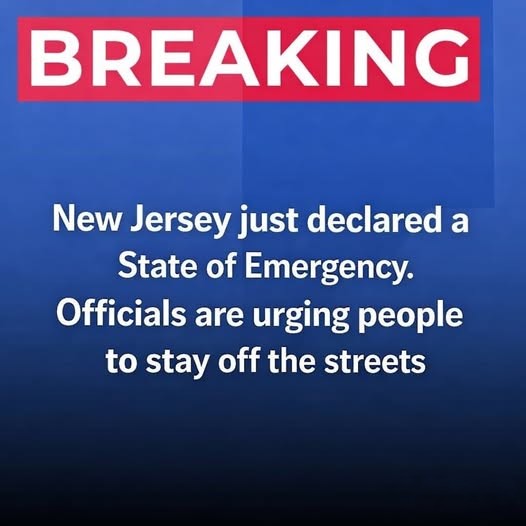
The atmosphere across New Jersey shifted with a sudden, bone-chilling weight as the sky turned the color of bruised iron. What began as a standard winter advisory rapidly escalated into a full-scale meteorological crisis, forcing the hand of the state government. By early afternoon, the transition from a routine seasonal chill to a high-stakes emergency was complete. Acting Governor Tahesha Way, stepping into a role of urgent leadership, officially declared a State of Emergency effective at 1:00 PM today. The declaration serves as both a legal mechanism to mobilize massive resources and a stark warning to millions of residents: the Garden State is currently in the crosshairs of a powerful, intensifying winter monster.
The storm, which began as a whisper of sleet along the southern coast, has transformed into a relentless barrage of heavy snow and freezing rain. For a region still shaking off the remnants of the holiday season, the timing could not be more disruptive. The state’s arteries—the Garden State Parkway, the New Jersey Turnpike, and the intricate web of local corridors—are rapidly becoming treacherous ribbons of black ice and slush. Forecasts from the National Weather Service have grown increasingly grim, with projected accumulations now sitting between four and nine inches for a vast swathe of the state. While those numbers might seem manageable in a vacuum, the specific “recipe” of this storm—a volatile mix of heavy, wet snow followed by a flash-freeze of sleet—creates a physical environment that is nearly impossible to navigate safely.
In the hallways of Trenton and in emergency management bunkers across all twenty-one counties, the mood is one of clinical focus. The State of Emergency allows for the redirection of state funds, the activation of the National Guard if necessary, and the streamlining of bureaucratic hurdles that might otherwise slow down a rescue or a salt truck. Acting Governor Way was clear in her address: this is not a drill, nor is it a minor inconvenience. The directive is simple but vital—stay off the roads. Every private vehicle that spins out on an icy overpass is not just a personal tragedy; it is a barricade that prevents snowplows from clearing the path and ambulances from reaching the vulnerable.
On the ground, the mobilization is a sight of industrial defiance. Thousands of state and local crew members have been working in rotating shifts, their yellow beacons flashing against the white-out conditions. Pre-treatment of the roads with brine had begun twenty-four hours prior, but the sheer volume of precipitation is threatening to wash away those efforts. The sound of the plow blade scraping against asphalt has become the rhythmic soundtrack of the afternoon, a lonely noise in neighborhoods where most residents have heeded the call to retreat indoors. Power companies have also moved to a high-alert status, prepositioning line crews in areas where the combination of heavy snow and high winds is most likely to bring down century-old oak trees and snap utility lines like brittle toothpicks.
For travelers caught in the post-holiday rush, the storm is a logistical nightmare. Newark Liberty International Airport has seen a cascade of cancellations, leaving thousands of passengers stranded in terminals, watching the runways disappear beneath a thickening white blanket. Rail services have implemented “storm schedules,” slowing down transit to ensure that tracks remain clear and switches don’t freeze shut. The irony of the situation is not lost on those trying to return home from visiting family; the very roads that brought them together are now the primary threat to their safety.
The geography of New Jersey creates a unique challenge for emergency responders during a storm of this magnitude. To the north, the hilly terrain of Sussex and Passaic counties acts as a funnel for the heaviest snow, while the coastal regions to the south deal with the more insidious threat of freezing rain and tidal flooding. As the mercury continues to drop, the “slush” currently sitting on the roads will inevitably harden into “black ice,” a transparent and deadly glaze that offers zero traction. This is the phase of the storm that officials fear most—the transition from a visual snowstorm to an invisible ice trap.
The human element of the State of Emergency is perhaps the most poignant. In local diners and gas stations, the talk isn’t just about the inches of snow, but about the elderly neighbor who might lose heat or the local pharmacy that might not open tomorrow. Community groups have mobilized digital “check-in” chains, ensuring that those living alone have what they need to weather the next forty-eight hours. The Acting Governor’s office has emphasized that while the state can plow the roads, it is the responsibility of the citizens to look out for one another. Emergency shelters have been prepared, equipped with back-up generators and warm cots, standing ready for the moment the power grid inevitably flickers and fails in the hardest-hit zones.
As evening approaches, the storm is expected to enter its most violent stage. The wind, currently gusting at thirty miles per hour, is predicted to sharpen, creating “white-out” conditions where visibility drops to near zero. In these moments, even the most heavy-duty state equipment must sometimes pull back, waiting for a break in the onslaught to resume clearing operations. For those at home, the advice remains consistent: keep your devices charged, have a battery-operated radio handy, and ensure that your heating vents are clear of snow buildup to prevent carbon monoxide risks.
The financial impact of a state-wide shutdown is significant, but the cost of inaction is far higher. By declaring the emergency at 1:00 PM, the administration aimed to catch the “swing shift” of commuters before they could become trapped in the evening’s peak intensity. It was a calculated move to prioritize human life over economic momentum. The quiet that has descended over the state is eerie, broken only by the howl of the wind and the occasional siren of a state trooper checking on a stranded motorist. New Jersey is a state built on movement—on the constant hum of commerce and transit—but for now, that hum has been silenced by the sheer weight of the winter elements.
Live coverage continues to stream from newsrooms, where meteorologists point to radar screens filled with deep blues and purples, indicating the heaviest bands of precipitation still to come. The “State of Emergency” label is not just a headline; it is a shield. It provides the legal framework to keep the most vulnerable safe and the most reckless off the streets. As the lights flicker in homes from Cape May to High Point, the collective hope is that the infrastructure holds and that the sunrise reveals a landscape that is beautiful, rather than broken. For now, the Garden State waits, hunkered down and shivering, as the winter storm of 2026 continues its relentless march across the Atlantic coast.