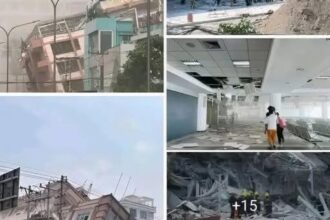
Late Wednesday, a massive and sudden earthquake ripped through the Alaskan Peninsula, sending powerful shockwaves across the region and immediately triggering high-level tsunami warnings. The seismic event, which reached a staggering magnitude of 8.2, caused widespread alarm as coastal communities braced for a potential disaster.
The United States Geological Survey reported that the quake originated about 91 kilometers east-southeast of Perryville, Alaska. It struck at a depth of roughly 35 kilometers. While the depth of the rupture helped cushion some of the immediate surface destruction, the sheer intensity of the 8.2 magnitude was more than enough to put emergency protocols into high gear across a vast area.
Almost immediately after the shaking stopped, warning systems were activated. In coastal towns like Kodiak, emergency sirens pierced the air, and residents were told to evacuate to higher ground without delay. Social media footage from the scene captured the tense atmosphere as the haunting sound of alarms signaled that a dangerous tsunami could be racing toward the shore.
State and federal authorities responded with urgency. The National Tsunami Warning Center issued official alerts for southern Alaska, specifically covering the coastline from Hinchinbrook Entrance to Unimak Pass. These warnings were treated with extreme seriousness, as quakes of this scale are notorious for generating lethal ocean surges that can devastate both nearby and distant coastlines.
The initial reach of the warnings extended deep into the Pacific. Regions as far away as Hawaii and Guam were placed under temporary alerts while scientists analyzed wave propagation data. Although these specific alerts were eventually canceled after further review, the early caution highlighted the unpredictable and dangerous nature of such a massive geological event.
Governor Mike Dunleavy confirmed that Alaska’s State Emergency Operations Center was activated immediately to coordinate the response between local and federal agencies. At the same time, international monitoring bodies like the Pacific Tsunami Warning Center began collaborating with experts in Japan and New Zealand to assess any trans-Pacific risks.
In the hours following the main event, the ground continued to shift. A series of at least eight significant aftershocks were recorded, two of which surpassed a magnitude of 6.0. While aftershocks are a standard part of a major earthquake’s aftermath, they created a secondary layer of fear for residents, as these tremors can weaken already stressed structures and trigger landslides.
Fortunately, early assessments suggest that there were no immediate reports of major casualties or catastrophic structural damage. While this is a massive relief given the 8.2 magnitude, officials are staying cautious. They emphasized that full damage inspections and coastal monitoring are ongoing and that the situation can change as more remote areas are surveyed.
This event serves as a vivid reminder of how quickly life can change in the “Ring of Fire,” an area known for intense tectonic movement. A moment of normal evening activity was instantly replaced by a violent shift in the Earth’s crust, followed by sirens and chaos. An 8.2 magnitude earthquake is a rare and monumental release of energy, equivalent to millions of tons of explosive force.
As the situation stabilizes, the focus remains on monitoring ocean levels and ensuring public safety. Emergency teams are staying active, and communication lines remain open to provide the public with the latest data. For the residents of Alaska, the night was a stark example of the power of nature and the vital importance of being prepared for a disaster that gives no warning. While the shaking has ceased, the full impact of such a massive quake will continue to be analyzed in the coming days as the world watches the recovery efforts.