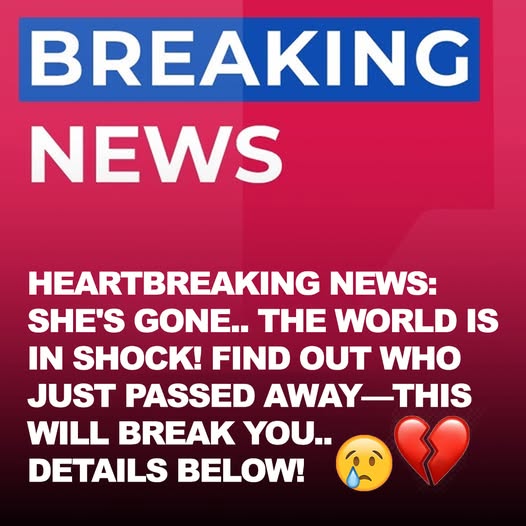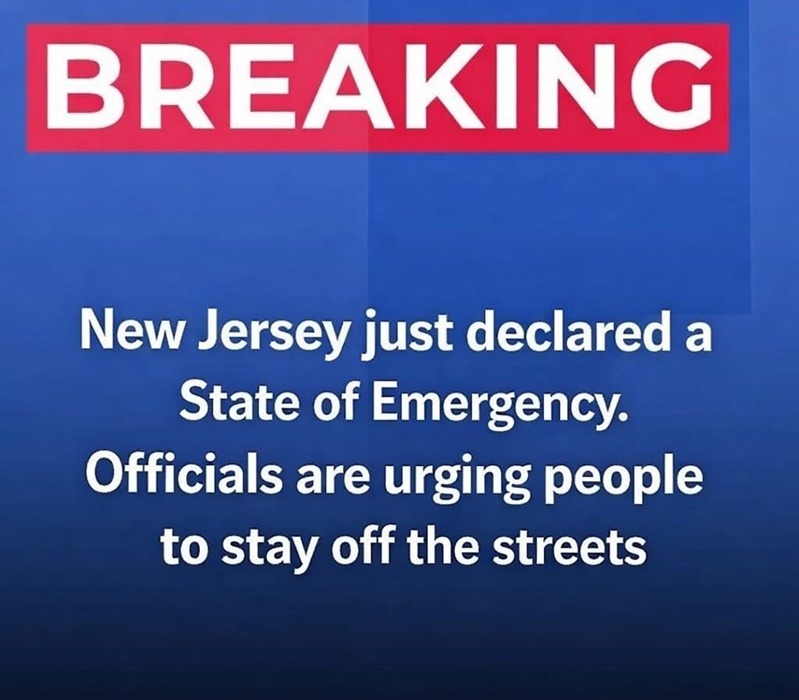
The digital age has fundamentally altered the velocity at which information travels, often outstripping the mechanisms of verification that once served as the gatekeepers of public discourse. In recent years, breaking news alerts have transitioned from occasional interruptions to a constant, high-decibel presence in daily life. Notifications flash across smartphone screens with relentless frequency, social media feeds race with unconfirmed headlines, and images claiming urgent societal developments are shared thousands of times before the dust of an event has even settled. One recurring phenomenon involves the circulation of messages such as: “BREAKING: New Jersey just declared a State of Emergency. Officials are urging people to stay off the streets.”
Such messages are designed to command immediate attention. The phrase “state of emergency” carries significant legal and psychological weight, and the directive to “stay off the streets” implies an imminent threat to life or infrastructure. However, in an era where misinformation can be manufactured and distributed with the click of a button, it has become essential for the public to pause and evaluate the context of these claims. Understanding the legal framework of emergency declarations, the motivations behind viral misinformation, and the proper channels for official communication is a critical component of modern civic literacy.
In the state of New Jersey, a state of emergency is not merely a rhetorical device used to denote a crisis; it is a specific administrative and legal tool utilized by the executive branch to facilitate a streamlined response to extraordinary circumstances. Under state law, the Governor holds the authority to issue an executive order declaring a state of emergency when conditions—ranging from natural disasters like hurricanes and blizzards to public health crises or large-scale infrastructure failures—pose a substantial risk to public health, safety, or property. This declaration empowers state agencies to bypass certain bureaucratic hurdles, reallocate funds rapidly, coordinate with federal partners like FEMA, and, if necessary, implement restrictions on travel or commerce to ensure public safety.
It is important for residents to recognize that such a declaration does not automatically signal a state of total lockdown or immediate peril for every individual. New Jersey’s emergencies can be highly localized, affecting only specific coastal counties during a storm, or statewide in the event of a broad health crisis. When officials urge people to stay off the streets, the motivation is typically centered on harm reduction rather than the incitement of alarm. During severe weather, for instance, reducing civilian traffic minimizes the likelihood of accidents and ensures that first responders, snowplows, and utility crews can navigate the roadways without obstruction. Staying home in these scenarios is often the most effective way for a citizen to contribute to the collective safety effort.
The rise of viral emergency claims, however, has complicated the public’s ability to discern genuine warnings from digital noise. Social media platforms, while useful for the rapid dissemination of legitimate updates from the New Jersey State Police or the Governor’s Office, are also breeding grounds for unofficial posts that lack crucial context. A post labeled “BREAKING” often triggers an emotional response that bypasses the reader’s critical thinking. In many instances, these viral posts are recycled screenshots from previous years or different geographic locations, repurposed to generate engagement or “clickbait.” The speed at which these posts circulate often creates a “lag time” during which panic can spread before a formal fact-check can be issued.
The consequences of unverified information are far from trivial. When a false state of emergency claim goes viral, it can lead to the unnecessary cancellation of school, work, and medical appointments, placing an undue burden on the economy and personal well-being. More dangerously, it can overwhelm emergency dispatch centers with inquiries from worried citizens, potentially delaying responses to actual life-threatening situations. In extreme cases, misinformation can lead to panic-buying or unsafe behavior as people act on perceived rather than real threats.
New Jersey residents should understand that legitimate emergency communications follow a standardized, multi-platform approach. When a state of emergency is truly in effect, the announcement originates from the Governor’s Office and is disseminated through the New Jersey Office of Emergency Management (NJOEM), verified social media accounts with official “checkmarks,” and established news organizations. A single, unsourced image or a vague tweet from an unverified account is rarely the way a government communicates a serious legal declaration. Furthermore, images shared online are frequently stripped of their original timestamps and metadata. A news banner showing “State of Emergency” might have been a legitimate report during Hurricane Sandy in 2012 or a major snowstorm in 2018, yet it can be presented today as if it were happening in the current hour.
Evaluating the credibility of an alert requires asking a few fundamental questions: What specific event triggered this? Is the alert coming from a source with a track record of accountability? Are reputable news outlets such as the Associated Press or local affiliates reporting the same information? In the absence of corroboration, a claim should be viewed with a high degree of skepticism. Professional journalists operate under editorial standards that prioritize accuracy over speed, whereas viral posters are often incentivized by the opposite.
New Jersey’s geography—positioned between major metropolitan hubs and boasting an extensive coastline—makes it particularly susceptible to various emergencies, from Nor’easters to heatwaves. Because residents are accustomed to seasonal weather challenges, they may be more inclined to believe emergency claims during active weather months. This familiarity underscores the need for “information hygiene.” Preparing for emergencies is a wise practice that should involve maintaining a basic supply kit and knowing local evacuation routes, but this preparation should be rooted in readiness, not reactionary fear.
Ultimately, the responsibility of navigating the digital landscape rests with the individual. Every person who shares a post plays a role in the broader information ecosystem. By choosing to verify before sharing, residents can help mitigate the spread of unnecessary panic. In New Jersey, as in any other state, the “state of emergency” remains a vital tool for public protection, but its effectiveness relies on a well-informed public that can distinguish between a formal government action and a fleeting internet rumor. Critical thinking, combined with a reliance on official, transparent channels of communication, remains the most effective tool for ensuring public safety in the twenty-first century. As the world continues to move faster, the ability to slow down and verify remains our greatest collective defense.