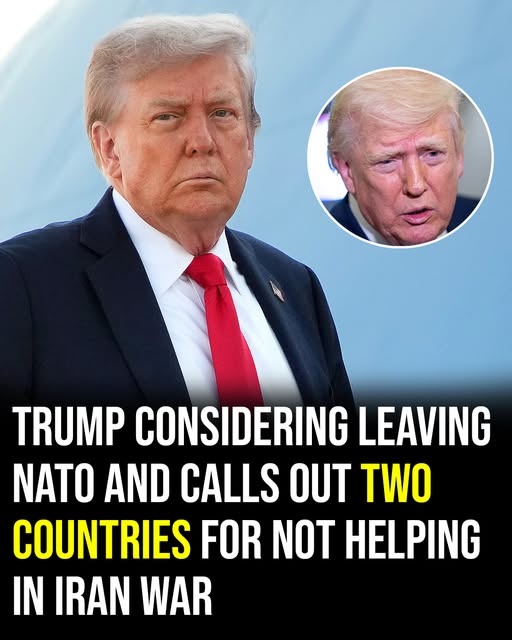
The relationship between the United States and its historic partners has hit a turbulent patch as Donald Trump once again brings up the potential for a U.S. exit from NATO—this time using much more definitive and blunt language. In a recent discussion, Trump indicated that his long-standing doubts about the alliance have only deepened. What used to be seen as a tactic to push for internal reform has now transformed into a serious look at a total withdrawal. He stated that the idea of leaving is “beyond reconsideration,” signaling that a departure is no longer just a hypothetical threat.
The timing of this escalation is strategic. It follows growing friction over geopolitical conflicts, particularly involving Iran, which has highlighted significant disagreements between the U.S. and its European counterparts. Trump argues that the lack of military and diplomatic backing from key allies during these tensions proves that NATO is no longer serving its intended purpose. He even went as far as labeling the 32-nation alliance a “paper tiger,” a stinging critique suggesting that the organization lacks real strength and credibility in the modern world.
Since its founding in 1949, NATO has operated on the bedrock principle of collective defense: an attack on one member is an attack on all. By dismissing the alliance’s effectiveness, Trump is challenging the very foundation of transatlantic security. His frustrations are currently aimed at two of America’s oldest allies: the United Kingdom and France. He has publicly criticized the UK for what he perceives as a refusal to engage in more aggressive military action against Iran, while accusing France of actively blocking logistical and operational support for U.S.-led initiatives.
Trump’s critique often stems from his transactional view of international diplomacy. He tends to measure the value of a partnership by direct military contributions and defense spending rather than historical ties or shared democratic values. He recently took a jab at Britain’s naval capabilities and defense infrastructure, reinforcing his long-held grievance that many NATO members rely too heavily on American military might while failing to meet their own financial obligations.
This pattern of challenging established norms is not entirely new. During his time in office, he sparked international debate with his interest in acquiring Greenland from Denmark and his constant pressure on allies to hike their military budgets. However, the current conversation feels different due to the level of escalation. A U.S. withdrawal would not be a minor policy shift; it would be a fundamental earthquake in global strategy. As a founding member and the primary military power of the alliance, a U.S. exit would force every other member state to completely rethink their national security and the regional balance of power.
For the time being, a withdrawal remains a possibility rather than a finalized plan, but the intensity of the rhetoric is forcing high-level discussions in government offices across the globe. While allied leaders have responded with calls for unity and stability, the underlying tension is undeniable. The stakes are incredibly high, as NATO has been the primary framework for Western security for over seventy years.
Ultimately, Trump’s stance boils down to whether he believes the current structure of the alliance still benefits American interests. For the rest of the world, the question is much more daunting: what does global security look like without a unified NATO? As this debate continues to unfold, it is becoming clear that the future of the world’s most powerful military alliance is no longer a settled issue, and the eventual resolution could redefine international relations for decades to come.