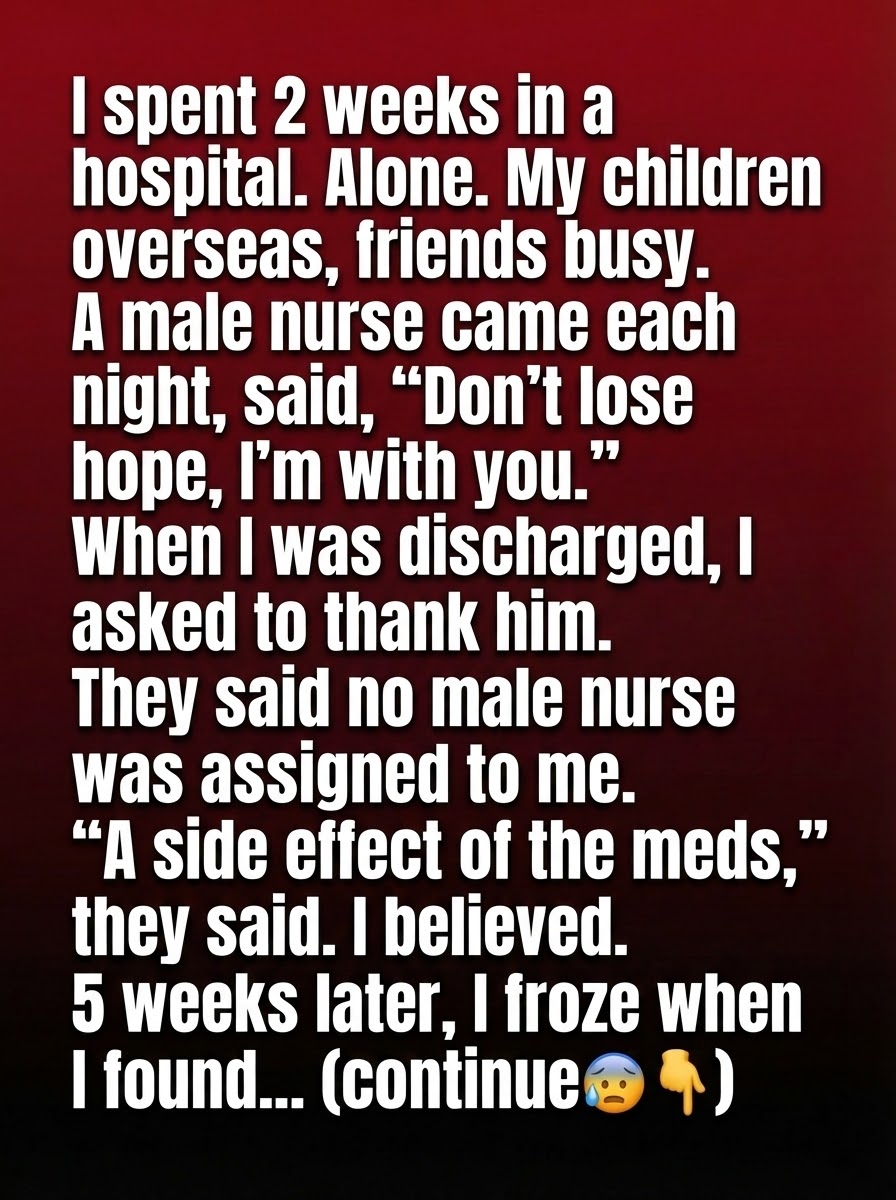
The hospital room was quiet in a way that felt heavier than silence should. Machines hummed softly, monitors blinked in steady rhythms, and the hallway outside my door echoed with footsteps that never seemed to stop long enough to belong to anyone I knew. I had been admitted for what was supposed to be a short stay, but complications stretched it into two long weeks. Somewhere along the way, the days began to blur together.
My children lived in different states, tied down by jobs, families, and responsibilities that made spontaneous visits impossible. Friends called when they could, sent messages full of encouragement, promised to visit soon. But “soon” kept slipping past visiting hours. I understood. Life doesn’t pause just because someone ends up in a hospital bed. Still, understanding didn’t make the room feel any less empty once the lights dimmed and the night shift took over.
During the day, there were distractions. Doctors came and went, nurses adjusted IVs, aides brought meals I barely touched. The world felt functional, busy, almost normal. Nights were different. The pace slowed. Conversations grew quieter. The hospital revealed its other face—the one built of waiting, uncertainty, and long stretches of thought you can’t escape.
It was during those nights that he appeared.
He was a nurse, or at least I believed he was. He came in quietly, usually just before midnight, when the floor settled into a low murmur and most patients were asleep. He spoke softly, never rushed. He asked how I was feeling, whether the pain was manageable, whether I needed anything before trying to rest. His voice carried a calm certainty that cut through the anxiety I tried so hard to hide.
Sometimes he stayed only a minute or two. Other nights, he lingered a bit longer, standing near the foot of the bed, reminding me that healing wasn’t a straight line and that setbacks didn’t mean failure. He never said anything dramatic or profound. Just steady, reassuring words. “You’re doing better than you think.” “Your body knows what to do.” “Don’t give up on yourself.”
I never caught his name. I assumed it was on his badge, but I never thought to look closely. In that environment, roles blur. You trust the people who come in wearing scrubs and speaking gently. You don’t question them. You’re just grateful someone is there.
Over time, his visits became something I quietly depended on. I found myself staying awake longer, listening for footsteps, feeling a small sense of relief when the door opened and he stepped inside. Those few minutes made the night feel less endless, less isolating. In a place where everything felt clinical and impersonal, his presence added warmth.
Eventually, the day came when the doctors said I was well enough to go home. Discharge paperwork replaced test results. The bed that had held me for two weeks suddenly felt temporary, already forgetting me. As I waited for my ride, I felt an unexpected sadness. The hospital had been exhausting and lonely, but it had also been the setting for quiet moments of kindness that mattered more than I realized at the time.
Before leaving, I stopped at the front desk. I wanted to say thank you. I explained that there had been a male nurse who checked on me most nights and that I hoped someone could pass along my gratitude. The staff exchanged glances. One of them pulled up my chart, scrolling through assignments. Another checked the night shift schedule.
They told me, politely and carefully, that no male nurse had been assigned to my room during my stay.
At first, I thought it was a mistake. Hospitals are busy places. Schedules change. People cover shifts. I insisted gently, describing him as best I could. Calm voice. Came by late at night. Always checked on me before the floor settled.
They checked again.
Still nothing.
One of the nurses smiled sympathetically and suggested that stress, medication, or exhaustion could have affected my memory. Hospital stays can do that, she said. The mind fills in gaps when the body is under strain. I nodded, thanked them, and left, unsettled but unwilling to argue. I had bigger things to focus on, like getting home and continuing to heal.
For a while, I pushed the confusion aside. Recovery demanded attention. Physical therapy appointments, follow-up visits, relearning patience with my own limitations. Life slowly resumed its rhythm. The hospital faded into something that felt distant, like a strange, self-contained chapter.
Weeks later, while unpacking my hospital bag, I found the note.
It was folded neatly, tucked into a side pocket I was sure I’d already checked. The paper was plain. No letterhead. No logo. Just a short message written in careful handwriting: “Don’t lose hope. You’re stronger than you think.”
There was no signature.
I sat down and stared at it for a long time. My first instinct was to assume it came from a nurse or staff member who didn’t want recognition. That would have made sense. Hospitals are full of quiet kindnesses that never get acknowledged. But something about the note felt different. It echoed the exact words I’d heard night after night, spoken in that calm, steady voice.
I tried to remember writing it myself, maybe as a reminder during a particularly low moment. But the handwriting wasn’t mine. I was sure of that.
In the end, I stopped trying to solve it.
Whether the nurse existed exactly as I remembered him or whether my mind created a presence to get me through the hardest nights no longer mattered. What mattered was what those moments had done for me. In the middle of loneliness and fear, I had felt supported. I had felt seen. And that feeling carried me forward long after I left the hospital.
The note sits on my dresser now. I don’t frame it or show it off. It’s just there, a quiet reminder. When recovery feels slow, when doubt creeps in, when the nights feel a little too long again, I read it and remember that hope doesn’t always arrive loudly or logically.
Sometimes it comes in the form of a soft voice in the dark. Sometimes it comes as words written without a name. And sometimes, it comes from a strength inside you that only wakes up when you think you’re completely alone.
Leave a Reply