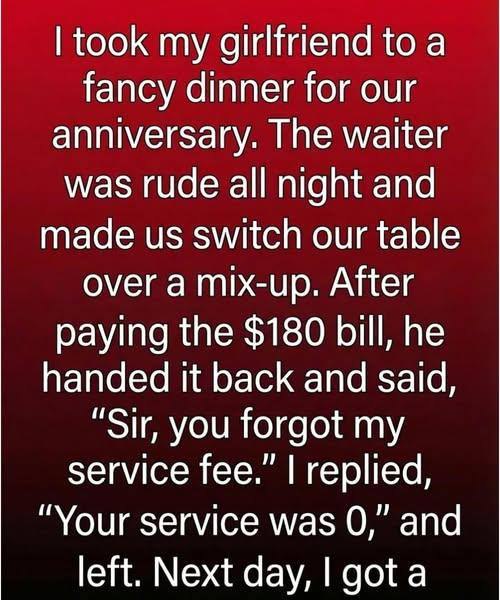
I had been picturing that evening for weeks, replaying it in my head during quiet moments at work and on long drives home. It wasn’t meant to be extravagant, just meaningful. I’d set money aside carefully, chosen a restaurant known for its understated elegance, and imagined a night where time slowed down enough for two people to really see each other. Soft lighting, muted conversations, crisp linens, glasses catching the glow of candlelight—everything about the place promised intimacy.
When my girlfriend arrived, smiling in that way that always makes the room feel warmer, I thought the night was unfolding exactly as planned. She looked beautiful without trying, comfortable and confident, and I felt that familiar mix of gratitude and excitement. This was someone I genuinely wanted to share moments with, not just milestones but ordinary evenings elevated by intention.
At first, everything flowed. We ordered appetizers and laughed over stories we’d both told before but never tired of hearing. We talked about work frustrations, half-formed plans for the future, small dreams that felt safer to share in a quiet corner of a nice restaurant. We toasted to how far we’d come together, and for a while, the rest of the world seemed to fall away. It felt like the kind of night you remember not for what happened, but for how it felt to simply be present.
Then, subtly at first, things began to shift.
The waiter had been distant from the start, but it became more noticeable as the evening went on. Questions were answered with clipped responses. Requests were met with visible irritation. When we asked about a dish, he sighed as if we were interrupting something far more important than our dinner. I tried to ignore it. Everyone has off nights. I didn’t want to let something small derail what we were enjoying.
Halfway through the meal, he returned and told us we needed to move to another table. There had been a “mistake,” though he didn’t explain what kind. No apology, no acknowledgment of the disruption—just an expectation that we would comply without question. We gathered our things and relocated, the moment broken like a snapped thread. The new table was fine, technically, but the rhythm was gone. The sense of ease we’d built was replaced by an uncomfortable awareness that we were no longer entirely welcome.
I told myself it didn’t matter. A restaurant is just a place. What mattered was who I was sitting across from. My girlfriend noticed the tension too and reached for my hand under the table, giving it a gentle squeeze. It was her way of reminding me that the evening didn’t belong to the staff or the setting—it belonged to us.
Still, every dismissive glance and impatient tone chipped away at the joy. Conversation became more guarded, laughter a little less natural. I could see her trying, see both of us trying, to salvage the atmosphere we’d hoped for. It wasn’t anger that settled in, but disappointment. The quiet kind that doesn’t explode, just sits heavy in your chest.
When the bill arrived, it totaled $180. I didn’t hesitate. I paid, because that part wasn’t the issue. I wanted to leave with grace, to step out without turning the evening into something uglier than it already felt. We stood, gathered our coats, and prepared to go.
That’s when the waiter returned.
“You forgot the service fee,” he said flatly, holding out the receipt as if I’d committed some offense.
It wasn’t the money that stung. It was the assumption. The complete disregard for the experience we’d just had, for the way we’d been treated from the moment we sat down. It was the idea that courtesy was owed regardless of conduct, that respect was automatic even when none had been shown.
I didn’t argue. I didn’t raise my voice. I didn’t make a scene.
I simply said that the service hadn’t earned one, thanked him, and walked out.
Outside, the night air felt cooler, cleaner. In the car, the silence lingered for a moment before doubt crept in. Had I overreacted? Should I have just paid and moved on? Those questions hovered, the way they always do when you assert a boundary instead of swallowing discomfort.
But we didn’t talk about the restaurant for long.
Instead, we talked about respect—how easily it’s overlooked, how quietly it shapes our experiences. We talked about how moments like this reveal things, not in dramatic confrontations but in small choices. What you accept. What you let slide. What you decide is worth standing your ground over, even when it would be easier not to.
By the time we got home, the disappointment had softened into something reflective. The night hadn’t been what I planned, but it had still mattered. In an odd way, it had brought clarity.
The next afternoon, my phone rang. It was the restaurant manager.
He explained that he’d reviewed the situation and wanted to hear my side. I told him calmly what had happened, not embellishing, not venting—just laying out the facts as I experienced them. I didn’t expect much. Calls like that often feel procedural, more about damage control than genuine concern.
But to my surprise, he apologized. Not vaguely or defensively, but sincerely. He acknowledged that the waiter’s behavior had been inappropriate and thanked me for speaking up. He said they would address it internally.
When the call ended, I didn’t feel triumphant. There was no sense of winning. What I felt instead was closure. A quiet satisfaction that I hadn’t ignored my instincts or talked myself out of respecting my own experience.
The dinner hadn’t gone as planned. It wasn’t the flawless, romantic evening I’d imagined. But it left me with something more enduring than a perfect memory.
It reminded me that dignity doesn’t require confrontation, only honesty. That respect isn’t demanded through volume or anger, but through clear boundaries. And that once respect is lost, it costs far more than any bill ever could.
Sometimes the lessons that stay with us come from nights that go wrong, not right. And sometimes, walking away calmly says more than any argument ever could.
Leave a Reply