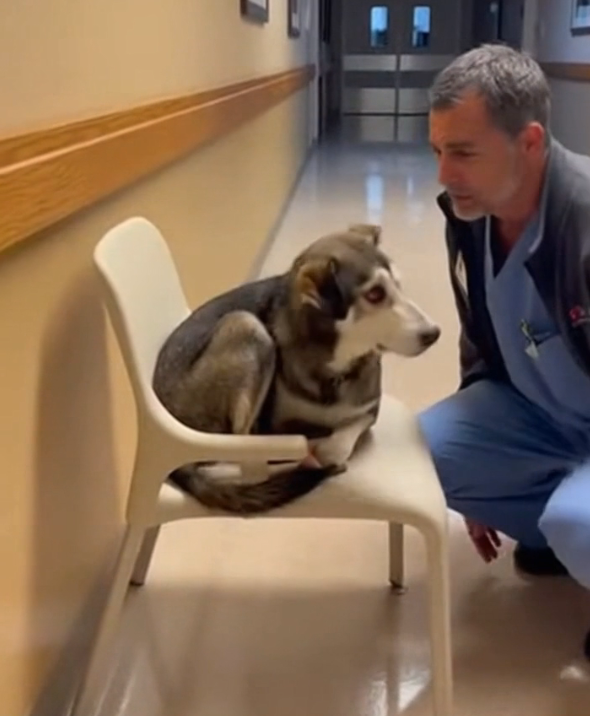
The dog did not move when the gurney rolled past.
It stayed curled into itself on a cheap plastic chair—white, scuffed, meant for people who were waiting for news they might not survive. The fluorescent lights hummed above. Shoes squeaked. Voices passed like weather. The dog stayed.
A doctor slowed, then stopped.
He looked down at the animal—medium-sized, brown-and-cream fur dulled by weeks of stress, ribs faint beneath the coat. The dog’s paws trembled, tucked under its chest, nose pressed into the curve of its tail. One ear lifted at the sound of the doctor’s shoes, then flattened again.
The doctor bent, lowering his voice without knowing why.
“Hey, buddy,” he said. “Where’s your family?”
The hallway froze.
A nurse paused mid-step.
A man holding a paper cup stopped breathing for a beat.
Even the elevator ding felt too loud.
The dog lifted its head.
Its eyes were red-rimmed and glassy, the way eyes get when sleep comes in short, frightened pieces. It did not bark. It did not whine. It only looked past the doctor—down the corridor—toward the double doors marked ICU.
The doctor followed the gaze.
Then he noticed the collar.
Old leather. Cracked. A tag rubbed nearly smooth by fingers and time. No number. No address. Just a name, faintly etched.
“Buddy.”
The doctor straightened slowly. Something tightened in his chest.
“Whose dog is that?” he asked the nurse.
The nurse swallowed. “We don’t know,” she said. “He’s been here all night.”
And that was when the dog laid its head back down—carefully, deliberately—like someone who had decided to wait, no matter how long it took.
The security guard had tried first.
“Can’t have animals in the hallway,” he’d said gently, crouching. “C’mon, boy. Let’s go.”
The dog stood—only to take three steps toward the ICU doors before sitting again. When the guard reached for the collar, the dog leaned away, eyes pleading, not aggressive. The guard sighed and stepped back.
The dog curled up again.
A volunteer brought water. He drank, then placed his chin on the rim and stared down the corridor.
That’s when Nurse Elena remembered.
“Wait,” she said. “I saw him earlier—yesterday afternoon.”
She closed her eyes, piecing it together. A man had come in soaked from the rain, clothes smelling faintly of engine oil and wet wool. Late 60s, white hair matted to his forehead, hands shaking. He’d been clutching his chest, breathing hard.
And beside him—this dog.
The man had collapsed near the intake desk.
They rushed him through the doors.
The dog had tried to follow.
“Sir, we need to take him now,” Elena had said. The man nodded weakly, knelt with effort, and pressed his forehead to the dog’s.
“Stay,” he whispered. “I’ll be back.”
The doors closed.
The dog sat.
And waited.
Here came the first twist.
The man—Walter Greene—had no phone listed. No next of kin on file. No emergency contact. When his heart attack worsened and he was taken to surgery, there was no one to call.
Except a dog in the hallway.
The second twist surfaced hours later, when a janitor found a folded paper beneath the plastic chair. It was damp at the edges, smudged with paw prints.
A note.
“If anything happens to me, please don’t send Buddy to a shelter. He saved me once.”
Elena felt tears sting her eyes.
Saved him how?
The answer came from a social worker who recognized the name.
Walter Greene had been homeless for three years.
Before that, he was a machinist. A widower. A man who lost his home to medical bills after his wife’s cancer. He lived out of a van until the van died. He slept inառնալways—until Buddy found him.
The dog had appeared one winter night, thin and limping, and curled against Walter’s legs to survive the cold.
They had saved each other.
And now Buddy was returning the favor the only way he knew how.
By not leaving.
The night deepened.
Lights dimmed.
Footsteps softened.
The hospital learned the shape of waiting.
Buddy shifted positions every hour—standing, circling once, then lying back down with his chin on his paws. Each time the ICU doors opened, his ears lifted. Each time they closed without Walter, his body sank.
Dr. Harris—the same doctor who had asked the question—found himself returning between rounds. He brought a blanket. Buddy accepted it without lifting his head.
“Hang in there,” Harris murmured. “He’s fighting.”
Hours passed.
At 2:17 a.m., the code alarm sounded in the ICU.
Buddy stood.
His legs shook. His breath quickened. He paced, nails clicking on tile, then stopped directly in front of the doors.
Everyone felt it—the air tightening, the sense that something fragile was balancing on a knife’s edge.
Inside, surgeons worked under harsh lights. Hands moved fast. Voices clipped and urgent. Sweat streaked down faces.
Outside, a dog pressed his nose to cold glass.
At 2:42 a.m., the doors opened.
Dr. Harris stepped out, mask pulled down, eyes tired.
Buddy took one step forward.
Harris knelt.
“We got him through,” he said softly. “He’s stable. He needs time.”
Buddy’s tail moved once. Then again. A small, careful wag, like he didn’t want to break anything.
Harris exhaled, surprised by the burn in his own eyes.
The next challenge came quickly.
Hospital policy.
“No animals past this point,” administration said.
A volunteer offered to foster Buddy. A shelter offered a quiet room.
Buddy refused to move.
He sat by the doors and leaned his body against them, as if becoming weight itself.
Here came the everyday hero.
Mrs. Alvarez, a cleaning supervisor in her 60s, shook her head. “Let the dog stay,” she said. “I’ll take responsibility.”
She brought food. Sat with him during breaks. Talked about her own husband’s surgery years ago, about fear and faith.
Buddy listened.
Three days passed.
Walter woke on the fourth.
Weak. Confused. Alive.
His first words were hoarse. “Buddy?”
Harris smiled. “He’s right here.”
They wheeled Walter to a private room. Buddy walked beside the bed, tail low, eyes fixed on Walter’s face. When Walter reached out, Buddy pressed his head into the man’s hand and cried—a soft, keening sound that filled the room.
Walter cried too.
“I’m here,” he whispered. “I’m here.”
Walter recovered slowly.
Cardiac rehab. Paperwork. Meetings with social services. For the first time in years, people asked how to help—and meant it.
A housing advocate found him a small apartment near the hospital. A church donated furniture. A nurse brought a plant.
Buddy moved in first—claimed the rug by the window, where afternoon light warmed his bones.
Walter learned to breathe again.
On their first walk, they passed the hospital. Buddy slowed near the entrance, ears lifting at familiar sounds.
Walter stopped too.
They stood there for a moment, remembering the chair.
The plastic chair stayed in the hallway for a while—until it broke and was replaced. But people remembered. Staff spoke quietly of the dog who waited. Of the night everyone learned what loyalty looks like when it’s tired and shaking and still refuses to leave.
Sometimes family isn’t who can sign a form.
Sometimes it’s who stays when the doors close.
And sometimes the smallest body carries the heaviest promise: I’ll be here when you wake up.
What would you have done if you’d seen Buddy on that chair—walked past, or stopped to listen?
Share your thoughts in the Facebook comments.
Leave a Reply