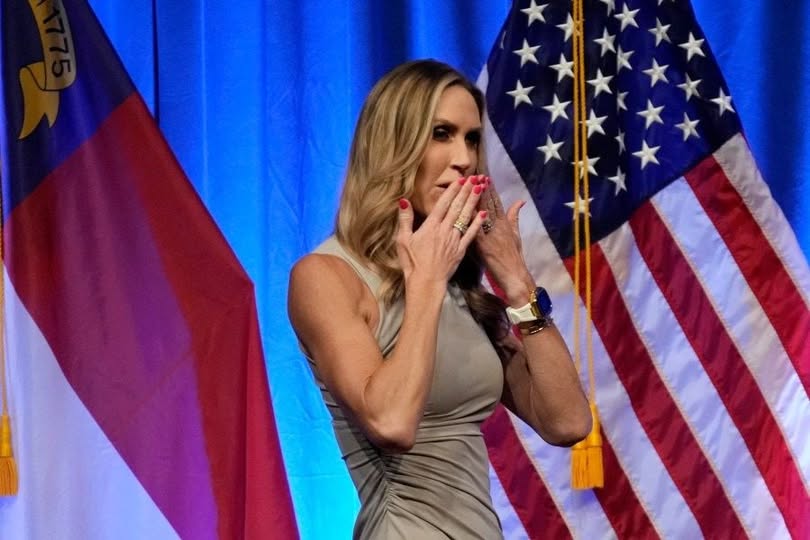
Lara Trump’s confirmation as co-chair of the Republican National Committee was not announced with fanfare or spectacle, but its implications are anything but quiet. Inside a plain meeting room in North Carolina, a decisive shift in Republican power was formalized. What took place was more than a routine leadership vote. It was the final step in fusing the party’s institutional machinery with one family’s political future.
Lara Trump’s elevation represents a consolidation that has been years in the making. The RNC is no longer merely aligned with Donald Trump; it is now structurally embedded with him. By placing a close family member at the top of the party’s operational hierarchy, Trump has ensured that fundraising, messaging, staffing, and grassroots strategy flow through a trusted inner circle. Control is no longer ideological or rhetorical. It is procedural.
To Trump loyalists, this move feels overdue. From their perspective, the Republican Party spent years resisting the political reality that Trump reshaped it in his own image. He dominates its base, drives its media narrative, and defines its priorities. Installing Lara Trump as co-chair is seen as an act of honesty — an acknowledgment that the party should reflect the will of its most influential figure rather than pretending otherwise.
Supporters argue that this alignment removes friction. No more internal sabotage. No more mixed signals. No more party leaders quietly hedging against Trump while relying on his voters. In their view, the party can now operate with clarity and unity heading into a high-stakes election cycle that will demand discipline, loyalty, and relentless messaging.
Inside the broader Republican Party, however, the reaction has been far more conflicted. For many long-time operatives and elected officials, Lara Trump’s confirmation feels like the final guardrail giving way. What was once a national party with competing factions now resembles a centralized operation built around a single surname. The line between party and personality has effectively disappeared.
This shift has profound consequences. The RNC controls the purse strings. It decides which candidates receive funding, which messages are amplified, and which ground operations are prioritized in battleground states. With Lara Trump in a leadership role, those decisions are no longer abstract or ideological. They are personal. Loyalty to Trump is no longer an informal expectation; it is structurally rewarded.
Critics within the GOP have long warned about this trajectory. Some hoped the party would eventually reassert independence, especially after electoral setbacks. Others believed a second Trump-era campaign would force a recalibration. Lara Trump’s confirmation signals the opposite. The party is not retreating from Trumpism. It is doubling down, formalizing it, and preparing to enforce it.
This is not about Lara Trump’s individual qualifications, though those are debated. She has served as a campaign adviser, appeared frequently in conservative media, and positioned herself as a disciplined messenger for the Trump brand. Her supporters say she understands the base better than traditional consultants and brings an outsider’s urgency to party operations. Her critics counter that the role demands institutional experience and neutrality — qualities fundamentally incompatible with her family ties.
What matters more than her résumé is the symbolism. Political parties are supposed to outlast individuals. They function as coalitions, not inheritances. By elevating a family member to co-chair, the RNC has crossed into territory more commonly associated with dynastic politics than modern American party structures. That reality unsettles even some Republicans who otherwise support Trump’s agenda.
The timing is also critical. The confirmation comes as the GOP braces for a brutal election cycle defined by legal battles, polarizing rhetoric, and razor-thin margins in key states. Centralized control may bring efficiency, but it also brings risk. When strategy, funding, and messaging are all filtered through one political identity, failure has fewer escape hatches.
For Trump himself, the move is strategic brilliance. It ensures alignment at a moment when discipline matters most. It eliminates the possibility of internal resistance during a general election campaign. And it sends a clear message to donors, candidates, and activists: the Trump era is not winding down. It is institutionalizing.
The phrase “Trump National Committee” has circulated half-jokingly for years. With Lara Trump’s confirmation, it feels less like satire and more like description. The RNC’s transformation is now explicit. Those who remain within the party are expected to accept that reality or step aside.
This development also reshapes the future beyond a single election. By embedding family loyalty into party leadership, Trump has created a framework that could persist even if he leaves the political stage. The infrastructure, relationships, and decision-making processes will remain in hands aligned with his worldview. That is not accidental. It is succession planning.
For voters, the implications are stark. The Republican Party is offering clarity rather than ambiguity. It is no longer a coalition debating its identity; it has chosen one. Supporters will welcome the coherence. Detractors will see it as narrowing, exclusionary, and risky. Swing voters may view it as either decisive or destabilizing, depending on their tolerance for personalization of power.
What cannot be denied is the finality of the moment. Lara Trump’s confirmation marks the end of the illusion that the party and Trump are separate entities. Any remaining internal resistance has lost institutional leverage. The next chapter of Republican politics will be written by those who never intended to share authority in the first place.
In a quiet room in North Carolina, without applause or drama, a transformation that had been unfolding for years was completed. The machinery is aligned. The hierarchy is clear. And as the election cycle accelerates, the message is unmistakable: the Republican Party has chosen to become an extension of one political dynasty, and it is prepared to live with the consequences.