The autumn wind tore through the oaks around the Blackwood estate, scattering leaves across five manicured acres like spilled coins. The house itself was the kind people photographed for holiday cards: colonial columns, broad windows, a three-car garage, a driveway that curved like a private road. From the outside, it looked like the life of a family that had everything under control.
Inside the garage, under the hood of a battered 2004 Ford F-150, I looked like the opposite.
My hands were black with grease. A faded gray hoodie hung loose on my shoulders, one elbow worn through. The truck was a rusted workhorse most people would have written off years ago, but I knew every rattle and every quirk the way you know an old friend’s voice. I was tightening a belt, moving slowly, careful with my leg where a shard of metal had once tried to make a permanent home.
To the world that mattered to my sister-in-law, I was John Blackwood: unemployed, unambitious, and pointless. A man who drifted through life while my wife, Emily, carried the weight.
To the United States Army, I was Colonel Johnathan Blackwood, Army Intelligence. I had spent my adult life in places where silence kept you alive and arrogance got you killed. Right now I was on leave, healing, trying to live like a civilian again without dragging the war into my living room.
Sarah didn’t make that easy.
“Still pretending to be useful?”
Her voice came from the doorway like a thrown object. She stood there with a vanilla latte in one hand, wearing a cashmere sweater that cost more than my truck. Her expression had that practiced contempt she reserved for people she decided were beneath her.
Sarah was Emily’s older sister. Three months earlier she’d arrived with suitcases and a carefully edited story about a breakup and a “toxic” job. Emily, who collects strays the way some people collect antiques, had let her stay “for a little while.” A little while turned into months. Sarah settled into the guest suite like she owned the deed. She criticized the food, the cleaning, the thermostat, and me.
“The belt needed replacing,” I said, wiping my hands on a rag. “It’s done.”
Sarah took a slow sip like she was tasting victory. “Amazing. Maybe next you can fix your life. Emily is out there working herself to death, and you’re playing mechanic. If it were my house, you’d be living in a tent.”
I looked at her properly then. Not the outfit, not the performance. The insecurity underneath. The entitlement built like armor. The way she needed someone else to look small so she could feel large.
She didn’t know the “business trip” Emily was on wasn’t work. I’d pushed her to take it. Paid for it. She didn’t know the mortgage she ranted about didn’t exist. I bought this place years ago outright. She didn’t know the card she flashed at cafés was tied to my account. She didn’t know anything, really, except what she preferred to believe.
“Emily doesn’t mind,” I said evenly. “The house is taken care of.”
“She’s too nice,” Sarah snapped. “But don’t get comfortable. I’m helping her see the dead weight. And looking at you…” her eyes dropped to my grease-stained jeans, “…you’re getting heavy.”
She turned and walked back into the house, leaving the smell of perfume and judgment behind her.
I exhaled slowly and leaned my shoulder against the truck. My phone buzzed, a message from a secure line. I glanced, absorbed the information, and deleted it. Work could wait. That day mattered for a different reason.
It was Lily’s fifth birthday.
I washed the grease from my hands in the utility sink, the cold water turning it a cloudy gray, and studied my reflection in the cracked mirror. Tired eyes looked back. The kind that had watched too much and learned to show little. I wasn’t interested in fighting Sarah. Not for pride. Not for ego. I wanted peace in my home, and peace sometimes meant swallowing irritation for the people who mattered.
I drove into town and picked up the cake Lily had begged for: chocolate with pink sprinkles and a fondant unicorn that looked ridiculous and perfect. When I returned, the sun was sliding down and the air had sharpened into that biting fall cold that creeps into your sleeves.
The house was quiet. Too quiet.
I stepped inside with the cake box and called out, smiling before I even heard an answer. “Lily? Honey, I got it!”
Nothing.
I moved deeper. In the living room, Sarah lounged on the couch with a glass of red wine, watching reality television like it was a job. Her son Tyler sat on the floor with a controller, volume too loud, manners nonexistent.
“Where’s Lily?” I asked.
Sarah didn’t look away from the screen. “Outside.”
My stomach tightened. “Outside where?”
“Patio,” she said, bored. “She was coughing. I’m not letting Tyler get sick. He has tryouts tomorrow.”
The cold that hit me then wasn’t from the weather.
I crossed the house fast and reached the sliding door to the patio. It was locked, and the security bar was wedged tight. Curtains drawn.
I yanked them open.
Lily was huddled in the far corner of the stone patio, curled into herself in thin cotton pajamas. Her cheeks were flushed and blotchy. She was shivering so hard her whole body rattled. Her hair clung damply to her forehead.
I tried the lock. The bar held.
I didn’t smash anything. I didn’t waste time. I grabbed the spare key kept in the kitchen drawer, the one Emily insisted on for emergencies, and slid the door open.
“Lily,” I said, dropping to my knees beside her.
She lifted her head sluggishly, eyes glassy. “Daddy,” she rasped. “Aunt Sarah said I have germs. She said I can’t come in.”
Her skin burned when I touched her forehead. Fever. High. And she’d been sitting in the cold long enough that her small body was losing the fight.
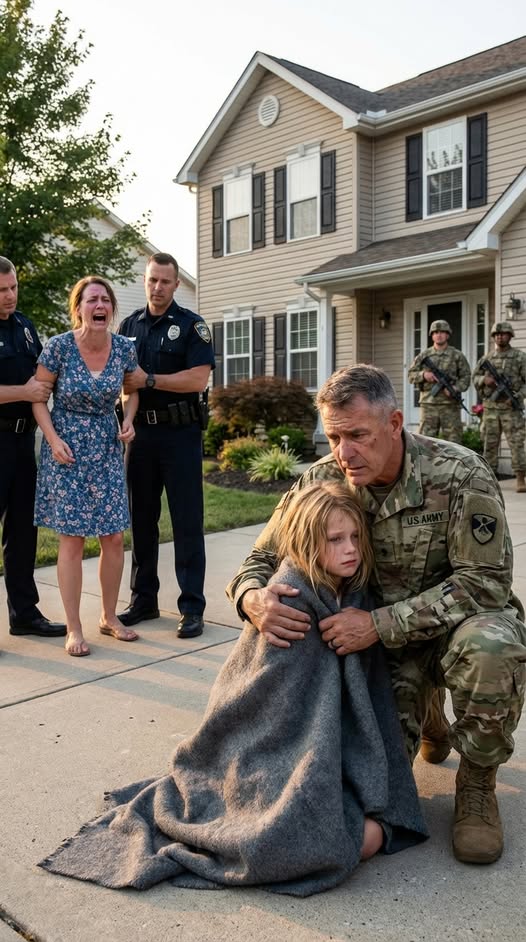
I scooped her up, wrapped her in my jacket, and carried her inside.
Sarah finally looked over, irritated. “Don’t bring her in here. I don’t want—”
“Stop,” I said, and the word landed like a door slamming. Not shouted. Not dramatic. Final.
I didn’t argue. I didn’t negotiate. I moved. I carried Lily to the bathroom, ran warm water, got towels, layered blankets, checked her breathing, and called emergency services. My voice on the phone was calm and precise, the way it becomes when you cannot afford panic. I gave the address, symptoms, timeline.
Paramedics arrived quickly. They saw the signs immediately: the fever, the exposure, the risk. One of them asked questions in that careful tone medical professionals use when they already know the answer but need you to say it.
“Who put her outside?” the paramedic asked.
Sarah opened her mouth, ready with excuses. I looked at her and she stopped, sensing something had shifted.
“I did,” Sarah said sharply, trying to regain control. “She was contagious.”
The paramedic’s expression hardened. “She’s five.”
I rode with Lily to the emergency room, holding her hand while monitors beeped and nurses moved with efficient speed. The doctor confirmed pneumonia, worsened by exposure. Another hour, maybe less, and the outcome could have been catastrophic.
Mandatory reporting kicked in. The staff did what they had to do. Police were notified. Statements were taken. The system began moving.
I didn’t need vengeance. I needed boundaries, consequences, and safety.
When Lily was stabilized and finally sleeping under warmed blankets, I stepped into the hallway and made one call—this time not to the military, not to friends in uniform, not to anyone who could intimidate. I called Emily.
She answered on the first ring. “John? I had a weird feeling. Is Lily okay?”
“Lily’s alive,” I said. “She’s stable. But it was close.”
Emily went silent, the kind that tells you her mind is already racing. “What happened?”
“Sarah locked her outside because she was coughing,” I said. “Lily had a fever. She got worse fast.”
I heard Emily’s breath catch. “No. No, she wouldn’t—”
“She did,” I said. “And the hospital reported it. Police are involved.”
Emily’s voice turned small. “I’m coming home.”
“Now,” I said. “And Emily… I should have told you sooner. About me. About the house. About why I’ve been quiet.”
She swallowed. “What do you mean?”
“I’m not unemployed,” I said. “I’m on leave. I didn’t want my job inside our marriage. But we’re past that.”
Three days later, Lily was home, weak but improving, wrapped in a blanket on the couch. The house felt different, not because Sarah’s voice was absent, but because Emily’s had changed.
Sarah had been removed from the home under a protective order while the case moved forward. Her ex-husband picked up Tyler. She called Emily once, demanding bail money and blaming everyone but herself. Emily didn’t pay. She didn’t argue. She blocked the number.
In the kitchen, Emily stared at the police report like it was written in a foreign language. Then she looked up at me, eyes red but steady.
“I thought you didn’t care,” she said quietly. “When she insulted you, you never reacted. I thought you were… passive.”
“I don’t fight battles that don’t matter,” I told her. “Words are noise. But Lily isn’t noise.”
Emily nodded slowly, grief and anger hardening into something sharper. “I should have stopped it. I let her stay. I made excuses.”
“You wanted to help your sister,” I said. “That wasn’t wrong. Keeping her here after she showed you who she was—that would have been wrong.”
Lily shifted under her blanket and looked up at me. “Daddy?”
“Yeah, bug.”
“Is Aunt Sarah gone?”
“Yes,” I said. “She’s gone.”
Lily’s eyes drooped again, trusting the answer the way only children can. Emily reached over and took my hand.
“I don’t care about the rank,” she said. “I care that you didn’t tell me you were carrying everything alone.”
“I didn’t want the job to define me at home,” I said. “I wanted to be just your husband. Just Lily’s dad.”
Emily squeezed my hand. “Then be that. But don’t shut me out again.”
Outside, the wind moved through the oaks, still stripping leaves, still pushing the season forward. Inside, the house finally felt like a home again—not because conflict had been avoided, but because it had been confronted.
I had spent years learning how to spot threats in distant places. That day taught me something simpler and uglier: sometimes the danger isn’t out there. Sometimes it walks into your house with a latte, calls cruelty “tough love,” and assumes you’ll stay quiet forever.
I stayed quiet until it mattered.
Then I made sure it would never happen again.