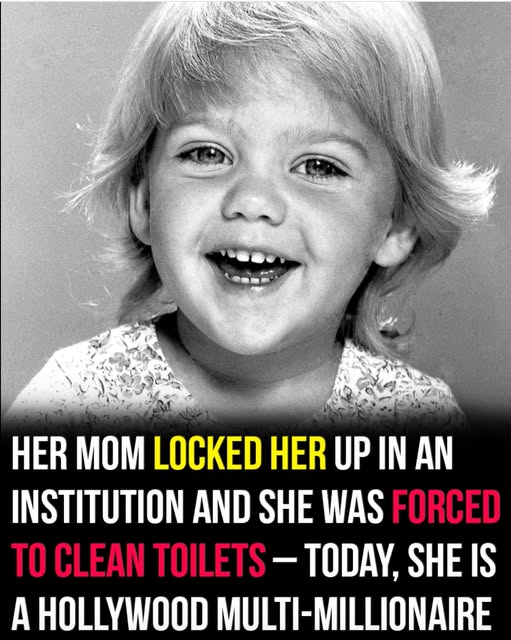
Drew Barrymore was eight years old when she had her first drink. By thirteen, she had already been through rehab. Not long after, she would attempt to take her own life and spend more than a year in a mental institution. Those facts alone would be enough to define most lives. Somehow, they became only the opening chapter of one of Hollywood’s most unlikely success stories.
Barrymore’s childhood began in front of a camera. At just eleven months old, she appeared in a dog food commercial, unknowingly continuing a family legacy that stretched back generations in Hollywood. Fame didn’t creep in gradually; it arrived almost immediately. By the time she was seven, she was a global sensation, charming audiences with her wide eyes and natural magnetism. A now-famous moment of her pouring Baileys over ice cream during a television appearance made her seem mischievous, confident, and far older than her years. An interview with Johnny Carson sealed the public’s affection, revealing a child who was funny, fearless, and disarmingly self-possessed.
Behind that sparkle, however, was a child who felt profoundly disconnected. Barrymore has often said she didn’t relate to other kids and felt emotionally older than them. While audiences adored her, she was quietly trying to make sense of a world that gave her attention but not stability.
Her film career began almost as early as her life itself. She appeared in Ken Russell’s Altered States at just five years old, but it was two years later, in E.T. the Extra-Terrestrial directed by Steven Spielberg, that she became a household name. Overnight, she was everywhere. Fame brought money, access, and freedom, but it also removed guardrails that most children rely on.
Barrymore was born into a family marked by addiction. Alcoholism and substance abuse ran through her bloodline, and her home life reflected that instability. Her father, John Drew Barrymore, struggled with alcoholism and violence and was largely absent from her childhood. Barrymore pieced together who he was through fragments and passing comments, eventually confronting her mother about his absence when she was just ten years old.
Her parents divorced when she was nine, and her mother, Jaid, began taking her into adult spaces no child should inhabit. Studio 54 became familiar territory. Drugs were not hidden from her; they were introduced. With the success of E.T. came a sense that there were no real limits.
“I really parented myself,” Barrymore later said. She has never spoken with bitterness toward her parents, but she has been brutally honest about the lack of structure in her childhood. In her own words, she wasn’t angry at them so much as disappointed in herself for having no guidance at all.
By nine, she was drinking. By twelve, she was in rehab. At thirteen, things reached a breaking point. Overwhelmed, isolated, and deeply lonely, Barrymore attempted suicide. The aftermath led to an eighteen-month stay in a psychiatric institution, where she was treated for substance abuse and mental health issues.
“When I was thirteen, that was probably the lowest,” she later reflected. “Just knowing that I really was alone.”
The institution was harsh. She wasn’t allowed to leave. Discipline was rigid and unforgiving. Yet, in retrospect, Barrymore credits that time with saving her life. For the first time, boundaries existed. Rules were enforced. Consequences were real.
“My mom locked me up in an institution,” she once said bluntly. “But it gave me discipline. I needed that insane discipline.”
After her release, she spent time living with David Crosby and his wife, who believed she needed to be surrounded by people committed to sobriety. Even then, her rebellion didn’t vanish overnight. She ran away, lashed out, and carried deep anger. But something fundamental had shifted. She began to understand how her parents’ flaws had shaped her path, and she started to take ownership of her future.
Hollywood, however, was unforgiving.
By fifteen, Barrymore was considered unemployable. By sixteen, she was cleaning toilets, waiting tables, and taking odd jobs just to survive. The industry that once celebrated her had no interest in a troubled former child star. She didn’t resent it. In fact, she embraced the humility. She remembered her father’s words: “Expectations are the mother of deformity.”
Her twenties became a period of reinvention. There were wild moments, public stunts, two marriages and divorces, and a defiant refusal to behave the way people expected her to. Dancing on David Letterman’s desk became symbolic of her refusal to be boxed in by shame or regret.
Slowly, she rebuilt her career on her own terms. Romantic comedies became her domain. Films like The Wedding Singer, Never Been Kissed, and 50 First Dates showcased a woman who blended vulnerability, humor, and emotional honesty in a way few actresses could. Audiences didn’t just watch her; they trusted her.
Motherhood reshaped her again. In 2012, after having daughters Olive and Frankie with then-husband Will Kopelman, Barrymore stepped back from acting. She wanted to be present in ways her own parents hadn’t been. She created a warm, structured, screen-free home filled with routines, shared meals, and emotional safety.
When she publicly said she didn’t believe she could “have it all at once,” the backlash was immediate — and largely from women. Barrymore clarified that she wasn’t limiting anyone else’s ambitions; she was acknowledging her own limits. Trying to do everything simultaneously, she said, would lead to poor results everywhere.
That philosophy guided her next chapter. She built a successful beauty brand, invested in real estate, and eventually returned to television as the host of The Drew Barrymore Show. In 2023, she moved to Manhattan to keep her children close to their father, prioritizing stability over convenience.
Today, Barrymore’s estimated net worth sits around $85 million, split between acting, business ventures, and property investments. More importantly, she has something she never had as a child: agency.
At fifty, she has spoken openly about feeling grounded in a way she never expected. Looking back, she admits her younger self wouldn’t have listened to advice anyway. She was stubborn, rebellious, and determined to learn things the hard way.
Now, she values freedom, independence, and peace. Not the chaotic freedom of her childhood, but the earned kind — the kind that comes from surviving darkness and choosing light anyway.
Drew Barrymore didn’t escape her past. She carried it, confronted it, and reshaped it. Her life stands as proof that even the most chaotic beginnings don’t have to dictate the ending.