The engines roared to life — and the dog ran.
Not barking.
Not hesitating.
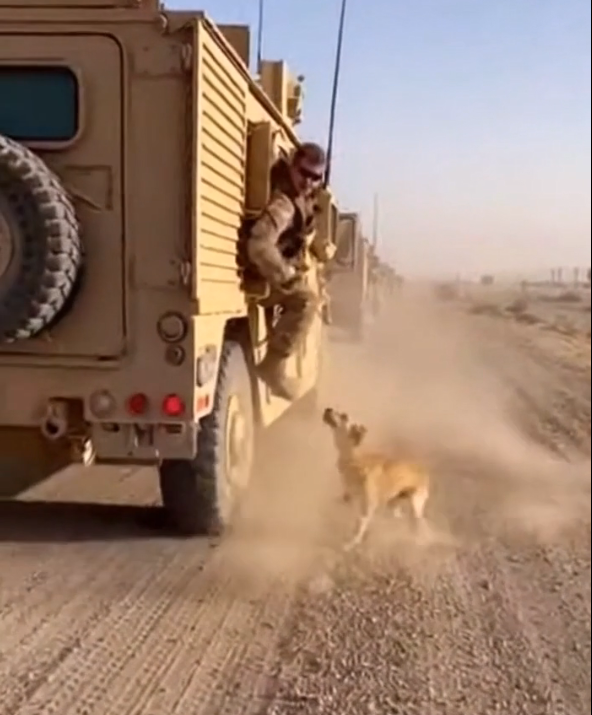
Running with everything his thin body had left, paws slapping against cracked asphalt as the military convoy began to roll forward.
“Hey—HEY!” someone shouted.
Dust rose. Tires turned. The lead truck gained speed.
And behind it, a scruffy tan dog, ribs showing, ears flattened by wind and fear, chased the vehicles like his life depended on it.
Maybe it did.
The soldiers froze inside their seats.
A white American sergeant in his late 30s leaned out the window, helmet tilted, eyes wide. The dog stumbled. Fell. Scrambled back up. His legs shook but he didn’t stop.
No one spoke.
No one laughed.
This wasn’t funny.
This wasn’t cute.
This was desperate.
“Stop the convoy,” someone said quietly over the radio.
But the order didn’t come.
Not yet.
The dog reached the last truck. Jumped. Missed. Hit the ground hard.
He didn’t cry out.
He just lay there for half a second — then pushed himself up again, eyes locked on the vehicle disappearing in front of him.
That’s when the convoy finally slowed.
Because every soldier watching felt the same thing, all at once:
Whatever this dog was chasing… it wasn’t the trucks.
It was someone.
They’d met him three months earlier.
The base sat on the edge of a dry, forgotten town — concrete buildings, razor wire, heat that never really left. The dog had appeared one morning near the mess tent, thin, cautious, watching from a distance.
At first, they ignored him.
Rules were rules.
No pets.
No attachments.
No names.
But the dog stayed.
He learned their routines before they noticed him learning. Learned which boots meant food scraps. Which voices meant calm. Which ones meant stay away.
He never begged.
He waited.
One night, during a mortar scare, he ran toward the soldiers instead of away. Curled under a vehicle with them while alarms screamed overhead. Shaking. Silent.
After that, things changed.
Someone left water out.
Someone else shared half a sandwich.
A third started calling him “Buddy.”
Buddy learned their names faster than they realized.
He knew who laughed loudest. Who moved slowest after patrol. Who sat alone at night staring at nothing.
Most of all, he knew Corporal Jake Miller.
Jake was younger than most — late 20s, clean-shaven, eyes older than they should’ve been. He’d found Buddy injured one morning, a cut on his paw bleeding into dust.
Jake had torn his own shirt to bandage it.
“Don’t get used to me,” he’d said quietly. “I’m not permanent.”
Buddy didn’t argue.
He just stayed close.
Jake talked to him at night when sleep wouldn’t come. About home. About the daughter he hadn’t met yet. About the fear he pretended wasn’t there.
Buddy listened.
And when the unit got orders to leave, no one thought to tell the dog.
Because no one thought the dog would understand.
They were wrong.
The convoy came to a full stop.
Dust settled slowly, like it didn’t want to interrupt.
Jake jumped out before anyone could stop him.
“Buddy!” he shouted, voice breaking.
The dog staggered forward, tail wagging weakly, body shaking from exhaustion. He pressed his head hard into Jake’s legs like he was afraid they might disappear.
Jake dropped to his knees.
Helmet off.
Hands trembling.
Breath uneven.
“I can’t take you,” he whispered. “I can’t…”
Buddy looked up at him, eyes wide and trusting. No accusation. No panic.
Just relief.
The rest of the unit stood frozen.
A white American lieutenant in his early 40s cleared his throat. Looked away. Looked back.
“How long has the dog been with us?” he asked.
“Three months,” someone said. “Maybe more.”
“Any incidents?”
“No, sir.”
The lieutenant sighed. Rubbed his face. Glanced at the convoy clock ticking away orders and schedules.
Then he said the words no one expected:
“Load the dog.”
Jake froze. “Sir?”
“We’re not leaving him here,” the lieutenant said quietly. “Not after this.”
There were rules. Paperwork. Problems.
But there was also something heavier than all of that.
The dog had chosen them.
The ride back was quiet.
Buddy lay at Jake’s feet, head resting on his boot. For the first time since anyone could remember, the dog slept.
Not half-listening.
Not ready to run.
Sleeping.
Buddy didn’t make the journey easily.
There were vet checks. Quarantines. Months of waiting. But he made it.
He lives now in a small house with a backyard and a woman who cried the first time she saw him.
Jake’s daughter calls Buddy “my brother.”
Sometimes, Jake wakes up at night, heart racing, memories sharp and loud.
Buddy gets up without being called. Presses his body close. Grounds him.
Some bonds aren’t formed by time.
They’re formed by shared survival.
And sometimes, the bravest thing a unit ever does isn’t what’s written in the mission report — but the moment they stop, turn around, and refuse to leave one of their own behind.
If this story stayed with you, share what you felt in the comments.
Would you have stopped too?