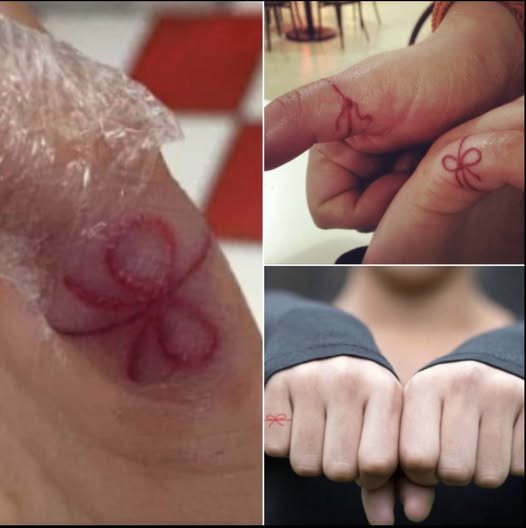
Long before humanity possessed the art of the written word, we were already using our skin as a canvas for communication. Across every continent and every era, the act of marking the body has served as a profound declaration of identity, faith, grief, and love. To an outsider, a symbol etched into someone’s flesh might appear as nothing more than an aesthetic choice or a fleeting trend, but to the wearer, that mark often holds the weight of a lifetime. These visual narratives frequently pass us by in the rush of daily life, yet certain symbols recur with such quiet persistence that they eventually demand our attention. One such symbol is the small, delicate red string tattooed on the hand or finger.
Unlike the sprawling back pieces or bold sleeves that shout for recognition, the red string tattoo whispers. It is often nothing more than a minimalist line, a tiny knotted bow, or a thin ribbon that appears to wrap around the finger as if caught in mid-motion. It is easy to overlook, yet its frequency in modern culture suggests a shared significance that transcends mere decoration. It is a visual whisper of a story that is centuries old, a modern manifestation of a myth that has traveled across oceans and generations to settle on the skin of people today.
To uncover the origin of this modest mark is to journey into the heart of East Asian folklore. Known as the “Red String of Fate,” this legend is a cornerstone of Chinese mythology, later woven into the cultural tapestries of Japan and Korea. According to the ancient tales, the deities—specifically the “Old Man Under the Moon,” a celestial matchmaker—tie an invisible red cord around the ankles or fingers of those destined to meet one another. This thread is not merely a romantic tie; it is a tether of destiny. The myth posits that no matter how much time passes, no matter the vastness of the distance or the height of the obstacles between them, the two people connected by this thread will eventually find their way to one another. The string may stretch to its breaking point, it may tangle into impossible knots, but it is fundamentally unbreakable.
The modern red string tattoo is a visible tribute to this ancient belief in fated connection. It is fascinating to observe how the concept of being bound to another person by forces beyond human control appears in almost every civilization. Whether we call them soulmates, twin flames, or kindred spirits, humans have always clung to the comforting notion that certain relationships are not accidental but predetermined. The red string is simply a beautiful, visual metaphor for that universal human hope—a story that has migrated from ancient parchment and lantern-lit storytelling to the vibrant, permanent medium of ink.
While many assume these tattoos are exclusively romantic, their modern interpretation has expanded to cover any bond that feels larger than circumstance. For some, the red string represents a lifelong partner; for others, it marks a connection to a sibling, a child, or a friend whose presence in their life felt like a rescue. It serves as a reminder that some relationships are carved into the foundation of our existence, predating our first meeting and likely outlasting our final goodbye. It is a mark of a bond that doesn’t just exist in time, but in the soul.
The specific placement of the tattoo often carries its own layer of secondary meaning. Traditionally, the pinky finger is the most common site for women, a placement that evokes the “pinky swear”—a gesture of childhood trust that evolves into an adult commitment. To wrap a red string around the pinky is to seal an oath with the universe, a permanent vow to honor the person on the other end of the thread. Conversely, when the tattoo appears on the thumb, it often leans toward symbols of willpower, logic, and grounding. Here, the string acts as an anchor, a reminder to stay steady and connected to one’s core values and the people who provide a sense of home.
There is a striking, almost cinematic quality to the imagery of the red string. If one leans into the myth, it suggests that we are all walking through the world with invisible threads trailing behind us, slowly and inevitably tugging us toward moments of recognition—a conversation with a stranger that turns into a decade of friendship, a chance encounter that becomes a marriage, or a moment of shared grief that builds a bridge of empathy. The tattoo does not necessarily mean the wearer believes in a rigid, predetermined fate; rather, it acts as an acknowledgment of the beautiful coincidences and the “strange magic” that brings certain souls into our orbit.
For many, wearing the red string is an act of hope. It is a declaration that human connection is the highest currency we possess. In a world that can often feel fragmented, isolated, and fast-paced, the tattoo is a grounding force. It says, “I am connected. I am part of something larger than myself.” It is a quiet rebellion against the idea that we are all just solitary actors moving randomly through space. Instead, it suggests that our paths are interwoven, creating a grand, unseen fabric of human experience.
There is also a poignant beauty in seeing the red string on a stranger. You may never know who their thread leads to, but the mark tells you that they have a story worth telling. The woman in the grocery store might wear it in memory of a mother she lost too soon, keeping the connection alive through ink when the physical presence is gone. The man on the train might wear it as a symbol of the love he waited decades to find. A teenager might wear it as a promise to their future self that they will not settle for anything less than a soul-deep connection.
This evolution of myth is one of the most compelling aspects of tattoo culture. Something that began as a story whispered between elders in ancient villages has transformed into a global icon of intimacy. It proves that despite our technological advancements and our modern cynicism, we still crave the ancient comforts of destiny and belonging. The symbol moves through different cultures like a needle through silk, quietly stitching people together across geographical and temporal divides.
Ultimately, the red string tattoo is a testament to the fact that people matter. Certain relationships shape the contours of our lives, grounding us when the world feels unstable and saving us when we feel lost. Whether it is viewed as a literal map of destiny or a metaphorical tribute to meaningful love, the message remains universally understood: our bonds are our greatest strength. The next time you see that thin red line on a hand, remember that it isn’t just a design. It is a thread tied to a memory, a hope, or a person—a reminder that in the grand design of the universe, no one is truly walking alone.