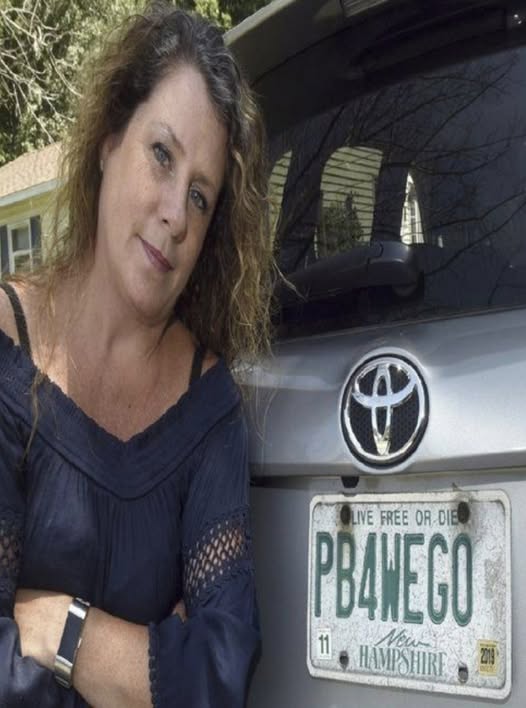
In the quiet, scenic state of New Hampshire, where the state motto “Live Free or Die” is emblazoned on every license plate, Wendy Auger believed she was doing exactly that. For fifteen years, her white and green vanity plate had been a source of consistent, low-stakes joy for fellow travelers and neighbors alike. The plate bore seven simple characters: PB4WEGO. To any parent, caregiver, or person who has ever embarked on a grueling family road trip, the translation was instantaneous and hilarious: “Pee before we go.” It was the universal mantra of the American minivan, a lighthearted reminder of the logistical realities of traveling with children. For over a decade and a half, the plate had been a fixture of Wendy’s identity, sparking smiles at stoplights and laughter in grocery store parking lots. It was a harmless bit of observational humor that seemed to epitomize the New England spirit of rugged independence and practical wit.
However, the bureaucratic machinery of the New Hampshire Department of Motor Vehicles (DMV) eventually turned its gaze toward Wendy’s bumper, and the result was a sudden, jarring confrontation between personal expression and state regulation. Out of the blue, Wendy received a formal notification that her beloved plate had been recalled. The state’s reasoning was as clinical as it was surprising: the plate allegedly violated state guidelines regarding “inappropriate” or “offensive” content. The DMV’s sudden reversal after fifteen years of tacit approval left Wendy in a state of bewilderment and profound disappointment. To her, the message was the antithesis of offensive; it was a celebration of a shared, wholesome human experience.
The conflict centered on a delicate and often arbitrary intersection of public standards and individual creativity. State officials argued that they had a responsibility to maintain a certain level of decorum on public property—which, technically, a license plate is. They pointed to administrative rules that prohibit vanity plates referencing sexual or excretory functions. From a strictly literalist perspective, “PB4WEGO” fell under the latter category. However, this interpretation seemed to ignore the context and the spirit of the message. Wendy argued that the phrase was a common parental directive used in millions of households, a far cry from the vulgar or malicious messages the rules were designed to prevent. She felt that the state was reaching for a level of puritanical censorship that didn’t align with the reality of how the community actually perceived the plate.
As news of the recall spread, Wendy’s struggle resonated far beyond the borders of her small town. Her story became a viral sensation, striking a chord with people who were weary of perceived bureaucratic overreach and the sanitization of public life. Supporters argued that if the plate had been acceptable for fifteen years without a single recorded complaint, the state’s sudden “discovery” of its offensiveness felt like a solution in search of a problem. Community members and strangers from across the country voiced their support, noting that the message was widely understood as a playful, relatable phrase. They pointed out the irony of a state that champions “freedom” while simultaneously policing a harmless joke about a basic biological necessity that every human being has managed since childhood.
The controversy highlighted a broader, more complex conversation about the limits of government authority in the realm of symbolic speech. License plates are a unique form of government-issued property that allows for a sliver of personal branding. When a citizen pays an extra fee for a vanity plate, they are engaging in a form of speech that is protected, albeit limitedly, by the First Amendment. The question became: at what point does a state’s interest in “decorum” override an individual’s right to be slightly cheeky? Critics of the DMV’s decision argued that the lack of consistency in these guidelines created a confusing environment for drivers. If a plate is approved once, should the state have the right to revoke it years later without a change in the law or a specific instance of harm?
For Wendy, losing the plate felt like losing a small but significant piece of her personal narrative. The plate had been on her vehicle through school drop-offs, family vacations, and the quiet routines of daily life. It had connected her to countless strangers through a shared laugh, a brief moment of levity in the often-stressful environment of traffic and commutes. This connection, she believed, was a net positive for society. In a world that often feels increasingly polarized and tense, a license plate that reminds us of our shared humanity—and our shared parental struggles—seemed like something to be protected, not purged.
The situation eventually escalated to the highest levels of state government. Even Governor Chris Sununu weighed in, suggesting that the DMV might have been a bit too “stopped up” in their interpretation of the rules. The Governor’s intervention signaled a shift in the momentum, highlighting that common sense should play a role in the application of administrative code. The public outcry and the subsequent political pressure forced a re-evaluation of the case, turning Wendy Auger from a frustrated driver into an accidental advocate for freedom of expression.
Ultimately, the battle over “PB4WEGO” served as a powerful reminder that even the smallest symbols can carry deep meaning. It wasn’t just about a piece of embossed aluminum; it was about the right to navigate the public square with a sense of humor and a touch of personality. The case forced the state to consider whether its role is to act as a stern moral arbiter or a facilitator of a diverse and occasionally funny public discourse. Wendy’s experience proved that when bureaucracy attempts to over-regulate the “human” out of the human experience, the people will often find a way to speak back.
In the end, the story of the “PB4WEGO” plate is a testament to the power of relatability. It reminds us that some of the most enduring connections we make are based on the simplest, most universal truths—like the fact that we should probably all take a moment before we hit the road. Wendy’s resilience in the face of a faceless administrative decision showed that personal expression is worth fighting for, even if it’s just seven letters on the back of a car. Her journey through the maze of state guidelines ended up ensuring that her small piece of personal expression could continue to bring a smile to those driving behind her, reinforcing the idea that “Living Free” sometimes means being allowed to make a harmless joke about the bathroom.