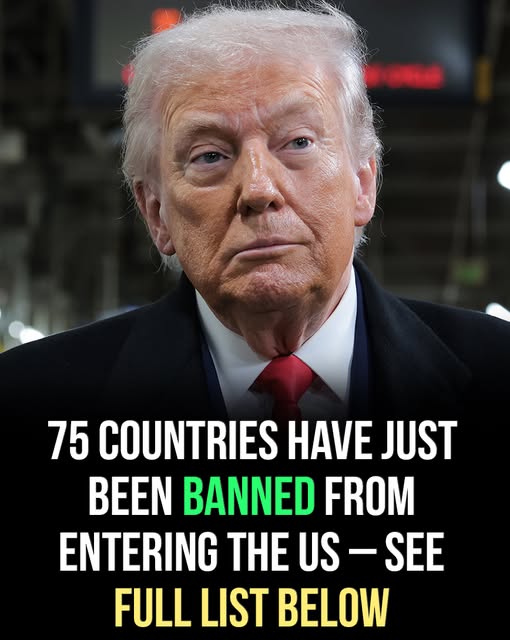
The dawn of the second Trump administration has been marked by a series of geopolitical shocks and domestic policy shifts that have reverberated far beyond the borders of the United States. However, few actions have generated as much immediate friction as the recently announced “reassessment” of immigrant visa processing—a move that effectively bars citizens from 75 different nations from entering the country. This sweeping executive maneuver, framed by the State Department as a necessary pause to safeguard the American economy, has ignited a firestorm of legal, diplomatic, and humanitarian debate. As the world watches, the administration is doubling down on its “America First” agenda, signaling a fundamental transformation in how the United States interacts with the global community.
The policy, which was first brought to light through internal State Department communications and later confirmed by major news outlets, instructs consular officers across the globe to halt the issuance of immigrant visas for an unspecified duration. The scope of the list is staggering, encompassing a diverse array of nations across nearly every continent. From South American giants like Brazil and Uruguay to African powerhouses such as Nigeria and Ethiopia, and spanning through the Middle East and Central Asia, the ban impacts a massive portion of the world’s population. According to the administration, the pause is not a permanent termination of diplomacy but a mandatory “cooling-off period” required to overhaul screening procedures and ensure that incoming residents do not become a financial burden on the American taxpayer.
A spokesperson for the Department of Homeland Security took to social media to articulate the rationale behind the freeze, stating that the pause will remain in effect until the government can guarantee that new immigrants will not “extract wealth” from the American populace. The terminology used by the administration is pointed and intentional, specifically citing concerns over “public charges.” The memo argues that immigrants from several of the listed nations—including Somalia, Haiti, and Eritrea—have historically relied on public assistance at rates the administration deems unacceptable. By framing the issue as a matter of economic protectionism, the White House is appealing to its core base, asserting that the generosity of the United States has been systemically “abused” and that the current visa infrastructure is no longer fit for its purpose.
The timing of the announcement has added to the sense of urgency and chaos. The freeze is set to officially commence on Wednesday, January 21, leaving thousands of families and individuals who were in the final stages of their immigration journey in a state of sudden, harrowing limbo. Immigration advocates have been quick to point out the human cost of such a broad policy. Legal cases that have been in the works for years, involving family reunifications, high-skilled labor transfers, and refugee resettlements, are now frozen indefinitely. Critics argue that the administration is using a “broad brush” to paint entire populations as economic drains, ignoring decades of data that suggest immigrants often fill vital gaps in the labor market and start businesses at higher rates than native-born citizens.
The geopolitical implications of the 75-country ban are equally profound. The list includes several nations with which the United States maintains complex, often delicate, diplomatic relationships. For instance, the inclusion of countries like Brazil, Colombia, and Egypt—key regional allies in various capacities—suggests a shift toward a more isolationist or transactional foreign policy. This move comes on the heels of other controversial foreign policy stances, such as the president’s renewed interest in acquiring Greenland and the heightened military posturing toward Venezuela. When viewed in tandem, these actions suggest an administration that is less concerned with traditional diplomatic etiquette and more focused on exerting unilateral American will.
One of the most immediate and practical complications of this visa freeze involves the sporting world. The United States is currently preparing to co-host the FIFA World Cup alongside Canada and Mexico. This event is arguably the largest and most prestigious athletic competition on the planet, and Donald Trump has previously celebrated the U.S. role as a host nation. However, the 75-country ban includes several perennial football powerhouses, such as Brazil, Colombia, Iran, and Ivory Coast. If the ban remains in place through the summer, it creates a logistical nightmare for FIFA, the participating teams, and the hundreds of thousands of fans who have already begun making travel arrangements. While the administration has suggested the policy primarily targets immigrant visas rather than short-term visitor visas, the lack of clarity has created a climate of uncertainty. There are lingering fears that the “reassessment” of screening procedures could bleed into the vetting process for all travelers, potentially leading to a World Cup where entire nations are unable to send their teams or supporters to American soil.
Domestically, the ban has become a lightning rod for civil unrest. Protests have already erupted in major metropolitan hubs, with demonstrators arguing that the policy is a thinly veiled attempt to reshape the demographic fabric of the country under the guise of economic security. These protests are occurring against a backdrop of existing tension, following a controversial ICE shooting in Minnesota and a general intensification of deportation efforts. For many, the visa freeze is seen not as an isolated administrative tweak, but as one piece of a much larger puzzle aimed at significantly reducing the number of non-Western immigrants allowed into the United States.
The legal community is already bracing for a protracted battle in the courts. Civil rights organizations and immigration law firms are preparing filings to challenge the constitutionality of the ban, arguing that it exceeds executive authority and discriminates based on national origin without a sufficient national security justification. However, the administration remains undeterred. The “America First” rhetoric that defined the campaign trail has become the functional blueprint for the second term. From the White House’s perspective, the outcry from critics and the international community is merely proof that the policy is working to disrupt a status quo they believe has disadvantaged American citizens for too long.
As the January 21 deadline approaches, the global community remains in a state of watchful anxiety. For the citizens of the 75 listed countries, the “shining city on a hill” has effectively pulled up its drawbridge. Whether this “pause” is a temporary administrative hurdle or the beginning of a long-term wall of bureaucracy remains to be seen. What is clear, however, is that the Trump administration is willing to endure significant international backlash and domestic friction to realize its vision of a more insulated and restrictive United States. The consequences of this policy will likely be felt for generations, as it fundamentally alters the narrative of America as a nation of immigrants and replaces it with one of a fortress guarding its gates.
The full list of affected nations serves as a map of the administration’s current priorities and concerns. Countries ranging from Afghanistan and Yemen to Russia and North Macedonia find themselves side-by-side in this new era of American exclusion. The economic, social, and cultural threads that once connected these nations to the American dream are being tested like never before. As the “reassessment” begins, the world is left to wonder what the criteria for “re-entry” will look like and which nations will eventually be welcomed back into the fold—and at what cost. For now, the gates are closing, the paperwork is being shelved, and a new chapter of American isolationism is being written in real-time.
The next step in this unfolding story will be the reaction from the international stage. Many of the banned countries are members of significant trade blocs and international organizations that may seek to retaliate through their own visa restrictions or economic sanctions. As the United States moves to “ensure the generosity of the American people will no longer be abused,” it may find that the world is equally prepared to reassess its own relationship with a nation that is increasingly choosing to stand alone. The “turbulent start” to this second term appears to be just the beginning of a transformative and highly contentious period in American history.