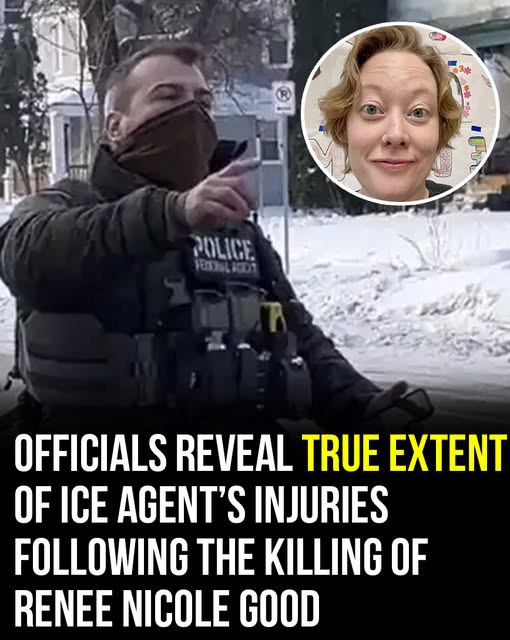
The city of Minneapolis finds itself at a volatile crossroads following the fatal shooting of Renee Good by Immigration and Customs Enforcement (ICE) agent Jonathan Ross on January 7, 2026.1 While the community grapples with the fallout of the encounter, new medical reports have emerged indicating that Agent Ross suffered internal bleeding during the incident.2 According to multiple unnamed U.S. officials, Ross sustained blunt-force injuries to his torso, though the precise severity of the internal hemorrhaging has not been made public. The Department of Homeland Security has confirmed the injuries, and the narrative surrounding the shooting has become a focal point in the national debate over federal immigration enforcement tactics.+1
The fatal confrontation occurred on a residential street when Renee Good, while seated behind the wheel of her Honda Pilot, was approached by ICE officers.3 According to witnesses and preliminary reports, the officers ordered Good to exit the vehicle. In the moments that followed, Good appeared to attempt to drive away. Video footage from the scene captures a chaotic sequence of events, showing physical contact between Ross and the moving vehicle just as the agent discharged his firearm. Good was struck in the head and killed instantly.
The political response to the shooting has been immediate and divided. The Trump administration has steadfastly defended the agent’s actions, asserting that Ross acted in self-defense while being struck or dragged by the vehicle.4 Deputy Attorney General Todd Blanche recently stated that there is currently no basis for a criminal civil rights investigation into the matter.5 Furthermore, the federal government has moved to centralize control over the legal fallout; the FBI is handling the investigation exclusively, a move that pointedly excludes Minnesota state authorities from the process.+1
This centralized federal approach has only deepened the rift between Washington and local leadership. Minneapolis Mayor Jacob Frey has been a vocal critic of the recent surge in federal activity, labeling the enforcement actions as inherently discriminatory.6 Mayor Frey argued that the operations appear to target individuals based solely on their racial and ethnic backgrounds—specifically the Latino and Somali communities. He further alleged that the aggressive nature of these tactics has resulted in the detention of U.S. citizens, a claim he insists has been thoroughly documented by local observers and legal advocates.
The human element of this tragedy is reflected in the massive, competing GoFundMe campaigns that have emerged in the wake of the shooting. The fundraiser for Agent Ross has garnered more than $700,000, while the campaign to support Renee Good’s surviving wife and son has exceeded $1 million. However, the disbursement of these funds faces significant legal hurdles. Under the U.S. Office of Government Ethics, federal employees are generally barred from receiving outside compensation for performing their official duties, leaving the fate of Ross’s donations in a state of bureaucratic limbo.7
The atmosphere in Minneapolis has been further strained by a massive influx of federal personnel. The administration has deployed over 2,400 Department of Homeland Security agents to Minnesota as part of a high-intensity push to apprehend undocumented immigrants. This surge has led to repeated clashes between federal agents and local demonstrators. Viral footage has shown agents pulling individuals from their vehicles and engaging in heated physical altercations with angry bystanders who characterize the federal presence as an occupying force.8
Public anxiety reached a fever pitch this week following yet another shooting incident involving federal authorities. On Wednesday, a federal officer fired at a suspect’s leg during an attempted arrest.9 The Department of Homeland Security released a statement explaining that the officer had caught up to the subject on foot, at which point the individual reportedly began to resist and violently assault the officer.10 While this second incident did not result in a fatality, it served as a grim reminder of the hair-trigger tensions currently defining the city’s streets.+1
In the courtroom, Minnesota state officials are attempting to use the legal system to halt the federal crackdown. During a hearing regarding the state’s lawsuit against the administration, Minnesota Assistant Attorney General Brian Carter made an impassioned plea for a de-escalation of tactics. He argued that the “temperature needs to be lowered” and called for a pause in enforcement actions to prevent further loss of life. U.S. District Judge Katherine Menendez has indicated that she recognizes the gravity of the situation, keeping the killing of Renee Good on the “front burner” of the court’s docket and requiring the Justice Department to provide a formal response to the state’s request for a restraining order by the following Monday.
The statistics surrounding these enforcement actions reflect the broader demographic shifts and tensions in the region. According to 2024 and 2025 census estimates and DHS data, the Minneapolis-St. Paul metropolitan area has seen a notable increase in its immigrant population, with the Somali community numbering approximately 74,000 and the Hispanic or Latino population exceeding 300,000. Critics of the current surge point out that while non-white residents make up roughly 40% of the city’s population, they represent nearly 90% of those targeted in the recent wave of federal detentions. These figures have fueled the local perception that the enforcement is not just a matter of law, but a matter of racial profiling.
As Minneapolis remains on edge, the narrative of the “internal bleeding” suffered by Agent Ross has become a primary talking point for those defending the federal response. Proponents of the administration’s policy argue that the injury proves the life-threatening nature of the encounter and justifies the use of lethal force. Conversely, legal advocates for the Good family argue that the injury does not mitigate the fact that a residential street was turned into a kill zone, nor does it justify the exclusion of state investigators from a shooting that occurred on city soil.
The city is currently a landscape of protests, memorials, and heavy federal patrol. Whether through the courts or through continued civil unrest, the people of Minneapolis are demanding a resolution that addresses both the immediate tragedy of Renee Good’s death and the systemic shifts in how federal law is being applied within their neighborhoods. For now, the “pause” requested by the Assistant Attorney General remains elusive, as federal agents continue their mission and the local community remains in a state of profound, collective grief and anger. The coming days will likely determine whether the legal system can provide a release valve for this pressure or if the city is headed toward an even more significant confrontation.