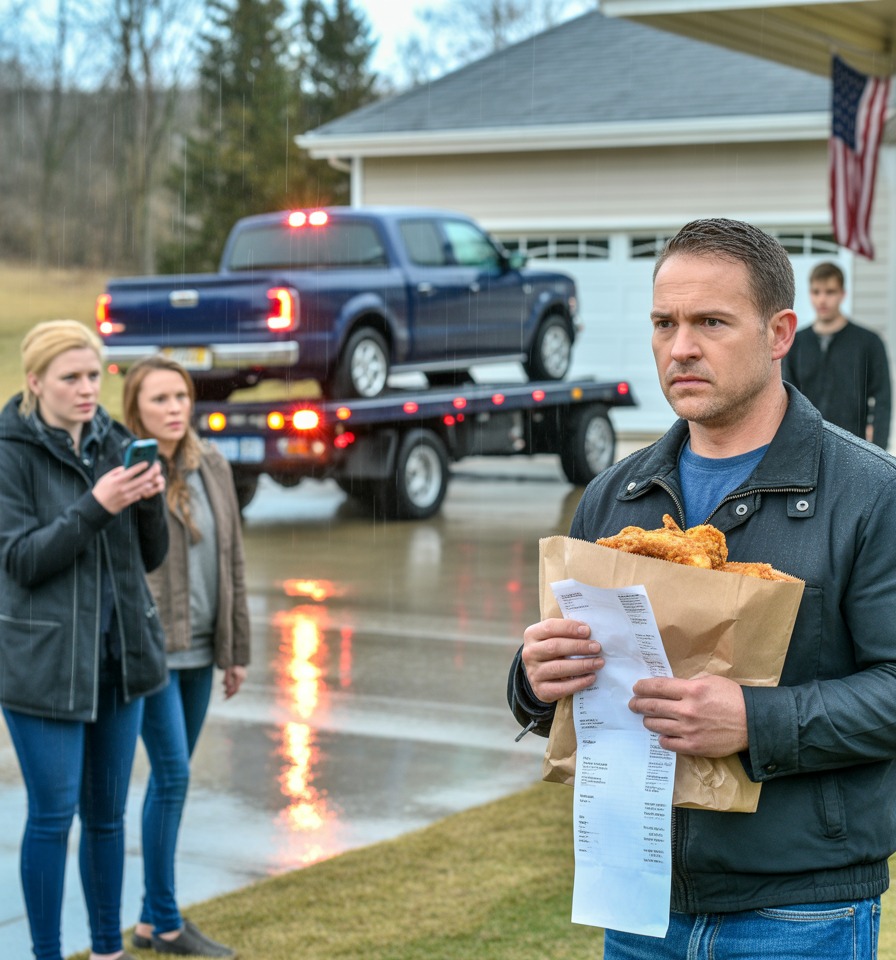
The December air in Hendersonville had a sharp, biting chill that seeped through the gaps in my garage door. I was standing in the dark, clutching a warm bag of fried chicken from Ingles, thinking about a quiet evening with my family. That was before I heard my stepson’s voice. “Yeah, I already cut the brake line,” Trevor said, his tone as casual as if he were discussing a grocery list. “See you at his funeral tomorrow.” Through a crack in the side door, the blue glow of a smartphone illuminated his face—calm, relaxed, and utterly devoid of remorse.
The world seemed to tilt on its axis. I listened, paralyzed, as my wife of eleven years, Deborah, responded through the phone’s speaker. She didn’t scream; she didn’t beg him to stop. She simply sounded cautious, as though she were confirming the details of a dinner reservation. “Tomorrow,” she whispered, her voice laced with an unmistakable sense of relief. “Just be careful.” I stood there, a fifty-eight-year-old man who had spent a decade building a life with these people, realizing that the woman I loved was currently coordinating my murder with her thirty-two-year-old son.
Patience had always been my primary tool. As a retired HVAC technician, I had spent years telling apprentices that rushing a job only led to stripped screws and broken systems. Now, that professional philosophy became a survival strategy. I slipped away into the night, my breath fogging the windshield of my sedan as I sat on the curb, trembling. I knew that in a small town, calling the police without proof would make me look paranoid or unstable. Trevor would play the concerned son; Deborah would dab her eyes and talk about my “declining mental state.” I needed more than a story; I needed a case.
I opened a roadside assistance app and summoned a tow truck to haul my silver F-150 away under the cover of darkness. My heart hammered against my ribs as the winch rattled, pulling my truck onto the flatbed. I told the driver it was a mechanical issue, but as the taillights of the tow truck faded into the distance, I felt the final shred of my old life tear loose. I drove thirty minutes through the dark mountain roads to Asheville, heading for the one man I knew could handle the truth: Eugene Carter, Trevor’s biological father.
Eugene was a retired mechanic who knew cars and, more importantly, knew the darkness that resided in his son. When I arrived, he slid under the truck on a creeper. A moment later, he rolled out, his face ghostly under the beam of a flashlight. “Thomas,” he said quietly, “this isn’t an accident. The line was cut. Clean. Straight. Deliberate.” The sight of that severed metal was the physical manifestation of a betrayal so deep it made me physically ill.
Following the advice of my attorney, Elizabeth Garrett, I began a meticulous process of documentation. In the legal world, facts beat fear every time. While Deborah took to Facebook to craft a narrative of a “disgruntled, unstable husband” who had abandoned his family in a fit of rage, I was gathering the receipts of her treachery. My friend Stanley, a fellow technician, helped me secure security footage from a local AutoZone. It showed Trevor buying a tubing cutter two days prior, followed ten minutes later by Deborah paying cash for supplies to avoid a paper trail.
The most devastating blow, however, came from within my own home. During a supervised visit to collect my belongings, I discovered a prepaid burner phone hidden beneath the lining of a nightstand drawer. It contained hundreds of messages between Deborah and an insurance agent named Glenn Hartman. She had promised him a life together, funded by my retirement accounts and a life insurance policy that would pay out upon my “accidental” death. But even that wasn’t the final nail in the coffin.
I had forgotten that four months earlier, following a string of neighborhood thefts, I had installed motion-activated security cameras in the garage. With trembling fingers, I opened the app and scrolled to the night of the incident. The video was crystal clear. It showed Trevor entering the garage, followed by Deborah. “You sure about this, Mom?” he asked. Her reply was bone-chilling: “Just do it. Make it clean. No fraying. It has to look like normal wear.” I watched my wife watch her son kneel beside my vehicle to ensure my death.
The preliminary hearing at the Henderson County Courthouse was a study in the collapse of a performance. Deborah arrived in a navy blazer and a silver cross, clutching tissues and playing the role of the grieving, confused wife. But the prosecution was relentless. They played the garage footage on a large screen, the audio of her instructions echoing through the silent courtroom. The gallery gasped; even the bailiffs looked away. When Glenn Hartman took the stand and testified about the life insurance plan, Deborah’s mask finally shattered. She turned on her own son in a desperate attempt to save herself, shouting, “I didn’t think he would actually do it!” Trevor, in a fit of reciprocal rage, screamed back that she was the one who had orchestrated the entire plot.
The judge, a woman with steel-gray hair and no patience for theater, remanded both of them into custody without bail. Trevor eventually took a plea deal, receiving eighteen to twenty-five years. Deborah went to trial and was found guilty on all counts, sentenced to fifteen to twenty years for conspiracy to commit murder.
A year has passed since that night in the garage. I now live in a small apartment in Asheville overlooking the French Broad River. I am fifty-nine years old, and while I carry the scars of that betrayal, I am no longer looking over my shoulder. I’ve started seeing a woman named Margaret, a librarian who understands that trust is something built slowly, brick by brick. We take walks along the river, and the air feels clean, real, and safe.
I learned that the voice inside you—the one that whispers when something is wrong—is the most important thing you own. I didn’t survive because I was stronger or faster; I survived because I was patient. I stepped aside and let the truth do the fighting for me. Some battles aren’t won with a confrontation; they are won with evidence, a good tow truck, and the courage to stop playing a game that was rigged from the start. Today, the river keeps flowing, and for the first time in a decade, I am flowing with it.