The humid Virginia afternoon hung heavy over Richmond, a typical Saturday where the air inside the supermarket smelled of floor wax and the faint, sweet promise of the bakery. It was the kind of unremarkable day that usually fades into the background of a long life, yet for my wife Danielle and me, it became the day that drew a definitive line in the sand. Danielle was inspecting peaches, humming a soft jazz melody that only she seemed to know. After thirty years of marriage, watching her simply exist remained my greatest privilege. She is a woman of quiet, impenetrable dignity, her dark hair braided back, her presence a calming anchor in a chaotic world.
I was leaning against the grocery cart, just a fifty-eight-year-old man named Mark in a faded polo shirt, content to be invisible. However, twenty years in the Marine Corps leaves you with a certain sensory residue. I felt the atmospheric shift before I heard a sound. It is a specific prickle on the back of the neck, the instinctual recognition of a predator entering the vicinity. Near the apple display, a group of four college-aged men appeared. They wore local university logos and backwards baseball caps, exuding that obnoxious, unearned confidence of youth that has never truly been tested by consequence.
The tallest of the group gestured toward Danielle with a dismissive tilt of his chin. “Damn,” he said, his voice projected just loud enough to shatter the peace. “Didn’t know they allowed that kind of mix in this store.”
The surrounding air seemed to solidify. A woman nearby suddenly found the plastic produce bags fascinating, her eyes darting away in a desperate attempt to remain uninvolved. I felt Danielle’s shoulders tense. She didn’t turn around; she simply let out a quiet sigh—the weary sound of a woman who had endured a thousand such tiny, jagged cuts over a lifetime.
I turned slowly. I didn’t scowl or puff out my chest in a display of performative machismo. Instead, I smiled. It was the specific smile I had honed on Parris Island—a cold, steady expression that conveys absolute presence and infinite patience. In the Corps, you learn that shouting is the refuge of the out-of-control. Real power resides in stillness. I locked eyes with the leader, and I watched his smirk falter. He saw an “old man” and failed to see the coiled spring of a machine trained to assess, adapt, and neutralize.
Danielle placed a hand on my arm, a gentle pressure I understood perfectly. “Mark, not here. It isn’t worth it,” she whispered. She was right, of course. We paid for our groceries and walked out into the blinding heat of the parking lot, the silence between us heavy with the weight of things unsaid. But the malice followed us.
“Hey, old man!” a high-pitched, cocky voice jeered from twenty feet behind. “You protecting your charity case?”
Danielle’s hand trembled in mine—not with fear, but with a vibration of pure, compressed rage that she had spent decades learning to contain. I, however, had spent my life learning exactly when and how to let it out. I reached the car and placed the bags in the trunk with a soft, final thud. Through the reflection in the rear window, I watched them fan out. There was the leader, the high-voiced instigator, a bulky follower, and a fourth boy who lingered in the back, his eyes darting with visible hesitation.
“Yo, we’re talking to you!” the leader barked, stepping into my personal space. This was the intimidation phase, a choreographed dance of bravado. He told me I didn’t belong here and certainly didn’t belong with her. Danielle pleaded for us to leave, but the high-voiced boy, emboldened by my silence, stepped forward. He held a fountain soda and, with a flick of his wrist—a gesture of pure, unadulterated contempt—splattered the dark liquid across the front of Danielle’s yellow sundress.
Time slowed to a crawl. I saw the stain spread and heard Danielle’s sharp intake of breath. The objective was no longer de-escalation; it was neutralization. I stepped forward with the calculated grace of a man who knows exactly how the next sixty seconds will unfold.
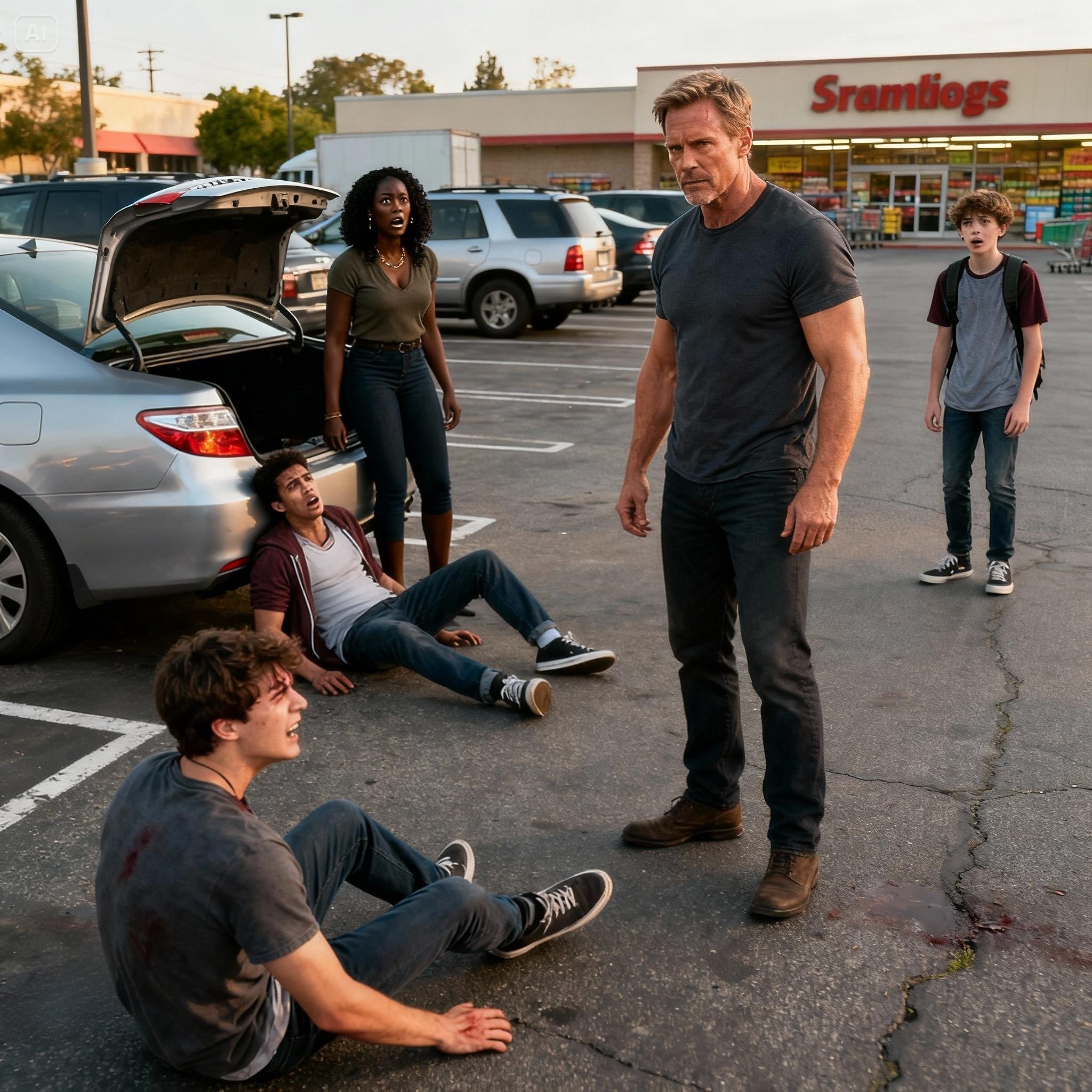
The first boy, the one who threw the drink, mistook my movement for a simple shove. He raised his hands in a telegraphed, clumsy motion. I moved inside his reach, my hand clamping onto his wrist while my other palm found the soft pressure point above his elbow. Using his own momentum, I executed a basic compliance pivot. I didn’t break his arm, but I folded him to the asphalt in a way that made submission his only option. He crumpled with a pathetic groan, his own soda spilling over his expensive sneakers.
The tall leader charged next, a rookie error fueled by blind emotion. He swung a wild, telegraphed punch that I didn’t bother to block. I sidestepped, letting him sail past, and delivered a light, jarring smack to his shoulder while pivoting my foot. It was a minimal expenditure of energy that utterly disrupted his balance. He careened sideways, his shoulder meeting the door panel of a parked Camry with a sickening metallic clang that set off the car alarm.
The third boy, the bulky one, froze. His bravado evaporated as he looked at his fallen friends and then back at me. He saw that I wasn’t panting or raging. I was merely efficient, and that was far more terrifying. He threw up his hands in a frantic gesture of innocence. “Walk away,” I commanded, my voice cutting through the blaring alarm. He didn’t need to be told twice; he scrambled away, leaving his friends behind.
I turned my gaze to the fourth boy, the one who had been a silent witness. As a store security guard jogged toward us, demanding to know what happened, this boy did something unexpected. His voice shook, but he pointed at his friends. “It was them,” he told the guard. “They started it. They threw a drink on her. This man just stopped them.”
The guard looked at the bruised boys, at Danielle’s stained dress, and at my absolute stillness. He nodded slowly and asked if we were alright. I let my smile fade and told him we were fine. We drove home in a car that smelled of peaches and sticky corn syrup. That night, I sat on the porch reflecting on the failure that is violence. I had served in jungles and deserts to protect the ideals of a country, but those ideals are worthless if a man cannot protect his wife in a supermarket parking lot.
Two days later, the fourth boy knocked on our door. He was alone, twisting his cap in his hands, his eyes red with the weight of his own guilt. He apologized for his friends and for his own cowardice. He told me that seeing how calm I remained had taught him what real strength looked like. He handed me a letter he had written for his college board and the student paper—an essay about the casual cruelty of privilege and the necessity of respect.
Danielle read the essay over my shoulder, resting her head against my back. “It seems your restraint taught more than your fists ever could,” she whispered. She was right. Violence had handled the immediate threat, but it was the discipline behind it that reached the only soul worth saving. Those other boys would go on to tell a story about a “crazy old man,” but one of them would never be the same. He had learned that true strength is grounded and steady; it is the ability to wait until the exact moment a lesson must be taught. My smile was never just a warning; it was a sign of the patience required to protect what is sacred.