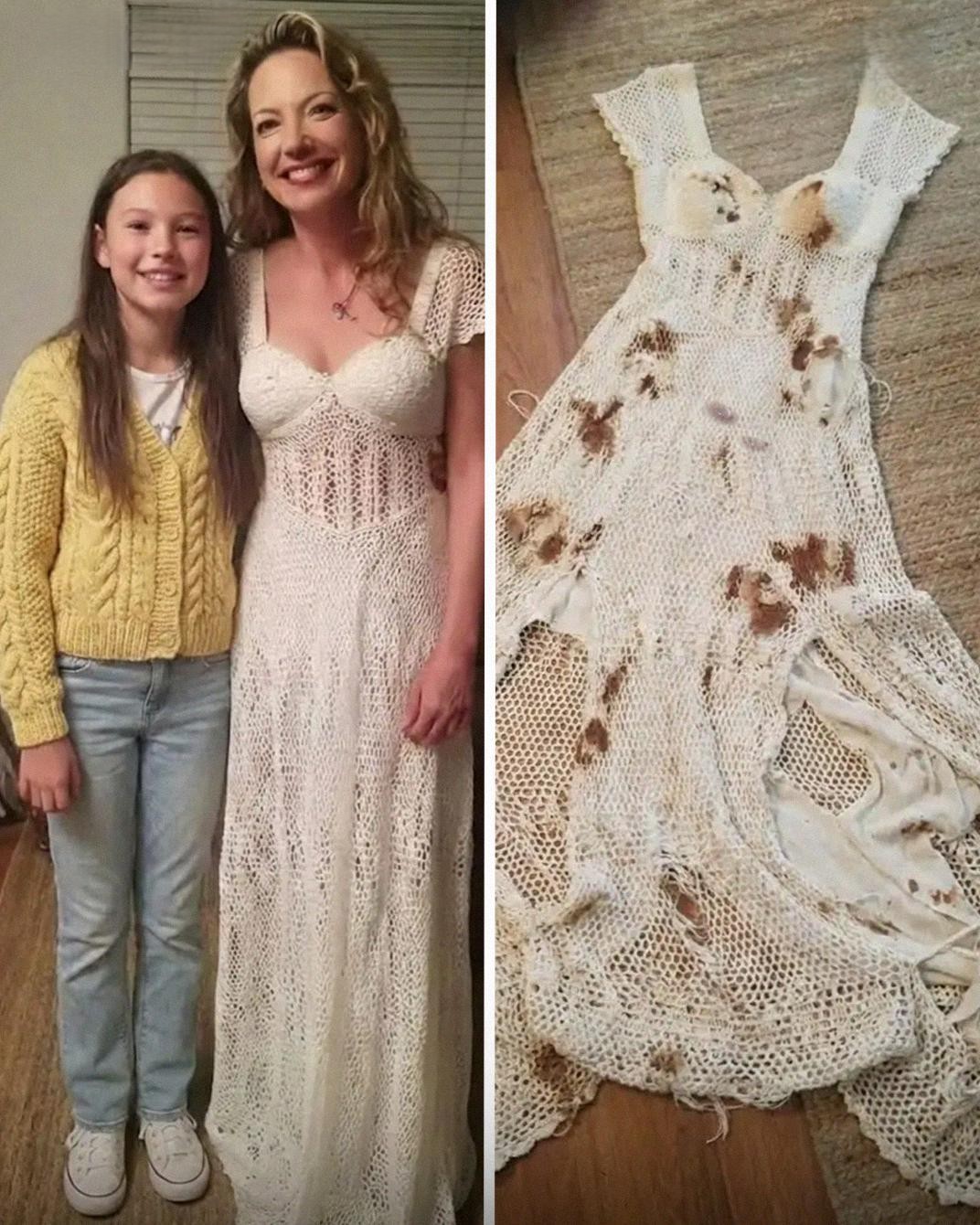
There were twenty-three people in my house that morning, and none of them noticed my daughter crying.
The kitchen was loud with movement and false cheer. Coffee cups clinked. Someone laughed too hard. Hair spray hung in the air like fog. A playlist hummed softly from a phone on the counter. The house felt crowded in that specific way weddings do — full of bodies, noise, and expectation — yet somehow blind to what actually mattered.
I found Lily by accident.
She was curled up on the laundry room floor beside the dryer, knees pulled tight to her chest, face buried in the sleeve of her sweatshirt. She was trying to cry quietly, the way children learn to do when they don’t want to become a burden.
Her shoulders shook in short, painful bursts.
I knelt behind her and wrapped my arms around her. I didn’t rush. I didn’t ask what happened. I just held her, the same way I used to when she was small and nightmares still sent her padding down the hallway in the dark.
“I checked it again, Mom,” she whispered. “Last night. Before bed. It was still perfect. I swear.”
My stomach dropped.
I didn’t need clarification. I already knew.
She was talking about my wedding dress.
Lily had knitted it herself. Every inch. Months of careful stitches turned grief into something solid and warm. I’d hung it in the upstairs closet like it was made of glass, terrified of wrinkles, dust, or careless hands.
“It doesn’t make sense,” she said, her voice thin. “Why would someone do that?”
I kissed the top of her head and stood.
“I’ll be right back,” I said.
The moment I opened the closet door upstairs, the truth hit me hard and fast.
The bodice wasn’t torn by accident. Stitches had been yanked out, ripped in uneven, angry lines. The skirt was soaked in dark red, the stain heavy and deliberate. This wasn’t a spill. This was intentional.
Lily made a broken sound behind me.
I turned and pulled her into my arms.
“Are you mad at me?” she asked, choking on the words.
“No,” I said firmly, holding her face in my hands. “I’m mad at the person who did this.”
And I already knew who that person was.
Downstairs, the house buzzed like nothing had happened. My groom, Daniel, stood near the coffee pot while my aunt talked at him about second chances and how proud everyone would be.
Daniel smiled politely. He always did. He never took more space than necessary.
When he proposed months earlier, Lily waited until he left the room before climbing onto the couch beside me.
“You can say yes,” she whispered. “I like him.”
Two weeks later, she came to me with the idea that broke my heart open.
“Would it be okay if I knit your wedding dress?” she asked. “I want it to be from me.”
That night, I gave her the knitting needles I’d kept since her father died. Smooth birch, engraved with her name and two quiet words beneath it.
Love, Dad.
Her father had taught her to knit with chopsticks when she was little. Knitting had been their thing. Giving her those needles felt like handing her a bridge back to him.
She worked on that dress every afternoon after school. She counted rows under her breath. She undid mistakes without complaint. She poured herself into it.
When I tried it on for the first time, she stepped back and studied me carefully.
“You look like the best version of yourself,” she said.
Daniel’s sister Clara arrived the night before the wedding. She had a way of entering rooms that made people straighten unconsciously. She looked at the dress hanging in the corner and paused.
“Oh,” she said. “That’s… sweet.”
Her eyes lingered too long. She asked if it would stay there overnight.
That was enough.
I found Clara downstairs by the mimosa bar, arranging orange slices like presentation could disguise cruelty.
“Hallway. Now,” I said.
She followed calmly. Too calmly.
I closed the door.
“The dress remembers what you did,” I said. “Ripped stitches. Red wine.”
Her eyes flicked toward the stairs.
“Don’t,” I said. “I know.”
She scoffed, but it rang hollow.
I listed the bottle. The color. The empty trash in her bathroom.
“You destroyed something my daughter made with her hands,” I said. “Something she made with her father in her heart.”
She finally cracked.
“I was protecting my brother,” she snapped. “That dress made this wedding look cheap.”
Aunt Sheryl’s voice cut through the hallway.
“Did you just admit you poured wine on a child’s dress?”
Daniel appeared seconds later. His face changed when he saw mine.
I told him everything. I didn’t soften it.
Clara lifted her chin. “I did what I had to.”
Daniel went still.
“Then you can leave,” he said. “But first, you’re apologizing to Lily.”
Upstairs, Lily sat on the bed with the ruined dress in her lap, fingers clenched in the yarn.
Clara muttered an apology that barely qualified.
Daniel opened the door behind her.
“Go,” he said. “And don’t come back.”
After she left, Lily whispered, “I tried to fix it.”
“It doesn’t need to be fixed the same way,” I said. “It can be changed.”
We worked together. She reknit what she could. She left the repairs visible. Honest.
When she held it up again, patched and imperfect, she smiled.
“She didn’t get to ruin it,” Lily said.
When I walked down the aisle later that day, the wind lifted the hem of the dress. The yarn held.
So did we.
Daniel took my hands and smiled.
“You look incredible,” he said.
“I feel like the best version of myself,” I replied.
That night, long after the guests were gone, Daniel held me in the quiet kitchen.
“She didn’t get to rewrite anything,” he said. “Not us. Not Lily.”
He was right.
The dress was never the point.
Choosing my child was.