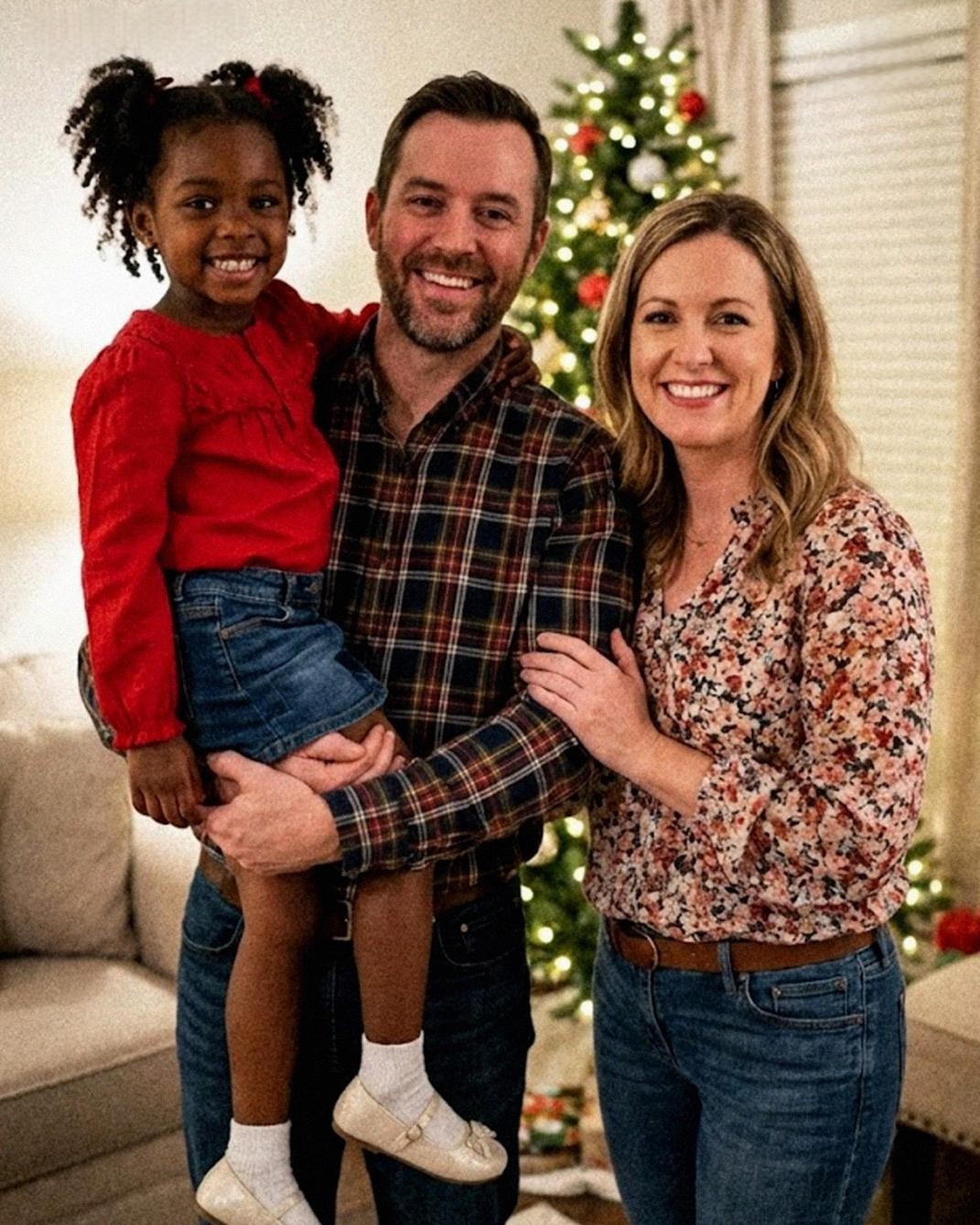
The journey to motherhood for Megan and Daniel was not paved with easy triumphs, but with the quiet, persistent ache of medical waiting rooms and the crushing weight of negative pregnancy tests. By the time Megan reached forty-two, she had made peace with the fact that her body would not be the vessel for a new life. The decision to stop “hating her own body” opened a door to a different kind of destiny—one that led them through a gauntlet of background checks, home visits, and social worker interviews. When they finally stepped into the foster center, the air thick with the scent of wax crayons and industrial cleaner, they were introduced to a four-year-old girl named Sophie. She was a quiet child who colored sunflowers with broken yellow crayons and carried a beat-up book like a shield. The agency file was brief: mother had surrendered her rights, father was deceased, and most notably, there were no major medical issues.
Six months later, a judge’s gavel officially transformed their household into a family. Bringing Sophie home felt like a series of gentle discoveries. Megan and Daniel watched as Sophie slowly unlearned the hyper-vigilance of a child used to temporary spaces. She apologized for every dropped fork and every loud laugh, her body tensing as if waiting for a reprimand that never came. It took months for her to realize that in this house, spilled water was just a mess to be cleaned, not a reason for fear. The most profound milestone occurred when she tentatively climbed into Daniel’s lap and called him “Daddy.” The word was a breakthrough, a linguistic anchor that tethered her to a permanent harbor.
By the time Sophie’s fifth birthday arrived, the house was a vibrant tribute to her favorite flower. Yellow balloons and sunflower-themed decorations filled every corner, and the laughter of preschool friends echoed through the halls. It was meant to be a day of pure, unadulterated joy—a celebration of her first full year of belonging. However, the festivities were interrupted by a hard, heavy knock at the door. Standing on the porch was a thin, disheveled woman in her early thirties with red-rimmed eyes. She introduced herself as Sophie’s biological mother and dropped a bombshell that threatened to dismantle the family’s newfound peace: Sophie was sick, and she had been sick for a long time.
The woman revealed that years ago, before surrendering her rights, she had received medical reports indicating that Sophie might have leukemia. Panicked by her own poverty and unable to face the mounting bills of long-term treatment, she had suppressed the information. She admitted that she had hidden the medical history from the agency and the courts, fearing that no one would adopt a child with such a “defective” medical file. She “rolled the dice,” hoping Sophie would find a home with insurance and stability, but she had kept the secret for five years. However, the revelation was not an act of altruism or a sudden surge of maternal guilt. As she stood on the porch, she demanded “compensation,” arguing that the information she provided was life-saving and that Megan and Daniel, with their comfortable home, owed her for the disclosure.
The confrontation was a chilling display of human transaction. Daniel and Megan were faced with a woman who had used her daughter as a pawn twice—first by hiding her illness to ensure her placement, and then by attempting to extort her rescuers. Despite the woman’s threats and her attempts to guilt them, Megan stood her ground. She refused to pay for a mother’s “bare minimum” duty to her child, and Daniel firmly escorted the woman away, promising legal action if she ever returned. The biological mother vanished as quickly as she had appeared, leaving a trail of terror in her wake but no genuine concern for the child she claimed to care about.
The following morning, the reality of the “terrible secret” began to unfold in the pediatrician’s office. The bloodwork, which the biological mother had so callously used as leverage, confirmed the nightmare: Sophie had an early form of leukemia. The diagnosis transformed Megan and Daniel’s world into a blur of oncology appointments, IV poles, and hospital vigils. Sophie, who had just been celebrating with sunflower cake, was now fighting a war within her own bloodstream. She lost her hair and her energy, but she never lost her spirit. She told her nurses that her “good guys” were winning the battle, a narrative of resilience that kept her parents upright when they felt they might collapse.
The treatment was brutal. Megan and Daniel took turns sleeping in cramped hospital chairs, watching cartoons at dawn, and learning the intricate language of white blood cell counts and chemotherapy cycles. They became experts in which nurses could find a vein on the first try and which snacks Sophie could tolerate during her worst bouts of nausea. Throughout the entire ordeal, the biological mother never reached out. She never called to check on the progress of the “secret” she had revealed; she never messaged to see if the child had survived the treatment. Her absence was the final proof that her visit had been a predatory gambit, not an act of love.
After months of grueling therapy, the oncologist eventually delivered the news they had prayed for: Sophie was in remission. The “good guys” had won. Today, Sophie is seven years old, a thriving girl whose hair has grown back in soft, resilient waves. She is a child of sunflowers and song, arguing about bedtimes and running through life with a vitality that belies her history. Yet, for Megan and Daniel, the trauma of that fifth birthday remains a permanent part of their story. It serves as the defining line between biological connection and true parenthood.
In the world of statistics regarding childhood cancer, pediatric leukemia is the most common form, accounting for approximately 25% of all cancer diagnoses in children and adolescents under the age of 20. Specifically, Acute Lymphoblastic Leukemia (ALL) makes up about 75% of these cases. While the diagnosis is terrifying, the five-year survival rate for children with ALL has seen a remarkable increase over the decades, now standing at approximately 90% due to advancements in targeted therapies and protocols. These concrete numbers represent thousands of families like Sophie’s, who navigate the intersection of medical uncertainty and unwavering devotion.
Reflecting on the journey, Megan realizes that being a mother had nothing to do with the shared DNA or the nine months of pregnancy she once craved. It was forged in the silence of the hospital rooms and the refusal to let go when the “bills” and the fear became overwhelming. The biological mother had been right about one thing: the secret was terrible. But she was wrong about everything else. She didn’t understand that Megan and Daniel’s love wasn’t a transaction that could be bought or sold. It was a commitment that had been signed in the heart long before it was signed on a court document. Standing in the doorway at night, watching Sophie sleep under the soft glow of the hallway light, Megan knows that they didn’t just adopt a daughter—they earned her. They stayed through the needles, the scans, and the terror, and in doing so, they turned a secret meant to destroy a family into the very foundation that made them unbreakable. Sophie is home, and she is whole, and that is a truth no knock on the door can ever change.