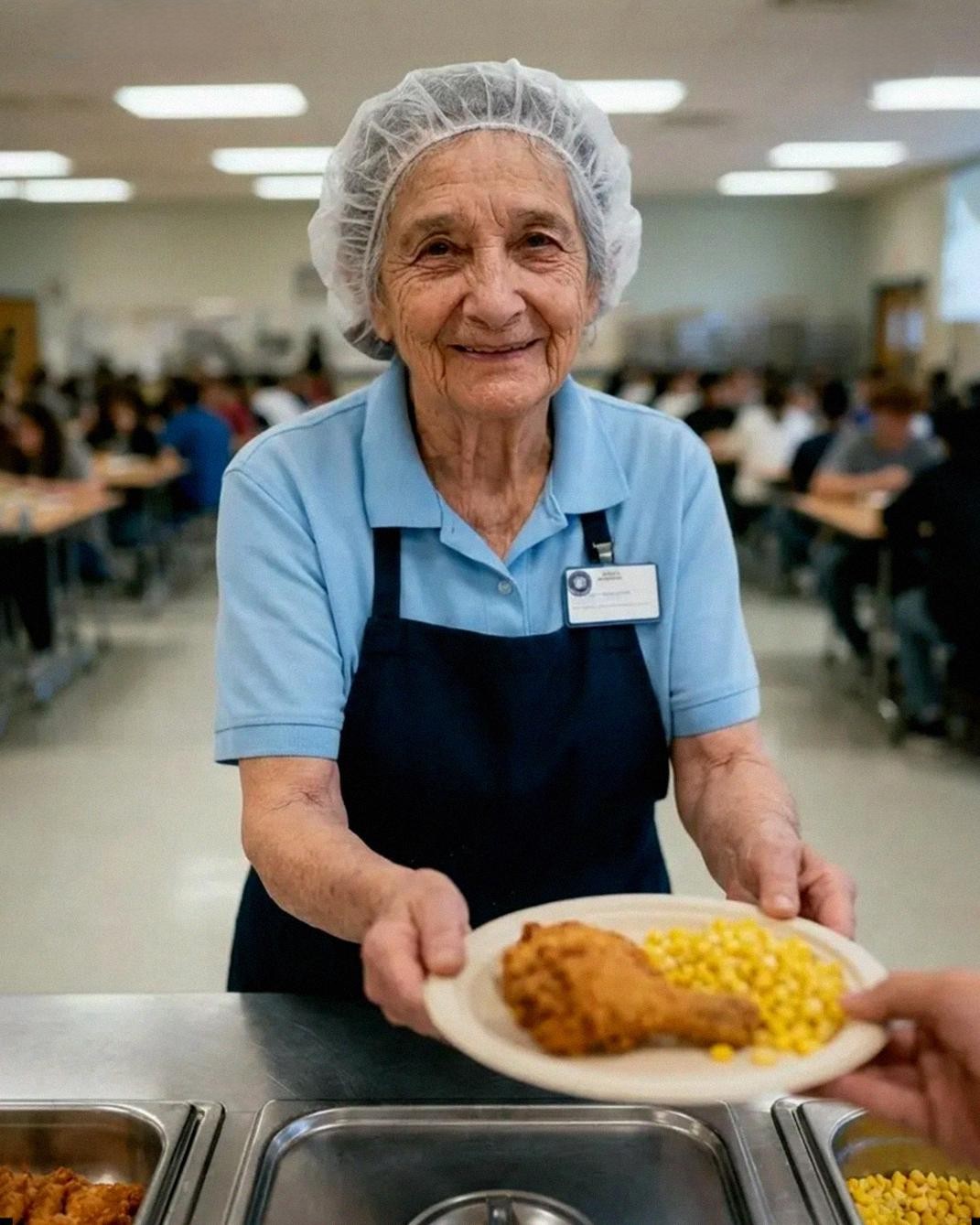
In the quiet aftermath of high school graduation, eighteen-year-old June found herself standing at the precipice of a future that felt strangely hollow. The air still carried the faint, ghostly scent of industrial floor cleaner and warm yeast rolls—the olfactory signature of the school cafeteria that had been the backdrop of her entire life. For June, graduation wasn’t just a milestone of academic achievement; it was the final, echoing chord of a life lived in the shadow of a woman whose hands were calloused from stirring industrial-sized pots and whose heart was large enough to anchor a grieving child.
June’s story began with a tragedy she could barely recall. A car crash when she was a toddler had claimed her parents, leaving behind only flashes of her mother’s laughter and the rhythmic ticking of her father’s watch. In the vacuum left by their absence, her grandmother, Lorraine, stepped in. At fifty-two, Lorraine took on the mantle of mother and father, raising June in a creaky house that sighed with the wind. To the students at school, Lorraine was simply “Miss Lorraine” or the “Lunch Lady,” a figure as utilitarian and unremarkable as the trays she served. To June, she was the support beam of her existence.
Lorraine was a woman of vibrant aprons—sunflowers, strawberries, and polka dots—which she wore like armor against a world that rarely slowed down to help. Despite spending her days feeding hundreds of other people’s children, she never failed to pack June’s lunch, always tucking in a sticky note with messages ranging from the ridiculous to the profound. They were poor, but Lorraine’s imagination was rich. When the heater failed in the dead of winter, she transformed the living room into a “candlelight spa,” making the struggle feel like an adventure. She spent nights stitching thrifted rhinestones onto June’s eighteen-dollar prom dress, humming Billie Holiday tunes and insisting that June’s happiness was the only wealth she required.
However, the cruelty of adolescence rarely respects the sanctity of a quiet life. In high school, Lorraine became a punchline. Classmates whispered about the “Lunch Lady’s” Southern accent, mocked her homemade scrunchies, and imitated the way she called everyone “sugar” or “honey.” June endured years of subtle barbs and overt snickers. Brittany, a girl who had once played in their backyard as a child, would lead the mocking, asking if Lorraine still packed “panties with the peanut butter.” The teachers often heard the snide remarks but remained silent, perhaps dismissing it as harmless teenage banter. June tried to shield her grandmother from the toxicity, not wanting to add the weight of schoolyard malice to the arthritis that already plagued Lorraine’s hands.
But Lorraine knew. She felt the eyes and heard the muffled laughs, yet she chose a radical, persistent kindness. She memorized every student’s name, slipped extra portions to the kids who looked hungry, and asked about their basketball games with genuine interest. She practiced a form of quiet love that didn’t demand an audience. June, fueled by a mixture of protective fury and ambition, buried herself in books and scholarships, determined to cross the finish line of graduation for both of them.
The spring of June’s senior year brought a change that no amount of studying could prepare her for. It started with a tightness in Lorraine’s chest, which the older woman dismissed as “angry chili” or simple indigestion. She refused to go to the doctor, insisting that June’s graduation ceremony was the priority. On a Thursday morning, the silence of the kitchen alerted June to the catastrophe. She found Lorraine on the linoleum floor, her glasses lying beside a half-full coffeepot. Despite the frantic efforts of paramedics, the “heart attack” was a definitive full stop. Lorraine passed away before the next sunrise, leaving June to face the purple honor cords and the graduation gown alone.
On graduation day, June wore the dress her grandmother had picked out and pinned her hair in the Sunday style Lorraine loved. When she was called to the podium to give her student speech, she discarded the clichés she had written weeks prior about “limitless futures” and “cheesy metaphors.” Instead, she looked out at the sea of faces—the classmates who had mocked her, the teachers who had stood by, and the parents who didn’t know the woman behind the counter.
Into the microphone, June delivered a truth that tasted like ash and iron. She spoke of Miss Lorraine, the woman who had served them thousands of meals while hearing every snicker and every insult. She detailed the sacrifices of a woman who ironed a graduation gown she would never see worn and worked extra shifts so her granddaughter could stand on that stage. “She taught me that love isn’t loud,” June’s voice rang out through the hushed gym. “Sometimes it looks like a warm meal you didn’t ask for or a hand steadying yours when the world falls apart.” She told the audience that Lorraine had died a week ago, and that the “Lunch Lady” they treated as a joke was, in fact, the strongest person June had ever known.
The silence that followed was heavy, a collective realization of a kindness that had been squandered. The applause, when it finally came, wasn’t the raucous cheering of a typical graduation; it was a steady, rhythmic mourning. Afterward, in the hallway, the perpetrators of the mockery approached June with eyes red and voices cracked. Brittany, Tyler, Marcus, and Zoey—the architects of June’s high school misery—stood small and ashamed. They admitted they had taken Lorraine’s presence for granted, assuming she would always be there to absorb their cruelty with a smile.
In a gesture of collective repentance, the students proposed a permanent tribute: a tree-lined walkway leading to the cafeteria, a peaceful grove to be named “Lorraine’s Way.” They planned to raise funds and involve the PTA, transforming their guilt into a living legacy. June realized that her grandmother’s kindness had finally done what her own anger never could—it had changed them. “She would have fed you anyway,” June told them, a final testament to the depth of Lorraine’s character.
That night, June returned to an empty house. She sat at the kitchen table where the apron hook now hung bare. The silence was no longer frightening; it was a space where she could finally breathe. She whispered the news of the trees to the empty room, feeling for the first time that she wasn’t truly alone. Lorraine had been her “polar star,” the constant light that guided her through the dark. By sharing the truth of her grandmother’s life, June had ensured that Lorraine’s light would continue to shine, not just for her, but for a whole school of children who finally understood what it meant to be truly seen. June realized that to honor Lorraine was to become a polar star for someone else—to endure, to forgive, and to practice a love that mattered more than any applause.