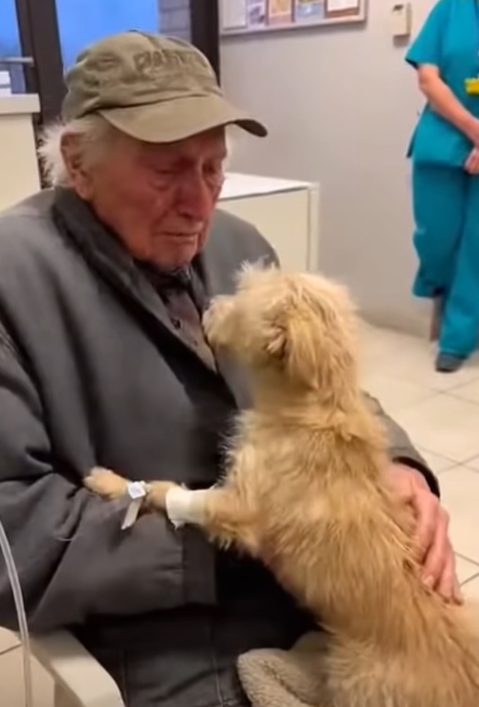
The bag moved.
Not much.
Just enough.
The old man froze mid-step, his cart of bottles rattling to a stop. For a moment, the alley went unnaturally silent — no traffic, no voices, no wind. Just the low hum of a distant city and the smell of damp cardboard.
Then he heard it again.
A muffled sound.
Weak.
Desperate.
A dog crying inside a trash bag.
His breath caught. His hands — knotted with age, veins standing out like cords — began to tremble. The bag lay half-hidden behind a dumpster, black plastic torn slightly at one corner. Rainwater pooled around it, reflecting the yellow glow of a flickering streetlight.
“Hello?” the old man whispered, voice thin.
The bag shifted again.
People passing at the end of the alley slowed, then stopped. A woman covered her mouth. A man muttered, “Is that… alive?”
The old man dropped his grabber stick and knelt, knees protesting sharply. His jacket smelled faintly of sweat and old tobacco. His breath came short and uneven.
He reached for the bag.
The plastic was thick. Knotted tight.
From inside came a panicked whimper, followed by frantic scratching.
The old man began to tear at the bag with his bare hands.
Plastic ripped. His fingers slipped. The sound echoed too loudly in the stillness.
And when the opening finally gave way —
A small, filthy dog burst forward and threw itself into the old man’s arms, paws wrapping around his chest, face pressed into his coat, shaking like it understood something everyone else had missed.
The alley stood frozen.
Because in that moment, it looked less like a rescue —
and more like a reunion that had been waiting too long to happen.
The old man’s name was Walter Greene.
Seventy-four years old.
Widowed.
Invisible.
Every morning before dawn, Walter pushed his cart through the city, collecting cans and bottles. Not because he wanted to — but because it kept him moving, and movement kept the memories quiet.
He used to be a machinist. A steady job. A small house. A wife who laughed easily and drank her coffee black.
Then the factory closed.
Then his wife got sick.
Then the house got sold.
Grief had a way of shrinking things.
Walter rented a room now. Ate mostly soup. Spoke to almost no one. People called him “the trash man” without knowing his name. Some days, they didn’t call him anything at all.
The only voice he still heard clearly belonged to Daisy — the dog he’d owned years ago. A mutt with crooked ears and boundless patience. Daisy used to sit by the door when Walter came home, tail thumping once, twice, always waiting.
When Daisy died, Walter stopped letting himself get close to anything that could leave again.
That morning, he’d nearly skipped his route. His knees ached. The weather was turning. But habit pulled him outside.
And that was when he heard the sound.
The dog in the bag was young — maybe a year old. A mixed breed, ribs visible beneath matted fur, one ear bent awkwardly. His eyes were wide with terror, pupils blown, body shaking uncontrollably.
Walter held him awkwardly at first, unsure how to comfort something so fragile. The dog clung tighter, nails digging into Walter’s coat, heart racing against his chest.
“It’s okay,” Walter murmured, though he didn’t know if that was true. “I’ve got you.”
Someone behind him said quietly, “Who would do that?”
Another voice replied, “Someone who didn’t want to hear him cry.”
Walter understood cruelty born of silence.
He noticed the rope marks around the dog’s neck. The smell of urine. The way the dog flinched when someone stepped too close.
This wasn’t an accident.
Walter wrapped his coat tighter around the dog, ignoring the cold biting through his shirt. He felt the dog’s breathing slowly change — still fast, but no longer frantic.
That was the first twist.
The second came when the dog finally loosened his grip just enough to look at Walter’s face.
And instead of fear —
There was recognition.
As if the dog had been waiting for this kind of person, not a specific one. Someone who would not walk away.
A delivery driver was the first to act.
“I’ve got a blanket,” he said, already moving.
A woman pulled out her phone, hands shaking, and called animal services. A security guard from a nearby building brought water in a paper cup.
Walter stayed kneeling, one arm around the dog, the other pressed into the ground to steady himself. His breathing was labored now. His knees screamed with pain.
“You okay, sir?” someone asked.
Walter nodded. “He’s cold.”
They wrapped the dog carefully. His shaking eased. He let out a long, exhausted sigh and rested his head against Walter’s shoulder.
Animal control arrived, then a vet tech from a nearby clinic who happened to be on call. She knelt beside Walter, eyes soft but alert.
“He’s dehydrated. Hypothermic. But he’s alive,” she said.
Walter swallowed. “Can I… can I stay with him?”
She looked at his face — lined, tired, hopeful in a way that hurt to see.
“Of course,” she replied.
At the clinic, the lights were too bright. The room smelled of disinfectant and wet fur. The dog whimpered once when they placed him on the table, then reached out a paw toward Walter.
Walter took it without thinking.
The vet worked quickly. IV fluids. Warm towels. Gentle hands.
“He’s a fighter,” the vet said. “Someone wanted him gone. He didn’t give up.”
Walter felt tears slip down his cheeks.
“Neither did you,” the vet added.
Hours passed.
When the dog was finally resting, wrapped in blankets, eyes half-closed, Walter sat in a plastic chair beside him. His cart sat forgotten outside.
The dog stirred, then opened his eyes and looked straight at Walter.
His tail thumped once.
That was enough.
Walter named him Chance.
Because that’s what they’d given each other.
The shelter waived the fees. Donations came in quietly — people from the alley, from the clinic, from nowhere at all. Someone repaired Walter’s coat. Another fixed the wheel on his cart.
Walter stopped collecting bottles every morning.
Some days, he still went out — but now Chance walked beside him, leash loose, tail up, eyes curious.
People noticed them.
Not as “the trash man.”
Not as “the abandoned dog.”
But as a pair.
Walter talked more. Smiled sometimes. Sat on benches longer than he used to. Chance slept at his feet, breathing slow and steady.
Some wounds don’t close completely.
They just stop bleeding.
And sometimes, the thing that saves us comes wrapped in fear, thrown away, waiting for the sound of footsteps that don’t pass by.
What would you have done if you heard that sound in the alley?
Share your thoughts in the comments — this story is meant to be felt together.