For generations of viewers, Gunsmoke was more than a television series. It was a steady presence in American living rooms, a familiar rhythm of justice, grit, and quiet humanity that aired week after week. For many families, Saturday nights meant Dodge City. And now, one of the actors who helped give that town its soul is gone.
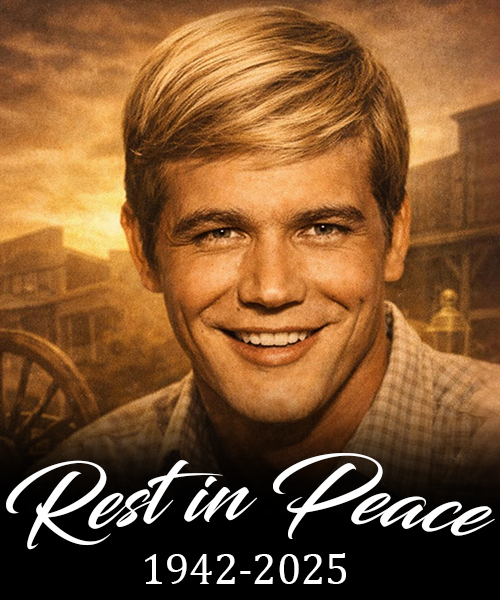
Roger Ewing, best remembered for his role as Deputy Marshal Thad Greenwood on Gunsmoke, has died at the age of 83. His family confirmed that he passed away on December 18 at his longtime home in Morro Bay, California, a coastal town he loved deeply and later served through civic involvement. His death marks the quiet closing of another chapter in television history.
Ewing wasn’t a loud star or a scene-stealer. He didn’t dominate storylines or deliver monologues designed to steal awards. Instead, he brought something rarer: steadiness. Reliability. The sense that when trouble came to Dodge City, Thad Greenwood would be there, calm and capable, doing his job without fuss.
Tall at 6-foot-4, with an easygoing, open face and a grounded demeanor, Ewing first appeared on Gunsmoke in February 1965 in the episode “Song for Dying,” playing a one-off character named Ben Lukens. It was a small role, but it made an impression. Just months later, he returned as a new character entirely—Clayton Thaddeus “Thad” Greenwood—debuting in the third episode of season eleven.
At just 23 years old, Ewing stepped into a series that was already a television institution. By then, Gunsmoke had been on the air for a decade and was deeply embedded in American culture. Joining such a show was no small task, but Ewing fit in almost immediately.
Thad Greenwood was written as the son of an elderly Oklahoma sheriff, played by the late Paul Fix. The character arrived in Dodge City chasing men he believed responsible for his father’s fatal heart attack. Though his legal authority didn’t extend into Marshal Matt Dillon’s jurisdiction, events unfolded in a way familiar to the show: justice found a way forward. With the suspects killed or apprehended for cattle theft, Thad’s mission ended—but his story didn’t.
James Arness’s Matt Dillon saw something in the young man and invited him to stay on as a deputy. From that moment, Thad became part of Dodge City’s emotional architecture. He wasn’t the sheriff, the doctor, or the saloon owner—but he was always there, filling in where needed, learning the job, and becoming part of the town’s chosen family.
Years later, Ewing reflected on how naturally that dynamic worked. With Thad’s biological family gone, the core group—Dillon, Kitty, Doc, Festus—became his surrogate family. If something needed doing, Thad did it. If someone needed backing up, he was there. That was the character’s strength, and it was also Ewing’s.
Ewing appeared in roughly 50 episodes between 1965 and 1967, during a period when Gunsmoke briefly faced declining ratings. As the show retooled and later rebounded, his role was gradually reduced. Eventually, Thad Greenwood was written out, and the deputy role passed to Buck Taylor’s Newly O’Brien, who would remain until the series ended in 1975.
Behind the scenes, Ewing’s time on the show intersected with a moment of uncertainty. When Burt Reynolds departed the series, producers at CBS quietly explored options that included bringing in younger faces to appeal to changing audiences. At one point, internal tensions even led to discussions about the future of Arness’s role—though those disputes were ultimately resolved, and Dillon remained firmly at the center of the show. Once stability returned, Ewing’s character was phased out, not due to performance, but to narrative necessity.
Roger Lawrence Ewing was born in Los Angeles on January 12, 1942. Long before he joined Gunsmoke, he was a fan of the series. As a high school senior, he once played Chester—Dennis Weaver’s character—in a parody sketch, never imagining that only a few years later he would be wearing a badge on the real set.
After a year of college and a stint working as a lifeguard, Ewing committed to acting. His first screen appearance came in the 1964 film Ensign Pulver, an uncredited role that involved a beer bottle and a duck—an anecdote he later recalled with humor. Television soon followed, with guest roles on Bewitched, Rawhide, The Bing Crosby Show, and The Baileys of Balboa. He also appeared in None But the Brave, a war film directed by and starring Frank Sinatra.
Ewing often joked about being typecast as tall, slightly awkward young men—roles that leaned more toward sincerity than swagger. That quality, however, was exactly what made him right for Thad Greenwood. He wasn’t meant to replace Matt Dillon; he was meant to support him.
He came close to a major film breakthrough in the late 1960s when director John Schlesinger reportedly considered him for the role of Joe Buck in Midnight Cowboy. The part ultimately went to Jon Voight, a decision that changed the trajectory of both men’s careers. Around the same time, Ewing made a lighthearted appearance as a contestant on The Dating Game, where future Bionic Woman star Lindsay Wagner chose another suitor.
After leaving Gunsmoke, Ewing continued acting for a few more years, appearing in Death Valley Days, The Mothers-in-Law, and films such as Smith! (1969) alongside Glenn Ford and Play It as It Lays (1972). Then, quietly and without drama, he stepped away from Hollywood.
What followed was a complete reinvention. Ewing became a photographer, traveling extensively through Europe, Russia, Mexico, and the South Pacific. He embraced a life far removed from studio schedules and casting calls, choosing instead curiosity, movement, and independence.
In later years, he turned his attention to community life in Morro Bay, where he became involved in local politics and even ran for a city council seat in 2003. It was a fitting second act for someone who had always played characters grounded in responsibility and service.
For fans of Gunsmoke, Roger Ewing will always be Thad Greenwood—the dependable deputy who didn’t need to be the toughest man in the room to matter. He represented the quiet backbone of Dodge City, the kind of presence you don’t always notice until it’s gone.
And for those who grew up watching the prairie streets flicker across black-and-white screens, his legacy remains woven into the feeling that Gunsmoke gave them: that somewhere out there was a town where decency counted, duty mattered, and people showed up for one another.
Roger Ewing showed up. And that’s why he’ll be remembered.