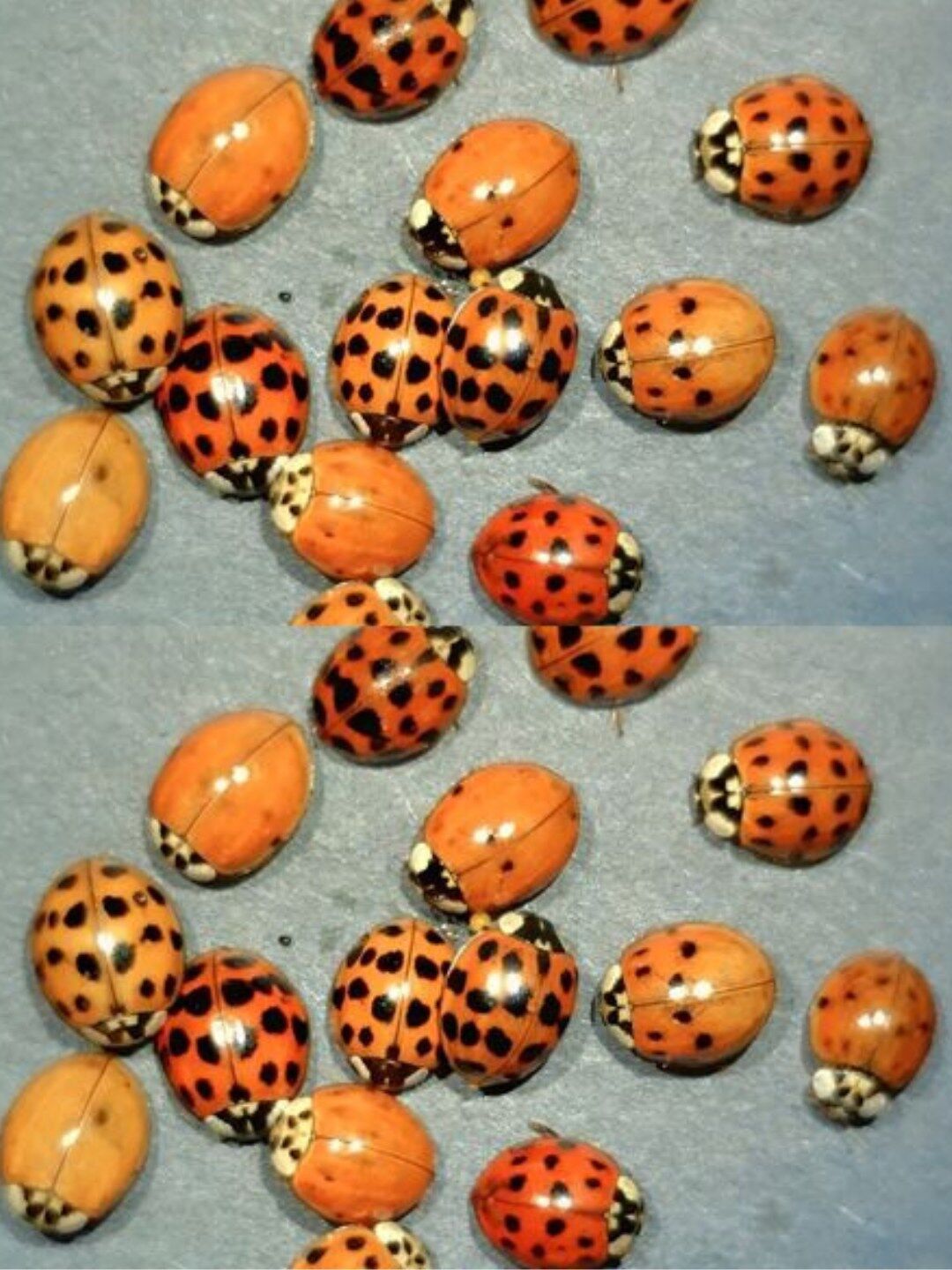
Coming across a yellow ladybug often feels like a small interruption from the ordinary, a quiet moment that makes you stop and look twice. Most of us grow up expecting ladybugs to be red with black spots, so when one appears in bright yellow, it naturally sparks curiosity. Is it rare? Is it lucky? Or is there a scientific explanation hiding behind the symbolism we instinctively assign to it?
The answer is that yellow ladybugs are very real, and they’ve been quietly sharing the world with us all along. Ladybugs belong to the Coccinellidae family, a group that includes thousands of species spread across nearly every continent. While red may be the most familiar color, ladybugs come in an impressive range of shades—orange, cream, black, and yes, yellow. One of the best-known yellow varieties is the 14-spotted ladybug, whose soft yellow body is decorated with black markings that sometimes look playful or even smile-like.
Their color is not random or decorative. In nature, bright colors often serve a purpose, and for ladybugs, yellow is a warning. This phenomenon is known as aposematic coloration. It’s nature’s way of advertising danger without violence. Ladybugs produce defensive chemicals that taste bitter and unpleasant to predators. Birds and other animals quickly learn that brightly colored insects are best left alone. The yellow hue sends a clear message: eating this would be a bad idea.
Beyond defense, yellow ladybugs play a valuable role in ecosystems, especially gardens and farms. Like their red counterparts, they feed on aphids and other plant-damaging pests. A single ladybug can consume dozens of aphids in a single day, making them a natural and environmentally friendly form of pest control. When a yellow ladybug appears on a leaf or flower, it’s often quietly doing essential work that keeps plants healthy.
Despite their usefulness, yellow ladybugs tend to stand out more because they are less familiar to the human eye. That unfamiliarity often invites interpretation, and this is where symbolism enters the picture. Across cultures and belief systems, ladybugs have long been associated with good fortune, protection, and gentle blessings. The yellow variety inherits that reputation and adds another layer of meaning.
Yellow is a color strongly tied to sunlight, warmth, clarity, and optimism. It’s associated with joy, creativity, and mental energy. In symbolic traditions, yellow represents fresh starts, confidence, and the promise of something positive on the horizon. When these ideas are combined with the already favorable symbolism of ladybugs, the yellow ladybug becomes a powerful emblem of hope and lightness.
Many people believe that encountering a yellow ladybug is a sign of good luck or a gentle reminder to stay positive. Some traditions suggest that if a ladybug lands on you, you should remain still and make a wish. The idea isn’t that the insect grants the wish directly, but that the moment itself is a pause—a chance to align your thoughts with something hopeful. Whether one takes this literally or metaphorically, the symbolism has endured because it resonates emotionally.
There’s also a psychological side to these interpretations. When something rare or unexpected appears, the brain assigns importance to it. The bright yellow color triggers attention, and the association with luck or positivity can shift mood instantly. Even skeptics often admit that seeing a yellow ladybug feels oddly uplifting. It’s a reminder that small, beautiful surprises still exist in a world that often feels rushed and predictable.
In folklore, ladybugs are sometimes seen as messengers. Farmers once believed their arrival signaled healthy crops or protection from plagues. In modern interpretations, the yellow ladybug is often linked to personal growth, self-belief, and the courage to move forward. Some see it as encouragement during moments of doubt, while others interpret it as reassurance that they’re on the right path.
Interestingly, yellow ladybugs are sometimes mistaken for different insects entirely because of their color. This leads to the assumption that they’re rare or unusual, when in reality they’ve simply been overlooked. Their presence reminds us how much of nature operates quietly in the background, unnoticed until something catches our eye just enough to make us pause.
From a scientific perspective, their life cycle is no different from other ladybugs. They hatch from eggs, pass through larval stages, and eventually emerge as adults. Their coloration develops as part of their species’ genetic makeup, not as a sign of age, health, or mutation. In other words, seeing a yellow ladybug isn’t a miracle—but it can still feel meaningful.
That balance between science and symbolism is what makes encounters like this so compelling. You can understand the biology and still appreciate the moment. Knowing why something exists doesn’t take away its ability to inspire. If anything, it deepens the appreciation. The yellow ladybug becomes both a functional part of nature and a quiet symbol of optimism.
In a world saturated with noise, notifications, and constant urgency, moments like spotting a yellow ladybug invite stillness. They don’t demand belief in luck or destiny. They simply offer a reminder: beauty doesn’t always announce itself loudly. Sometimes it appears briefly, in a flash of yellow on a leaf, asking only that you notice it.
Whether you see it as a biological wonder, a symbol of joy, or a gentle nudge toward positivity, the yellow ladybug carries meaning because we give it meaning. And perhaps that’s the most human part of the encounter. We look at something small and harmless and allow it to brighten our perspective, even if only for a moment.
Nature doesn’t promise miracles. But every now and then, it offers moments that feel like them anyway.