Tattoos have long sat at the fault line between personal expression and institutional control. For Kay’Ana Adams, that fault line became a breaking point. Her dismissal from the Mobile Fire Department was officially about policy. Unofficially, her story exposes how rigid rules, shifting standards, and workplace power dynamics can converge to end a career almost overnight.
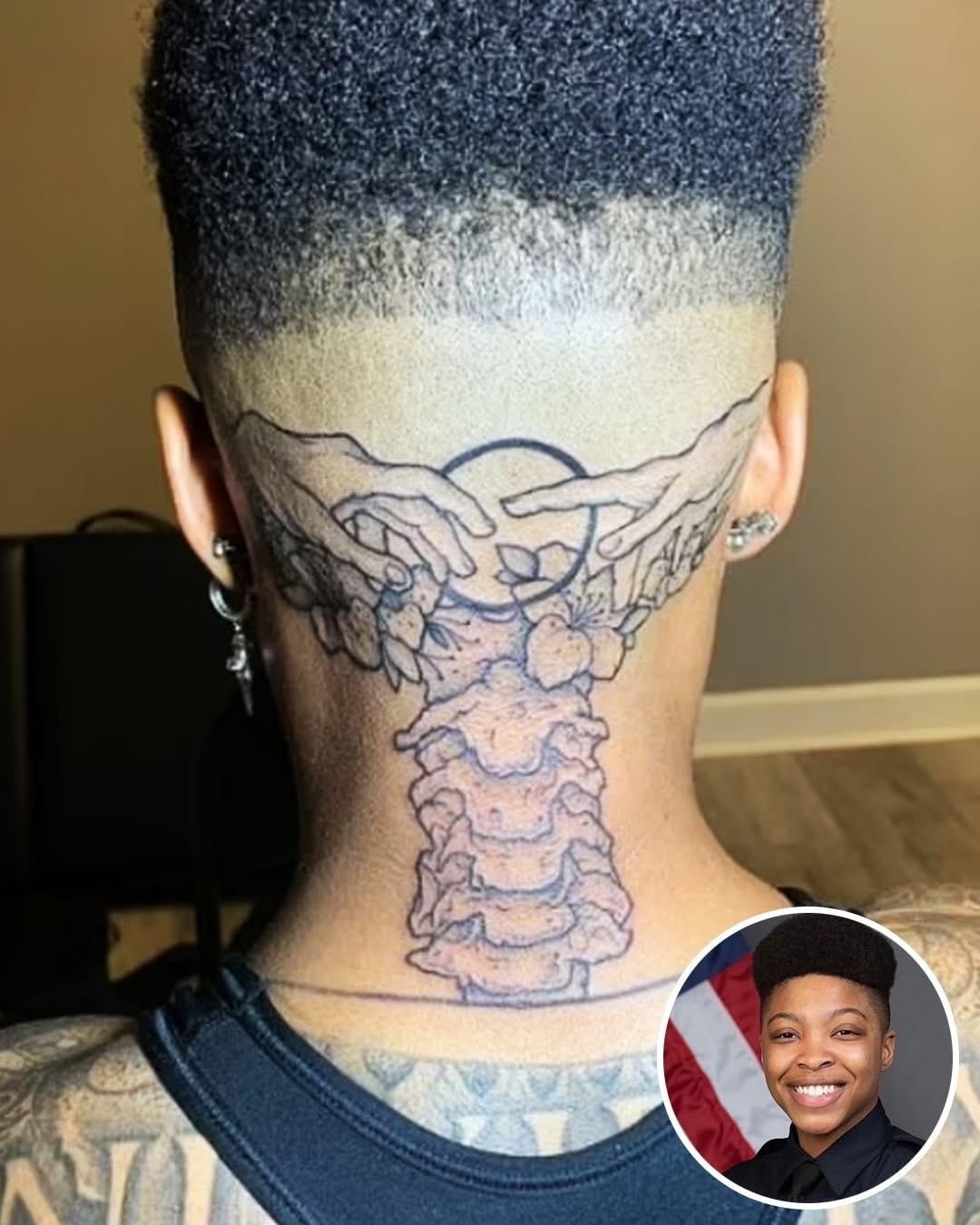
Adams joined the department in early 2023, proud to serve and aware she was entering a demanding, tradition-heavy profession. She was nine months into the job when everything unraveled. The issue centered on a tattoo she had gotten in June 2022, well before her termination and before any rule explicitly banned it. The tattoo sat on the back of her head, a placement she deliberately chose because it could be concealed by her hair. At the time, departmental policy prohibited tattoos on the face or neck. Head tattoos were not mentioned.
Based on that policy, Adams believed she was fully compliant. She didn’t hide the tattoo’s existence. She didn’t try to bend rules. She followed them as written. In interviews, she explained that she made a conscious effort to stay within what the department defined as “decency and order,” including keeping the tattoo covered while on duty.
That confidence evaporated when a complaint was filed about her appearance. The department opened an investigation. Adams was instructed to grow her hair out to ensure the tattoo remained covered. She complied. But instead of resolving the issue, it opened a new front. Her hair texture and growth rate became subjects of scrutiny. What was framed as a neutral appearance standard began to collide with the reality that not all hair behaves the same way, particularly for Black women.
While Adams was still adjusting to these demands, the department made a critical move. The tattoo policy was revised. The new version banned head tattoos entirely. The change came months after Adams had already gotten hers and after she had been working under the previous rules. Even so, she continued to cover the tattoo and believed she was meeting both the spirit and letter of the updated policy.
Then came November 10, 2023.
A captain photographed Adams while her tattoo was covered. Hours later, she was terminated.
She described the moment as shocking. There was no gradual escalation, no final warning that suggested her job was about to end. One moment she was a firefighter trying to navigate shifting expectations; the next, she was unemployed. The department’s leadership later confirmed her firing, stating that she failed to meet departmental standards. To Adams, the explanation rang hollow. From her perspective, compliance had never been the issue.
The tattoo itself was never decorative for her. It carried meaning rooted in her own body and history. Adams was diagnosed with scoliosis, a condition involving an abnormal curvature of the spine that can cause chronic pain and physical limitations. Becoming a firefighter despite that diagnosis was not easy. The tattoo symbolized resilience and determination, a reminder that obstacles did not get the final say over her ambitions.
She has consistently described her tattoos as extensions of her identity rather than acts of defiance. For her, the ink marked survival, not rebellion. That context matters, because it reframes the narrative from one about aesthetics to one about dignity.
As the story gained attention, Adams made it clear she didn’t believe the tattoo was the sole reason for her termination. She had previously raised concerns about the workplace culture, including sexist remarks and disturbing comments during training. In one instance, she objected to jokes involving nooses, which she found deeply offensive and inappropriate. Speaking up put her at odds with colleagues and supervisors in an environment not known for welcoming internal criticism.
Two captains who supported her, Jason Craig and Rodrick Shoots, faced consequences of their own. Craig was suspended for 30 days. Shoots was fired, accused of obstructing orders. The department’s leadership, including Public Safety Director Lawrence Battiste, maintained that these actions were unrelated to Adams’ complaints and were instead due to insubordination and policy violations.
To outside observers, the timing raised questions. When an employee raises concerns, and those who support her are disciplined shortly afterward, it inevitably invites scrutiny. Whether the department was enforcing rules or discouraging dissent became a central part of the public conversation.
Adams’ case has since become a flashpoint in broader debates about workplace conformity. Fire departments, like many uniformed services, place heavy emphasis on tradition, appearance, and hierarchy. Supporters of strict policies argue that uniformity fosters discipline and public trust. Critics counter that such standards often lag behind social reality and disproportionately impact women and people of color.
Her experience also highlights how policy changes can be weaponized when applied retroactively or selectively. Rules that shift without clear transition periods leave employees vulnerable, especially when enforcement depends on subjective judgments about appearance rather than objective performance.
What’s largely uncontested is that Adams wanted to do the job. She trained for it. She complied when told to adjust. She didn’t seek attention. The attention found her anyway.
Since her firing, Adams has spoken openly about the emotional toll of losing a career she worked hard to enter. She has also become an unintentional symbol for discussions about employee rights, inclusivity, and how institutions handle internal criticism. Her story resonates because it’s not just about tattoos. It’s about who gets to define professionalism and whose bodies are most often policed in the process.
At its core, her case forces an uncomfortable reckoning. When policies collide with identity, and when speaking up carries consequences, the question isn’t whether rules exist. It’s whether they’re fair, consistently applied, and capable of evolving.
Kay’Ana Adams didn’t lose her job because she failed to serve. She lost it at the intersection of expression, power, and an institution unwilling to bend. Whether her story leads to meaningful change remains to be seen, but it has already made one thing clear: professionalism is not a neutral standard, and enforcing it without context can cost more than a single career.