My name is Rachel Morgan, and last weekend changed the way I look at my parents in a way I can’t undo. It didn’t creep up slowly or reveal itself gently. It collapsed all at once, like a table giving way under too much weight. The worst part is that it began with something pure and generous.
My daughter Emily is seventeen. She’s quiet, observant, and far more comfortable expressing herself through food than through words. Cooking is how she communicates love. When my mother’s seventieth birthday came up, Emily didn’t hesitate. She told me she wanted to cook the entire meal herself. Not help. Not contribute a dish. Do all of it. Dinner for twenty-three people.
I tried to stop her. I told her it was too much. I told her she didn’t owe anyone that kind of effort. She smiled at me the way she does when she’s already decided. “Mom,” she said, “I want Grandma to feel special.”
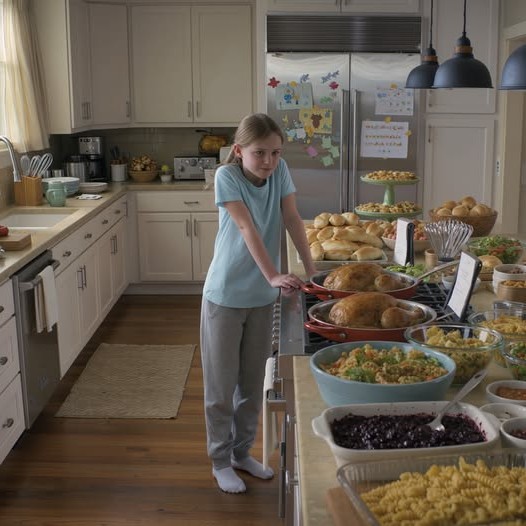
For three straight days, our kitchen turned into controlled chaos. Pasta dough drying on towels. Stock simmering at midnight. Handwritten recipe cards scattered across the counters. She made everything from scratch: roasted chicken, salads, garlic bread, appetizers, sauces, and a blueberry crumble that filled the house with warmth. She slept in short stretches on the couch, waking up to check timers. She hummed while she worked. She was exhausted, but she was proud.
She wanted her grandparents to see her. To see what she could do.
The party was scheduled for Saturday at six in the evening. At 4:12 p.m., while Emily was arranging the last trays on the counter, my phone buzzed. It was a message from my father.
“We’ve decided to celebrate at a restaurant instead. It’s adults only.”
I read it twice. Then a third time. Adults only. After three days of cooking. After a seventeen-year-old worked herself to the bone to feed a room full of people.
I walked into the kitchen carefully, like the floor might crack beneath us. “Sweetheart,” I said, “the plans changed.”
She looked up, confused. “What do you mean?”
I handed her my phone. She read the message once. Her shoulders dropped. Her mouth tightened. Her eyes filled, but she refused to let the tears fall. She looked around the kitchen at everything she’d made, at food that suddenly had nowhere to go.
“Why would they do that?” she asked quietly.
I didn’t have an answer. I hugged her and told her we weren’t wasting any of it.
That night, while my parents enjoyed themselves at a restaurant, I posted in our local community group. I offered a free homemade meal to anyone who needed it—single parents, elderly neighbors, anyone struggling. Within an hour, people were knocking on our door. Emily served every plate herself. She smiled shyly as people thanked her, complimented her cooking, and told her how much it meant.
For the first time that day, I saw her stand a little taller.
The next morning, the storm arrived.
At 9:03 a.m., someone pounded on our front door so hard the walls rattled. Emily froze in the hallway. My stomach sank. I already knew who it was.
I opened the door to find my parents standing there, anger and humiliation written all over their faces. My mother didn’t wait to be invited in. She pushed past me, already talking. My father followed, stiff and silent.
“What were you thinking?” my mother snapped. “Feeding strangers? Posting online like that?” She pointed at me. “People are calling us selfish.”
I crossed my arms. “Then maybe you should think about why.”
My father tried to smooth things over. “Your mom thought the restaurant would be easier.”
“Emily cooked for three days,” I said. “Three.”
My mother waved it off. “She’s a child. She’ll get over it.”
That sentence lit something in me I hadn’t felt before. “She’s your granddaughter,” I said. “And she worked herself to exhaustion for you.”
Emily flinched. She heard it.
My father finally looked at her. “We didn’t mean to hurt you.”
“But you did,” I said.
My mother claimed they hadn’t known how much Emily was cooking. I told her they hadn’t asked. She turned on Emily. “Why didn’t you tell me?”
Emily’s voice barely held. “I didn’t think I needed to.”
The room felt suffocating.
My father admitted they came because my post made them look bad. I looked him straight in the eye. “You abandoned your granddaughter. That’s why.”
My mother accused me of embarrassing her. I told her canceling a party your granddaughter cooked for and excluding her without warning was embarrassing.
Emily blinked fast, trying not to cry. I sent her to the kitchen.
When she was gone, I told my parents the truth. That our community had shown Emily appreciation they hadn’t. That those strangers made her feel valued. That respect was not optional.
My mother asked what I wanted. I told her: respect for my daughter.
My father finally understood. My mother did not. She said the restaurant was already booked. That’s when I realized she wasn’t sorry—she just wanted control.
I told them they weren’t welcome until they could respect my child. My mother stormed out. My father hesitated, then followed.
Emily came back into the room and asked if it was her fault. I held her and told her no. For the first time, I knew I was done letting my parents define family at my daughter’s expense.
Over the next few days, neighbors posted about Emily’s cooking. Photos. Praise. Gratitude. Emily read every comment in disbelief. People asked if she catered. Someone offered to pay her for a small event.
She started researching culinary schools. Cooking not from obligation, but joy.
My mother sent angry messages. I didn’t reply. My father left an apologetic voicemail. I didn’t reply to that either.
Three days later, my father came alone. He looked tired. He apologized properly—to Emily. He admitted he should have paid attention. He gave her a chef’s knife engraved with her initials.
“For your future,” he said.
Emily cried. I watched something soften between them. It wasn’t perfect. But it was real.
That night, Emily asked if things would get better. I told her yes. Not quickly. Not easily. But yes.
Sometimes family breaks. Sometimes it bends. And sometimes, when you choose to protect the person who deserves it most, it grows into something better than what you were given.