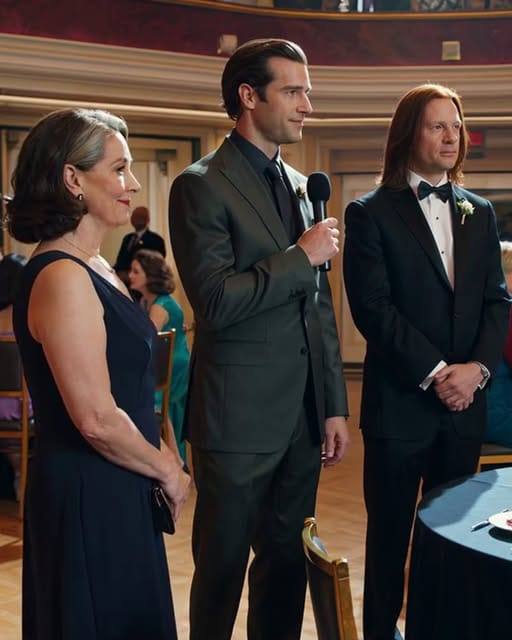
I knew the moment I walked into the ballroom that night that I no longer belonged in my son’s world.
The Riverside Grand Hotel glittered with money and confidence. Crystal chandeliers threw warm light across white-linen tables, champagne flowed freely, and two hundred guests filled the room with the easy laughter of people who had never had to choose between rent and groceries. Everything about the evening screamed success.
Ryan was turning thirty-five, and apparently that milestone required black tie, a live band, and a cake tall enough to need its own spotlight.
I wore a navy dress I’d owned for years. It was elegant, understated, practical—like me. The second I stepped inside, surrounded by couture gowns and tailored suits, I felt invisible. Not unwelcome. Just irrelevant.
I searched for my son. When I found him near the bar, laughing with Tessa and her parents, my heart lifted for a brief, foolish second. He looked handsome, confident, polished. Then our eyes met, and he looked away.
Dinner passed in a blur. I sat at a table near the back with strangers who talked about investment properties and ski homes. No one asked who I was. No one needed to. I was simply part of the background.
Then the cake arrived.
Four tiers. Gold leaf. Sparklers crackling like fireworks. Phones rose in unison as Ryan stepped up to the microphone.
He thanked Tessa. Applause.
He thanked her parents. Louder applause.
He talked about success, opportunity, the people who had “changed his life.”
I waited. Silly, hopeful me.
Then he smiled and said, casually, like it was nothing, “Just to clear something up—this entire party was paid for by my future father-in-law. My mom didn’t contribute anything at all. She didn’t even pay for the cake.”
Laughter. Comfortable, amused laughter.
I felt heat rush to my face. Two hundred people heard my son reduce my life’s worth to a punchline. I didn’t cry. I didn’t react. I smiled, stood, picked up my purse, and walked out.
No one noticed.
In the parking lot, I sat in my car and finally let myself break. Not loudly. Not dramatically. Just the quiet kind of grief that comes when something you believed in dies.
Ryan wasn’t ungrateful because of that one comment. That moment simply confirmed what I had been avoiding for years.
I raised him alone.
His father died when Ryan was three. There was no life insurance, no safety net. Just me, a toddler, and fear. I cleaned houses by day. I taught myself to cook at night. Eventually, I started catering small events. One client turned into two. Two into ten. Ten into a business.
Carter Events was built with cracked hands, sleepless nights, and absolute stubbornness. I grew it from a one-woman operation into a respected company across Dallas. I paid for Ryan’s college in full. I gave him a job. I never let him struggle the way I had.
Quietly, I saved. Every extra dollar went into a separate account. I called it the R Fund. It was meant for his future. His wedding. His security. His freedom.
By the night of that party, it held over two hundred eighty thousand dollars.
I drove home from the hotel, went straight to my office, and didn’t sleep. By morning, I was done pretending.
At seven a.m., I met my attorney.
I removed Ryan as beneficiary.
I redirected the money into a scholarship fund for single mothers pursuing culinary careers.
I stripped Ryan of financial access at the company.
I locked ownership permanently.
Then I did one more thing.
I gave my business to someone who actually respected it.
My niece Dana had worked beside me for six years. She cared about quality. About people. About integrity. She didn’t see the company as a stepping stone or a status symbol. She saw it as what it was—something built with purpose.
I made her my partner.
Ryan found out within days.
The phone started ringing.
Calls. Texts. Voicemails. Anger turned into panic. Panic turned into apologies. By the end of the week, I had seventy-six missed calls.
Not once did he ask how I felt. Only what he had lost.
When we finally met, weeks later, he looked exhausted and humbled. The future he thought was guaranteed had vanished. His fiancée’s parents had pulled their support. The connections dried up. The safety net was gone.
He apologized. Not perfectly. Not fully. But honestly enough.
“I thought you’d always be there,” he said. “No matter what.”
“I am,” I told him. “But not at the cost of my dignity.”
I didn’t give him the money back. I didn’t undo the business decision. Consequences mattered.
What I gave him instead was guidance—without rescue. Advice—without control. Love—without sacrifice that erased me.
Six months later, my life is quieter.
Dana runs the company brilliantly. I watch from the sidelines and feel proud instead of exhausted. The scholarship fund has its first recipients—women who remind me of myself decades ago, desperate and determined, finally given a chance.
Ryan is building something on his own. Slowly. Honestly. Without shortcuts.
Our relationship isn’t what it was. It never will be. But it’s real now.
I learned something far too late in life, but not too late to matter.
Love does not require self-erasure.
Sacrifice is not the same as worth.
And even motherhood has boundaries.
The night my son humiliated me, he thought he took something from me.
What he actually gave me was clarity.
And clarity, once you have it, changes everything.