When I won two hundred million dollars, I told no one. Not my son, Daniel. Not my daughter, Laura. Not the women I sat beside every Sunday at church. I sat alone at my kitchen table with the ticket in my hand, my heart racing, waiting for the rush people always talk about. It never came. What I felt instead was hollow. For years, I had slowly faded into the background of my own family’s life. Now, suddenly, I had a way to see the truth clearly.
I decided to test them.
Not out of spite. Not for revenge. I needed to know whether love still existed beneath the distance, or if it had quietly disappeared while I was busy being useful and undemanding.
I waited three days after claiming the prize. Long enough for the shock to settle, long enough to steady my voice. Then I picked up my phone. My hands were shaking. I called Daniel first. He was always busy, always important, always unavailable unless it was convenient.
“Daniel,” I said softly, forcing weakness into my voice. “I need help. I can’t afford my medication this month.”
The silence on the line told me everything before he said a word. Then the call ended. No goodbye. No explanation. I stared at the phone, confused, and called again. It didn’t ring. He had blocked me.
I sat there, frozen. The clock on the wall ticked loudly, every second stretching. I wasn’t even worth a conversation.
I tried Laura next. My daughter sighed the moment she heard my voice, already irritated.
“Mom, I really don’t have time for this,” she said when I told her the same thing. “I have enough problems of my own. You’ll have to figure it out.”
She hung up.
No questions. No concern. No pause. After everything I had done for them—raising them alone after their father died, sacrificing jobs, sleep, peace—this was what I meant to them now. A burden. An inconvenience.
I cried quietly that night, sitting alone in the dark. The kind of crying that doesn’t make noise, because it’s been building for years. My house felt colder than usual, as if it knew something had finally broken.
Close to midnight, I heard a car outside. Then a knock. Three soft, uncertain knocks.
When I opened the door, my breath caught.
“Grandma?”
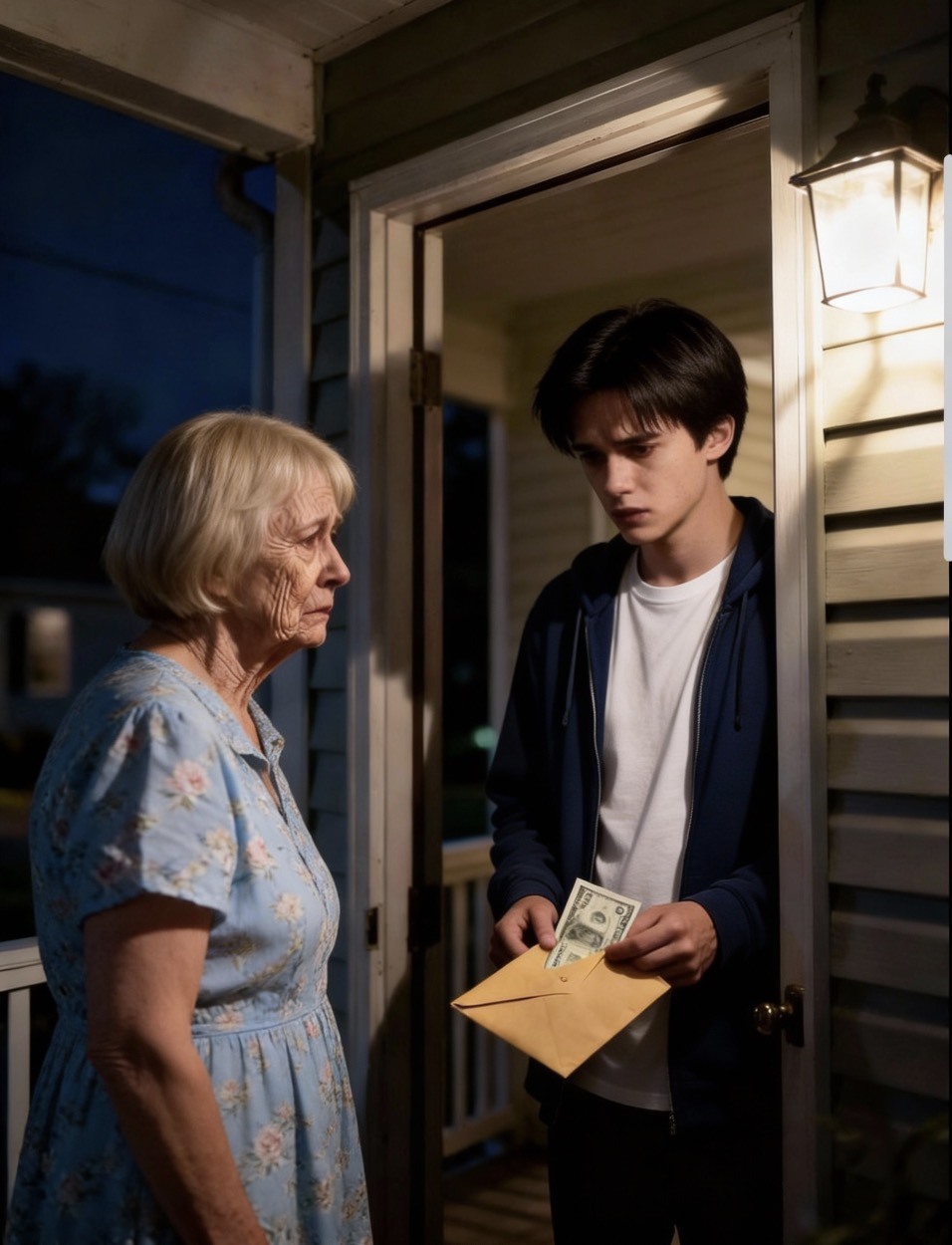
It was Ethan. My grandson. Eighteen years old. His eyes were red, his clothes wrinkled, exhaustion written all over him. He held an envelope in his hand.
“I drove here,” he said. “Four hundred miles. I brought what I could.”
Inside the envelope was five hundred dollars. Every dollar he had saved.
“I don’t have much,” he said quietly. “But I couldn’t let you be alone.”
I couldn’t speak. I just pulled him into a hug and held on. He smelled like cold air and gasoline. In that moment, my heart shattered and stitched itself back together at the same time.
That night, I made him soup. He told me how he borrowed a friend’s old car and left without telling anyone. He didn’t ask what was wrong. He didn’t ask how much I needed. He just came.
I didn’t sleep. I sat watching the sky lighten, thinking about my children, about all the years I gave without asking for anything back, about how easily they dismissed me. And I thought about Ethan, who had so little and gave without hesitation.
By sunrise, my decision was made.
A few days later, I invited everyone over for a family meeting. I said it was important. They came quickly. Daniel arrived first, uneasy, his smile stiff. Laura followed, overly cheerful, pretending nothing was wrong. Ethan sat beside me quietly.
When everyone was seated, I took a breath.
“I won the lottery,” I said.
The room froze.
“Two hundred million dollars,” I continued. “And I didn’t tell anyone. Until now.”
Shock turned into excitement almost instantly. Questions flew. Suggestions. Offers to “help manage things.” Smiles that felt rehearsed.
Then I told them about the calls.
About being blocked. About being brushed off. The room went silent.
“That wasn’t fair,” Daniel said. “You caught me at a bad time.”
“I didn’t think it was serious,” Laura added quickly. “You know how stressed I’ve been.”
I raised my hand. “Stop.”
I wasn’t angry. I was calm. Clear.
“I just wanted to know who would be there for me if I had nothing. Now I know.”
Ethan sat quietly, eyes lowered.
“He drove four hundred miles,” I said. “With his last five hundred dollars. No questions. That’s love.”
Laura stood up abruptly. “So what? You’re punishing us?”
“No,” I said. “I’m choosing honesty.”
I explained my plans. Ethan would have his education paid for, a home one day, a future without fear. The rest would go into a foundation to help elderly people who had no one—people like the version of me they almost ignored. Daniel and Laura would receive something, but far less, and only under conditions that required genuine presence, not obligation.
Laura left in tears. Daniel stayed longer, bargaining, promising, explaining. But my decision didn’t move.
After he left, Ethan hugged me. “You did the right thing,” he whispered.
The truth is, the money didn’t bring happiness. It brought clarity.
Ethan started college without worry. He called often, not because he had to, but because he wanted to. Daniel stayed distant. Laura disappeared completely.
Sometimes the house felt empty. But it was an honest emptiness.
One evening, Ethan called, excited. “I got a scholarship,” he said. “I didn’t need to try, but I wanted to.”
Then he said something I’ll never forget. “I didn’t come that night because I thought you’d ever repay me. I just didn’t want you to be alone.”
That was when I knew.
Money doesn’t change people. It reveals them. And sometimes, losing the illusion of family is the price you pay for peace.
I used to think loneliness was the worst thing. Now I know better. Being surrounded by people who don’t care is far worse.
That lottery ticket didn’t just make me rich. It gave me the truth. And the truth, painful as it was, finally set me free.