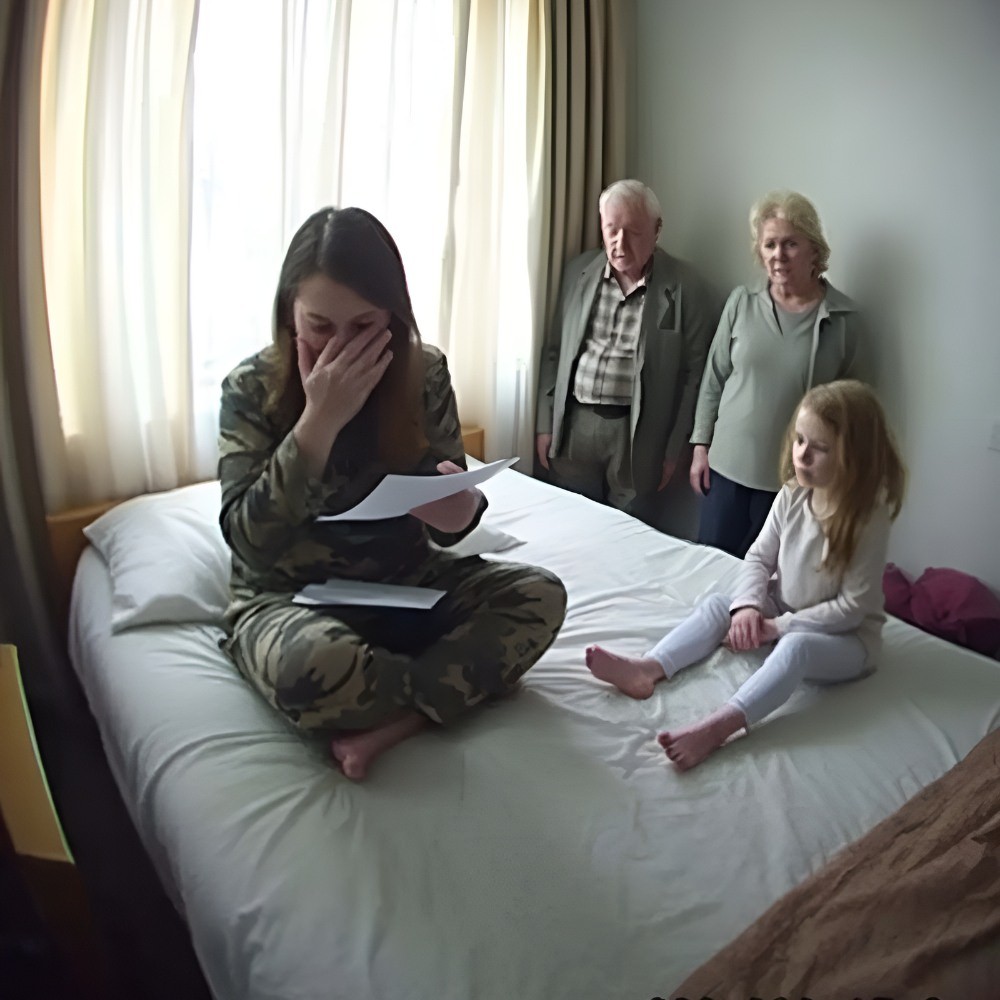
My name is Valerie, and for the last decade, my life has been defined by duty. As a combat medic in the U.S. Army, I am trained to handle trauma, to stem bleeding, and to maintain composure under the most harrowing conditions. But nothing in my military training prepared me for the betrayal I discovered within the walls of my own childhood home. After nine grueling months deployed overseas, my only mission was to return to my fourteen-year-old daughter, Lily, and reclaim the peace we had fought so hard to find.
Our journey toward stability began in tragedy five years ago when my husband, Chris, was killed in a car accident. At twenty-seven, I became a widow and a single mother overnight, navigating a sea of grief while trying to keep my young daughter afloat. The military became my lifeline—a way to provide Lily with a secure future and a sense of purpose for myself. For years, we thrived in our small routines, but when my deployment orders arrived, the delicate balance of our lives shifted.
My parents, living in the familiar comfort of Baton Rouge, stepped forward with open arms. They seemed genuinely eager to care for Lily, promising to provide her with a loving environment while I served. I trusted them implicitly. To ensure Lily wanted for nothing, I arranged a monthly transfer of $2,000 into my parents’ account. It was a significant sum, intended to cover her extracurriculars, a healthy diet, new clothes, and a savings cushion for her future. I even spent my final weeks before deployment redecorating her room at their house, trying to mask my own heartbreak as I watched her cry when I finally drove away.
The first hint that something was amiss came the moment I landed back on American soil. My sister, Sarah, picked me up from the airport, but her usual vibrance was replaced by a strange, jittery unease. She kept her eyes on the road, offering only a cryptic warning: “You’ll be surprised how much Lily has grown.”
When I finally reached my parents’ house, the reunion was bittersweet. Lily threw herself into my arms, clinging to me as if I might vanish again. But as I pulled back to look at her, the medic in me started triaging the situation. Her clothes were noticeably too small, her shoes were worn thin at the soles, and the screen of her phone was a spiderweb of cracks. Conversely, the house was unrecognizable. It gleamed with high-end furniture, a fully remodeled kitchen, and a brand-new, top-of-the-line SUV sat proudly in the driveway.
The tension broke during dinner. Lily mentioned casually that she had been forced to quit the soccer team because she couldn’t afford the new uniform fees. I froze, my fork halfway to my mouth. I had sent $18,000 over nine months specifically to prevent such a thing. My mother noticed my expression and immediately pivoted the conversation to a mundane story about a neighbor.
That night, I retreated to my room and pulled up my banking app. Every single transfer had been completed. The money was gone from my account, but it clearly hadn’t reached my daughter. The next morning, the reality became even more grim. Lily served me a meager breakfast of dry toast and a few slices of fruit. “Grandma says we have to be careful with groceries,” she whispered. “She says we don’t have much money for food.”
My stomach turned. I looked at her torn backpack and the patches on her boots. Something was terribly wrong. I began to pay closer attention, lingering in hallways and listening to the hushed tones of the adults in the house. I caught my mother whispering to my father, “She’s starting to suspect. Just stick to the story about your medical bills.” Then, Sarah’s voice joined in: “Make sure you hide the receipts for the cruise.”
The betrayal felt like a physical blow. The following day, while my parents were out, I searched my father’s desk. I didn’t have to look long. Beneath a pile of junk mail, I found the evidence: a $5,000 invoice for a Caribbean cruise, receipts for expensive jewelry, and a stack of bills for the extensive home renovations I had admired upon my arrival.
I confronted Sarah first, but she stammered through a weak defense, claiming our parents said I hadn’t been sending much at all. I knew I needed more than just my word against theirs. I visited Lily’s school and spoke with her counselor, who broke my heart with the truth. Lily had been working part-time at a local café, often arriving at school exhausted and falling asleep in class just to make ends meet. A friend’s mother later revealed that Lily had sold her iPad and—most devastatingly—her late father’s locket just to pay for a mandatory school field trip.
The confrontation came on Christmas Eve. The house was decorated with the spoils of my labor, and the extended family was gathered in the remodeled living room. I didn’t wait for a lull in the conversation. “While I was overseas, I sent $2,000 every month for Lily’s care,” I said, my voice ringing with the authority of a commanding officer. “That is $18,000. My daughter never saw a cent of it.”
The room went deathly silent. My mother’s wine glass shook in her hand; my father couldn’t meet my eyes. I placed a folder on the coffee table containing every bank statement, every luxury receipt I’d found, and a written statement from Lily’s counselor. “She sold her father’s locket so she could go on a school trip while you were installing granite countertops,” I said, my voice trembling with a mixture of rage and grief.
My father finally snapped, attempting to justify the theft by shouting about the “hidden costs” of raising a child. I cut him off. “I’ve been raising her alone for five years. I know exactly what it costs. It doesn’t cost an eighteen-thousand-dollar remodel and a cruise.”
My mother tried a different tactic, whispering about the “love” they provided. But love is not a currency used to buy silence or luxury at the expense of a child’s well-being. Lily’s quiet voice was the final nail in the coffin. “They told me you couldn’t send anything, Mom. They said you were struggling.”
I didn’t want revenge; I wanted the truth, and I wanted my daughter made whole. With a military attorney present, I forced a formal confession. We reached a legal agreement: they would sell the new SUV, cancel their upcoming travel plans, and repay every dollar at a rate of $1,000 a month. If they missed a single payment, I would press criminal charges for financial exploitation.
Months have passed since that night. We moved to a new base, far from the toxic shadows of Baton Rouge. Lily is back in therapy, healing from the trauma of being lied to by the people who were supposed to be her safety net. She’s back on the soccer pitch, her confidence returning with every goal she scores.
By the following summer, over $12,000 had been repaid. When Lily recently suggested inviting her grandparents for a brief Thanksgiving dinner—stressing “just dinner, not a sleepover”—I realized that she was learning the most difficult lesson of all: forgiveness. Forgiveness doesn’t mean forgetting, and it certainly doesn’t mean removing the consequences. It simply means choosing to move forward without the weight of hatred holding you back.
This experience was a brutal reminder that sometimes the people we trust the most are the ones capable of the deepest betrayals. But it also proved that my daughter is as resilient as any soldier I’ve ever served with. She no longer has to wonder “what money?” because now, her future is exactly where it belongs—protected, secured, and entirely in her own hands.