“You and your child mean nothing to me.” Those were the last words my mother-in-law, Deborah, flung at me before the heavy oak door of the apartment clicked shut. Two days earlier, I had stood at a gravesite, watching the earth cover Caleb, the man who was my entire world. Now, his mother was throwing me out like a bag of refuse, indifferent to the fact that I was holding her three-week-old grandson in my arms.
My name is Mia. At twenty-four, I found myself standing in a dimly lit hallway, clutching a suitcase, a diaper bag, and my son, Noah. I was still wearing the same black dress I’d worn to the funeral. I felt like a ghost haunting my own life. Noah, sensing my distress, began to wail, the sound echoing off the sterile walls of the apartment building. I had no plan, no home, and—thanks to Deborah’s calculated cruelty—no support. The only thing I possessed that felt like “home” was Caleb’s old hoodie, which I had stuffed into the top of my bag. It still smelled like him: a mix of cedarwood and the peppermint gum he always chewed. I clung to it as if it were an oxygen mask.
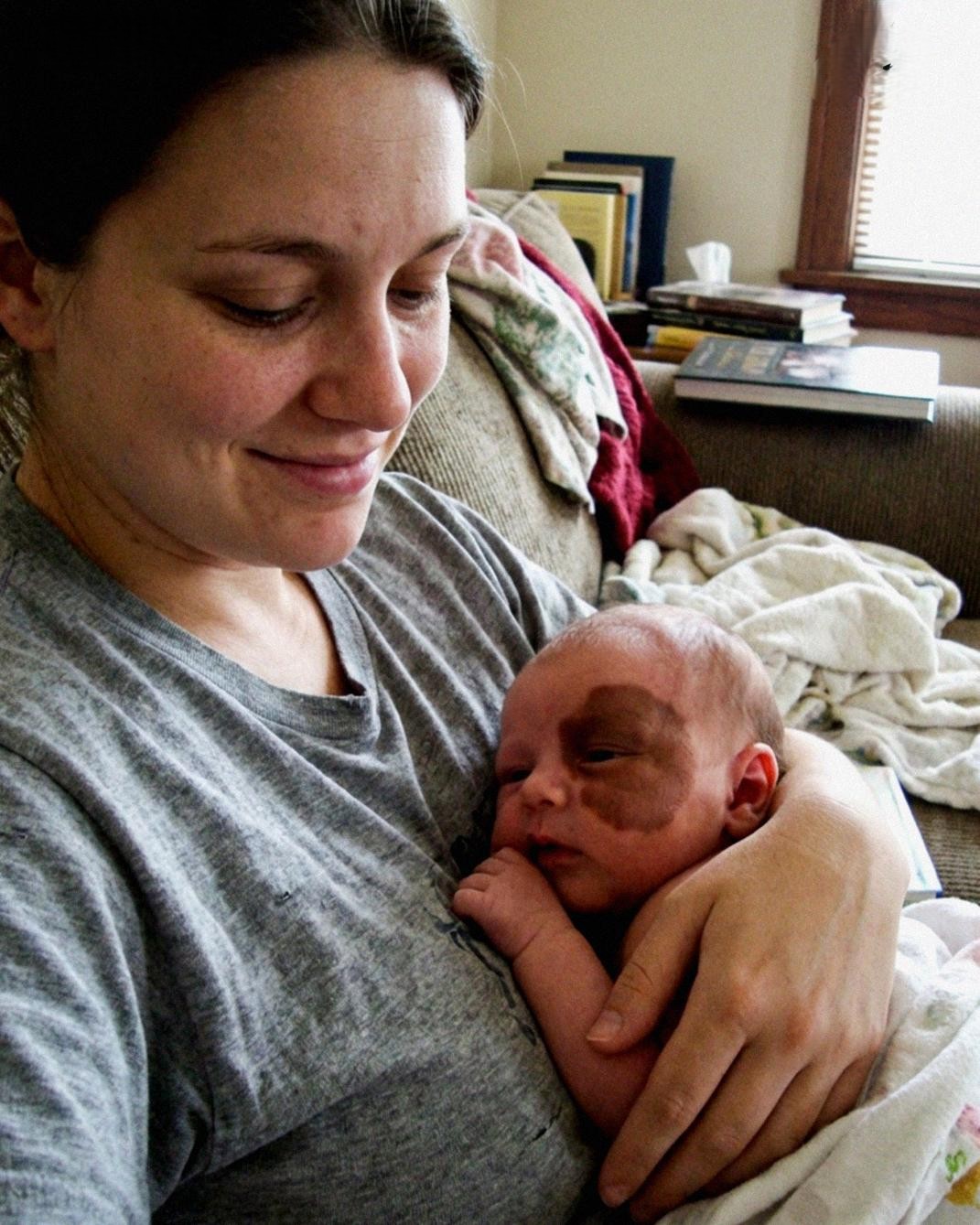
To understand the depth of Deborah’s hatred, you have to understand Noah. Caleb and I had spent years navigating the heartbreak of infertility. When Noah was finally born, he was perfect to us, but the delivery room had fallen into an uncomfortable silence. Noah was born with a large, deep-red port-wine stain covering nearly half of his face. While I had braced myself for a world that can be unforgiving toward physical differences, Caleb never wavered. He kissed that birthmark every single day, telling Noah it was a map to all the places we would go together.
Deborah, however, saw it as a mark of shame. She planted insidious seeds of doubt, whispering that perhaps the “imperfection” was a sign that Noah wasn’t truly a member of the family bloodline. Caleb had always defended us, telling me she would eventually “come around.” He was wrong. When Caleb died suddenly of a heart attack at twenty-seven, Deborah didn’t see a grieving widow and a fatherless child; she saw an opportunity to purge us from her life. She claimed the apartment, which was held in a family trust, and gave me one hour to vacate. Her parting shot was an accusation that I had “trapped” her son with a child who wasn’t his.
The weeks that followed were a blurred montage of survival. I lived out of cheap motels and bounced between friends’ couches, trying to maintain a facade of strength for Noah. Every time a stranger stared at his birthmark in a grocery store, or every time I had to choose between diapers and a hot meal, I felt the crushing weight of failure. Grief is a heavy burden, but the logistical reality of poverty is a suffocating one.
Everything changed on a rainy afternoon when a car sped through a puddle, drenching Noah and me as we walked to a local shelter. The driver, a young woman named Harper, jumped out of the car, initially defensive but quickly softening when she saw me standing there, soaked and sobbing. Harper wasn’t just a stranger; she was a lifeline. It turned out she was a lawyer who specialized in family disputes, having survived a similar betrayal by her own stepmother. “I know this kind of woman,” Harper told me as she handed me a dry towel in her office later that week. “And I know how to stop them.”
Shortly after I met Harper, Deborah’s behavior took a bizarre turn. She called me, her voice suddenly dripping with a saccharine warmth that made my skin crawl. She invited me to dinner, claiming she wanted to “move past the hostility” for the sake of her grandson. I knew it was a trap, but a desperate part of me hoped she had finally found her conscience.
The dinner was a surreal display of theater. Deborah had prepared a feast, cooing over Noah and calling him “my precious angel” while lighting candles and pouring wine. Then, the velvet glove came off. She revealed that Caleb had saved a significant sum of money in a private account, intended as a down payment for a house for us. He had left it to me in his will.
“But,” Deborah said, her eyes turning cold as she leaned across the table, “I raised him. I sacrificed my life for him. I think we should discuss how that money is ‘fairly’ divided. If you don’t agree to give me the lion’s share, I will tie you up in court until you’re destitute. You’ll never see a dime, and I’ll make sure everyone knows you’re an unfit mother.”
I left that house shaking, but this time, I wasn’t just a victim. I had Harper.
The ensuing legal battle was a war of attrition. Deborah tried to paint me as a gold-digger, a liar, and an unfaithful wife. She even attempted to sue for “grandparental visitation rights” while simultaneously claiming Noah wasn’t Caleb’s. But Harper was relentless. We uncovered the paper trail Caleb had meticulously left behind. He had known his mother’s nature better than I realized; his will was airtight, explicitly stating that the funds were for his wife and son, with no provisions for his mother.
When the judge finally dismissed Deborah’s claims, I didn’t feel a rush of triumph. I felt an overwhelming, bone-deep relief. I sat in Harper’s office and cried—not for the money, but for the safety it represented. My husband had reached out from beyond the grave to build a wall between us and the woman who wanted to destroy us.
A month later, I signed the deed for a small, two-bedroom cottage on the edge of town. It wasn’t grand, but it had a yard with an old oak tree and a kitchen flooded with morning sunlight. On moving day, I stood in the center of the empty living room with Noah in my arms. For the first time since the funeral, the air didn’t feel heavy.
Noah looked up at me, his birthmark vivid in the afternoon sun. I realized then that Deborah had been right about one thing: Noah and I meant nothing to her. But she was wrong about the most important thing. She thought family was about blood and control. I learned that family is about the people who show up when the world is dark. Caleb showed up through his foresight and his love. Harper showed up through her justice and her kindness.
Deborah never apologized. She vanished into the bitterness of her own making, likely telling anyone who would listen that she was the victim of a conniving daughter-in-law. I don’t care. I don’t need her apology to build a life.
Every night, as I rock Noah to sleep in a house that is truly ours, I tell him about the knight who fought for us. I tell him about his father, a man who loved every inch of him without condition. I’ve learned that love doesn’t end at the grave; it transforms into the roofs over our heads and the people who stand by us when we have nothing left to give. Caleb is gone, but his love is the foundation of our home, and that is a legacy Deborah will never be able to touch.