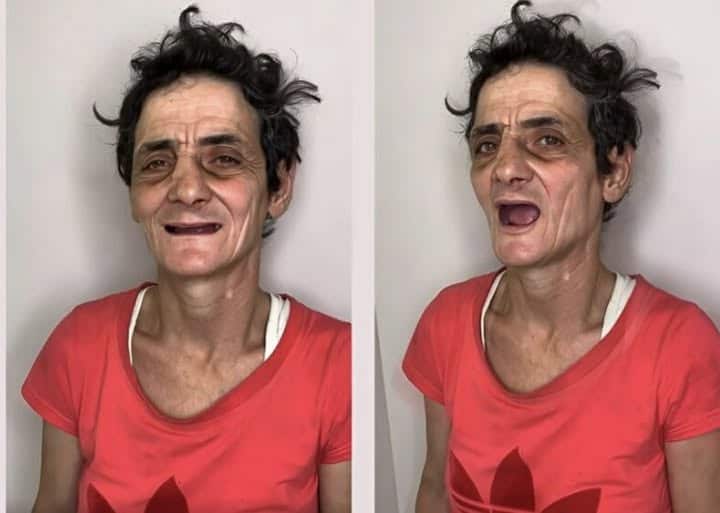
Rita had already been dismissed by the world. Years on the street had etched grief into her face, muted her laughter, and narrowed life to survival. She carried her belongings in plastic bags, counted empty bottles, and held memories of a son she had lost—memories that hurt to touch. Most people passed without seeing her. One person did not.
When Shafag Novruz stopped and looked closer, she made a quiet decision: not to rescue, not to perform kindness for an audience, but to restore dignity. She understood that real help begins before transformation—with care that says, you matter. The first step wasn’t cosmetics at all. It was a dentist appointment, paid for out of Shafag’s own pocket, returning Rita’s ability to smile without shame—and with it, the courage to meet the world’s gaze again.
What followed was slow and attentive work. A gentle manicure and pedicure washed years of neglect from Rita’s hands and feet. Hair was cleaned, lightened, and softly extended—not to disguise who she was, but to reveal what had been buried beneath exhaustion. Each step was deliberate, respectful, unhurried. Nothing was rushed, nothing was taken.
When Rita finally faced the mirror, the change was not merely external. Her shoulders lifted. Her eyes steadied. The woman looking back at her was familiar—older, marked by hardship, but unmistakably alive. The transformation did not erase her past; it gave her permission to imagine a future.
This was not a makeover. It was the return of identity. A reminder that dignity is not something earned by circumstances, but something intrinsic—something that can be uncovered when one human being chooses not to look away. Sometimes, the smallest acts of care are strong enough to reopen a life that the world had already closed.