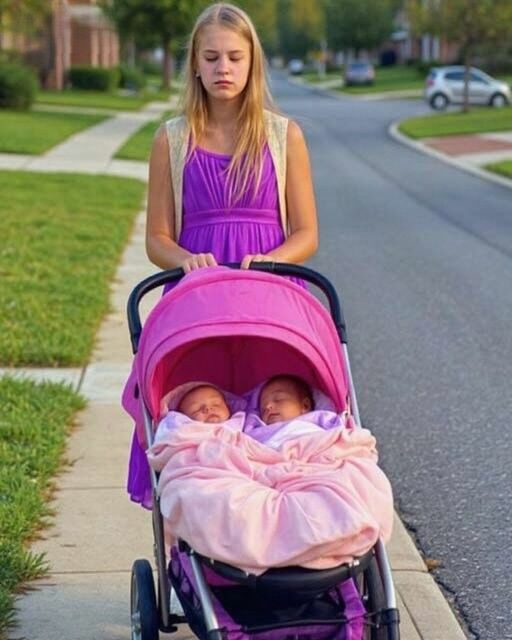
I was still in my scrubs, grocery bag digging into my wrist, when my fourteen-year-old daughter pushed a stroller onto our porch.
For a moment, my brain refused to cooperate. The sight didn’t belong to any version of my evening routine. Then I saw the contents of the stroller—two impossibly small faces, red and wrinkled, bundled in mismatched blankets. One of them made a thin, fragile sound, the kind that goes straight to your chest.
“Mom,” Lucy said, her voice shaking. “Please don’t be mad. I didn’t know what else to do.”
My hand stayed frozen on the doorknob. “Lucy… what is this?”
“I found them in the park,” she whispered. “By the playground. I thought they were dolls at first. Then one moved.” Her fingers tightened on the handle. “Someone left them there. I couldn’t just walk away.”
My heart slammed hard enough to make me dizzy. Years of nursing kicked in before panic could take over. “Okay,” I said, slow and even. “You did the right thing bringing them here. Now we need to make some calls.”
Her eyes filled instantly. “Please don’t call yet. They’ll take them away. What if no one cares about them?”
That fear—raw, unfiltered—split something open inside me. I pulled her into my arms, the stroller between us. “We have to,” I said softly. “They need doctors. And we need help to figure out what happened.”
Within an hour, our living room filled with quiet authority: police officers speaking gently, a social worker with tired but kind eyes. The twins were identical, right down to tiny star-shaped birthmarks near their shoulders. They were lifted carefully and taken to the hospital while Lucy sat beside the now-empty stroller, hands still gripping the handle as if she could keep them close by force of will.
There was no note. No witnesses. Nothing to explain why two newborn girls had been abandoned in the cold.
The story hit the local news. Lucy’s face was blurred, but her courage wasn’t. People called her a hero. She didn’t feel like one.
“I should’ve stayed with them longer,” she said one night, staring at nothing. “They looked scared.”
Weeks later, the hospital called. The twins were healthy. No family had come forward. The state asked if we’d consider temporary foster care.
I stared at the kitchen wall, mentally counting hours and energy I didn’t have. My shifts were long. Lucy was still a child herself. Two infants felt impossible.
Lucy overheard and stepped into the room like she’d already decided something. “Please, Mom. Just for a little while. I’ll help. I promise.”
She meant it. I could hear it in her voice, see it in her eyes. Maybe taking care of them was how she was holding the shock together.
I said yes.
We named them Grace and Hope because it felt right—because we needed words that meant something. The months that followed blurred into a cycle of bottles, diapers, and sleep stolen in fragments. I rediscovered the weight of a baby asleep on your shoulder, the way love arrives quietly and then refuses to leave.
Lucy amazed me. She set alarms for late-night feedings, learned their cries, sang the same lullaby until it became part of the house itself. She didn’t complain. She showed up.
Six months later, the court called. No biological family had been found.
“Can we adopt them?” Lucy asked, barely above a whisper.
“You’re still a kid,” I said gently.
“I know,” she replied. “But you’re not.”
She was right. By then, we were already a family. It hadn’t been decided all at once; it had grown through ordinary days and exhausted nights. When the adoption was finalized, we cried on the courthouse steps, holding hands as if to make it official with our bodies as well as ink.
Years passed. Grace and Hope grew into noise and light—scraped knees, mismatched socks, artwork taped to every surface. Lucy went off to college but came home constantly, still braiding hair, still reading bedtime stories. Life wasn’t perfect, but it was real and full.
I thought the strangest chapter of our story was over.
Then, ten years after that night, my phone rang while I was making dinner.
“Mrs. Davis?” a man asked. “I’m calling regarding an inheritance matter concerning Grace and Hope.”
I nearly dropped the pan.
He explained that a wealthy businessman had died, leaving a $4.7 million trust to be split between the twins, named specifically in his will. There was also a letter.
The next day, a lawyer sat in our living room and handed me an envelope. Inside was a handwritten note.
Grace and Hope are my granddaughters.
My breath caught as I read on. The man explained that his son had hidden the pregnancy, that shame and fear had driven terrible decisions. Before the son died, he confessed everything. The grandfather had searched until he found the twins—found us.
“I can never repay what you’ve given them,” the letter ended. “But I hope this helps secure the future you’ve already built.”
Lucy stood behind me, silent and wide-eyed. When the lawyer handed her a second envelope, she pulled out a photo of two newborns in a hospital bassinet.
A note was attached.
Because of you, they lived. You gave them life twice.
Lucy cried the kind of tears that come from being seen.
The story surfaced again, reshaped by time. The teen who found abandoned twins. The babies who turned out to have a grandfather who never stopped looking. People talked about fate, about money, about miracles.
The inheritance changed practical things—college funds, stability, choices we’d never had before. But it didn’t change the core truth of our lives.
What mattered had already happened on a quiet porch years earlier, when a scared girl chose compassion over comfort. When love showed up without guarantees or reward.
Sometimes I think about that unknown mother, the one who left two newborns in a park. For a long time, I carried anger toward her. Now, I let it go. I don’t know her story. I only know where it led.
When I watch Grace and Hope run across the yard, laughing, hair flying, I know this: the greatest inheritance they ever received wasn’t written into a will.
It was carried home in a stroller by a fourteen-year-old who refused to look away.