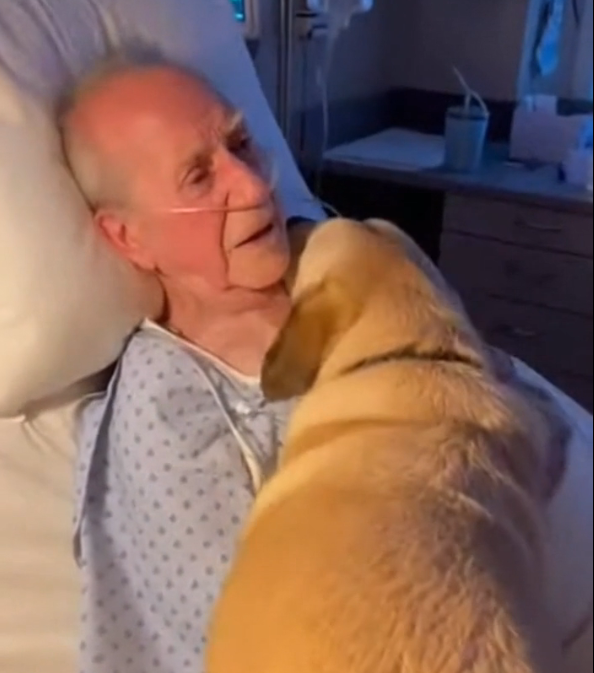
The old man screamed when the nurse touched his arm — until the dog lifted its head.
Then everything stopped.
The monitors kept beeping.
The fluorescent lights hummed softly.
But the room itself seemed to freeze.
“Don’t touch me!” the man shouted, eyes wide with terror, hands shaking as if he’d woken in a stranger’s body. His breath came fast and uneven. He didn’t recognize the bed. The walls. The faces.
He didn’t recognize himself.
But the moment the dog stood up — slowly, carefully — the man’s voice broke.
“Oh… there you are,” he whispered.
The dog was old. Very old. A yellowed Labrador mix with cloudy eyes and a muzzle dusted white. His back legs trembled as he walked, but he crossed the room anyway and pressed his head gently against the man’s chest.
The man’s hands — moments ago clawing at the air — softened.
They rested on the dog’s fur as if they had always known exactly where to go.
The nurse lowered her hand.
The doctor behind her swallowed hard.
Because the chart said advanced Alzheimer’s.
Because the daughter standing in the doorway had just been told her father no longer recognized her.
And yet—
This man, who couldn’t remember his own name,
knew the dog.
No one spoke.
The dog sat.
The man breathed.
And something no scan could explain filled the room.
His name was Frank Donovan.
Seventy-six years old. Former dock worker. Widower. Father of one.
Alzheimer’s had arrived quietly at first — missed appointments, misplaced keys, the same story told twice in one evening. Then louder. Then crueler.
Frank forgot how to cook.
Then how to drive.
Then how to find the bathroom at night.
But through all of it, Duke stayed.
Duke had come into Frank’s life eleven years earlier, rescued from a flooded underpass after a storm. Frank had wrapped the shivering dog in his jacket and driven him home, muttering the whole way, “You’re not dying today. Not on my watch.”
From that night on, Duke followed him everywhere.
When Frank’s wife passed away, Duke slept on her side of the bed for months, refusing to move. When Frank started forgetting words, Duke learned to wait. When Frank began wandering, Duke learned how to block the door.
“You can’t explain it,” Frank’s daughter, Emily, told the doctors. “He forgets me. He forgets the house. But he never forgets Duke.”
The doctors nodded politely.
Until tonight.
Frank had been brought to the hospital after collapsing at home. Severe confusion. Elevated heart rate. Disorientation.
Emily rode in the ambulance, holding Duke’s leash in one hand and her father’s paperwork in the other.
“He won’t understand where he is,” she warned them. “He might panic.”
She hadn’t expected this.
Frank now lay in the bed, fingers buried in Duke’s fur, whispering softly.
“Good boy… you stayed.”
Emily stood frozen.
He hadn’t said her name in weeks.
Just before midnight, Frank’s agitation returned.
He tried to sit up.
Tried to pull at the IV.
His breathing spiked.
Nurses moved closer.
Duke stood instantly.
His legs shook.
His tail didn’t wag.
He pressed his full weight against Frank’s chest, forcing him gently back down, nose nudging under Frank’s chin. Duke breathed slow. Deep. Deliberate.
Frank’s breathing began to follow.
One beat at a time.
The heart monitor steadied.
The nurse stepped back, tears pooling she refused to let fall.
“I’ve never seen anything like this,” she whispered.
Emily wiped her eyes with her sleeve.
“Me neither,” she said. “And I live with it.”
They dimmed the lights.
Fireworks burst faintly outside the hospital windows — it was New Year’s Eve — but inside the room, the world had narrowed to a single bed and an aging dog refusing to let go.
Frank stirred.
He opened his eyes and looked at Duke.
“You kept me safe,” he said clearly.
Emily’s breath caught.
The doctor turned away.
Frank reached out — not searching, not confused — and placed his hand on Duke’s head.
“Don’t worry,” he murmured. “I remember you.”
Duke rested his chin on the bed.
And for the first time that night, everyone believed him.
Frank survived the night.
And the next.
The disease did not disappear.
The forgetting did not stop.
Some mornings, Frank woke frightened.
Some days, he didn’t know where he was.
But Duke was always there.
At the foot of the bed.
Beside the chair.
Watching. Waiting.
The hospital made an exception.
Then the care facility did too.
When Frank no longer recognized Emily’s face, Duke became the bridge. When Frank forgot words, Duke responded anyway. When Frank forgot time, Duke stayed present.
On Frank’s last clear morning, weeks later, he looked at Duke and smiled.
“You found me,” he said softly.
Emily sat beside them, holding both their hands.
Frank passed quietly that night.
Duke didn’t move for hours.
And when Emily finally knelt and pressed her forehead to Duke’s, she realized something that stayed with her forever:
Alzheimer’s can steal names.
It can steal places.
It can steal years.
But it cannot touch love that lives in the body.
If you believe animals remember us when we cannot remember ourselves,
share your thoughts in the comments below.