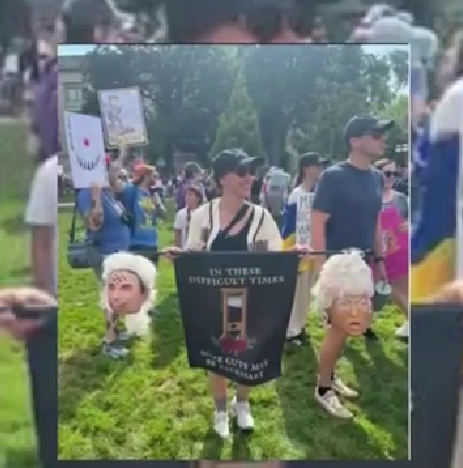
The video lasted only a few seconds, but its impact was immediate and explosive. A guillotine stood front and center. At its base was a severed head bearing a striking resemblance to former President Donald Trump. The image was not posted by an anonymous protester or a fringe activist, but shared publicly by a sitting Democratic lawmaker from North Carolina. Within hours, Representative Julie von Haefen’s political future was thrown into serious doubt.
The backlash was swift and unforgiving. Screenshots spread faster than deletions could keep up. Conservative media outlets, political commentators, and grassroots activists seized on the imagery as an unmistakable call to violence. By the time von Haefen attempted damage control, the controversy had already escaped her grasp. Social media accounts were quietly wiped. A short apology followed. She claimed the most offensive portion of the video had been edited out and insisted she did not support political violence.
For many critics, the explanation rang hollow.
The guillotine is not a neutral symbol. Historically, it represents execution, revolution, and public bloodshed. In the context of today’s polarized political climate, pairing that symbol with the likeness of Donald Trump, a former president and current leading Republican figure, crossed a line that many Americans believe elected officials should never approach. The outrage was not limited to Republican voters. Even some Democrats privately admitted the optics were indefensible.
Republicans were quick to frame the incident as proof of a long-standing double standard in American politics. For years, they argue, violent rhetoric and extremist imagery are condemned only when they originate from the right. Had a Republican lawmaker shared an image depicting violence against a Democratic leader, calls for resignation would have been immediate and relentless. In this case, critics say, the initial response from Democratic leadership was muted, cautious, and carefully worded.
The controversy surrounding Julie von Haefen has since evolved into a broader national debate about political violence, free speech, and accountability for public officials. In a country already strained by election disputes, assassination attempts, and rising threats against politicians, symbolism matters more than ever. A single image can inflame tensions, radicalize individuals, and normalize ideas that once would have been universally condemned.
Von Haefen’s apology emphasized that she does not condone violence and regrets sharing the post. But political damage is rarely undone by regret alone. Once an image enters the digital bloodstream, it becomes permanent. Deleting a post does not erase screenshots, archived links, or the perception created in the minds of voters. In modern political media, perception often outweighs intent.
Democratic leaders now face an uncomfortable dilemma. Defending von Haefen risks alienating moderate voters who are exhausted by escalating political hostility. Condemning her outright could fracture party unity and fuel Republican accusations of internal chaos. Calls for her resignation have grown louder, particularly from conservative lawmakers who argue that allowing her to remain in office sends the wrong message at a dangerous time.
Beyond von Haefen’s individual career, the incident highlights how protest culture and social media activism can collide with the responsibilities of public office. What might be dismissed as provocative symbolism at a rally becomes something far more serious when shared by someone entrusted with legislative power. Elected officials are not private citizens shouting into the void. Their words and actions carry institutional weight.
This scandal also underscores how rapidly online content can reshape political narratives. In the past, a misjudged post might have taken days to surface. Now it takes minutes. Algorithms reward outrage. Cable news thrives on visual controversy. High-CPC political keywords like “Trump assassination imagery,” “Democrat scandal,” “violent political rhetoric,” and “elected official controversy” dominate headlines and search results within hours.
For many Americans, the guillotine image feels like a symptom of a deeper problem. Political discourse has become increasingly dehumanizing. Opponents are no longer seen as rivals but as enemies. When execution imagery becomes a form of expression rather than an obvious red line, the risk of real-world consequences grows.
Security experts have repeatedly warned that political violence is often preceded by symbolic normalization. What begins as imagery can evolve into language, then into action. That is why critics argue this incident cannot be brushed aside as a “mistake” or an unfortunate share. They believe accountability must be immediate and unmistakable.
Von Haefen’s defenders insist that outrage is being weaponized for partisan gain. They argue that protest imagery has always been provocative and that intent matters. They point out that she did not create the display herself and removed the post once concerns were raised. Still, even some sympathetic voices admit that judgment, not intent, is the core issue.
In today’s hyper-connected political ecosystem, judgment is the currency of leadership. Voters expect their representatives to understand how their actions will be interpreted, not just how they are meant. That expectation becomes even more critical when the subject is a former president who remains at the center of national politics and ongoing election discourse.
Whether Julie von Haefen ultimately survives this scandal remains uncertain. Primary challenges, ethics investigations, and mounting public pressure could all shape the outcome. What is clear is that this moment will follow her long after any apology statement fades from public view.
More broadly, the incident serves as a warning to politicians across the spectrum. The line between protest and provocation is thin, and crossing it can carry career-ending consequences. In an era dominated by viral political news, digital outrage, and relentless media scrutiny, one image is enough to define a legacy.
For a nation already on edge, the guillotine controversy is more than a partisan flare-up. It is a reminder that political symbolism is not harmless, that leadership demands restraint, and that words and images shared online can ignite fires far beyond their original intent.