Susan Boyle’s comeback wasn’t just a performance — it was a resurrection in the full glare of the same stage that once turned her into a global sensation. Fifteen years after she stunned the world with “I Dreamed a Dream,” she returned to the Britain’s Got Talent stage carrying something heavier than nerves: the weight of a year spent learning to use her voice again.
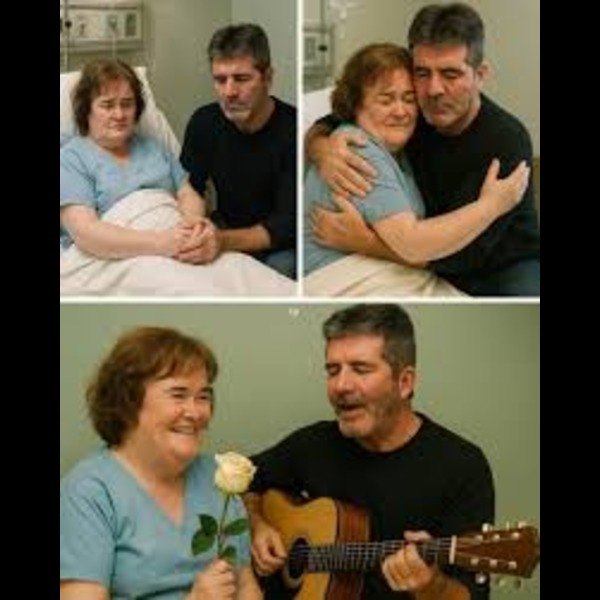
In April of the previous year, Susan suffered a mild stroke. It didn’t take her life, but it tried to take the part of her that was her life — her ability to sing. Overnight, the woman with the voice that silenced millions found herself struggling to speak clearly, let alone hit the notes that made her famous. Doctors warned her recovery would be slow. Some doubted she would ever perform again. And behind all that speculation, Susan quietly disappeared from the spotlight to fight a battle no audience would ever see.
Her recovery became a daily discipline. Speech therapy. Breathing exercises. Hours spent retraining muscles that once worked instinctively. Moments of frustration when a note cracked, or breath ran out too quickly, or her voice simply wouldn’t obey her. There were setbacks — days she could barely form certain words, nights when fear whispered that her singing career was already over. But there was also that unshakable resolve that had carried her through a lifetime of underestimation. The same resolve that had pushed her onto the BGT stage in 2009 when no one expected anything from her.
So when she walked back into the lights one year after her stroke, the audience didn’t just see Susan Boyle — they saw courage in human form.
She appeared alongside the cast of Les Misérables, choosing to sing the very song that made her famous. It wasn’t nostalgia; it was reclamation. “I Dreamed a Dream” isn’t an easy song even for a healthy vocalist. For someone recovering from neurological trauma, it’s a mountain. But Susan stood there — trembling, terrified, yet unmistakably determined.
For a moment, the entire room held its breath.
The first note could have failed her, wavered, broken under pressure. It didn’t. It rang out clear enough to snap Simon Cowell’s attention to her instantly. The audience grew quiet, then emotional, as she settled into each phrase with growing strength. Every line carried more than melody — it carried the memory of hospital rooms, word-relearning drills, the long, exhausting climb back to something she once did effortlessly.
She wasn’t just singing a song. She was proving that the part of her stroke tried to silence was still alive.
By the time she reached the final verse, many in the audience were in tears. Even Simon Cowell, usually reserved behind his judging table, looked visibly moved. Later, he called her performance “invaluable,” not only because of what it meant to the show but because of what it reminded people: Susan Boyle’s story has always been about resilience. About fighting back. About rewriting the expectations others place on you.
After the performance, Susan shared on Instagram just how steep her climb had been. She admitted that reclaiming her voice took months of intense therapy and sheer willpower. She’d kept her struggle mostly private — not because she was hiding, but because she wanted to return when she could stand onstage with her head high, not as someone pitied for her condition but as a woman who refused to be defeated by it.
That night, she didn’t simply return — she reclaimed her place.
Her voice, older now, carried a depth shaped by struggle. Her presence had more gravity, more humanity. She was no longer just the unexpected star from a viral audition; she was a seasoned performer who had fought through something deeply personal and come out on the other side still willing to share her gift with the world.
People often talk about comebacks in grand terms, but Susan’s comeback wasn’t defined by spectacle. It was defined by persistence. By refusing to let a stroke end her story. By showing up — despite fear, despite uncertainty, despite every reason to stay safely out of the spotlight. She knew the world would compare her performance to the version of her from 2009. But she also knew something more important: growth changes a voice, but it doesn’t erase it.
When she finished singing, the room erupted. Not just in applause, but in gratitude — gratitude for the reminder that strength doesn’t always look loud or flawless. Sometimes it looks like a woman standing under bright lights after a year of silence, daring to trust her voice again.
Susan Boyle didn’t return to prove she was perfect. She returned to prove she was still here.
And that was more powerful than any high note she could ever hit.
Her performance was a message — not only to fans, not only to skeptics, but to anyone who has ever been knocked down by illness or circumstance: you can lose your footing, your momentum, even the abilities you once depended on, but you can still rise. You can still rebuild. You can still sing.
On that stage, in front of millions, Susan Boyle did exactly that.
She walked back into the lights they thought she’d never stand under again — and illuminated them with a strength no stroke could take away.