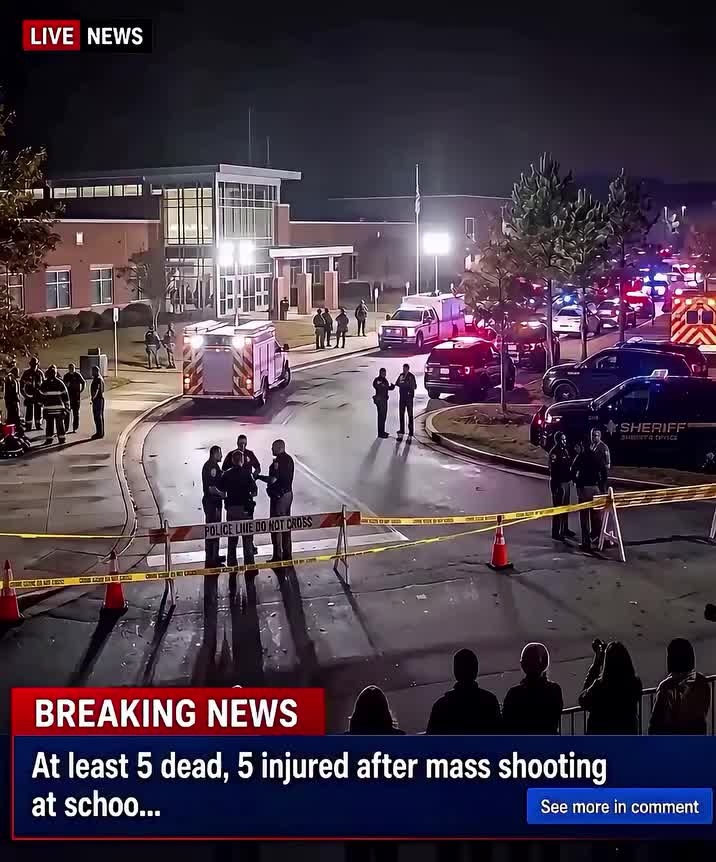
A quiet suburban community has been left devastated after a fictional mass shooting at a local high school claimed the lives of five people. What began as an ordinary school day quickly turned into a nightmare, leaving students, teachers, and families overwhelmed with fear and heartbreak. Parents rushed to the school as emergency crews responded to the unfolding tragedy.
Authorities in this fictional scenario said the incident prompted an immediate emergency response, with police officers, paramedics, and school personnel working together to secure the campus and assist those affected. Students were evacuated while worried families waited desperately for news about their loved ones.
As news spread, the community came together to support the grieving families and everyone affected. Flowers, candles, and handwritten messages appeared near the school, creating a memorial for the victims. Counselors were also imagined as being made available to help students and staff cope with the emotional aftermath.
The fictional tragedy has once again brought attention to the importance of school safety, emergency preparedness, and protecting young people. For the families in this imagined story, the loss is unimaginable, and the entire community is left searching for comfort and answers.
This is an imagined scenario, with no named school, town or real victims identified by the source. The emergency, deaths and community response belong to that fictional account. Its urgent wording should be understood within that setting.
The story begins by contrasting a routine school day with an event that changes what families expect from familiar surroundings. That contrast gives the scene its emotional force. Parents who normally know where their children are suddenly find themselves waiting for information, while staff and responders work through a situation the narrative presents as chaotic.
The memorial described afterward marks a different stage of the story. Flowers, candles and written messages create a place for people to express grief when they may have little to say aloud. In the fictional community, the gathering also allows people affected in different ways to recognize that others are sharing the loss.
The imagined availability of counselors extends that response beyond the first evening. A frightening event can remain part of the characters’ daily lives after the emergency vehicles have gone. The source gestures toward that longer period of support, even though it gives no detailed account of individual students or staff members.
The page’s focus is on collective shock and the attempt to respond with care. It does not identify an attacker, a motive or a sequence of investigative findings. Adding such details would turn its broad scenario into a different story. The available narrative stays with families, the emergency response and the beginnings of a memorial.
Read as fiction, the account raises questions about how a community gathers after a sudden loss and how people make room for one another’s grief. It does not establish that a school shooting has occurred in any particular place or on the day the reel is viewed. The people and events described here remain part of an imagined story.