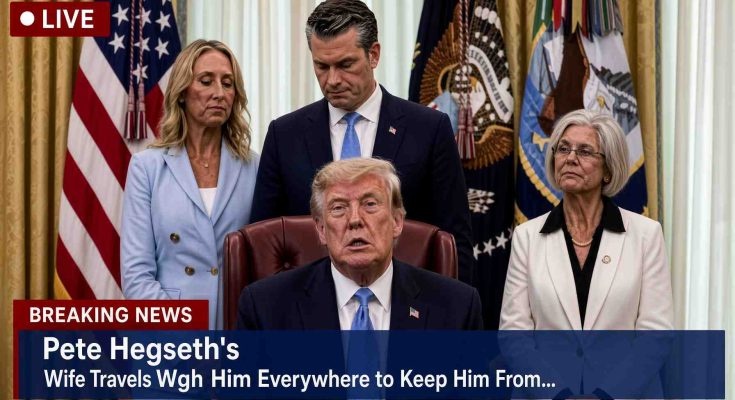
Her involvement extends beyond typical spousal roles, with sources describing her as part of the defense secretary’s informal inner circle. The extent of her participation in Pentagon activities involving classified matters has prompted questions about appropriate boundaries between personal and professional responsibilities.
Jennifer Hegseth attended a U.S.-U.K. military intelligence meeting regarding Ukraine, prompting British officials to limit the information shared during the session due to concerns about her presence. A more detailed follow-up discussion occurred without her attendance.
Former Pentagon spokesperson John Ullyot, who departed his position after three months, publicly questioned her involvement. “I was interviewed by her for approximately 40 minutes and questioned why a defense secretary’s spouse would participate in sensitive official matters,” Ullyot said.
The Pentagon dismissed Ullyot’s account and defended the administration’s handling of the situation. Officials have not disclosed that Jennifer Hegseth improperly shared classified information.
Supporters characterize her close involvement as reflective of personal trust, while critics argue such participation raises concerns about access to sensitive government information and accountability protocols.
The controversy highlights ongoing debates about who should access sensitive discussions within senior government offices. Cabinet officials commonly rely on trusted advisers and family members, but national security roles carry heightened expectations regarding information security.
The scrutiny has also surfaced amid public discussion of Pete Hegseth’s past struggles with alcohol, which he has addressed publicly, crediting his wife and faith with supporting his recovery.
The central question raised by the account is what happens when an informal adviser sits inside a formal decision-making process. A defense secretary may turn to family members for personal counsel. A meeting with allied intelligence officials has a different purpose. Its participants need to know who is present, what each person is authorized to hear, and how information will be handled after the meeting.
That distinction matters even when a guest takes no active role. Participants choose what to say based in part on who is listening. An unexpected attendee can change what an ally feels comfortable sharing and how freely officials discuss their options. The concern described in the report is about those practical effects as much as the title or family relationship of the person in the room.
Informal access also makes accountability harder to see. An official adviser has an assigned role and a chain of responsibility. When a person is present because of a personal relationship, observers have less information about whether that person is offering advice, helping with logistics, or simply accompanying the official. Attending a meeting does not on its own establish that an attendee saw particular material or influenced a decision.
The reported episode leaves several questions open. The account does not provide a complete list of attendees, the rules applied to each session, or a detailed record of what information was withheld. Those details would matter in distinguishing a disagreement about meeting protocol from a specific breach of information-handling rules.
The broader issue is how defense officials protect working relationships with allies while maintaining clear boundaries around sensitive discussions. A process that makes each attendee's role clear gives all participants a shared understanding of the room before an exchange begins.