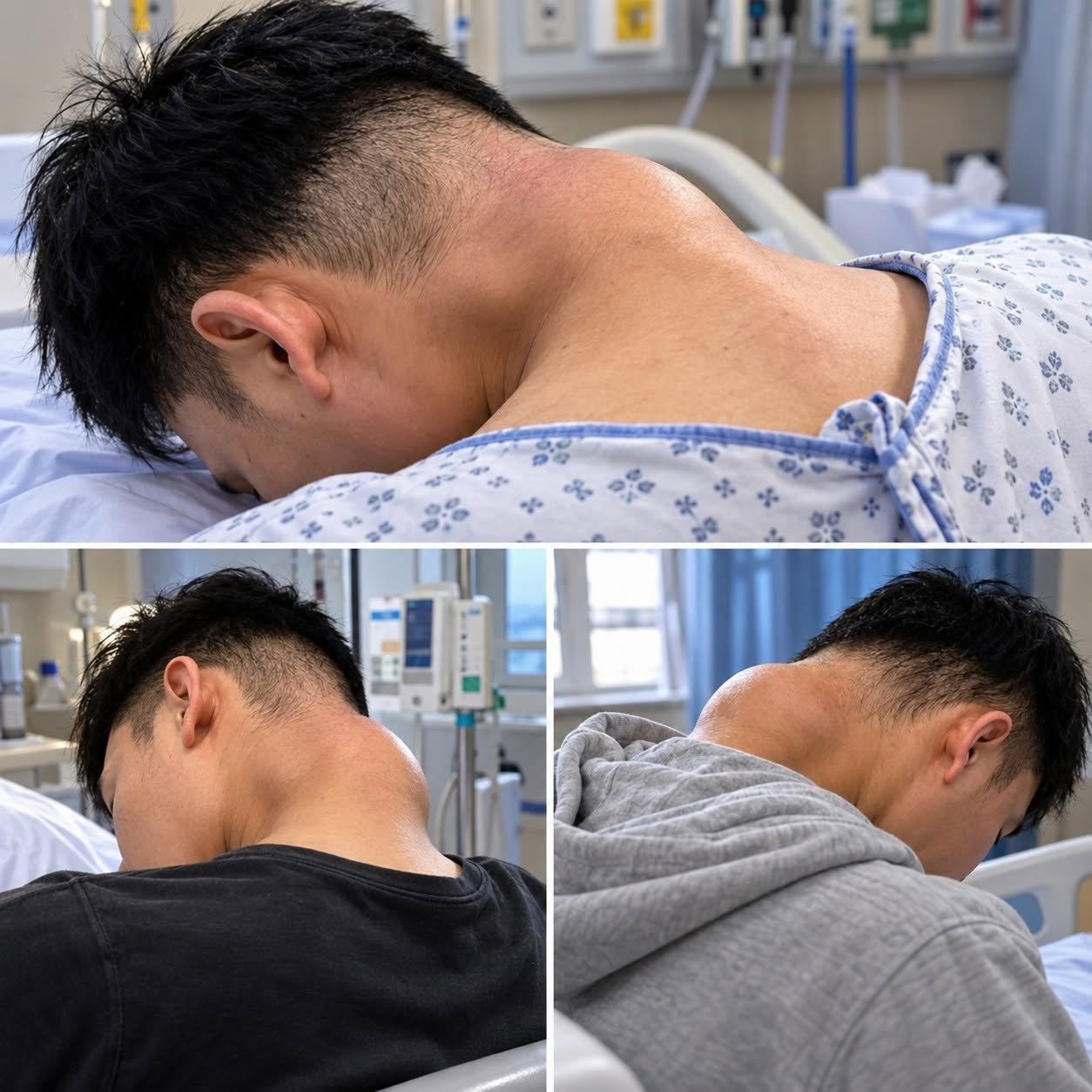
At just 23 years old, being unable to comfortably hold your own head upright can be a frightening and deeply disruptive experience.
For most young adults, weakness in the neck is something they might associate with temporary muscle strain, fatigue, an awkward sleeping position, or spending too much time looking downward. But when the muscles responsible for supporting the head become so weak that the head begins to fall forward and can no longer be maintained in an upright position, the situation is very different.
A reported case from Isfahan has drawn attention to this unusual symptom after a young man was described as developing Dropped Head Syndrome , a condition characterized by severe weakness of the muscles that normally keep the head upright.
The image of a young person struggling to support the weight of his own head is understandably alarming. It can immediately prompt assumptions about smartphones, computers, poor posture, or spending long hours looking downward.
But the medical reality is more complicated.
Dropped Head Syndrome is not simply another word for “bad posture.” It describes a physical presentation that can have a range of underlying causes. Some of those causes involve the muscles themselves, while others can involve the nerves or the neuromuscular system.
In some cases, conditions such as myasthenia gravis or amyotrophic lateral sclerosis (ALS) may be considered among the possibilities, although the information provided about this particular young man does not establish which condition, if any, caused his symptoms .
That distinction is extremely important.
A dramatic symptom does not automatically reveal its cause.
And while modern lifestyles can certainly contribute to neck discomfort and muscular strain, prolonged screen use should not be presented as a proven explanation for this reported case.
The story is ultimately a reminder that unusual weakness deserves proper medical evaluation—especially when the body can no longer perform a basic function that was previously effortless.
What Is Dropped Head Syndrome?
The term Dropped Head Syndrome describes a situation in which weakness of the muscles responsible for extending and stabilizing the neck causes the head to fall forward.
Under normal circumstances, a network of muscles in the neck and upper back works continuously to support the weight of the head.
We rarely think about this process because it happens automatically.
We stand.
We sit.
We walk.
We look around.
We turn our heads.
We keep our eyes level with the horizon.
All of these activities depend on coordinated muscular control.
When the muscles become severely weak, however, maintaining that position can become difficult or even impossible.
The head may gradually drift forward.
A person may need to consciously fight to bring it back into alignment.
Eventually, holding the head upright may become extremely tiring.
In more severe cases, the characteristic forward-flexed posture can become obvious.
The result can be more than a visual change.
Holding the head upright is important for everyday activities such as walking, communicating face-to-face, eating, reading, and looking ahead while moving around.
When the neck muscles cannot perform that job effectively, seemingly simple activities can become difficult.
Dropped Head Syndrome is often discussed in the context of conditions affecting older adults, which makes a reported case involving someone only 23 years old particularly striking.
However, the fact that a condition is more commonly seen in one age group does not mean it is impossible in another.
Young people can develop neuromuscular disorders.
They can also experience other medical problems capable of causing significant weakness.
That is why age should never be used as the only reason to dismiss an unusual symptom.
A 23-year-old who has trouble keeping their head upright is not automatically suffering from a serious neurological disease.
There are many potential explanations for weakness and physical symptoms in general.
But the symptom is unusual enough that it deserves proper assessment rather than being casually attributed to lifestyle.
The head may not look particularly heavy, but the neck is continuously working to keep it balanced over the body.
When the head is aligned above the shoulders, the muscles can maintain that position efficiently.
When the head moves forward, the mechanical demands on the supporting structures increase.
This is one reason people who spend long periods looking downward may experience neck discomfort or fatigue.
However, ordinary postural strain and severe muscle weakness are not the same thing.
A person can experience neck soreness after sitting at a desk all day and still be able to hold their head upright normally.
Dropped Head Syndrome involves a much more significant problem with the ability to maintain head position.
That difference matters when thinking about the reported case.
A young person's neck becoming tired after prolonged screen use is one thing.
A person's neck becoming too weak to support the head upright is something else entirely.
This is perhaps the question many people will ask first.
If a young adult spends hours every day looking at a smartphone or computer, it is tempting to connect the two events immediately.
Long periods of looking downward can certainly contribute to neck strain, discomfort, and fatigue .
Taking movement breaks and adjusting screen positioning can therefore be sensible habits.
But that does not prove that screen use causes Dropped Head Syndrome.
The distinction between musculoskeletal strain and neuromuscular weakness is crucial.
A person can develop soreness from posture without having a disorder that prevents the neck muscles from functioning properly.
The information provided about the Isfahan case does not establish that prolonged screen use caused the young man's condition.
Therefore, blaming smartphones or computers would go beyond the evidence.
It is much more accurate to say that healthier screen habits may reduce ordinary neck strain, while persistent or severe weakness needs medical investigation for other possible causes.
Dropped Head Syndrome is a presentation rather than a single disease.
That means doctors need to determine why the neck muscles are becoming weak.
According to the information provided, possible underlying causes can include neuromuscular disorders such as myasthenia gravis and ALS , among others.
But this list should not be interpreted as a diagnosis.
A person experiencing dropped head posture does not automatically have either condition.
The purpose of considering possible causes is to understand that significant weakness can originate from different parts of the neuromuscular system.
Doctors therefore need to investigate the broader picture.
They may ask whether weakness is limited to the neck or affects other parts of the body.
They may look at how symptoms have developed over time.
They may consider whether there is pain, numbness, fatigue, difficulty with movement, or other neurological symptoms.
Only a proper medical evaluation can begin to answer those questions.
Myasthenia gravis is a neuromuscular condition that affects communication between nerves and muscles.
One characteristic feature is weakness that can fluctuate, often becoming more pronounced with activity and improving with rest.
Depending on the individual, the muscles involved can include those responsible for eye movements, facial expressions, swallowing, speaking, limb movement, and other functions.
In some situations, muscles involved in keeping the head upright can also become significantly weak.
That makes myasthenia gravis one condition that may be considered when a patient presents with dropped head symptoms.
However, again, it is essential not to make the leap from symptom to diagnosis.
A young person with neck weakness may have many possible explanations, and only a clinician can determine whether myasthenia gravis is relevant.
Amyotrophic lateral sclerosis , commonly called ALS, is a progressive neurological disorder that affects nerve cells involved in voluntary movement.
Because it can cause muscle weakness, ALS may also be included in the broader differential diagnosis of dropped head symptoms.
But the mere presence of a dropped head does not mean someone has ALS.
The symptom can occur for different reasons, and the diagnosis of ALS requires a much broader clinical assessment.
This is an important point because dramatic health stories can easily cause readers to assume that the most serious possibility is the most likely one.
That is not how medical diagnosis works.
Doctors look at the entire pattern of symptoms, examination findings, progression, and testing.
A symptom can point toward a category of problems without identifying one specific disease.
If someone cannot keep their head upright, the problem is significant enough to deserve professional assessment.
The reason is not simply that the posture looks unusual.
The underlying weakness needs an explanation.
Doctors may begin with a detailed medical history and physical examination.
They may assess muscle strength.
They may examine reflexes and sensation.
They may look for weakness elsewhere in the body.
They may ask whether symptoms change with activity or rest.
They may also review how quickly the problem developed.
These details can help narrow the possibilities.
The evaluation may then involve additional testing depending on the suspected cause.
The information provided notes that imaging may be part of the evaluation.
Imaging can help doctors examine structural problems involving the cervical spine or surrounding tissues.
This can be important because not every problem that causes a person's head to fall forward is purely muscular or neurological.
Structural abnormalities may also need consideration.
The specific imaging study used depends on the clinical circumstances.
A healthcare professional may decide what is appropriate after examining the patient.
This is another reason why a photograph alone is not enough.
An image can show what a person's posture looks like.
It cannot show why that posture developed.
Doctors may also use nerve or muscle testing when they suspect a neuromuscular problem.
These tests can provide information about how nerves communicate with muscles and how muscles respond.
The exact testing strategy depends on what the clinician suspects.
The goal is not simply to confirm that the neck is weak.
It is to identify the pattern of weakness and determine where in the neuromuscular system the problem might be occurring.
That information can help guide further evaluation and treatment.
There is no single treatment for Dropped Head Syndrome because the syndrome itself can have different underlying causes.
Treatment therefore depends on the diagnosis.
The information provided identifies several possible components of management, including:
Supervised physical therapy
Physical therapy may be used to address strength, mobility, function, and safe movement when appropriate.
Supportive bracing
Some patients may benefit from a brace or other supportive device to help maintain head position.
Treatment of an underlying illness
If the dropped head is caused by another medical condition, treating that condition may be an important part of management.
The key word is individualized .
A brace that helps one person may not be appropriate for another.
An exercise program that is suitable in one situation may need to be modified in another.
Treatment should therefore be guided by the medical diagnosis rather than by generic internet advice.
When a muscle is weak, the natural reaction might be to exercise it as much as possible.
But more exercise is not automatically better.
The appropriate type, amount, and intensity of physical activity depend on the underlying condition.
This is especially important when neuromuscular disease is being considered.
Professional supervision can help ensure that treatment is tailored to the person's actual physical limitations.
The goal is to support function without creating unnecessary strain or risk.
That is why people with substantial neck weakness should not simply begin an aggressive exercise routine based on online videos.
A supportive neck brace may sometimes help a person maintain a more upright position.
This can potentially make certain daily activities easier.
However, a brace does not necessarily correct the underlying problem.
It may provide mechanical support while doctors work to understand and treat the cause of the weakness.
In other words, support and treatment are not always the same thing.
The brace may help manage a symptom.
The medical evaluation is still needed to determine what is producing that symptom.
When a young person develops an unusual physical symptom, people often search for an easy explanation.
Maybe it's poor posture.
Maybe it's too much screen time.
Maybe it's stress.
Maybe it's lack of exercise.
Sometimes those factors really do contribute to discomfort.
But a serious functional change should not automatically be explained that way.
A person who can no longer comfortably maintain head position deserves more than a reminder to “sit up straight.”
The body is communicating something significant.
The correct response is curiosity followed by medical evaluation.
Not every episode of neck fatigue is a medical emergency.
People can experience temporary muscle fatigue after unusual physical activity.
They can develop soreness from sleeping in an awkward position.
They can experience stiffness after long periods at a desk.
But difficulty keeping the head upright is a different level of symptom, especially when it is persistent or progressively worsening.
The information provided specifically notes that medical evaluation becomes particularly important when the weakness occurs alongside:
These combinations make the issue more than a simple posture complaint.
Doctors rarely evaluate a symptom in isolation.
If someone develops significant neck weakness, they may also be asked about other changes.
Are the arms or legs becoming weaker?
Is there difficulty swallowing?
Has speech changed?
Are the eyes or face affected?
Is there numbness?
Is there pain?
Does fatigue become worse after activity?
Have there been changes in walking or coordination?
The answers can help doctors build a more complete picture.
Again, not every person with dropped head symptoms will have these additional problems.
The point is that the presence or absence of other symptoms can be important in figuring out the underlying cause.
Weakness and numbness are not the same symptom.
Weakness refers to reduced ability to generate force or perform a movement.
Numbness refers to altered sensation.
When both appear together, doctors may want to consider whether nerves or other structures are involved.
That is why persistent neck weakness accompanied by numbness should not simply be attributed to muscle fatigue.
It is another reason to seek professional assessment.
Dropped Head Syndrome is fundamentally associated with weakness, but pain can coexist depending on the underlying cause.
Pain may point clinicians toward additional possibilities, including structural or musculoskeletal contributors.
The presence of pain does not automatically identify the diagnosis.
But when a person develops both significant weakness and pain, a more complete medical evaluation is especially appropriate.
The same applies when symptoms are becoming progressively worse.
This is another question that often appears after stories like this go viral.
The answer should be approached carefully.
Good screen ergonomics and regular movement breaks can be useful for reducing ordinary neck strain.
Positioning a screen at a comfortable height may reduce the need to constantly look downward.
Changing position during the day can also reduce stiffness and fatigue.
But these habits cannot guarantee prevention of a neuromuscular disorder.
A person can have excellent posture and still develop an underlying medical condition.
Likewise, a person with imperfect posture may never develop serious neck weakness.
It is therefore misleading to suggest that Dropped Head Syndrome is simply the result of poor posture.
Although screen use should not be blamed for the reported case, there is still a practical lesson worth keeping.
Many people spend long periods looking at phones, tablets, and computers.
Remaining in one position for extended periods can contribute to:
Simple habits may help.
Adjust the screen so you don't have to keep your neck bent downward.
Change position regularly.
Stand up and move around.
Avoid remaining in one posture for hours at a time.
Pay attention to discomfort before it becomes severe.
These strategies may support general musculoskeletal health.
But they should be understood as ways of reducing ordinary strain—not as guaranteed prevention for Dropped Head Syndrome.
This may be the single most important distinction for readers.
Strain can produce soreness, tightness, stiffness, and fatigue.
Weakness means the muscles are having difficulty generating the force necessary to perform a task.
A person who says:
“My neck hurts after sitting at my computer for eight hours”
is describing a very different problem from someone who says:
“I cannot keep my head upright.”
The second situation deserves medical investigation.
Confusing the two can lead to delayed care.
The reported case from Isfahan is striking partly because of the person's age.
At 23, the idea of becoming physically unable to hold the head upright seems almost unimaginable to most people.
That naturally encourages questions.
How did this happen?
Was it caused by technology?
Was it a rare disease?
Could it happen to other young adults?
The available information does not answer all of those questions.
And it is important not to pretend that it does.
What the story does provide is a valuable opportunity to discuss a condition that many people may never have heard of.
Awareness can help people recognize that unusual muscle weakness is not necessarily something to ignore.
When a dramatic medical image goes viral, viewers often search for similar symptoms.
That can create a confusing cycle.
A person sees an unusual posture.
They read about one disease.
Then another.
Then another.
Soon, a list of frightening diagnoses appears.
This can create unnecessary anxiety.
At the same time, someone may discover a reassuring explanation and decide not to seek care.
Both responses can be problematic.
Online medical information is useful for education, but it cannot replace an examination.
A photograph cannot establish a diagnosis.
A short story cannot provide a complete medical history.
And a single symptom rarely identifies a specific disease.
If a person develops significant neck weakness, the most useful information may be surprisingly basic.
When did the problem begin?
Did it develop suddenly or gradually?
Is it getting worse?
Is the weakness present all the time?
Does rest change it?
Are other muscles affected?
Is there numbness?
Is there pain?
Have there been problems with swallowing, speaking, breathing, walking, or other movements?
What medical conditions are already known?
What medications are being taken?
These questions may help clinicians determine what type of evaluation is needed.
The more accurately a patient can describe the timeline, the more useful the clinical history can become.
A symptom that appears over minutes is different from one that develops over months.
Likewise, weakness that fluctuates during the day may provide different clues from weakness that steadily progresses.
The timeline can therefore be one of the most important details.
Someone experiencing persistent weakness should keep track of changes rather than trying to remember everything at a single appointment.
Simple notes can help:
When did symptoms begin?
What was the person doing when they noticed them?
Did the condition change after rest?
Has the weakness spread?
What other symptoms appeared?
These observations don't diagnose the problem.
They simply make the clinical history clearer.
Physical weakness can affect more than the body.
Imagine being 23 years old and suddenly struggling to hold your head upright.
A person may worry about appearance.
They may feel embarrassed in public.
They may become afraid of walking outside.
They may struggle with ordinary activities.
They may wonder whether their condition will improve.
Uncertainty can be emotionally exhausting.
This is why medical care should address not only the physical symptoms but also the psychological experience of living with an unusual condition.
Support from family, friends, and healthcare professionals can make a meaningful difference.
The neck plays a role in nearly every upright activity.
Reading requires looking ahead.
Walking requires visual orientation.
Eating involves positioning the head and neck.
Conversation depends on being able to face another person.
Driving and navigating the environment require a stable field of view.
Even using a smartphone can become difficult.
As weakness progresses, activities that once required no thought may require planning.
That can affect work, education, relationships, and independence.
This is one reason an apparently simple posture change can have much greater consequences than people realize.
Stories involving rare medical syndromes can sometimes lead readers to become hyperaware of every minor symptom.
That is not the goal.
Most people who experience occasional neck stiffness after a long day are not developing Dropped Head Syndrome.
Most people who spend hours on their phones will not suddenly lose the ability to hold their head upright.
And most ordinary neck discomfort does not indicate a rare neuromuscular disorder.
The important point is to recognize significant functional weakness when it occurs.
There is a difference between discomfort and inability.
A difference between temporary fatigue and progressive weakness.
A difference between ordinary posture-related strain and a physical function that is suddenly becoming impossible.
Another lesson from the reported case is that not every medical problem can be prevented through lifestyle choices.
Maintaining a comfortable screen position is sensible.
Regular movement is sensible.
Healthy habits are sensible.
But none of those measures can guarantee that a person will never develop a neuromuscular condition.
This matters because patients sometimes blame themselves after a diagnosis.
They may think:
“If I had sat differently…”
“If I had exercised more…”
“If I had used my phone less…”
That kind of thinking is not necessarily justified.
When an underlying illness is responsible, the most important step is identifying it and receiving appropriate care.
If a person's head repeatedly falls forward because they cannot maintain an upright position, especially if the problem is new or worsening, professional medical evaluation is appropriate.
The information provided specifically emphasizes evaluation when difficulty holding the head upright is accompanied by worsening weakness, pain, or numbness.
The goal is not to self-diagnose.
It is to determine whether the problem comes from the muscles, nerves, structural tissues, or another cause.
The sooner an unusual weakness is properly assessed, the sooner an appropriate management plan can be considered.
There is a tendency to dismiss health problems in young adults.
Someone in their twenties is often assumed to be healthy.
That assumption can sometimes delay attention to unusual symptoms.
Young adults can develop medical conditions too.
Age can influence risk, but it does not eliminate the possibility of illness.
When something clearly changes the way the body functions, it deserves to be taken seriously regardless of age.
The reported case from Isfahan is striking because it illustrates how a symptom that looks simple from the outside may reflect a much more complicated medical question.
A head falling forward may look like a posture problem.
But if the underlying muscles are too weak to support the head, the problem is fundamentally different.
The visible posture is only the final result.
The real question is:
Why did the muscles become weak?
That question cannot be answered from a photograph.
It requires an appropriate clinical assessment.
There is also a broader lesson for the way we talk about technology and health.
Screens are easy targets.
Whenever someone develops neck pain, headaches, eye strain, or poor posture, people often blame smartphones immediately.
Sometimes screen habits really do contribute to discomfort.
But blaming every unusual physical symptom on technology can distract us from more important causes.
A balanced approach is better.
Use screens comfortably.
Take movement breaks.
Pay attention to posture.
But recognize that severe or progressive weakness is not something that should simply be explained away as “phone neck.”
A reported case involving a 23-year-old man in Isfahan has drawn attention to Dropped Head Syndrome , a condition in which weakened neck muscles make it difficult or impossible to keep the head upright.
The symptom can be dramatic, especially in a young adult, but the appearance alone does not reveal its cause.
Possible underlying causes can include neuromuscular disorders such as myasthenia gravis and ALS , among others. However, the information provided does not establish that either condition caused this particular case , and there is not enough information to determine the man's exact diagnosis.
Most importantly, prolonged screen use should not be presented as a proven explanation for the condition .
Screen-related posture can contribute to ordinary neck strain and discomfort, which is why comfortable positioning and regular movement breaks are sensible habits. But severe weakness that prevents someone from keeping their head upright is different and warrants medical evaluation.
Doctors may use a physical examination, imaging, and nerve or muscle testing to investigate the cause. Treatment depends entirely on the diagnosis and may involve supervised physical therapy, supportive bracing, or treatment directed at an underlying illness.
The key lesson is simple:
When the body suddenly loses the ability to perform a basic movement, don't assume it's just posture.
Neck stiffness after a long day is common.
Temporary discomfort is common.
Fatigue is common.
But persistent difficulty holding the head upright is something different.
It is a signal that deserves attention.
For a 23-year-old, the symptom may seem completely unexpected. But unusual medical conditions do not always follow the age patterns people assume. Recognizing significant weakness, seeking appropriate evaluation, and avoiding unsupported explanations can make a much bigger difference than trying to diagnose the problem from a photograph or a viral post.
And perhaps that is the most important lesson behind this unusual case: sometimes the most visible symptom is not the real disease—it is simply the clue that tells doctors to look deeper.