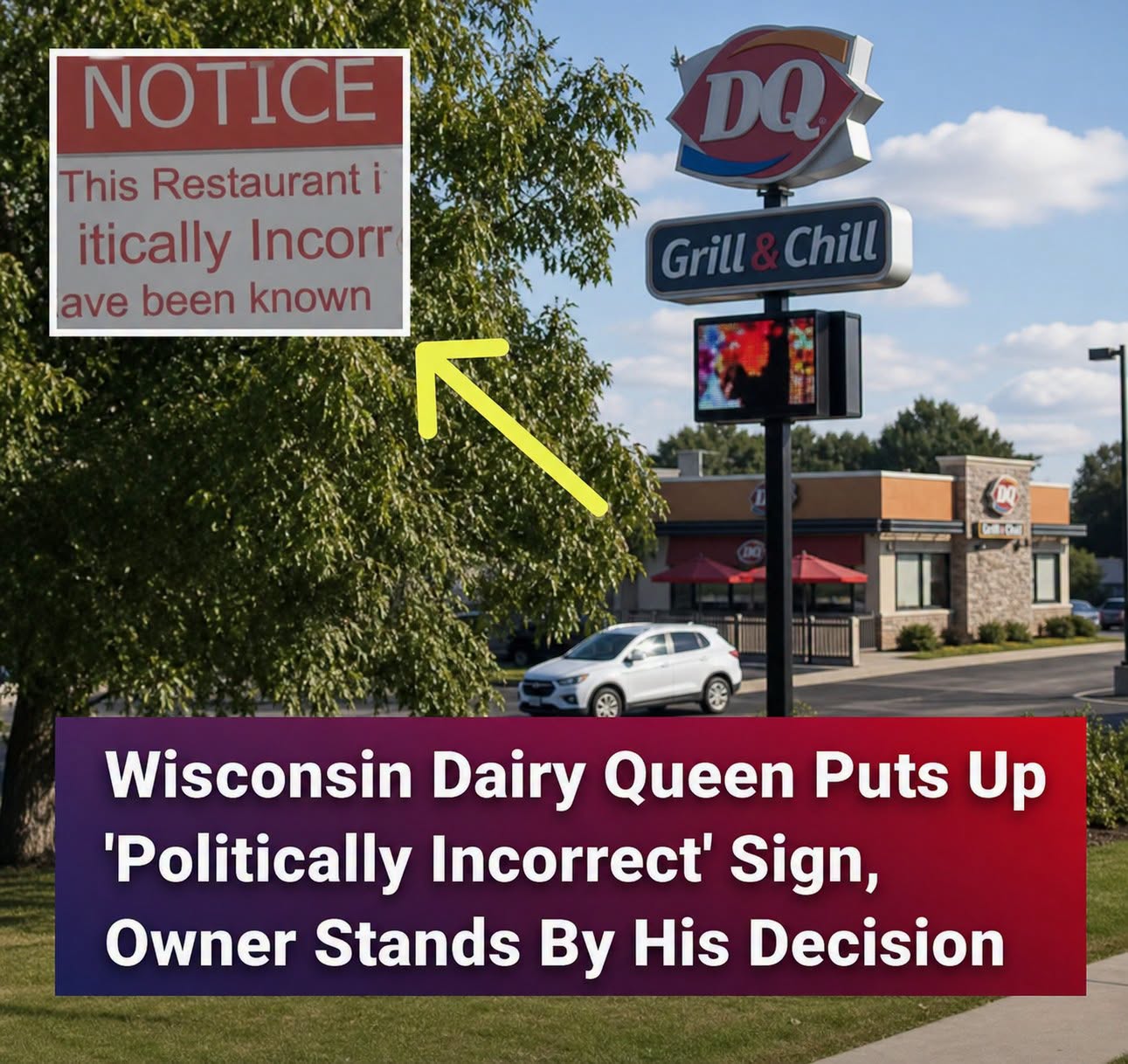
A window sign at a Dairy Queen in Kewaskum, Wisconsin, began as one franchise owner’s attempt to describe the values of his restaurant. After a photograph spread online, however, the message became the center of a national argument about faith, patriotism, private expression, and what makes customers feel welcome.
Owner Kevin Scheunemann described the restaurant as politically incorrect. The sign said customers could expect Christian music, the phrase Merry Christmas, the words God Bless America, and visible support for military veterans. Scheunemann viewed those statements as an honest explanation of the atmosphere he wanted to create.
For many local customers, the sign was not surprising. Supporters said the owner had consistently treated people with courtesy regardless of their beliefs or background. They saw the message as an expression of the convictions of a privately operated franchise rather than an announcement that some people were unwelcome.
The reaction changed when the image moved beyond the community. Online readers encountered the sign without the daily experience of the restaurant or its owner. Some praised Scheunemann for refusing to hide his beliefs. Others felt that a business serving the general public should avoid political or religious messages that could make customers question whether they belonged.
That difference in interpretation drove the debate. To supporters, the sign represented transparency. Customers knew what kind of music might be playing and what seasonal greeting employees would use. To critics, the same words could appear less like information and more like a test of whether visitors shared the owner’s cultural and political outlook.
The restaurant’s connection to a national brand added another layer. A franchise may be locally owned while still carrying a name recognized across the country. Customers often assume that signs and policies reflect the corporation as a whole, even when an individual franchisee is responsible for daily decisions.
Dairy Queen’s corporate office responded by separating the company’s position from that of the local owner. The company emphasized respect for all guests and made clear that the sign reflected the franchisee’s views. That response attempted to protect the wider brand without denying that independently operated locations have some control over their own atmosphere.
The argument was never really about ice cream. It became a question about the line between personal conviction and public hospitality. Business owners do not stop having beliefs when they open their doors. At the same time, customers do not stop evaluating whether the environment feels respectful and inviting.
Scheunemann said his intention was not exclusion. He believed the sign promised a traditional, patriotic, and faith-oriented environment. Many residents defended him on those terms and noted that the restaurant continued serving anyone who entered.
Critics focused more on impact than intention. A message can be meant as welcoming by the person who writes it while feeling uncomfortable to someone who reads it differently. The internet magnified that disagreement by turning one small-town window into a symbol in a much larger cultural conflict.
The photograph also showed how quickly local context disappears online. People who had never visited Kewaskum debated the character of the owner, the staff, and the town based on a single image. Supporters and opponents often spoke past one another because they were answering different questions. One side asked whether an owner had the right to express his values. The other asked whether that expression was wise for a public-facing business.
There was no simple resolution. The sign remained a statement of Scheunemann’s convictions, while the corporate response reaffirmed a broader commitment to serving everyone. Local customers continued to judge the restaurant through their own experiences, and online audiences continued to interpret the message through wider political divisions.
In the end, the controversy demonstrated that even a short sign can carry different meanings depending on who is reading it. For one person, it may signal honesty and tradition. For another, it may suggest that acceptance comes with conditions. The debate surrounding the Kewaskum Dairy Queen was ultimately about how communities balance identity, expression, and the responsibility to make public spaces feel open to all.