I thought helping my granddaughter clean out the attic would mean dust, old decorations, and a few embarrassing photos from my teenage years. Then she found one picture, stared at it for a little too long, and said something that made me realize the past might not be as settled as I believed.
I was cleaning the attic with my granddaughter Ellie when she found the photograph I had spent forty-two years pretending meant less to me than it did.
“Grandma, look at your hair!”
I turned around and saw her holding my old prom album.
She dodged me, laughing.
“You look like your head exploded.”
“It was 1984. We had different standards.”
She dropped beside me on the dusty floor and flipped through the pages.
School friends.
My parents standing stiffly beside me.
My older brother Charlie making a face behind my head.
Charlie had always been the dependable one in our family.
Then Ellie stopped.
I knew before I looked.
David.
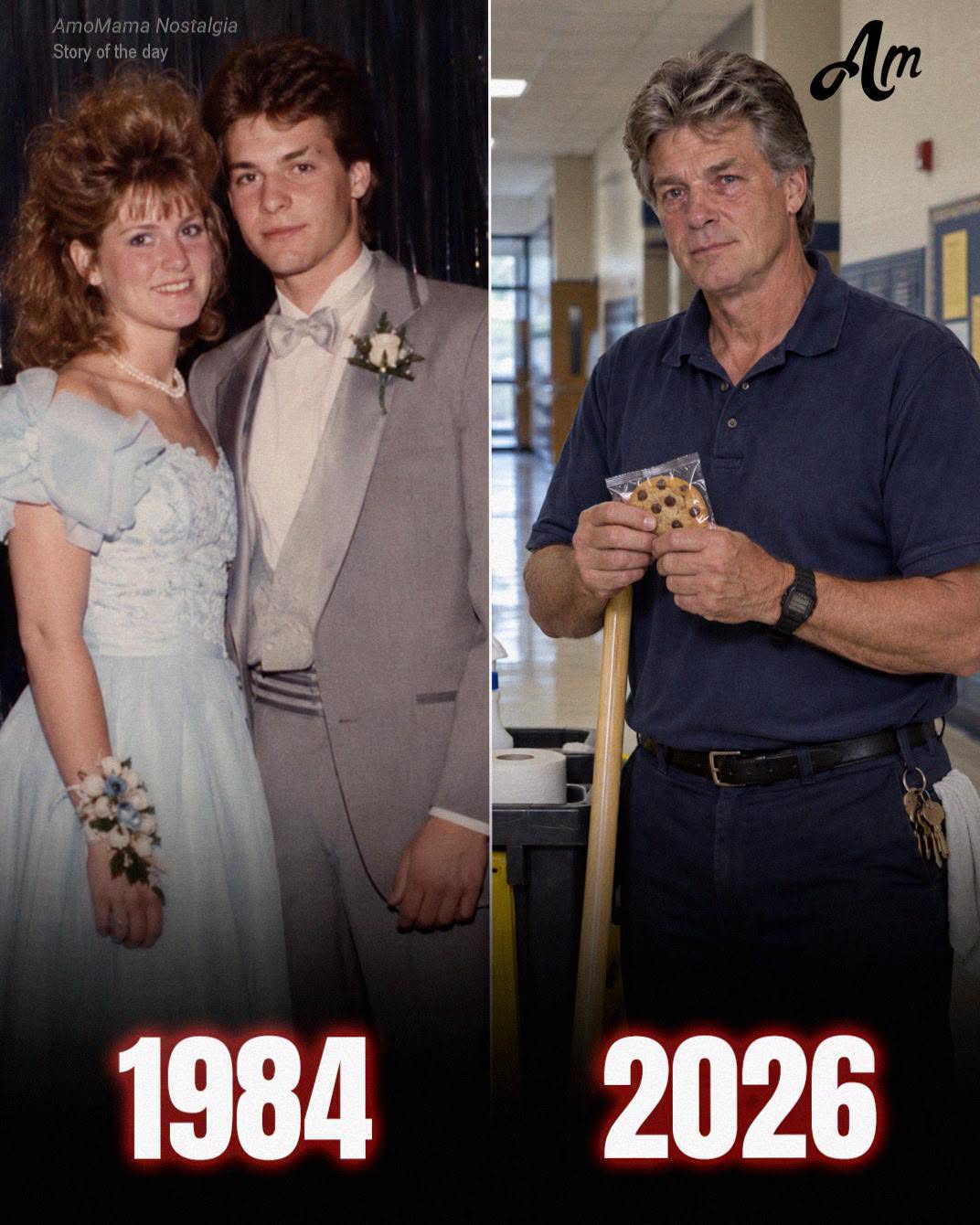
He was eighteen in the photograph, wearing a rented black tuxedo and the nervous smile he always got when somebody pointed a camera at him.
I was beside him in a pale blue dress.
“His name was David,” I said.
“Was he your boyfriend?”
Ellie grinned.
“Before Grandpa?”
“Long before Grandpa.”
She studied the photograph.
“Were?”
She laughed.
David and I had been together since sophomore year.
He worked evenings at his father’s hardware store.
I worked weekends at a bakery.
Whenever we got paid, we’d compare what we’d saved.
One evening, David spread several crumpled bills across the hood of his car.
“At this rate,” he said, “we can afford the smallest apartment in America.”
“Does it have indoor plumbing?”
“Luxury costs extra.”
“A window?”
Our plan was community college.
Then jobs.
Then that tiny apartment.
We thought planning something meant it would happen.
Six weeks after prom, David’s house caught fire before dawn.
I woke to my mother standing beside my bed.
David survived the fire, but he’d been badly burned.
His mother called me from the hospital.
“They’re keeping him asleep.”
“Can I come?”
Three days later, she called again.
David was dead.
I barely ate for weeks.
His family’s house was ruined, and his mother told mine they were taking David’s remains to be buried near relatives out of state.
I wasn’t invited.
By the time I understood they had actually left town, they were gone.
There was no proper goodbye.
Life continued anyway.
I married years later.
Had two children.
Divorced.
Became a grandmother.
And somehow that prom photograph stayed with me through every move.
Ellie was still staring at it.
Then she tapped David’s face.
I smiled.
“Who’s him?”
“The man at school. Grandma, he gives me extra dessert at school”
My smile disappeared.
“What man?”
“The new cafeteria cleaner.”
I stared at her.
“What?”
“The custodian. He cleans after lunch.”
She looked at the photograph again.
“Ellie, this photograph is forty-two years old.”
She frowned.
“Then maybe it’s his dad.”
I took the album from her.
David’s face hadn’t changed because photographs don’t age with us.
Ellie shrugged.
“He asked me once if my grandma’s name was Laura.”
The attic suddenly felt much smaller.
“What did you say?”
“Yes.”
“Did he ask anything else?”
“Just if you went to Westbrook High.”
My stomach tightened.
“I said I thought so.”
“What is his name?”
Not David.
Of course not David.
David had been dead for forty-two years.
Ellie pointed toward the photograph.
“He has the little moon thing too.”
“What moon thing?”
My eyes moved to David’s face.
There, just above his left eyebrow, was a faint crescent-shaped scar.
David had gotten it at sixteen when he crashed my brother’s bicycle into a fence.
Most people never noticed it.
I closed the album.
“Why?”
“Because I’m done cleaning.”
Ellie followed me to the attic stairs.
Then she stopped.
“Oh!”
“I forgot.”
She ran toward her backpack.
“He gave me something yesterday.”
My mouth went dry.
“For me?”
She unzipped the front pocket and pulled out a small object.
When she placed it in my palm, my knees nearly gave out.
A red pocketknife.
One blade broken.
Two letters scratched into the handle.
L.A.
My initials.
David’s father had given him that knife when he started working at the hardware store.
David carried it everywhere.
Then, shortly before the fire, it disappeared.
He’d told me he’d lent it to Charlie while they repaired a bicycle.
Charlie always insisted he’d returned it.
A folded note was wrapped around the knife.
I opened it.
Call this number.
The truth isn’t what it seems.
You shouldn’t have trusted your family.
I realized Ellie was watching me.
“I’m fine.”
“You don’t look fine.”
I called.
A man answered.
His voice was too young to be David’s.
“Who is this?”
“My name’s Tom.”
“Where did you get this knife?”
A pause.
“I’m not David.”
“I know. David was my uncle.”
I sat down hard on the bottom stair.
Tom told me his mother was Nancy, David’s older sister.
“Ellie thinks you look like him.”
“My grandmother used to say I did.”
“Birthmark. Same shape, apparently.”
“How did you know who Ellie was?”
“She mentioned her grandmother Laura and Westbrook High. My family still has David’s prom picture.”
“Why give her the knife?”
“I didn’t have your number, and I wasn’t going to ask a kid for your address. I knew you’d recognize it.”
Tom went quiet.
“From Charlie.”
I stood so quickly I got dizzy.
“My brother?”
“Yes.”
“So am I.”
Tom said they’d known each other casually for years.
A few weeks earlier, he’d seen the knife on Charlie’s workbench.
“When you asked Charlie?”
“He told me it was nothing and put it away.”
“Yes.”
“Why?”
“Because my mother remembered that knife disappearing before David died.”
My pulse thudded in my ears.
“What did Charlie tell you?”
“Tom.”
“I shouldn’t tell you the rest.”
“Why?”
“Because it’s his confession, not mine.”
I gripped the phone.
“Then tell me what to ask.”
A long pause.
I stopped breathing.
“What?”
“Ask him, Laura.”
I tried to stand.
The room tipped sideways.
Ellie’s voice sounded far away.
I reached for the banister and missed.
The next thing I remember clearly was Ellie kneeling beside me with my phone in both hands.
“She’s awake,” she said into it. “She’s awake now.”
“Who are you talking to?”
“Ellie—”
“You fainted.”
“I did not.”
“You fell down.”
That was harder to argue with.
By the time the paramedics arrived, I was sitting against the wall, embarrassed and shaking. They checked my blood pressure, asked me questions, and told me I had likely had a stress reaction. They wanted me to get checked further if the dizziness returned or I developed any new symptoms.
Ellie crossed her arms after they left.
I almost laughed.
“Excuse me?”
“You just fell over.”
So I waited. I drank water. I called my daughter and told her what had happened.
And several hours later, when I felt steady again, she drove me to Charlie’s house and waited in the car.
Charlie opened the door smiling.
I held up the pocketknife.
His smile vanished.
“Where did you get that?”
“Tom.”
Charlie closed his eyes.
That was enough.
“Come inside.”
“No. Tell me.”
He looked seventy then.
Not my older brother who’d always known what to do.
Just an old man standing in his doorway.
“About the knife?” he asked.
Charlie went quiet.
Then he looked down.
“David came over.”
My throat tightened.
“The night before the fire.”
“Why?”
“He wanted to see you.”
“And where was I?”
“Upstairs.”
For several seconds, I couldn’t speak.
Charlie nodded.
“Why?”
He rubbed both hands over his face.
“Mom and Dad were worried about you.”
“You were eighteen, Laura.”
“So were you!”
“I was twenty-one.”
“Congratulations.”
He flinched.
Then he said, “They knew David had applied for a training program out of town.”
I stared at him.
“That’s why he came.”
Charlie swallowed.
“Mom thought you’d drop everything and follow him. Dad thought you’d give up college. They told me that if David came before they talked to you, I was supposed to send him away.”
“I thought they were overreacting. I told myself I’d give you whatever he left the next morning.”
My stomach dropped.
“What did he leave?”
Charlie didn’t answer.
“Charlie.”
“An envelope.”
My head spun.
“I didn’t know.”
“You opened it?”
“No.”
“Where is it?”
His face crumpled.
“Where is it?”
“The fire happened before I gave it to you.”
“And after?”
“You couldn’t?”
“You were barely eating. Mom said a letter about him leaving town would destroy you.”
“And then?”
“A week became a month.”
He looked at the floor.
“After a while, became too daunting and staying quiet seemed comfortable.”
There it was.
Not protection.
Not anymore.
Cowardice.
He led me into his workshop.
He opened an old desk drawer, removed a wooden tray, and reached behind it.
The envelope underneath was yellow with age.
My name was written across the front in David’s handwriting.
It had never been opened.
I tore it open.
His acceptance letter was inside.
So was one handwritten page.
Training costs.
Expected wages.
Groceries.
Utilities.
Rent.
At the bottom he’d written:
Still think we can afford the smallest apartment in America.
I laughed.
Then I started crying.
Charlie stood behind me.
“I’m sorry.”
I turned around.
“I know.”
“You watched me bury him in my mind.”
“I thought telling you later would only hurt you.”
“You didn’t get to decide that.”
“You don’t have the first clue what it means to me.”
He wiped his eyes.
“You had a good life.”
I stared at him.
He looked away.
This time, he didn’t say he knew.
I left his house with David’s letter in my purse and forty-two years’ of trust shattered.
For weeks, I barely spoke to Charlie.
He stopped coming to Sunday dinner.
The second week, Ellie asked why Uncle Charlie never came over anymore.
I told only them that we were having a disagreement.
Charlie didn’t push.
That made what he’d done harder to understand, not easier.
“Are you mad at Uncle Charlie?” Ellie asked me one afternoon.
“Yes.”
“I don’t know.”
And for once, that answer wasn’t about David.
It was about Charlie.
Eventually, he called.
“Can I make you something?”
“I don’t want a gift.”
I told him no.
A few weeks later, he asked again.
Eventually, I went to his workshop.
On the table sat a miniature wooden apartment.
Tiny kitchen.
Tiny sofa.
Tiny bedroom.
Tom had given Charlie scraps of wood salvaged years ago from David’s father’s hardware store.
On the front was a small brass plaque.
THE SMALLEST APARTMENT IN AMERICA.
Charlie stood beside it.
I said nothing.
“I think I spent forty-two years telling myself I protected you because that sounded better than admitting I was afraid to tell you the truth.”
I looked at the little apartment.
I didn’t forgive Charlie then.
Not completely.
Maybe I never will.
But I took the apartment home.
Ellie put it beside the prom photograph.
A few days later, she stood looking at both.
“Grandma?”
“Do you think you and David would’ve been happy there?”
I looked at eighteen-year-old me.
Then at him.
She frowned.
“But you loved him.”
“I did.”
“Then wouldn’t it have worked?”
“Maybe.”
I smiled.
“Maybe we’d have stayed together forever. Maybe we’d have driven each other insane in six months.”
Ellie considered that.
“Exactly.”
That was the part Charlie had never understood.
He hadn’t stolen some guaranteed perfect life from me.
He’d stolen my right to find out.
A conversation.
A choice.
A chance.
Last night, I passed the shelf where Ellie had placed the miniature apartment beside the prom photograph.
Finally, I didn’t wonder whether David and I would have made it.
I touched the little brass plaque.
Then I went downstairs.