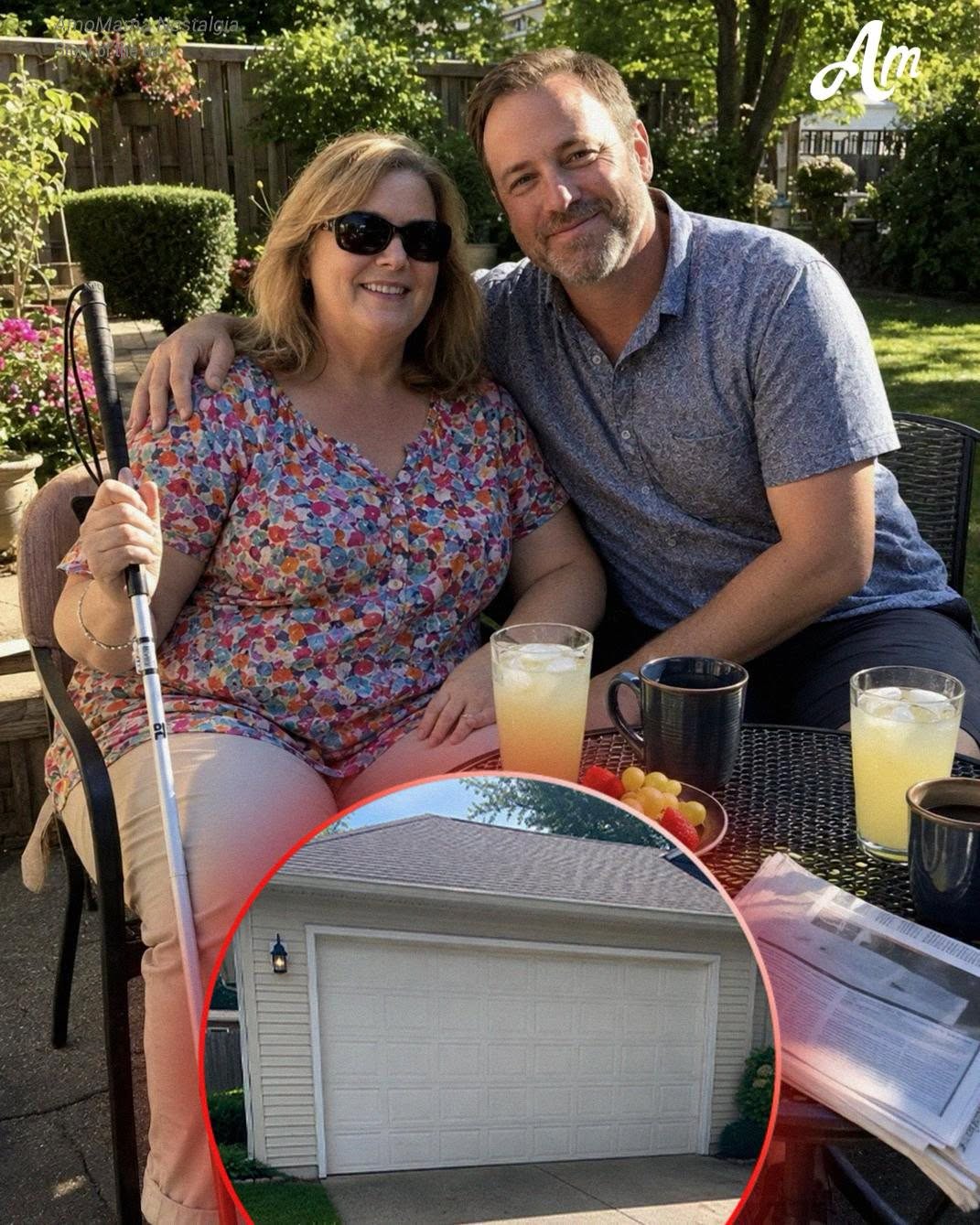
For nearly a decade, Gina experienced her home through sound, touch, and the descriptions of the husband she trusted. A rare eye disease began blurring signs and faces a year after her marriage to Brian. As her vision deteriorated, unfamiliar places became difficult to navigate, and eventually she could distinguish little more than light and large shapes.
Brian stepped into every practical gap. He drove, read the mail, and handled anything he said required good eyesight. The garage became his private responsibility. It supposedly contained tools, car supplies, storage boxes, and equipment related to Gina’s condition. Whenever she offered to organize it, Brian guided her away and promised to bring out anything she needed.
Gina interpreted his control as devotion. Her best friend Marissa saw something else: Gina had gradually stopped making decisions for herself. When Marissa found an experimental laser program, Brian dismissed it as a long shot that would only cause disappointment. Gina applied anyway while he was away on a weeklong business trip.
A treatment changed what Gina could see
The doctors made no promises, but the procedure worked. At first the world looked like a watercolor. Then Gina saw the blades of a ceiling fan, the color of her curtains, and her own older face in the mirror. She decided not to tell Brian immediately because she wanted to surprise him when he returned.
Remembering that Christmas lights were stored in the garage, Gina opened the door for the first time in years. There were no dusty tools or crowded storage bins. Instead, she found a furnished living area with a couch, a bed, a small bathroom, and a woman’s coat. Framed photographs showed Brian smiling beside a dark-haired woman named Penelope.
Marissa arrived within minutes. Together they found permits showing that Brian had converted the garage six years earlier. Recent invoices, utility records, a toothbrush, and a handwritten note revealed that Penelope had been living there. The note was worse than the photographs: Brian had told Penelope that Gina was dying and would soon move into a care facility, allowing them to stop hiding.
The secret involved more than an affair
Gina and Marissa documented the room before touching anything else. A book containing Brian’s passwords led them to joint-account records showing years of small transfers into unfamiliar accounts. Brian had not simply concealed another relationship. He had used Gina’s disability and dependence to build a separate life while quietly preparing his financial exit.
The next morning, Gina met a family lawyer and preserved the photographs, documents, and account records. When Brian returned, Christmas lights glowed across the living room. He froze when he saw Gina standing without her cane.
She told him about the surgery, the room, and Penelope. Brian attempted to defend himself by saying he needed someone who could truly see him. Gina answered that she could see him completely now. She handed him separation papers, financial disclosure requests, and copies of the evidence.
Gina had also contacted Penelope, whose number appeared on an envelope in the hidden room. Penelope had been deceived too; she believed Brian was caring for a dying, estranged wife. Telling her the truth prevented Brian from controlling another woman’s understanding of the situation.
Regaining more than eyesight
Weeks later, Gina sat beside the window of her own apartment, looking at the Christmas lights she had wanted to see. A short note from Penelope thanked her for being honest. Marissa remained beside her as she began rebuilding a life that belonged to her.
The most painful discovery was not only that Brian had cheated. It was that he had turned assistance into control and treated Gina’s limited vision as protection for his lies. Gina’s recovery gave her access to visual evidence, but her decisive change was internal. She began asking what she wanted, trusted her own judgment, and acted carefully instead of accepting Brian’s explanations. Losing sight had forced her to depend on others. Getting it back reminded her that support should never require surrendering her voice.